
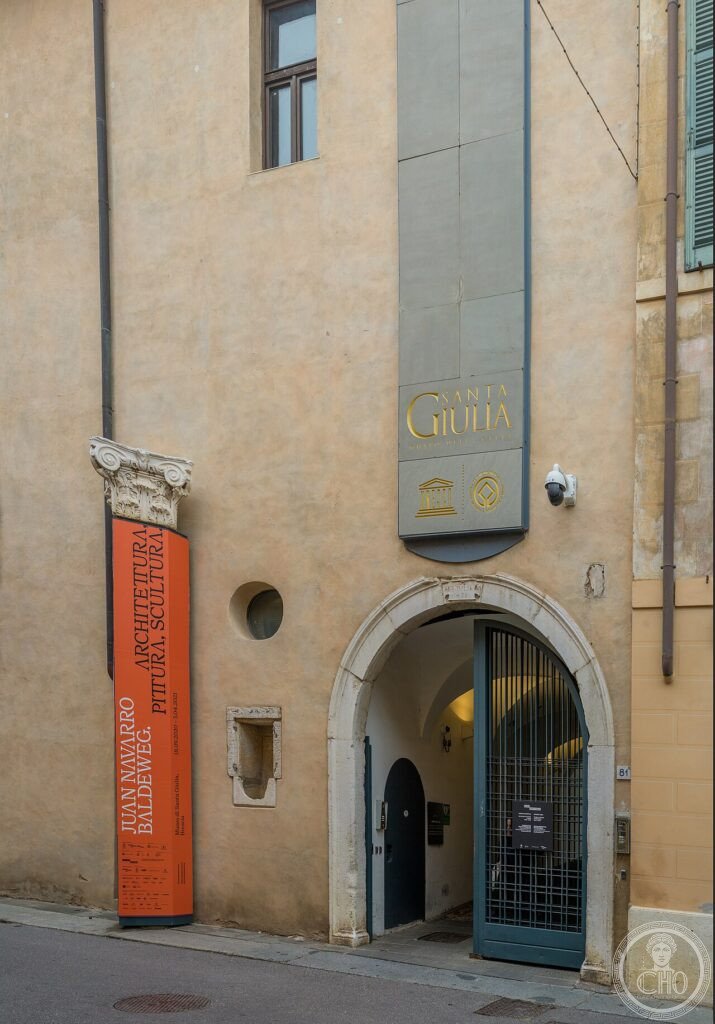
Museo di Santa Giulia, Brescia — il Monastero Longobardo (753 d.C.) sulla Villa Romana: 3.000 Anni di Storia in un Unico Complesso (UNESCO 2011)
In 753 CE, the last Lombard king, Desiderius — a native of Brescia who would be deposed by Charlemagne in 774 CE — founded a Benedictine monastery for his daughter Anselperga on the site of a first-century BCE Roman villa, over which previous buildings of the Roman Imperial period, the late Antique period, and the early medieval period already stood; the result, now the Museo di Santa Giulia, is the most complete stratified urban archaeological site in Italy, containing under one roof a Roman mosaic floor, a Roman garden, Lombard stucco reliefs, three churches of three different periods, and a collection of material covering 3,000 years of continuous occupation of the same urban block.
At a glance
The Museo di Santa Giulia (Museum of Santa Giulia) is a museum complex in Brescia, Lombardia, established in the buildings of the former Benedictine monastery of San Salvatore e Santa Giulia, founded in 753 CE by the Lombard king Desiderius (last king of the Lombards, ruled 757-774 CE) and his wife Ansa for their daughter Anselperga. The complex is inscribed on the UNESCO World Heritage List in 2011 (ref. 1318) as part of the “Longobardi in Italia: i Luoghi del Potere” serial inscription. The museum contains the most complete archaeological stratification visible in situ in any Italian museum, covering a Roman villa (I century BCE), a Roman domus (I-IV century CE), a late Antique complex, a Lombard monastery (VIII century CE), and three Lombard/Romanesque churches.
Key facts
- Foundation: 753 CE; king Desiderius (Desiderio) of the Lombards and his wife Ansa; the monastery was dedicated to San Salvatore (the Saviour); the church of Santa Giulia was added in the later medieval period; the monastery was one of the wealthiest in Lombard Italy and remained so through the Carolingian and medieval periods
- Roman domus beneath the museum: The excavation of the monastery in the 1980s-1990s revealed a complete Roman domus of the 1st century BCE to the 5th century CE directly below the monastery buildings; the mosaic floors, painted walls, and garden of the Roman house are visible through glass panels in the museum floor — a visit to the museum is simultaneously a visit to a Roman house
- Church of San Salvatore (8th century CE): The most important Lombard building in the complex; the nave and two lateral aisles survive with three apses; the Lombard stucco decoration on the nave walls (8th century CE) is among the finest surviving examples of Lombard decorative art outside Cividale
- Oratorio di Santa Maria in Solario (11th century CE): A small two-story oratory with exceptional 11th-century frescoes on the upper floor and the Desiderius Cross (IX century CE) — the most important Lombard-Carolingian gold cross in existence (approximately 90 × 90 cm, decorated with 212 precious stones, cameos, and miniatures)
- Winged Victory of Brescia (I century BCE): The most important single object in the Brixia Roman collections (displayed separately in the Capitolium museum, but visible at Museo di Santa Giulia in the context of the Roman domus finds)
- UNESCO: 2011, ref. 1318 — one of the 7 “Longobardi in Italia” sites
- GPS: 45.5398, 10.2280 — Google Maps
History
Brescia (Roman Brixia) was the capital of the Lombard duchy of Brescia from approximately 568 CE — one of the earliest Lombard centres in Italy, reflecting the importance of the Po plain cities as the first targets of the Lombard invasion. King Desiderius was a native of Brescia (his family was from the Lombard nobility of the city) and when he became king in 757 CE, he made Brescia one of the royal residences alongside Pavia (the Lombard capital). The foundation of the monastery of San Salvatore in 753 CE — four years before he became king — reflects both his personal piety and the political strategy of Lombard rulers who used monastic foundations as instruments of territorial control and dynastic prestige.
The choice of the site was not random: the Roman domus below the monastery had been partially visible above ground throughout the post-Roman period, and the Lombards (like other early medieval builders in Italy) consistently built on Roman foundations because the Roman materials (brick, stone, opus reticulatum) were superior to anything they could produce. The Roman mosaic floors were laid over or built around, not destroyed; the Roman columns were incorporated into the Lombard nave structure — an archaeological testimony to the Lombards’practical relationship with the Roman past they had replaced.
What you see
The visit to the Museo di Santa Giulia is organised as a circuit through the monastery buildings and the three historic churches. The starting point (from the entrance on Via Musei 81/b) is the Roman domus level, visible through glass panels in the museum floor: mosaic floors (black-and-white geometric, 1st century BCE; polychrome figurative, 2nd century CE), painted wall plaster, and the garden (an open space within the Roman house, now covered by a glazed ceiling). The scale of the Roman house — extending approximately 40 × 30 m under the present museum floor — makes clear that this was a substantial aristocratic residence, not a modest dwelling.
The Church of San Salvatore (8th century CE) is the architectural centrepiece: three aisles separated by reused Roman columns (some with 5th-century CE capitals), with the Lombard stucco decoration on the nave walls partially preserved. The Oratorio di Santa Maria in Solario (adjacent to San Salvatore) has its most important feature on the upper floor: the Desiderius Cross (IX century CE), a processional cross decorated with 212 stones (amethysts, garnets, topazes, ancient cameos, and early medieval miniatures) — the most magnificent single surviving Lombard-Carolingian metalwork object.
Gallery
Practical information
- Opening: Tuesday-Sunday 10:00-18:00 (November-May) / 10:00-19:00 (June-September). Closed Monday, 25 December, 1 January. Last entry 1 hour before closing.
- Admission: ~€10 (includes the Museo di Santa Giulia, the Roman domus, and the three churches). Combined ticket with the Capitolium museum (Roman temple, Winged Victory) ~€16.
- Duration: 2-3 hours for the complete circuit through the museum. Allow an additional 1 hour for the Capitolium museum if using the combined ticket.
Getting there
Via Musei 81/b, Brescia, Lombardia. In the historic centre of Brescia, 5 minutes on foot from Piazza della Loggia. By train: Brescia FS station (Trenitalia: from Milan Centrale, 50 min; from Verona, 45 min; from Venice, 1h30); from the station, walk 20 min or take bus line 3 to “Via Musei.” By car: from Milan, A4 east to Brescia Est exit (100 km, 1h); from Verona, A4 west to Brescia Ovest (65 km, 45 min). The historic centre is a ZTL zone; park at the Piazzale Arnaldo or the ex-Fiera car park and walk 10-15 min.
Nearby
- Capitolium di Brescia (Brixia) — 300 m north; the Roman temple complex (1st century CE) with the unique standing Corinthian columns; the Winged Victory of Brescia (74 BCE, converted from a statue of Alexander) in the museum below; combined ticket with Santa Giulia recommended
- Piazza della Loggia e il centro storico — 500 m north-west; the Venetian-era piazza (loggia 1492-1574, the most beautiful building in Brescia); the Torre dell’Orologio (astronomical clock, 1543); the Palazzo Broletto (13th century); the Duomo Vecchio (circular Romanesque, 1100 CE)
- Lago di Garda — 30 km east; the largest Italian lake (370 km²); Sirmione (the peninsula at the southern tip, with the Roman villa Grotte di Catullo and the Scaligero castle); the eastern shore (Salò, Gardone, Riva del Garda) is one of the most visited lake landscapes in Europe
Sources
- UNESCO: whc.unesco.org/en/list/1318
- Wikipedia EN: Santa Giulia (Brescia)
- Brogiolo, Gian Pietro & Chavarria Arnau, Alexandra: I Longobardi: dalla caduta dell’Impero all’alba dell’Italia, Silvana Editoriale, 2007
- Museo di Santa Giulia: bresciamusei.com
Find it on the map
See this place and what’s around it →📷 Diventa un fotografo di Cultural Heritage Online
Condividi le tue foto dei luoghi: restano pubblicate con la tua firma come autore. Più vengono viste, più ti fai conoscere — e presto un concorso premierà le foto più apprezzate.
Accedi o registrati gratis per aggiungere una foto