
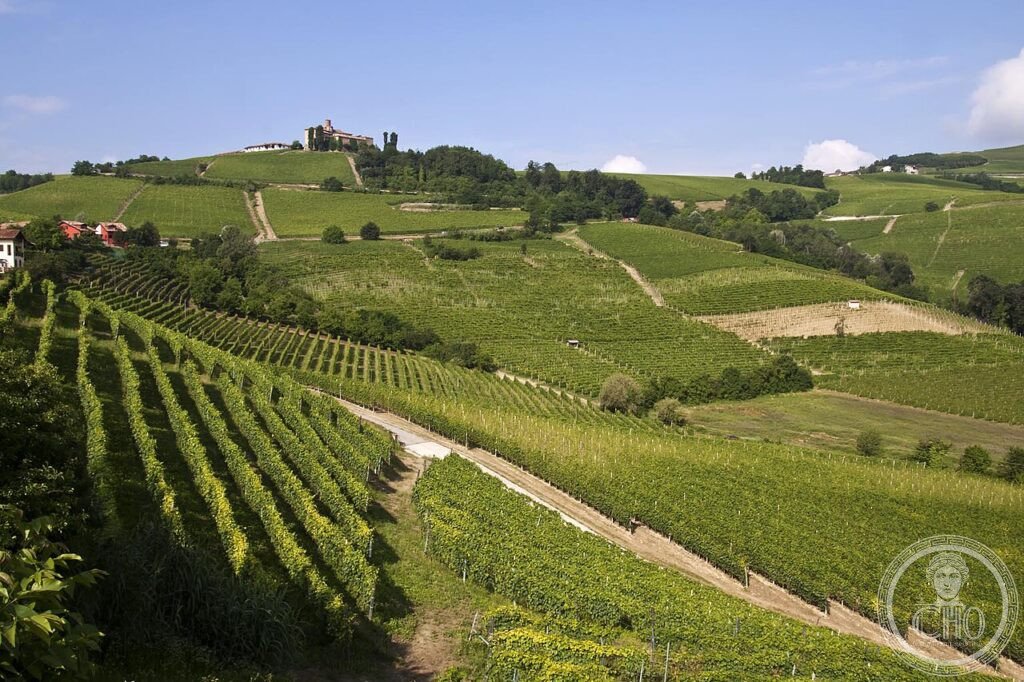
The Langhe and Monferrato hills south and east of Alba are the most celebrated wine-producing landscape in Italy — a 10,000-hectare checkerboard of vineyards, each varietal occupying a precisely calibrated slope aspect and altitude, producing in the Barolo DOCG zone (620 hectares) the wine that since the nineteenth century has been called “the king of Italian wines and the wine of kings,” and in the Barbaresco, Barbera d’Asti, Moscato d’Asti, and Gavi zones some of the most internationally recognised Italian wines — a landscape inscribed on the UNESCO World Heritage List in 2014 as one of only four wine landscapes in the world so recognised.
At a glance
The Vineyard Landscape of Piedmont: Langhe-Roero and Monferrato is a UNESCO World Heritage cultural landscape (2014, ref. 1390) covering six areas of vineyard landscape in the provinces of Cuneo, Asti, and Alessandria in Piedmont, Italy. The six components are: the Langhe del Barolo (comprising the five Barolo communes: La Morra, Barolo, Castiglione Falletto, Serralunga d’Alba, and Monforte d’Alba); the Barbaresco wine zone; the Nizza Monferrato-Canelli area (Barbera d’Asti DOCG); the Canelli and Santo Stefano Belbo area (Moscato d’Asti DOCG); the Astesana vineyard landscape; and the Monferrato Casalese (Grignolino area). The total UNESCO-inscribed area is approximately 10,789 hectares of core zone and 76,655 hectares of buffer zone.
Key facts
- Barolo DOCG: 620 hectares in five communes (La Morra, Barolo, Castiglione Falletto, Serralunga d’Alba, Monforte d’Alba); the only grape variety is Nebbiolo; minimum ageing 38 months (62 for Riserva), of which 18 in oak; approximately 12 million bottles/year; the individual “MGA” (Menzioni Geografiche Aggiuntive — vineyard designations) are to Barolo what Premier and Grand Crus are to Burgundy
- Barbaresco DOCG: 700 hectares in four communes (Barbaresco, Neive, Treiso, San Rocco Seno d’Elvio); also 100% Nebbiolo; minimum ageing 26 months (50 for Riserva); approximately 9 million bottles/year
- Moscato d’Asti DOCG: Canelli and Santo Stefano Belbo area; sweet sparkling wine from Moscato Bianco; the only DOCG in which CO2 is naturally captured in the bottle from a single fermentation; approximately 95 million bottles/year (the most produced DOCG in Italy)
- Tartufo bianco d’Alba (White truffle of Alba): The Langhe hills are the primary production area for Tuber magnatum Pico (white truffle); the International Alba White Truffle Fair (Fiera del Tartufo Bianco d’Alba) runs October-December each year; individual truffles of 500+ grams are auctioned for €3,000-10,000+
- UNESCO: 2014, ref. 1390 — “Vineyard Landscape of Piedmont: Langhe-Roero and Monferrato” — one of only 4 wine landscapes on the World Heritage List (others: Champagne, Saint-Émilion, Rhine Gorge)
- GPS: 44.6987, 8.0315 — Google Maps (Langhe hills near La Morra)
History
Nebbiolo — the grape variety that produces Barolo and Barbaresco — has been cultivated in the Langhe since at least the thirteenth century (documented in the communal statutes of Rivoli in 1268, where it is referred to as “nibiol”); the name refers to the nebbia (fog) that covers the hills in autumn when the grapes are harvested, a distinctive feature of the Piedmontese autumn climate that delays the harvest later than any other major Italian wine region. The wine from the hills of Barolo was supplied to the Savoy court in Turin from the sixteenth century onward; King Victor Emmanuel II and Camillo Cavour (who owned vineyards in Grinzane and Cavour respectively, both in the Barolo zone) were central figures in the creation of the modern style of Barolo in the 1830s-1840s, when the French enologist Louis Oudart (working for Count Camillo Benso di Cavour) adapted the winemaking techniques used in Bordeaux to the Nebbiolo grape, producing a dry, tannic, long-lived wine instead of the sweet or semi-sweet wine that had been common before.
The UNESCO inscription (2014) recognised both the exceptional beauty of the Langhe vineyard landscape — the geometrically precise rows of vines on the south-facing slopes, the hilltop villages, and the contrast of vineyard and woodland — and the long continuity of the human tradition that had created it: 700+ years of viticulture on the same slopes, in some cases by the same families.
What you see
The Langhe landscape is best experienced by driving the secondary roads between the Barolo communes: the road from Alba south to La Morra, then east through Barolo village to Castiglione Falletto and Serralunga d’Alba, then back north to Alba via Grinzane Cavour. The vine-covered slopes — organised in rows running perpendicular to the slope contours, each row separated from the next by precisely 1.2-1.5 m — give the hills a corduroy texture in summer and autumn; in November the Nebbiolo turns red and gold before the leaves fall, creating a brief but spectacular autumn colour display on a landscape that is otherwise dominated by the grey-green of the vine wood.
The key points of architectural and cultural interest are: the Castello di Grinzane Cavour (Grinzane Cavour; XIII century, Cavour family property in the 1830s; now the Enoteca Regionale Piemontese Cavour and the White Truffle Auction venue, October-November); the hamlet of La Morra (high point of the Langhe, views over 20+ communes in every direction); the village of Barolo itself (900 inhabitants; the WiMu — Museo del Vino, 2010, Francois Confino; possibly the best wine museum in Italy).
Gallery
Practical information
- Best season: September-November (vendemmia/harvest period; the Fiera del Tartufo Bianco d’Alba runs October 1-November 30; the landscape is at its finest and most active). April-June is also excellent (the vines are flowering; the hills are green). August is hot and the vines are dense and dark green; less interesting for photography.
- WiMu Barolo (Museo del Vino, Castello di Barolo): Via Roma 1, Barolo; open daily 10:30-19:00 (March-November); closed Monday in December-February; admission ~€15. The museum is designed by Francois Confino (the same designer as the Museo Nazionale del Cinema in Turin); covers the culture, history, and sensory world of wine.
- Wine tasting: The cantina (winery) road offers direct sales and tastings throughout the Langhe; most producers (Barolo, Barbaresco) are open by appointment, with some exceptions. The Enoteca Regionale del Barolo (Piazza Falletti di Barolo, La Morra) offers curated tastings of Barolo from all five communes.
- Tartufo bianco: Alba’s Truffle Fair is free to visit (the truffle market is open to all; the auction events require tickets, available via fieradeltartufo.org).
Getting there
Alba (CN), Piemonte — the historic capital of the Langhe and the base for visiting the wine zone. By train: from Turin Porta Nuova to Alba (Trenitalia, 1h-1h30 via Fossano or Bra; 2-3/day); or from Asti (30 min). By car: from Turin, 60 km south via A6 (exit Marene) then SS231 east to Alba; or via SS29 south through the hills from Cherasco. From Genova, 120 km north via A26 to Alessandria then A21 to Asti then SS231 west. Alba is the starting point for the Strada del Vino Barolo (signposted wine road through all Barolo communes).
Nearby
- Asti — 40 km north-east; the capital of the Barbera d’Asti and Moscato d’Asti zones; the Palio di Asti (the oldest horse race in Italy, pre-dating Siena by 300 years; September); the Romanesque Battistero di San Pietro (XII century); the collection of Gothic and Romanesque churches in the historic centre
- Bra — 15 km north; the town that founded the Slow Food movement (Slow Food headquarters are here; the biennial Salone del Gusto/Terra Madre is in nearby Turin); the Museo Craveri di Storia Naturale (XVIII century); the historic centre with Baroque churches
- Saluzzo — 40 km south-west; an intact fifteenth-sixteenth century Marquis’ residence; the best-preserved small Piedmontese Renaissance town; the Castiglia (XIV-XVI century castle); La Manta (12 km south: the Castello della Manta with the most important Gothic secular fresco cycle in Piedmont, ca.1420, Giacomo Jaquerio)
Sources
- UNESCO: whc.unesco.org/en/list/1390
- Wikipedia EN: Vineyard Landscape of Piedmont
- Consorzio del Barolo e Barbaresco: langhevite.it
- WiMu Barolo: wimubarolo.it
Find it on the map
See this place and what’s around it →📷 Become a Cultural Heritage Online photographer
Share your photos of places: they stay published under your name as the author. The more they're seen, the more you get noticed — and soon a contest will reward the most appreciated photos.
Log in or sign up free to add a photo