
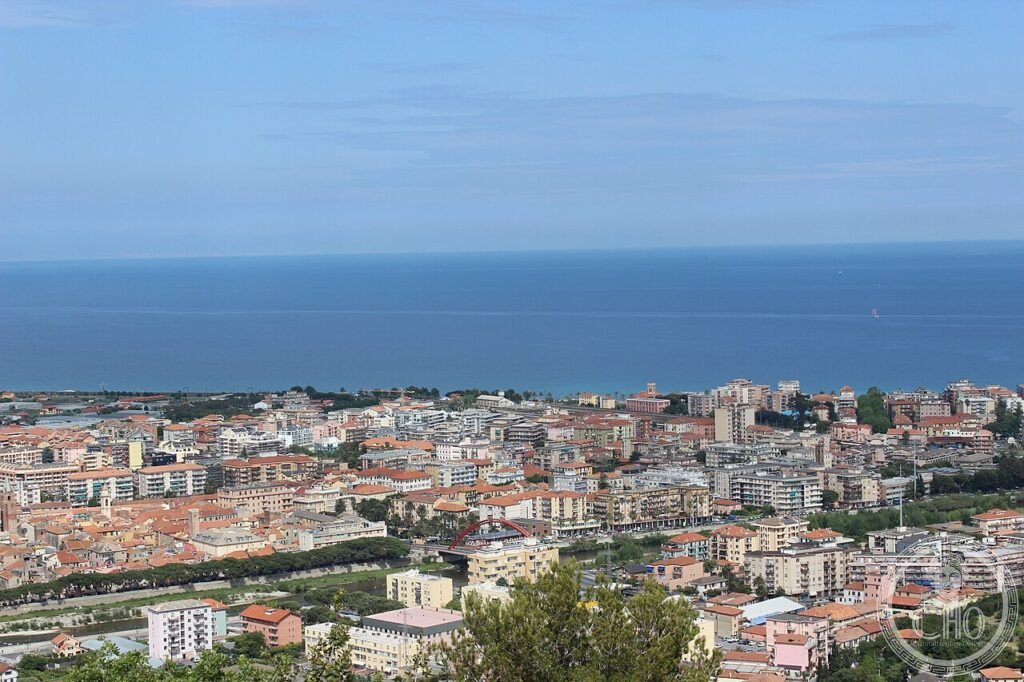
A small Ligurian city that contains one of the most significant early Christian monuments in northern Italy: a fifth-century baptistery with a decagonal exterior and an octagonal interior, decorated with a mosaic cycle in the intense blue-and-gold style of Byzantine Ravenna — still in its original position, still used liturgically, in a city that has otherwise grown around it without touching it, its towers rising on three sides.
At a glance
Albenga is a coastal city on the Ligurian Riviera, between Savona and Imperia, at the mouth of the Centa river. The city occupies the western part of a small alluvial plain (the Piana di Albenga), which was settled in pre-Roman times by the Ingauni Ligurian tribe; the Roman city (Album Ingaunum) was established in the second century BCE and developed under Augustus as a municipium on the Via Julia Augusta. The historic centre of Albenga is concentrated on a grid of Roman streets (the decumanus maximus is still recognisable in the Via Roma) surrounded by medieval walls.
The most important monument is the Battistero paleocristiano (fifth-century baptistery): a decagonal building (ten sides externally, eight sides internally, with the octagon aligned to the cardinal points) with a Byzantine-style mosaic cycle in the apse. The baptistery is still in liturgical use and is the only early Christian baptistery in northern Italy to survive in its original form and location.
Key facts
- Battistero paleocristiano: V century (c. 400–450 CE); decagonal exterior; octagonal interior; 1 km in diameter (small); mosaic cycle in the apse vault (blue-gold Byzantine palette, 12 apostles)
- Cattedrale di San Michele Arcangelo: Romanesque-Gothic; XII–XIII century; partially rebuilt XIV century; campanile XIV century; adjacent to the baptistery in the Piazza San Michele
- Medieval towers: 15–18 surviving towers (originally ~28); XIII–XIV century; built by Albenga’s noble families; the tallest (Torre dei Clavesana) reaches 30 metres
- Museo Diocesano: in the Palazzo Vescovile adjacent to the cathedral; early Christian and medieval art, including Roman sarcophagi and medieval reliquaries
- Roman Albenga (Album Ingaunum): settled II century BCE; municipium under Augustus; Via Julia Augusta passes through the city; the decumanus of the Roman grid is still the main street
- GPS: 44.0485, 8.2126 — Google Maps
History
The Ligurian Ingauni tribe had their principal settlement on the site of present-day Albenga from at least the fourth century BCE; the Roman city Album Ingaunum was built over this settlement in the second century BCE, after the Roman conquest of Liguria (179–172 BCE). The city developed rapidly under Augustus, who made it a municipium and built the Via Julia Augusta (the coastal road connecting Genoa to the French Riviera) through its centre. The Roman city was enclosed within a rectangular circuit of walls, of which substantial sections survive, particularly the north gate (Porta Molino, I century CE) and the corner towers.
The baptistery was built in the fifth century — a period when the early Christian church was investing heavily in monumental architecture throughout the Mediterranean world, from Ravenna to Rome to Syria. The bishop who commissioned the Albenga baptistery was working within the Ravennate tradition of early Christian art (the mosaic cycle at Albenga is clearly related to the mosaics of the Orthodox Baptistery in Ravenna, datable to c. 458 CE), but adapting it to a smaller scale. The building survived the fall of the Western Roman Empire (476 CE), the Lombard conquest of Liguria (643 CE), and the medieval period with its function intact; it was used as a baptistery continuously until the early modern period and remains a consecrated building today.
What you see
The Piazza San Michele at the centre of the historic district: the baptistery stands at the north-west corner, with the Romanesque-Gothic cathedral on its south side and the Bishop’s Palace closing the east side of the piazza. The baptistery’s exterior is the most unusual element: the ten-sided perimeter, with walls of Roman brick alternating with Ligurian stone, reads as neither a church nor a civic building but as something distinctly different from both — a reminder that early Christian architecture was inventing its forms as it went. The main entrance is on the south side, facing the cathedral.
Inside, the octagonal plan is immediately readable: eight sides of equal width, with niches alternating with shallow apses; the vault of the central space rises approximately 8 metres. The mosaic cycle in the main apse (east side) shows the twelve apostles in a garden of paradise, arranged in a circle around the Chi-Rho monogram; the blue ground of the mosaic is the exact Byzantine blue of Ravenna — lapis lazuli-rich tesserae — and is still vivid after 1,600 years. A circular font (now empty) occupies the centre of the floor: this is the original baptismal font, where adult immersion baptism was administered in the fifth century.
Gallery
Practical information
- Battistero: Piazza San Michele, Albenga. Open Tuesday–Sunday 9:30–12:30 and 14:30–18:30 (winter 14:00–17:30). Admission ~€3 (includes the Museo Diocesano and the Navicella Romana).
- Cathedral: Free; open during Mass times and visiting hours (ask at the baptistery ticket office).
- Navicella Romana: Roman boat (I century BCE) recovered from the Centa river; displayed in the old city museum adjacent to the baptistery.
- Duration: 1–1.5 hours for the baptistery, cathedral, and a walk through the medieval centre.
- Festival: The Torneo storico del Palio del Comune (August) features medieval costume processions through the historic centre.
Getting there
Albenga, Savona, Liguria. On the A10 motorway (Savona–Ventimiglia), exit Albenga; 5 minutes from the motorway exit to the historic centre. By train: Albenga station is on the main Genoa–Ventimiglia–Nice coastal line; frequent trains from Savona (25 minutes), Genoa (1h10), and Nice (1h30 from Ventimiglia). From the station, the historic centre is 10 minutes on foot. By car from Genoa: A10 exit Albenga (75 km, 50 minutes). Parking: free parking at the Piazzale Elio Morino on the north side of the historic centre; follow signs “Centro Storico.”
Nearby
- Laigueglia — 12 km east; a Ligurian fishing village with a Baroque church facade and a small harbour; the beach is one of the best on the Riviera di Ponente; the old village centre has eighteenth-century painted facades
- Ceriale e Borghetto Santo Spirito — 8 km east; the eastern end of the Piana di Albenga, with a small nature reserve at the mouth of the Varatella river; good beaches and a cluster of flower cultivation greenhouses (Albenga is Italy’s second-largest cut flower production area)
- Grotte di Toirano — 25 km east; paleolithic caves with extensive bear-bone deposits and human footprint traces (c. 12,000–15,000 BCE); the stalactite and stalagmite formations in the Grotta di Santa Lucia are the finest cave formations in Liguria
Sources
- Wikipedia EN: Albenga
- Wikipedia EN: Baptistery of Albenga
- Settis, Salvatore: Italia S.p.A., Einaudi, 2002 (on early Christian architecture in Liguria)
- Commune di Albenga: comune.albenga.sv.it
Find it on the map
See this place and what’s around it →📷 Become a Cultural Heritage Online photographer
Share your photos of places: they stay published under your name as the author. The more they're seen, the more you get noticed — and soon a contest will reward the most appreciated photos.
Log in or sign up free to add a photoIs this page about you?
This page is read by travellers and heritage enthusiasts who find it on Google. Tell us how you are connected to this place and we will take it from there.