
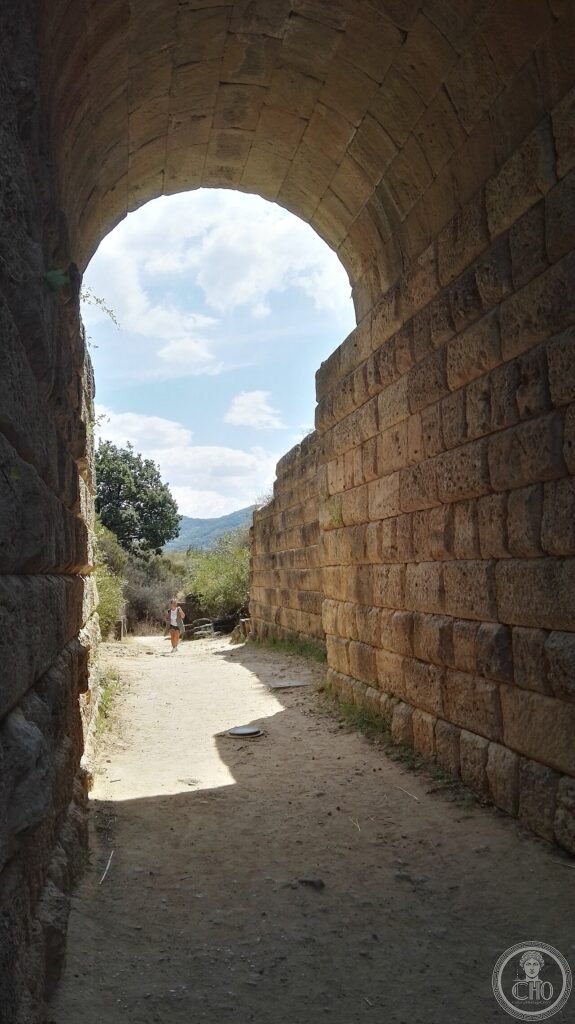
A Greek colonial city founded around 540 BCE by Phocaean refugees from what is now western Turkey — the city that produced Parmenides and Zeno of Elea, the two philosophers whose arguments about the nature of being and motion created the conceptual framework within which all subsequent Western philosophy has operated — and whose most visible monument, the Porta Rosa (c. 300–250 BCE), is one of the oldest surviving stone arches in Europe still in situ.
At a glance
Velia (Greek: Hyele or Elea) is an ancient Greek colonial city on the coast of the Cilento, approximately 100 kilometres south of Paestum. It was founded around 540 BCE by Phocaeans — Greeks from the city of Phocaea in western Anatolia (modern Turkey), who had been expelled by the Persian conquest of Ionia. The Phocaeans first landed at Alalia in Corsica, then moved to southern Italy after conflicts with the Carthaginians and Etruscans; they chose a site on the coast of the Cilento, on a hill between two rivers (the Fiumicello and the Palistro), and built a city that survived as an independent or semi-independent community until at least the first century CE.
The archaeological park of Velia is included in the UNESCO inscription “Cilento and Vallo di Diano National Park with the Archaeological Sites of Paestum and Velia, and the Certosa di Padula” (1998, ref. 842).
Key facts
- Foundation: c. 540 BCE; by Phocaean Greeks from Ionia (modern western Turkey)
- Names: Greek: Hyele or Elea; Latin: Velia
- Porta Rosa: c. 300–250 BCE; semicircular arch in local pink sandstone; span 2.7 m; height 4.7 m; one of the oldest stone arches in Europe in situ
- Parmenides of Elea: c. 515–450 BCE; philosopher; founder of the Eleatic school; argued that “being” is one, unchanging, and eternal; Plato’s dialogue “Parmenides” is the main source for his thought
- Zeno of Elea: c. 490–430 BCE; pupil of Parmenides; inventor of the paradoxes of motion (Achilles and the Tortoise; Arrow paradox) — arguments that the appearance of motion is an illusion, since space and time are infinitely divisible
- Acropolis: upper city; remains of the medieval tower and the Hellenistic agora; the main residential quarters on the south slope
- UNESCO: 1998, ref. 842 — “Cilento and Vallo di Diano National Park with Paestum, Velia, Certosa di Padula”
- GPS: 40.1678, 15.1303 — Google Maps
History
The Phocaean founding of Velia in c. 540 BCE was part of a westward diaspora of Greek colonists who had been expanding into the western Mediterranean since the eighth century BCE. By the time the Phocaeans arrived, the most productive coastal sites in southern Italy (Campania, Calabria, Sicily) were already occupied by earlier Greek colonies; the Cilento coast, with its rough terrain, limited agricultural land, and few natural harbours, was available. The Phocaeans chose it for what it did offer: the steep hill of the future acropolis was naturally defensible, and the two river mouths gave sheltered anchorages for the trading ships that were the basis of Phocaean wealth.
The city produced two philosophers who between them established the framework within which Greek philosophy moved for the next century. Parmenides (c. 515–450 BCE) argued in his poem “On Nature” that reality is single, eternal, and unchanging; that plurality and change are illusions of the senses; and that only reason can access what truly exists. This argument was directed against the cosmologies of Heraclitus and the Milesians, who had tried to explain a world of change; Parmenides denied that change was possible. His pupil Zeno (c. 490–430 BCE) invented the paradoxes of motion as arguments in support of Parmenides’ thesis: the most famous (Achilles cannot overtake the Tortoise, because he must first reach the point from which the tortoise started, by which time the tortoise has moved again) are still discussed in mathematics and philosophy.
What you see
The archaeological park is divided into two areas: the lower city (on the slopes above the modern village of Ascea Marina) and the acropolis (the hilltop, accessible by foot from the lower city or by car). The most visited monument is the Porta Rosa at the southern entrance to the lower city: a semicircular arch in local pink sandstone (the name “Rosa” comes from the stone’s colour), approximately 2.7 metres span and 4.7 metres high, datable to c. 300–250 BCE by its construction technique (dry-laid voussoir blocks). It is one of the earliest surviving stone arches in Europe and one of the very few still visible in situ rather than in a museum.
The acropolis area includes the remains of the medieval castle (built over the ancient structures, using ancient stone), the Hellenistic agora, a covered odeon (small theatre for music and lectures), and the foundations of several temples — the most important of which (the “Tempio di Asclepio”) has recently been identified as possibly having been used for medical incubation practices, since Velia had a tradition of medical practitioners (iatroi) who combined Eleatic philosophy with Hippocratic medicine. The sea view from the acropolis (on a clear day extending to the Cilento coast and the Punta Licosa headland) is one of the finest in the park.
Gallery
Practical information
- Park: Open daily 9:00 to one hour before sunset. Admission ~€5. The lower city (Porta Rosa) and the acropolis are both within the park; the walk between them is uphill (approximately 30 minutes on foot) and partly unpaved.
- Footwear: Sturdy shoes required; the terrain is uneven and the path to the acropolis is steep in places.
- Season: Spring (April–June) and autumn (September–October) are the best times; the site is in full sun and can be very hot in July–August. There is no shade on the path to the acropolis.
- Combined visits: Paestum (the best-preserved Greek temples in Italy) is 65 km north by car; the two sites make a natural full-day combination. Certosa di Padula (UNESCO, 1306) is 50 km east.
Getting there
Ascea (Velia), Cilento, Campania. By car from Naples: A3 Salerno–Reggio Calabria, exit Battipaglia; follow the SS18 south through Agropoli and Paestum; the site is at Ascea Marina (signposted). Total distance: ~115 km, 1h45. By train: Trenitalia Salerno–Reggio Calabria regional service to Ascea station (2h15 from Salerno); the site is 3 km from the station (taxi or bus). Bus: CSTP buses from Salerno to Ascea Marina (seasonal; 2h30). By boat (summer only): ferries from Agropoli or Palinuro to Ascea Marina (July–August; check seasonal timetables). Note: access to the upper acropolis from the archaeological park requires a 30-minute uphill walk.
Nearby
- Paestum — 65 km north; three Doric Greek temples (Tempio di Hera I c. 550 BCE, Tempio di Hera II c. 470 BCE, Tempio di Atena c. 500 BCE) in the best state of preservation of any Greek temple complex in the world; the Museo Nazionale di Paestum has the Tomb of the Diver (c. 480 BCE), the only surviving example of figurative fresco painting in the Greek world
- Certosa di San Lorenzo, Padula — 50 km east; the largest Carthusian monastery in Italy (1306; enlarged through the 18th century; 320 rooms); the great cloister (107 × 108 m) is one of the largest in the world; UNESCO 1998
- Parco Nazionale del Cilento e Vallo di Diano — the entire archaeological park is within this protected area; excellent hiking, swimming beaches, and inland medieval villages (Casaletto Spartano, Rofrano, Stio)
Sources
- UNESCO: whc.unesco.org/en/list/842
- Wikipedia EN: Velia (ancient city)
- Tannery, Paul: “Le concept scientifique du continu, Zénon d’Élée et Georg Cantor” (1885); repr. in Mémoires scientifiques, Toulouse, 1912
- Parmenides, “On Nature” (fragments): in Kirk, G.S., Raven, J.E., Schofield, M.: The Presocratic Philosophers, Cambridge UP, 1983
Find it on the map
See this place and what’s around it →📷 Become a Cultural Heritage Online photographer
Share your photos of places: they stay published under your name as the author. The more they're seen, the more you get noticed — and soon a contest will reward the most appreciated photos.
Log in or sign up free to add a photo