

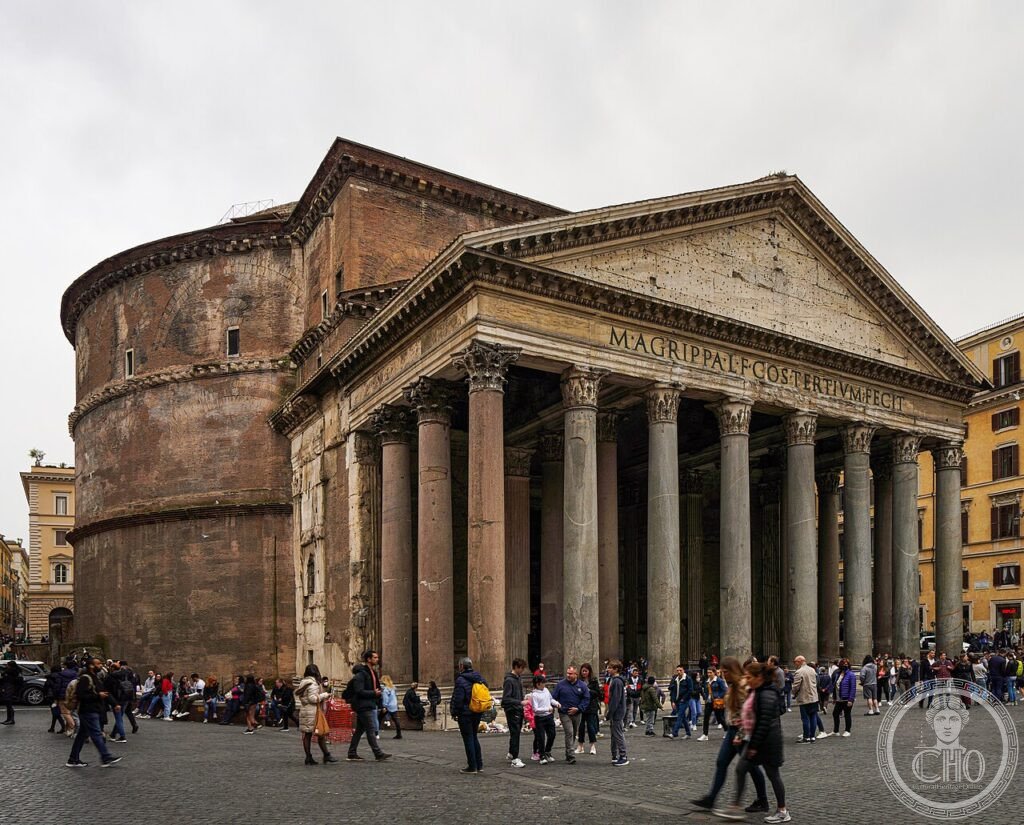
The most perfectly preserved building of the ancient world — a domed rotunda of 43.3 metres interior diameter built by the Emperor Hadrian between 118 and 125 CE, whose unreinforced concrete dome has remained the largest in the world for nineteen centuries, and whose structural logic was not fully understood until the twentieth century: the building that all subsequent Western architecture has had to reckon with, from Brunelleschi’s Duomo in Florence to the US Capitol to the Panthéon in Paris.
At a glance
The Pantheon stands in the Piazza della Rotonda in Rome’s historic centre, 500 metres north of the Capitoline Hill. It is the best-preserved building of the ancient world because it was converted into a Christian church — Santa Maria ad Martyres — in 609 CE and has been in continuous use as a place of worship since then. The building now also contains the tombs of the kings of Italy (Vittorio Emanuele II and Umberto I) and of Raphael.
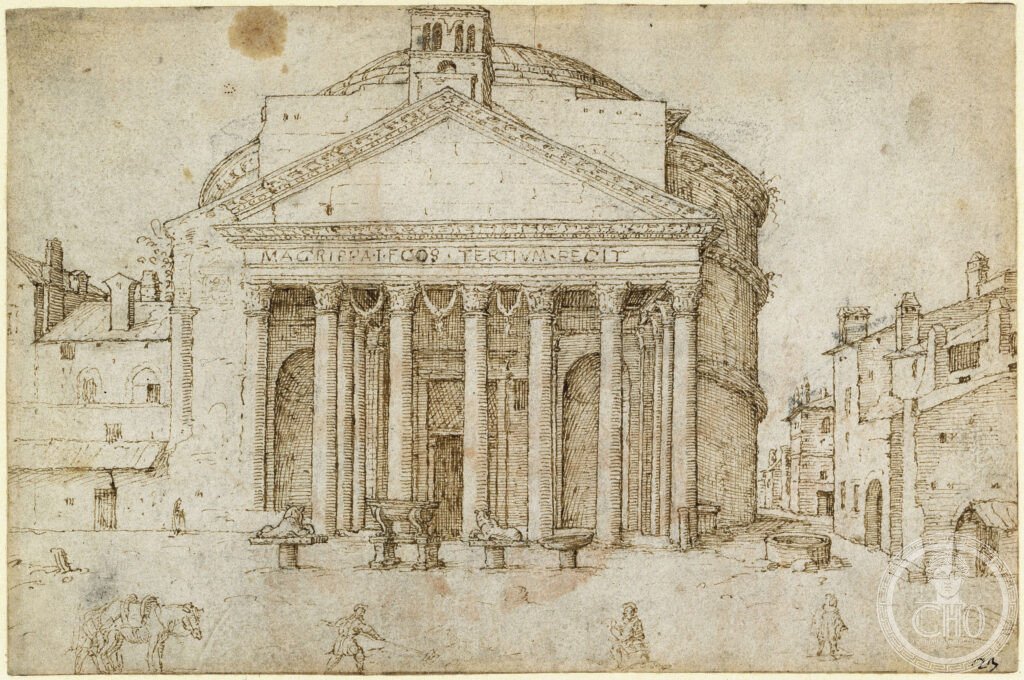
The building as it stands was built by the Emperor Hadrian between 118 and 125 CE, replacing an earlier Pantheon on the same site built by Marcus Agrippa in 27–25 BCE (the dedication on the portico — “M·AGRIPPA·L·F·COS·TERTIVM·FECIT” — refers to Agrippa’s original building, not Hadrian’s replacement). The Pantheon is part of the UNESCO “Historic Centre of Rome, the Holy See and San Paolo fuori le Mura” inscription (1980, ref. 91 rev.).
Key facts
- Construction: 118–125 CE, Emperor Hadrian (replacing Agrippa’s original of 27–25 BCE)
- Dome diameter: 43.3 m (interior); largest unreinforced concrete dome in the world
- Oculus: 8.9 m diameter; the only light source in the rotunda; open to the sky
- Portico: 16 monolithic granite columns, 13.7 m high; Corinthian capitals
- Converted to church: 609 CE (Pope Boniface IV; donated by Byzantine Emperor Phocas)
- Tombs: Raphael (1483–1520); King Vittorio Emanuele II; King Umberto I
- UNESCO: 1980, ref. 91 rev. — “Historic Centre of Rome, the Holy See and San Paolo fuori le Mura”
- GPS: 41.8986, 12.4769 — Google Maps
History
The original Pantheon was built by Marcus Agrippa in 27–25 BCE, in the Campus Martius district that was his area of patronage. It burned in 80 CE and was rebuilt by Domitian; it burned again in 110 CE under Trajan. The current building is entirely Hadrian’s work (118–125 CE), though the inscription on the pediment preserved Agrippa’s name from the original dedication — a deliberate archaism on Hadrian’s part, presenting the new building as a continuation of the Augustan tradition.
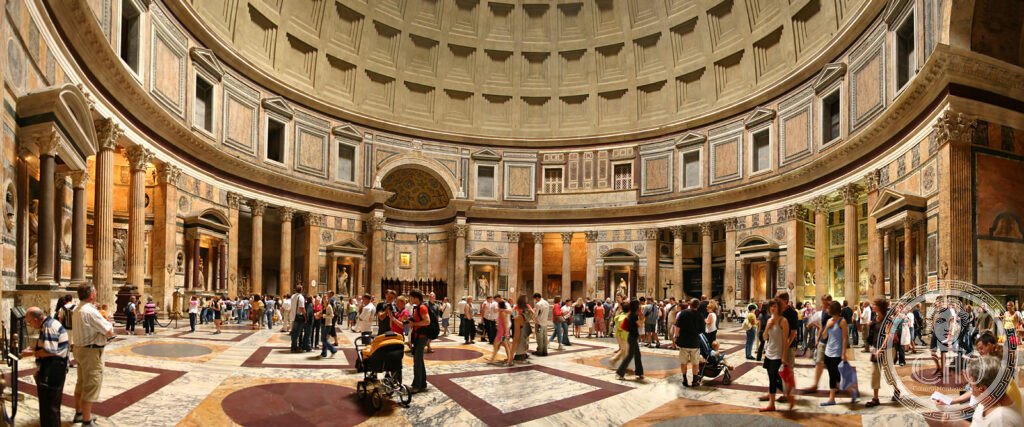
Hadrian’s Pantheon is the first building in the Western tradition in which the dome is the primary spatial and structural element rather than an auxiliary covering. The rotunda — a perfect cylinder supporting a hemisphere of precisely equal radius, making the diameter and height of the interior identical — is lit from a single source: the oculus, the circular opening 8.9 metres in diameter at the crown of the dome. The dome is constructed in unreinforced concrete with a series of coffers (recessed panels) that reduce its weight toward the crown, and is thicker at the base (6.4 m) than at the top (1.2 m); it achieves its structural stability through the combination of different aggregates — heavier tufa and brick near the base, lighter pumice near the crown — and the compression ring geometry of the hemisphere.
The building was converted to a Christian church in 609 CE when the Byzantine Emperor Phocas donated it to Pope Boniface IV. This act of conversion — unique among major Roman civic buildings — is the reason it has survived intact. In the eighteenth century, Gianlorenzo Bernini added two bell towers to the portico (the so-called “Ass’s Ears of Bernini”), which were removed in 1883 as aesthetically incompatible with the original.
What you see
Approaching from the Piazza della Rotonda, the Pantheon presents its portico — eight enormous monolithic granite columns in the front row, four pairs on the sides, creating three bays — and the brick rotunda behind it. The relationship between the columned portico (Greek in form) and the domed rotunda (Roman in form) is the defining architectural combination of the building and the model for every subsequent domed building with a columnar entrance.
Inside, the spatial effect is extraordinary and cannot be reproduced by photography: the perfectly circular plan and the dome that rises from it create an enclosed space of complete geometric clarity, in which the proportional relationship between floor, wall, and dome is immediately legible. The light falls in a single column from the oculus 43 metres above; on sunny days it moves slowly across the coffered ceiling as the earth rotates; on rainy days a small drain in the floor (original) removes the water that falls through. The seven aediculae (niches) around the perimeter alternate between triangular and arched pediments; the floor is original marble, in concentric circles. The altar and the tombs of Raphael, Vittorio Emanuele II, and Umberto I are modest additions that do not obscure the spatial clarity of the original design.
Gallery
Practical information
- Admission: €5 (introduced in 2022, previously free). No booking required; ticket on site. Open daily 9:00–19:00 (last entry 18:30); closed on religious holidays.
- Queues: The queue outside can be 30–60 minutes at peak times (July–August). Arrive at opening time (9:00) or in the late afternoon (after 17:00) for shorter waits.
- Free entry: First Sunday of each month (within MiC’s free museum day programme).
- Duration: 30–45 minutes is sufficient; the building is relatively small and the interior is a single space. A longer visit is rewarded by watching the light-shaft from the oculus move across the dome.
Getting there
Piazza della Rotonda, Roma. On foot from Piazza Navona: 5 minutes east. On foot from the Trevi Fountain: 10 minutes west. On foot from Piazza Venezia / Capitoline Hill: 15 minutes north. No metro stop is close; nearest are Barberini (Line A, 15 minutes on foot) and Spagna (Line A, 20 minutes). Bus to Senato stop: 40, 46, 62, 63, 70, 81, 87. Taxi rank at Largo Argentina, 5 minutes on foot. The historic centre is pedestrianised around the Pantheon; no car access to the piazza.
Nearby
- Piazza Navona — 5 minutes west; the most important Baroque public space in Rome, defined by Borromini’s Sant’Agnese in Agone (1653–1657) and Bernini’s Fontana dei Quattro Fiumi (1651); the oval plan follows the perimeter of the stadium of Domitian (86 CE)
- Campo de’ Fiori — 10 minutes south-west; Rome’s most atmospheric morning market square, with the statue of Giordano Bruno (burnt here in 1600) at its centre
- Palazzo Altemps (Museo Nazionale Romano) — 8 minutes north-west; one of the finest collections of Greek and Roman sculpture in the world, including the Ludovisi Throne and the Galatian Suicide
Sources
- UNESCO: whc.unesco.org/en/list/91
- Wikipedia EN: Pantheon, Rome
- MacDonald, William L.: The Pantheon: Design, Meaning, and Progeny, Harvard UP, 1976 (2002 edition)
- Mark, Robert and Paul Hutchinson: “On the Structure of the Roman Pantheon,” The Art Bulletin 68.1 (1986)
Find it on the map
See this place and what’s around it →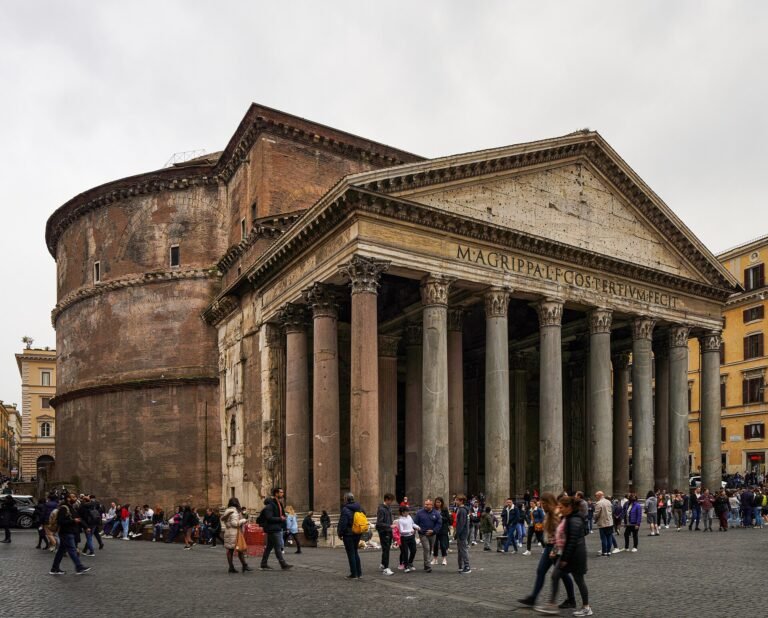
📷 Become a Cultural Heritage Online photographer
Share your photos of places: they stay published under your name as the author. The more they're seen, the more you get noticed — and soon a contest will reward the most appreciated photos.
Log in or sign up free to add a photoIs this page about you?
This page is read by travellers and heritage enthusiasts who find it on Google. Tell us how you are connected to this place and we will take it from there.