

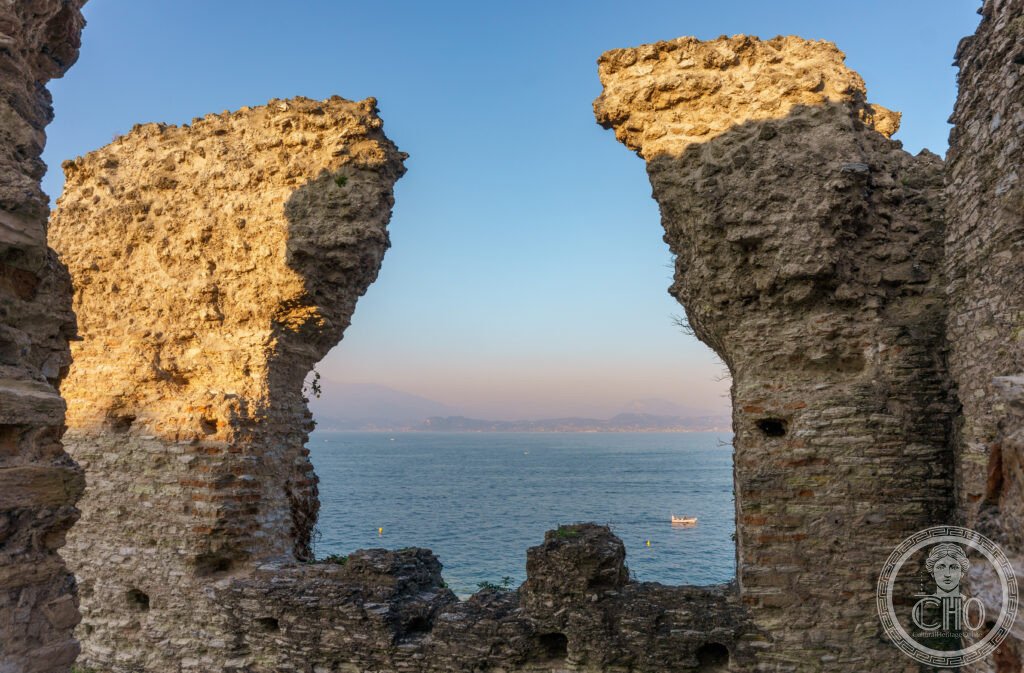
The largest Roman villa in northern Italy, occupying the entire southern tip of the Sirmione peninsula on Lake Garda — a building platform of 167 by 105 metres with colonnaded terraces over the lake — traditionally associated with the poet Catullus, though the existing remains post-date him by a century.
At a glance
The Grotte di Catullo (Grottoes of Catullus) are the ruins of the largest Roman villa in the Po plain, distributed across the headland at the south end of the Sirmione peninsula, above the eastern shore of Lago di Garda. The name associates them with the Latin lyric poet Gaius Valerius Catullus (c. 84–54 BCE), who was born in Verona and who wrote repeatedly of a property at Sirmio (“paene insulam / Sirmio” — “almost-island Sirmio”) as his favourite retreat. The archaeological remains, however, date primarily from the late first century BCE to the second century CE — roughly a century and a half after Catullus’s death — suggesting either that the villa was built or substantially rebuilt after his time, or that a separate Catullan property is yet to be found beneath the modern village.
The site is managed by the Ministero della Cultura (MiC) and includes an excavated area of approximately 2 hectares plus a small museum (Antiquarium) with finds from the excavation. The combination of archaeological complexity, extraordinary lake setting, and literary association makes it one of the most visited sites on Lake Garda.
Key facts
- Date: Late I century BCE – II century CE (main construction phase)
- Dimensions: 167 × 105 m (platform/podium); villa footprint approximately 150 × 90 m
- Named for: Catullus (c. 84–54 BCE), Roman lyric poet from Verona
- Key poem: Carmen XXXI: “Paene insularum, Sirmio, insularumque / ocelle…” (O Sirmio, jewel of almost-islands…)
- Location: Via Catullo, Sirmione (BS), Lago di Garda, Lombardia
- GPS: 45.4927, 10.6100 — Google Maps
History
Catullus’s poem 31 — one of the most widely memorised short Latin poems in the Western tradition — addresses Sirmio directly: “Paene insularum, Sirmio, insularumque / ocelle, quascumque in liquentibus stagnis / marique vasto fert uterque Neptunus…” (O Sirmio, jewel of almost-islands, wherever Neptune carries us through clear pools and the vast sea…) and celebrates his return home from service in Bithynia. The poem establishes the lyric convention of the beloved birthplace as a refuge from public life that persists in Italian poetry from Virgil’s Mantua to Pascoli’s Myricae.
The villa remains date from the late Republic and early Imperial period. The building platform — a vast substructure of vaulted chambers in opus incertum (irregular stone) — was cut into the limestone headland to create a level terrace over the water, comparable in engineering ambition to the contemporaneous substructures of Villa Adriana at Tivoli. Over the platform rose a two-storey villa with colonnaded terraces on three sides (east, south, and west) commanding views across the lake. The vaulted basement chambers are what gave rise to the medieval name “grottoes” — visitors in the Middle Ages interpreted them as caves rather than architectural substructures.
Excavation has been ongoing since the nineteenth century; the main excavated area covers approximately a third of the full villa footprint, with the remainder still unexcavated under the olive groves of the headland.
What you see
The site is an open archaeological park on the headland, accessible via a path from the Sirmione village entrance. The most impressive remnant is the eastern portico — a run of vaulted chambers with engaged pilasters surviving to a height of 8–10 metres, giving an immediate sense of the villa’s original scale. To the south, the “Grotta di Catullo” proper is a barrel-vaulted cryptoporticus (underground corridor) that ran under the main garden terrace; it is the best-preserved individual element and the one that struck travellers as cave-like from antiquity.
The Antiquarium at the site entrance displays mosaic fragments, painted plaster, pottery, and small finds from the excavations; the most significant items (including first-century bronze objects and a series of black-and-white mosaic floors) are in the Antiquarium and the Museo Civico in Brescia. The combination of Roman ruins, Mediterranean vegetation (cypress, olive, rosemary), and the lake views makes the Grotte di Catullo one of the aesthetically richest archaeological sites in Italy in terms of setting.
Gallery
Practical information
- Opening: Tuesday–Saturday 8:30–19:30 (summer); 8:30–17:00 (winter). Sunday 8:30–14:00. Closed Monday.
- Admission: ~€6; reduced for EU citizens 18–25; under-18 free.
- Duration: 1.5–2 hours including the Antiquarium.
- Footwear: The archaeological surface is uneven; good walking shoes essential. Parts of the site are on sloping ground with no railing.
- Summer crowds: Sirmione is extremely busy in July–August; arrive at opening time. The village itself can be gridlocked; consider arriving by ferry from Desenzano or Peschiera.
Getting there
Sirmione is at the end of the 4 km Sirmione peninsula on the south shore of Lago di Garda. By car: A4 motorway exit Sirmione; 3 km to the peninsula entrance (road then closes to non-residents in season). By train: Desenzano del Garda station (Milan–Venice line); then bus or taxi 9 km to Sirmione. By ferry: hydrofoil from Desenzano (5 min) or Peschiera del Garda (15 min) to Sirmione landing stage — the most pleasant approach in summer. The Grotte are at the south tip of the peninsula, 1 km on foot from the medieval entrance gate. From Milan: A4 motorway, 120 km, 75 minutes.
Nearby
- Rocca Scaligera, Sirmione — at the entrance to the village; thirteenth-century Scaligeri fortress with its own moat, directly on the lake
- Desenzano del Garda — 9 km east; Roman mosaics of Villa Romana di Desenzano (I–IV century CE) in the town centre
- Mantova — 45 km south-east; Gonzaga Palazzo Ducale and Palazzo Te (UNESCO)
Sources
- Wikipedia EN: Grottoes of Catullus
- Catullus, Carmen XXXI (Sirmio poem), Latin text and translation
- Mirabella Roberti, Mario: Sirmione e le Grotte di Catullo, Brescia, 1985
Find it on the map
See this place and what’s around it →📷 Become a Cultural Heritage Online photographer
Share your photos of places: they stay published under your name as the author. The more they're seen, the more you get noticed — and soon a contest will reward the most appreciated photos.
Log in or sign up free to add a photoIs this page about you?
This page is read by travellers and heritage enthusiasts who find it on Google. Tell us how you are connected to this place and we will take it from there.