
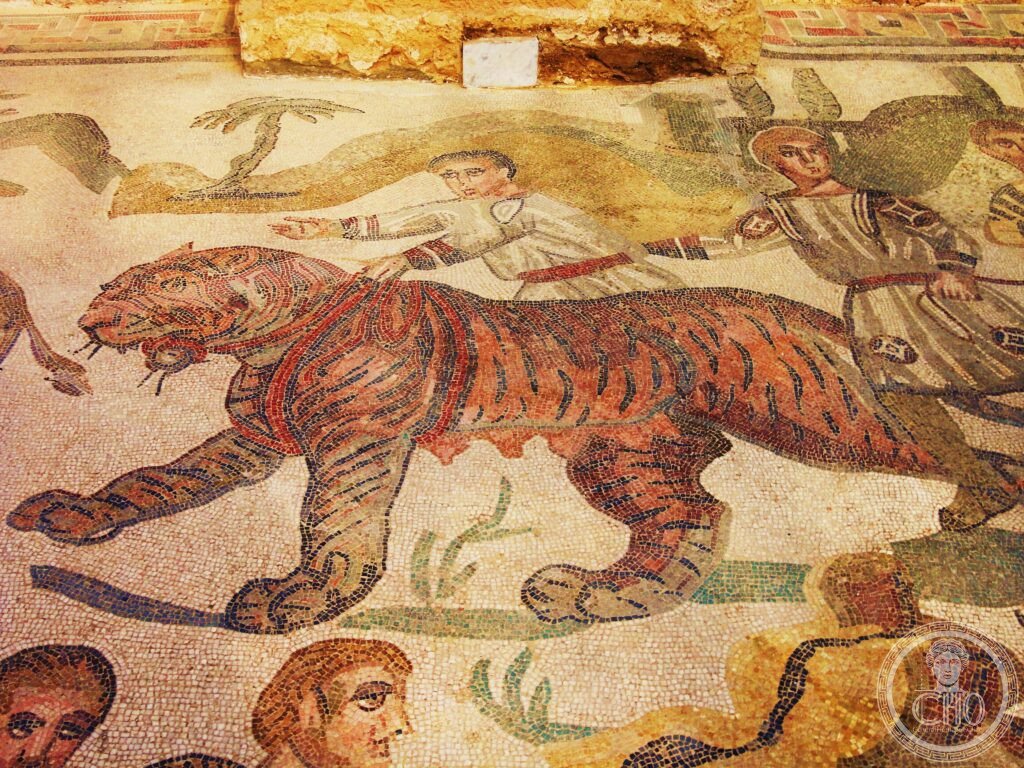
Beneath the Sicilian hillside near Piazza Armerina lies the best-preserved large Roman country villa of the late empire, its floors covered edge to edge in mosaic. The Great Hunt corridor alone runs the length of a modern swimming pool, and the images beneath the visitor’s feet have barely faded in some seventeen centuries.
At a glance
Villa Romana del Casale stands in Contrada Casale, a few kilometres from Piazza Armerina in central Sicily. It is regarded as the finest surviving example of a large Roman country villa from the late imperial period, built in the fourth century CE and later buried under a landslide that preserved its floors for centuries. The site was inscribed on the UNESCO World Heritage List in 1997 under reference 830.
The villa spreads across roughly forty interconnected rooms linked by corridors and peristyle courtyards, covering some 3.5 hectares of ground. Its floors carry the largest surviving collection of Roman mosaics still in their original setting anywhere in the world, with a combined mosaic surface of about 3,500 square metres. Scholarship dates the mosaic decoration to roughly the second and third quarters of the fourth century CE, and the leading hypothesis identifies the owner as Maximianus Herculius, co-emperor alongside Diocletian, though a wealthy Sicilian landowner or a member of the Anicii family have also been proposed.
Key facts
- Great Hunt mosaic: a single panel some 60 metres long and 5 metres wide, generally described as the longest continuous Roman floor mosaic to survive.
- Subject: the capture of African animals, including elephant, rhinoceros, lion, tiger, bear, antelope, ostrich, giraffe, zebra, hippopotamus and wild ass, destined for the games at Rome’s amphitheatre.
- Presiding figure: a man in a purple military cloak, the only figure shown in that colour, watching the hunt from a raised position and often linked to the villa’s imperial owner.
- Sala delle Ragazze in Bikini: ten young women shown in two-piece athletic dress performing exercises such as discus, javelin and running, created long before the modern swimsuit of the same name.
- Mosaic area: approximately 3,500 square metres across roughly forty rooms.
History
The villa was raised in three main building phases across the fourth century CE. The earliest phase gave it its private apartments and baths; a second stage added the main body of the house, including the peristyle garden, the dining hall and the corridor housing the Great Hunt; a third phase brought the elliptical peristyle, the room of the ten girls and the small circus chamber.
Around the twelfth century, in the Norman period, a landslide buried the villa under several metres of debris. Paradoxically this collapse protected the mosaics, sealing them from the air and from later disturbance for some eight centuries.
Modern excavation began in 1881, with systematic work carried out by Paolo Orsi from 1929, and the site was fully uncovered between 1950 and 1960 under Gino Vinicio Gentili, revealing the full extent of the mosaic floors. Between 1957 and 1960 the architect Franco Minissi designed the transparent covers and raised walkways that still shelter and display the mosaics today, a solution admired at the time but now showing its age, with the plastic yellowed and humidity managed by modern climate control. The villa was added to the UNESCO World Heritage List in 1997 under reference 830.
What you see
The visit follows the villa’s ancient sequence of rooms. It opens with the baths, whose earliest mosaics show marine scenes, then leads into the great peristyle, a large rectangular courtyard with a central fountain. From there a raised walkway carries visitors along the full length of the Great Hunt corridor, allowing the animal-capture scenes to be viewed from above.
Beyond lies the triclinium, the imperial dining room, with three apsed mosaics depicting the labours of Hercules and a floor inlaid with coloured marble. The private apartments follow, including bedroom mosaics of fishing cupids and a smaller hunting scene set in Sicily itself, showing boar, hares and rabbits. Later in the route comes the room of the ten girls in athletic dress, and finally the elliptical peristyle, associated with the possible imperial owner, decorated with mosaics of Orpheus charming the animals and a personification of the seasons.
Practical information
- Tickets and access: admission and current opening times are set by the site’s management and should be checked through its official channels before visiting.
- Guided visit: an audioguide is available in several languages and covers the full route.
- Accessibility: the walkways are raised but designed to be accessible, with wheelchairs permitted along the whole circuit.
- When to go: high summer brings intense heat on the plexiglass walkways, so spring and early autumn are generally more comfortable for a visit.
Getting there
The nearest railway station is at Enna, from where a bus or taxi completes the journey to Piazza Armerina. There is also a provincial bus service linking Catania, Enna and Piazza Armerina. Travelling by car from Catania, the route runs via the A19 motorway between Palermo and Catania.
Nearby
- Piazza Armerina — about 5 km away; the medieval historic centre, the town’s Duomo and the Castello di Lombardia.
- Valle dei Templi, Agrigento — about 100 km away; Doric temples of the fifth century BCE, including the Temple of Concordia, and a UNESCO World Heritage Site in its own right, inscribed in 1997.
- Siracusa — about 100 km away; the Greek Theatre of the fifth century BCE, the Ear of Dionysius, and the island quarter of Ortigia, part of a UNESCO World Heritage Site inscribed in 2005.
Sources
- UNESCO World Heritage List: “Villa Romana del Casale”, rif. 830
- Gentili, Gino Vinicio: “La Villa Romana di Piazza Armerina”, Istituto Poligrafico dello Stato, Roma 1959
- Wilson, Roger J.A.: “Piazza Armerina”, University of Texas Press, Austin 1983
- Carandini, Andrea: “Filosofiana: The Villa of Piazza Armerina”, Flaccovio, Palermo 1982
Find it on the map
See this place and what’s around it →📷 Become a Cultural Heritage Online photographer
Share your photos of places: they stay published under your name as the author. The more they're seen, the more you get noticed — and soon a contest will reward the most appreciated photos.
Log in or sign up free to add a photoIs this page about you?
This page is read by travellers and heritage enthusiasts who find it on Google. Tell us how you are connected to this place and we will take it from there.