

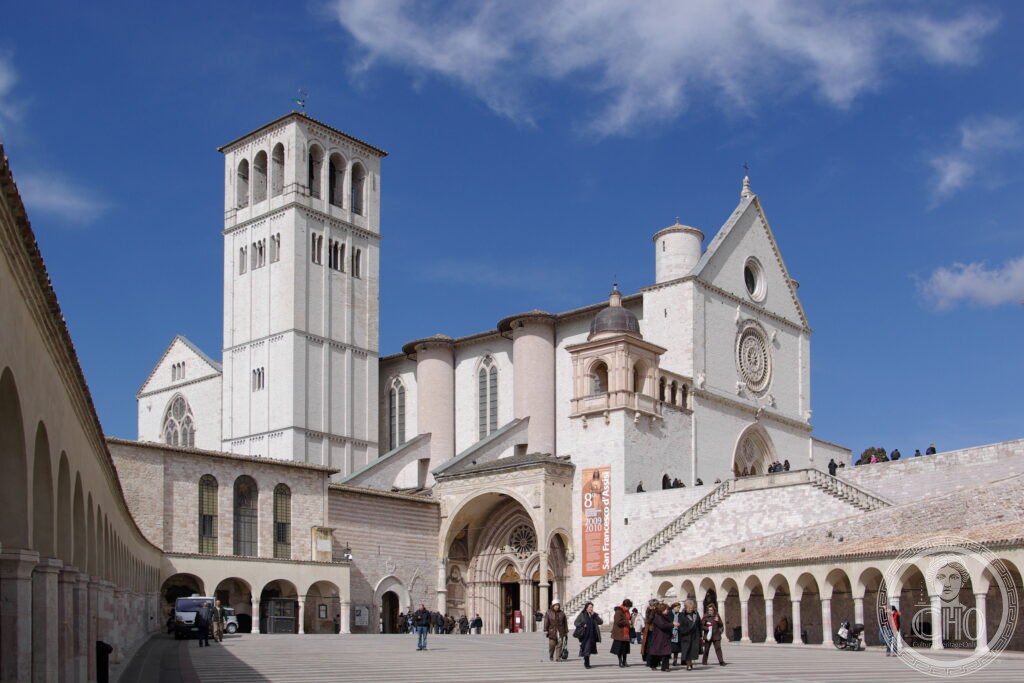
In the upper church of the Basilica di San Francesco, twenty-eight frescoes painted between 1296 and 1304 mark the point where Italian painting turned from flat, symbolic medieval imagery towards figures with weight, shadow and legible emotion. Traditionally attributed to Giotto, the cycle tells the life of Francis of Assisi across the nave walls.
At a glance
The Basilica di San Francesco stands on Piazza Inferiore di San Francesco in Assisi, Umbria, and takes the form of two churches built one above the other. The lower church, in a transitional Romanesque-Gothic style, holds the crypt with the tomb of Saint Francis and frescoes by Cimabue, Simone Martini and Pietro Lorenzetti. The upper church, built in the Italian Gothic style, contains the twenty-eight scenes of the Life of Saint Francis painted between 1296 and 1304 and generally attributed to Giotto di Bondone.
The Basilica is the principal monument of a wider UNESCO listing that also covers thirteen other Franciscan sites in Assisi, including the Rocca Maggiore, the church of Santa Chiara and the Tempio di Minerva on Piazza del Comune.
Key facts
- Construction: begun on 17 July 1228, the day after Francis’s canonisation, under the direction of Fra Elia da Cortona; the lower church dates to 1228–1253 and the upper church to 1239–1253.
- Giotto cycle: twenty-eight frescoes in three tiers around the nave of the upper church, painted 1296–1304 and traditionally attributed to Giotto, though a minority of scholars credit an anonymous Master of the St Francis Cycle.
- Lower church frescoes: works by Cimabue in the 1280s, Pietro Lorenzetti around 1315–1320, and Simone Martini around 1322–1326.
- Tomb of Francis: in the crypt of the lower church, hidden in 1442 for fear of theft and only rediscovered in 1818 after excavation; four niches hold the remains of his companions Leone, Rufino, Masseo and Angelo.
- 1997 earthquake: sections of the vaulted ceiling of the upper basilica collapsed, destroying parts of four Giotto scenes in the first bay; the fragments were collected, scanned and the affected scenes reconstructed by 1999.
History
Francesco di Pietro di Bernardone was born in Assisi around 1181 to a wealthy cloth merchant and his French wife. Following illness after a military defeat near Collestrada, he experienced a conversion around 1204–1205 after hearing a voice in the church of San Damiano telling him to repair the church, and he went on to renounce his father’s wealth and found the Franciscan order. In September 1224, at the hermitage of La Verna near Arezzo, he is said to have received the wounds of Christ. He died at the Porziuncola, near Assisi, on 3 October 1226, and was canonised by Pope Gregory IX in July 1228, with construction of the Basilica beginning the following day.
The double structure of lower and upper church was designed to serve the two functions of the Franciscan order at once, the lower for private contemplation and the upper for public preaching. The Giotto cycle in the upper church was likely commissioned by Giovanni di Muro della Marca, Minister General of the Franciscans, and completed between 1296 and 1304. On 26 September 1997, an earthquake struck the region and part of the vaulted ceiling of the upper basilica collapsed, killing several monks and restoration workers and damaging four of the Giotto frescoes; the site was inscribed on the UNESCO World Heritage list in 2000.
What you see
The visit begins in the lower basilica, where the crypt holds the tomb of Francis and the walls carry frescoes by Cimabue, Pietro Lorenzetti and Simone Martini, including Lorenzetti’s Crucifixion. The upper basilica is reached from the main façade or via the connecting corridor inside, and the Giotto cycle runs around the nave in a sequence that starts at the left transept and moves clockwise, with scenes on the left wall followed by those on the right. Among the most discussed episodes are Francis renouncing his possessions before his father and the bishop, his sermon to the birds, his reception of the stigmata at La Verna, and his death.
Nearby on Piazza del Comune stands the Tempio di Minerva, a Roman temple from the first century with its façade still intact, and the church of Santa Chiara, built between 1257 and 1265, which holds the cross of San Damiano said to have spoken to Francis.
Practical information
- Dress code: shoulders must be covered and shorts are not permitted inside either church.
- Crowds: the upper basilica is busiest with pilgrim groups arriving by coach in the late morning during summer; visiting early or in mid-afternoon is quieter.
- Dates to avoid: 4 October, the feast of Saint Francis and Italy’s patron saint day, draws very large crowds and makes a considered visit difficult.
- Tickets and hours: entry to the churches is free; current opening times and any restrictions are best checked on the Basilica’s official channels before travelling.
Getting there
Assisi is reached by train from Rome, Florence or Perugia, generally with a change at Foligno or Terontola, or by high-speed train to Perugia followed by a bus. From Assisi’s railway station, the historic centre sits uphill and is reached by local bus or taxi.
Nearby
- Perugia — about 25 km away, with a medieval old town and the Galleria Nazionale dell’Umbria, home to works by Perugino and Piero della Francesca.
- Orvieto — about 60 km away, its Duomo built between 1290 and 1350 with a Gothic façade and the Cappella di San Brizio, frescoed by Luca Signorelli between 1499 and 1504.
Sources
- UNESCO
- Giorgio Vasari, Lives of the Artists
Gallery
Find it on the map
See this place and what’s around it →📷 Become a Cultural Heritage Online photographer
Share your photos of places: they stay published under your name as the author. The more they're seen, the more you get noticed — and soon a contest will reward the most appreciated photos.
Log in or sign up free to add a photoIs this page about you?
This page is read by travellers and heritage enthusiasts who find it on Google. Tell us how you are connected to this place and we will take it from there.