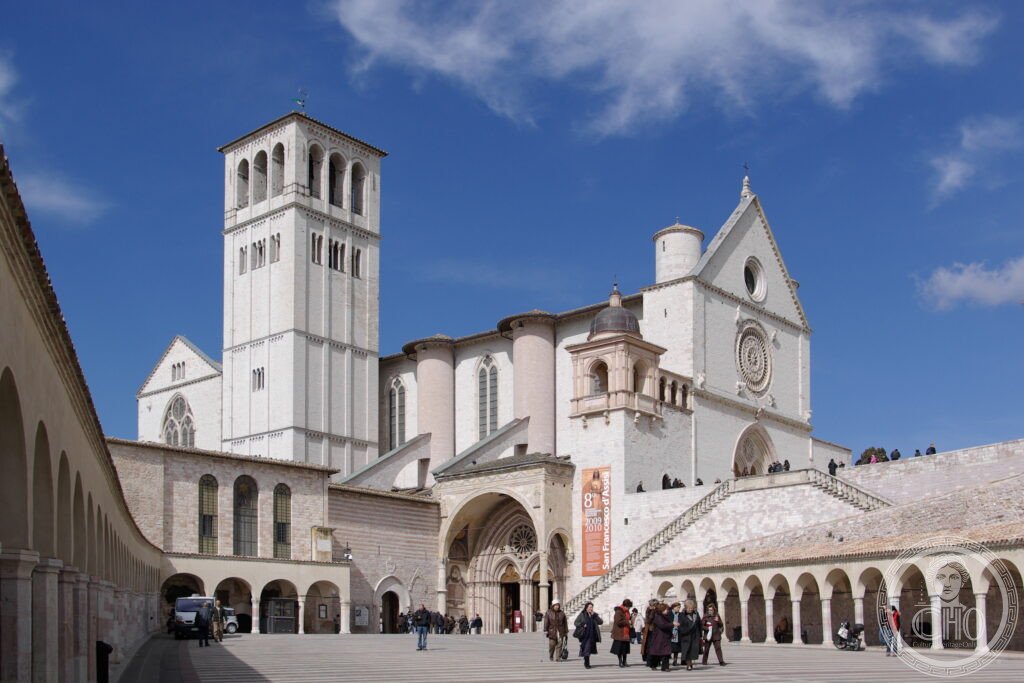
Assisi
Assisi (UNESCO 2000, rif. 990) è la più completa confluenza medievale di architettura e pittura in Italia — la Basilica di San Francesco (1228 CE) custodisce il ciclo di 28 affreschi di Giotto sulla “Vita di San Francesco” (1296–1304 CE) che cambiò la storia dell’arte europea introducendo per la prima volta lo spazio tridimensionale, l’emozione autentica e il paesaggio naturalistico nella pittura.
At a glance
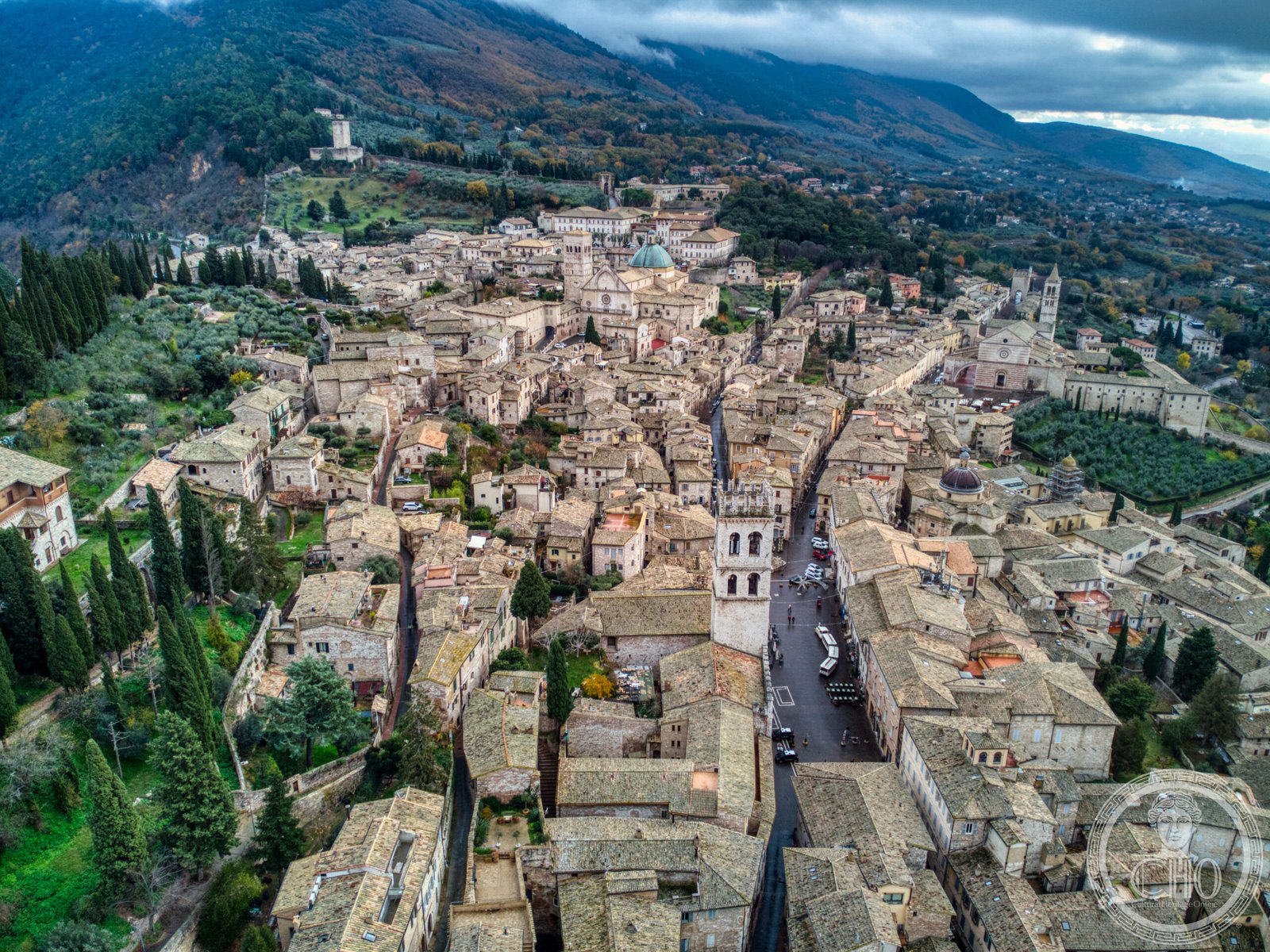
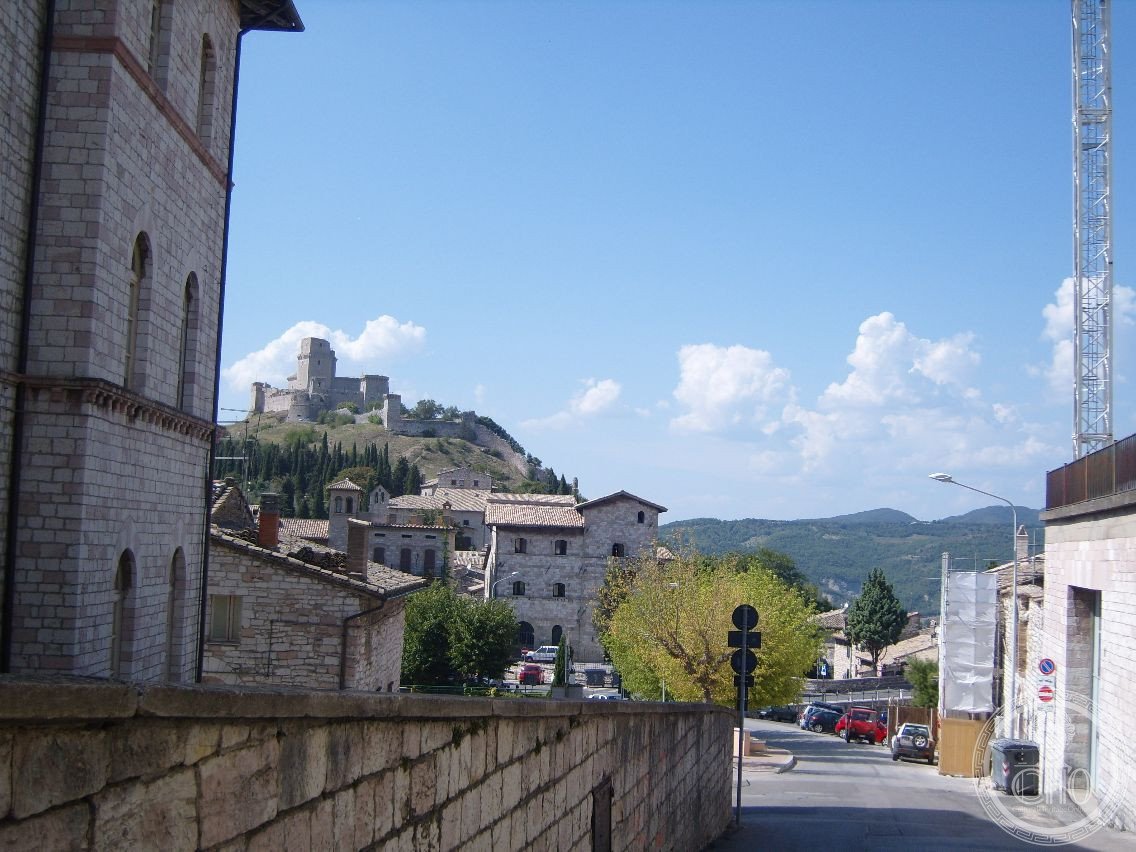
Assisi Umbria (the most precisely Assisi zone Assisi Perugia Umbria Italy 43.0746 N 12.6105 E UNESCO WHS 2000 reference 990 Assisi, the Basilica of San Francesco and Other Franciscan Sites: the site (the UNESCO inscription covers 9 monuments and sites in and around Assisi: the Basilica di San Francesco (the main monument: the double basilica); the Convento di San Francesco (the Franciscan convent attached to the Basilica: 365 rooms, one for each day of the year: the largest convent in Italy); the Basilica di Santa Chiara (1257–1265 CE: the sister church to San Francesco; the burial place of Santa Chiara (Clare of Assisi: 1194–1253 CE; the founder of the Order of Poor Ladies (the Poor Clares))); the Rocca Maggiore (the 14th century fortress above Assisi); the Eremo delle Carceri (the hermitage 4 km from Assisi where Francesco went to pray: the cave (the “Spelaeum”: the rock grotto where Francesco slept on the stone; the hollow in the rock: 80 cm × 60 cm × 40 cm (the dimensions of the hollow are the dimensions of the body of a man lying in fetal position: the smallest sleeping space in any religious site in Umbria))); San Francesco (the historical Francis of Assisi: born c.1181–1182 CE in Assisi (the Umbrian hill town under the jurisdiction of the Bishop of Perugia) to Pietro di Bernardone (a wealthy cloth merchant) and Donna Pica (from Provence): the wealth (Pietro di Bernardone was one of the 5 wealthiest merchants in Assisi; Francesco grew up in luxury, dressed in French-style (the Provençal fashion the father imported with his cloth); the conversion (the conversion of Francesco: not a single moment but a 3-year process 1205–1208 CE: (1) the vision at San Damiano (1205 CE): the voice from the crucifix telling him to “rebuild my church”; (2) the embrace of the leper (1206 CE: Francesco overcame his revulsion of leprosy by dismounting from his horse, embracing a leper, and giving him money; the significance: in medieval culture the leper was the most feared figure; the act = the breaking of the class and sanitary boundary); (3) the renunciation of Pietro di Bernardone (1208 CE: Francesco publicly stripped off his fine clothes and returned them to his father in front of Bishop Guido II in the Piazza del Vescovado; the bishop covered the naked Francesco with his own cloak); the stigmata (the stigmata of Francesco: September 17, 1224 CE on La Verna (Monte della Verna, 1,283 m above Chiusi della Verna, 80 km from Assisi): the 5 wounds of Christ appearing on Francesco’s body (the hands, the feet, the right side); the duration: Francesco lived with the stigmata from September 1224 CE until his death on October 3, 1226 CE (2 years and 16 days)); the death (Francesco died on October 3, 1226 CE at the Porziuncola chapel (Santa Maria degli Angeli, 4 km below Assisi): the death was witnessed by approximately 200 of his brothers; he died singing Psalm 141 (the Song of the Creatures he had composed 3 weeks earlier))
Key facts
- Il ciclo di Giotto nella Basilica Superiore (1296-1304 CE) e la rivoluzione pittorica che cambiò l’arte europea: perché il pannello del “Dono del Mantello” è il primo paesaggio naturalistico della pittura medievale: the Giotto cycle (the 28 frescoes in the upper nave of the Basilica Superiore of Assisi (north wall + west wall + south wall; the sanctuary arch; the vault): painted by Giotto di Bondone (c.1267–1337 CE) between 1296 CE and 1304 CE (the date is based on documentary evidence: a payment of 1,000 florins from the Franciscan Order to “Magistro Iocto de Florentia pictore” in 1297 CE; the payment of 500 florins in 1302 CE: the 2 payments bracket the working period); the revolutionary elements (the 5 innovations of the Giotto Assisi cycle that made it the pivot of Western art history): (1) three-dimensional space (the architectural backdrops in the Assisi frescoes are the first in Western art to convey convincing depth: the “Gift of the Cloak” (panel 2): the city gate of Assisi is painted in foreshortening with a nave of arches retreating into the picture plane; the depth is imperfect by Renaissance standards but incomparably more convincing than anything before Giotto); (2) emotional expression (the “Death of the Knight of Celano” (panel 16): the dead knight is carried by his brothers while his widow and daughters weep: the faces show individualized grief, not the Byzantine hieratic mask); (3) natural landscape (the “Gift of the Cloak” (panel 2): the hills behind Assisi are the first naturalistic landscape in medieval painting: the rocky hill profile is clearly the Monte Subasio (877 m) behind Assisi, not a conventional gold-ground backdrop); (4) portrait individualism (the “Approval of the Franciscan Rule by Innocent III” (panel 7): the face of Pope Innocent III is a portrait of an old man with specific physiognomy, not a generic papal type); (5) narrative continuity (the 28 scenes flow as a continuous narrative (the “storia continuata”: the same characters reappear across panels as if the viewer is watching a film, not a series of disconnected icons))
- GPS (Basilica di San Francesco, Piazza di San Francesco, Assisi): 43.0746° N, 12.6105° E
History
Da Francesco 1226 CE al UNESCO 2000 (the most precisely Assisi zone history: the basilica construction (Francesco died October 3, 1226 CE; construction of the basilica began 2 days after his canonization (July 16, 1228 CE: Pope Gregory IX canonized Francesco only 2 years after his death, the fastest canonization in medieval history (the previous fastest: Thomas Becket, 3 years (1173 CE))); the architect (the architect of the Basilica: Frate Elia da Cortona (1180–1253 CE): the General Minister of the Franciscan Order (the second most powerful Franciscan after the Pope); the design (the Basilica is a double church: the Lower Basilica (Basilica Inferiore: built 1228–1230 CE over the tomb of Francesco; the nave is 29 m long and 13 m wide; the low ribbed vaults at 8 m emphasize the horizontal = the Romanesque tradition; the 4 main frescoes of the crossing: by the “Master of the Isaac Stories” (disputed Giotto attribution)); the Upper Basilica (Basilica Superiore: built 1230–1253 CE above the Lower Basilica; a completely different aesthetic: the Gothic French style (the pointed arches, the ribbed vaults, the large windows for light); the nave: 50 m long, 13 m wide, 19 m high; the large lancet windows (the first large Gothic windows in Italy)); the paintings (Cimabue (Giovanni Cimabue: c.1240–1302 CE) painted the apse and the transept of the Upper Basilica 1280–1285 CE (the earliest major painted program at Assisi); the Giotto cycle (nave, 1296–1304 CE: see Key Facts above); Simone Martini (1284–1344 CE) painted the Chapel of San Martino in the Lower Basilica 1315–1320 CE)); the UNESCO inscription (2000 CE: reference 990; the inscription covers the Basilica + 8 other Franciscan sites in Assisi).
What you see
La Basilica Inferiore, la Basilica Superiore con Giotto, il Convento e la vista sulla Valle Umbra (the most precisely Assisi zone visit (3–4 hours for the full Basilica circuit; 6 hours for the full UNESCO Assisi circuit): the Basilica di San Francesco (free entry; Piazza di San Francesco; open daily 6:00–19:30; the visit sequence: (1) the Lower Basilica (the entrance is from the right side door (not the facade): the tomb of Francesco in the crypt (discovered 1818 CE: the friars hid the body in 1230 CE to prevent it being stolen as a relic; the discovery: the workers excavating the foundations of the new nave found the sarcophagus at 5 m depth; the current tomb: the stone sarcophagus within a 19th century iron cage within a travertine edicola); the 4 great crossing frescoes (disputed Giotto attribution 1278–1280 CE): the Allegories of Poverty, Chastity, Obedience and the Apotheosis of Francis; the Chapel of San Martino (Simone Martini 1315–1320 CE)); (2) the Upper Basilica (the Giotto cycle: use the wall map at the entrance; start from panel 1 at the north wall and proceed clockwise; the best viewing distance: 5–8 m from the wall; binoculars recommended for the vault frescoes; the damage (the 1997 Umbrian earthquake (September 26, 1997 CE: M5.7; the ceiling vault above the entrance of the Upper Basilica collapsed: 2 Franciscan friars and 2 officials of the regional superintendency were killed by falling masonry; the 4 frescoes on the vault (Giotto and workshop: “St Jerome”, “St Francis”, “St Augustine”, “St Ambrose”) were destroyed: 150,000 fragments recovered and 80,000 reassembled in the 7-year restoration (1997–2004 CE); 70,000 fragments were too small to identify and are stored in acid-free boxes)); the Eremo delle Carceri (4 km uphill by foot (trail 51: 1.5 hours from Assisi) or by car (parking lot); free; open 6:30–19:00; the cave where Francesco prayed).
Practical information
- Come raggiungere Assisi da Perugia, Roma e Firenze, e perché il treno è la scelta migliore nonostante la fermata distante dal centro: il trasporto (Perugia → Assisi: Trenitalia (25 min; €3.10; ogni 30 min); Roma Termini → Assisi: Trenitalia (2h30; €18; con cambio a Foligno); Firenze SMN → Assisi: Trenitalia (2h; €20; con cambio a Terontola-Cortona); la stazione (stazione di Assisi: 4 km sotto il centro storico; bus Busitalia D dalla stazione alla Piazza Matteotti (centro storico Assisi): 15 min; €1.30; every 30 min); l’auto (il centro storico di Assisi è ZTL (Zona a Traffico Limitato): i parcheggi consigliati: Parcheggio Giovanni Paolo II (sotto la Basilica di Santa Chiara: €1.20/ora; ascensore fino al centro); Parcheggio Piazza Matteotti: €1.00/ora)); il codice di abbigliamento (la Basilica di San Francesco: spalle coperte e pantaloni/gonna sotto il ginocchio obbligatori per uomini e donne; non esiste noleggio di coprispalle all’ingresso (a differenza della Basilica di San Pietro a Roma): portare uno scialle o una giacca)
Getting there
Trenitalia da Perugia (25 min, €3.10) poi bus D al centro (15 min, €1.30). GPS: 43.0746/12.6105. Ingresso gratuito. 6:00–19:30. Codice abbigliamento obbligatorio.
Nearby
- Perugia (centro medievale + Galleria Nazionale dell’Umbria) — 25 km (Trenitalia 25 min; la Fontana Maggiore (Nicola e Giovanni Pisano 1278 CE); il Palazzo dei Priori (1293 CE); Perugino e Pinturicchio alla Galleria Nazionale dell’Umbria (Corso Vannucci 19; €8; la “Pala dei Decemviri” di Perugino e “L’Adorazione dei Magi” di Pinturicchio))
- Spello (affreschi del Pinturicchio, Cappella Baglioni 1501 CE) — 12 km (bus Busitalia 20 min; la Cappella Baglioni nella Collegiata di Santa Maria Maggiore: €2; il trittico “Annunciazione, Natività, Adorazione dei Magi” (1501 CE): il più grande ciclo di Pinturicchio fuori Roma; il dettaglio: Pinturicchio si auto-ritrae nello specchio della scena dell’Annunciazione)
Gallery


Sources
- Wikipedia, Basilica of San Francesco d’Assisi; Francis of Assisi; Giotto di Bondone, accessed June 2026
- UNESCO, Assisi, the Basilica of San Francesco and Other Franciscan Sites, WHS reference 990, inscribed 2000
- Bellosi, Luciano. Cimabue. Abeville Press, 1998 (the frescoes in context)
Find it on the map
See this place and what’s around it →📷 Diventa un fotografo di Cultural Heritage Online
Condividi le tue foto dei luoghi: restano pubblicate con la tua firma come autore. Più vengono viste, più ti fai conoscere — e presto un concorso premierà le foto più apprezzate.
Accedi o registrati gratis per aggiungere una foto