
Ferrara

Ferrara Castello Estense 1385 Addizione Erculea Biagio Rossetti 1492 Palazzo Diamanti Este UNESCO 1995
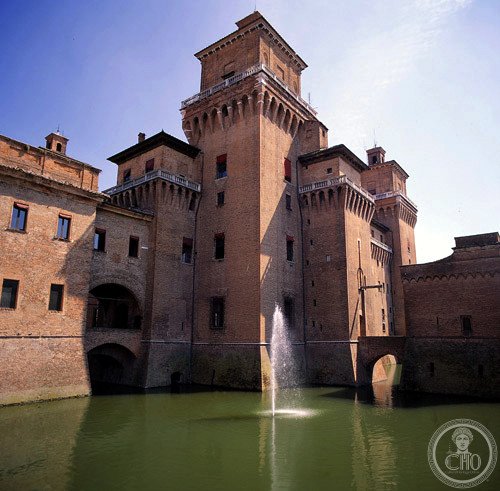
Castello Estense di Ferrara, Ferrara, Emilia-Romagna, Italia. Il Castello Estense (1385 CE) riflesso nel fossato: il castello a 4 torri angolari (Bartolino da Novara 1385–1395 CE; la torre di Marchesana—ovest, la torre di Leone—nord; la torre di Santa Caterina—est; la torre di San Paolo—sud) costruito dai Duchi d’Este come fortezza interna cittadina (il fossato originale: 4 m di profondità × 12 m di larghezza; alimentato da un canale di deviazione della Fossa di Ferrara; l’acqua del fossato non è mai stata asciugata nella storia del castello; il livello attuale: mantenuto artificialmente dalla cura del Comune di Ferrara a 1.5 m di profondità); la facciata del castello verso Corso Martiri della Libertà (il lato settentrionale: il prospetto più fotografato; le merli ghibellini (le merlature a coda di rondine: un segnale visivo della fedeltà imperiale degli Este, anche se nel XIV sec. CE le “merli ghibellini” erano già diventati puramente un motivo decorativo; la tradizione delle “merli ghibellini” a coda di rondine vs “merli guelfi” quadrati è documentata dalla fine del XIII sec. CE in testi di tattica militare toscani (il “Trattato di tattiche” di Ristoro d’Arezzo, c.1282 CE) ma era già obsoleta nel 1385 CE come segnale politico reale)). UNESCO World Heritage Site 1995+2001 (riferimento 733+753: Ferrara, città del Rinascimento e il suo Delta del Po). Foto via Wikimedia Commons.
Ferrara, Emilia-Romagna, Italia · Ducato d’Este 1240–1598 CE; Castello Estense (Bartolino da Novara 1385 CE; il castello con fossato più fotografato d’Italia); Addizione Erculea (Biagio Rossetti 1492 CE; prima città pianificata del Rinascimento); Palazzo dei Diamanti (8.500 bugne); UNESCO WHS 1995+2001 (rif. 733+753)

Ferrara

Ferrara (UNESCO 1995+2001, rif. 733+753 Città del Rinascimento) è la prima grande città pianificata dal Rinascimento italiano — l’Addizione Erculea di Biagio Rossetti (1492 CE) aggiunse al nucleo medievale una griglia ortogonale di 2 km per la corte estense, con il Palazzo dei Diamanti dai suoi 8.500 blocchi a punta di diamante, il Castello Estense nel fossato, e le biciclette che la rendono la capitale italiana del ciclismo urbano.

At a glance

Ferrara Este Rinascimento (the most precisely Ferrara zone Ferrara Emilia-Romagna Italy 44.8352 N 11.6193 E UNESCO WHS 1995+2001 reference 733+753 Ferrara City of the Renaissance and its Po Delta: the site (Ferrara: the city of the Este dynasty (the ruling family of Ferrara from 1240 to 1598 CE; the longest single-dynasty government of any Italian city-state); the Addizione Erculea (the “Herculean Addition”: the Renaissance urban expansion of Ferrara (1492–1510 CE); the commissioner: Ercole I d’Este (1431–1505 CE; Duke of Ferrara 1471–1505 CE); the architect: Biagio Rossetti (c.1447–1516 CE): the most influential urban planner of the Italian Renaissance before Michelangelo and Bramante; the plan (the Addizione Erculea is the first Italian Renaissance “ideal city” extension actually built (Sforzinda by Filarete (1460 CE) was designed but never built; Pienza by Rossellino (1459–1463 CE) was a village, not a city): the extension doubled the area of Ferrara from 110 hectares to 220 hectares; the grid: 2 main axes (Corso Ercole I d’Este (N–S; 1,600 m long; 12 m wide) × Corso Rossetti (E–W)) with a secondary grid of 8 m streets)); the Palazzo dei Diamanti (the centerpiece of the Addizione Erculea: Palazzo dei Diamanti (via Ercole I d’Este 21; begun 1493 CE by Biagio Rossetti for Sigismondo d’Este (1433–1507 CE)): the facade (8,500 marble blocks (“bugnato a punta di diamante”: faceted diamond-point rustication); the marble (white Istrian limestone (Cretaceous biocalcarenite, 100–66 Ma; quarried at Orsera, Istria): the specific optical effect of the diamond-point rustication: the facets create a shadow-pattern that changes with the time of day; at noon in summer (the sun is directly overhead): the shadow-pattern is uniform across the facade (all facets equally lit); at 4 PM (the sun is SW): the shadows are maximal on the NE faces of each diamond; the visual effect: the facade appears to “move” as the light angle changes); the height (3 stories + attic; 22 m height; 90 m facade width); the current use (since 1992 CE: the Pinacoteca Nazionale di Ferrara (the national painting gallery: the Este collection + Ferrarese school paintings))).

Key facts

  • Ferrara “città delle biciclette” e perché è la città italiana con il più alto tasso di utilizzo della bicicletta per spostamenti quotidiani: the Ferrara bicycle culture (the cycling rate of Ferrara: the specific data (the “ISTAT Report on Mobilità Sostenibile”, 2023): Ferrara: 35% of all daily journeys by bicycle (the highest rate in Italy; second highest in Europe after Amsterdam (38%)); the explanation (why Ferrara is so cycle-friendly): (1) the topography: Ferrara is perfectly flat (maximum elevation difference in the city: 4 m); (2) the street grid: the Addizione Erculea grid creates long straight streets with no hills (the flattest Renaissance city plan in Italy); (3) the cycle path network: 122 km of dedicated cycle paths (the longest network per capita in Italy: 122 km / 130,000 inhabitants = 0.94 m of cycle path per inhabitant; comparison: Milan 0.14 m/inhabitant; Bologna 0.23 m/inhabitant); (4) the historical absence of the car culture: Ferrara had no major industry until the 1960s CE (Montecatini-Edison chemical plant opened 1963 CE) so the pattern of cycling was never disrupted by a rush to motorize); the Este literary court (the 16th century CE Este court was the most important literary court of Italy: the court hosted: (1) Ludovico Ariosto (1474–1533 CE): who wrote “Orlando Furioso” (the epic poem: 38,736 verses; published in full 1532 CE; the most important Italian epic poem after Dante’s Divine Comedy; the specific Este dedication: the poem is dedicated to Cardinal Ippolito I d’Este (the cardinal who paid Ariosto’s salary of 240 ducats/year but reportedly called the poem “frottole” (nonsense) when Ariosto presented it)); (2) Torquato Tasso (1544–1595 CE): who wrote “Gerusalemme Liberata” (the Crusade epic; 1581 CE))
  • GPS (Castello Estense, Piazza della Repubblica): 44.8352° N, 11.6193° E

History

Dal Ducato d’Este 1240 CE al UNESCO 1995 (the most precisely Ferrara zone history: the Este rule (the Este dynasty ruled Ferrara as lords (signori) from 1240 CE and as Dukes (duchi) from 1471 CE; the total reign: 358 years; the Este were one of the oldest Italian dynasties (the family originated in the Este castle in the Euganean hills, Padova; the first Este lord of Ferrara: Obizzo II d’Este (c.1247–1293 CE; lord from 1264 CE)); the peak (the cultural peak of Este Ferrara: 1471–1534 CE (the reigns of Ercole I + Alfonso I + Ercole II): the court of Ferrara was the most sophisticated literary-artistic court in Italy; the painters of the Ferrarese school (the “scuola ferrarese”: the painters who worked for the Este court: Cosmè Tura (c.1430–1495 CE; the founder of the Ferrarese style: the angular, nervous, anti-classical drawing style unique to Ferrara); Ercole de’ Roberti (c.1451–1496 CE); Francesco del Cossa (c.1430–1477 CE) (the frescoes of the Sala dei Mesi in Palazzo Schifanoia (1469–1470 CE): the 12 months cycle with astrological and courtly scenes)); the loss of Ferrara (the Este lost Ferrara in 1598 CE when Duke Alfonso II died without heirs and Pope Clement VIII (the Aldobrandini pope) “devolved” (reverted) the Duchy of Ferrara to the Papal States: this devolution ended 358 years of Este rule and the Pope gained a major strategic city; after 1598 CE Ferrara began a slow decline under papal governance that lasted until 1860 CE)); the UNESCO inscription (1995 CE: reference 733; extended 2001 CE: reference 753 to include the Po Delta).

What you see

Il Castello, il Palazzo dei Diamanti, l’Addizione Erculea, la Cattedrale, e la Salama da Sugo (the most precisely Ferrara zone visit (1 day full): the Castello Estense (Corso Martiri della Libertà; €10; open Tue–Sun 9:30–17:30; the moat circuit (free): walk the full perimeter of the moat (880 m; 15 min); the interior: the underground prisons (the “carceri”: the dungeon where Parisina Malatesta (1404–1425 CE) and her lover Ugo d’Este (1405–1425 CE) were imprisoned and executed by Nicolò III d’Este for adultery; the ballad by Lord Byron (“Parisina”, 1816 CE) and by Donizetti’s opera “Parisina d’Este” (1833 CE) are based on this event)); the Palazzo dei Diamanti (Via Ercole I d’Este 21; the Pinacoteca Nazionale: €8; the facade: viewable 24h free; the corner: the best view of the diamond-point rustication is from the NW corner (the “Cantonale dei Diamanti”) at 15:00 on a sunny day (maximum shadow-play)); the Cattedrale di San Giorgio (Piazza della Repubblica; the 12th century CE Romanesque–Gothic cathedral; the marble facade: 3 portals + loggia + 68 m bell tower (1451 CE; Ferrarese marble); the interior: the “Madonna Pomposiana” (the painting attributed to Cosmè Tura in the north chapel; the golden frame: 16th century CE Este gift)); the Palazzo Schifanoia (Via Scandiana 23; €6; open Tue–Sun; the “Sala dei Mesi” frescoes: the 12-month cycle by Francesco del Cossa + Ercole de’ Roberti (1469–1470 CE); the most important secular fresco cycle of the Italian Quattrocento outside Florence).

Practical information

  • Come raggiungere Ferrara da Bologna e Venezia e perché noleggiare una bicicletta è il modo migliore per visitare l’Addizione Erculea: il trasporto (Bologna Centrale → Ferrara: Trenitalia Regionale (30 min; €4.60; ogni 30 min); Venezia Santa Lucia → Ferrara: Trenitalia Regionale (55 min; €9.50); la bici (il noleggio a Ferrara: Rent4You Bike (piazza della Stazione; €3/h o €10/giorno; ogni tipo di bici incluso e-bike); il circuito consigliato in bici (2h): Stazione → Castello → Corso Ercole I d’Este (1.6 km rettilineo) → Palazzo dei Diamanti → Corso Rossetti → Mura Estensi (le mura rinascimentali: 9 km di ciclopista sulle mura del XVI sec. CE; la più lunga passeggiata sulle mura d’Italia) → Piazza della Repubblica → Cattedrale → ritorno); il pranzo: Osteria dell’Orsa (Via Marogna 5; la “Salama da Sugo” (la specialità di Ferrara: un insaccato di carne suina cucinato bollito per 3h; €18; prenotare))

Getting there

Trenitalia da Bologna (30 min, €4.60) o Venezia (55 min, €9.50). Noleggio bici dalla stazione €10/giorno. GPS Castello Estense: 44.8352/11.6193. Visita: 1 giorno completo.

Nearby

  • Delta del Po (UNESCO 2001 rif. 753 — l’estensione UNESCO di Ferrara) — 50 km (le valli di Comacchio + le lagune + la fauna migratrice; la batterie di pesca; l’Abbazia di Pomposa (X sec. CE); il Parco del Delta del Po (visita in barca o in bici))
  • Ravenna (UNESCO 1996 rif. 788 — 8 mosaici paleocristiani) — 60 km (il Mausoleo di Galla Placidia + San Vitale; Trenitalia Ferrara–Ravenna 1h10; €8)

Sources

  • Wikipedia, Ferrara; Addizione Erculea; Biagio Rossetti; Castello Estense, accessed June 2026
  • UNESCO, Ferrara, City of the Renaissance, and its Po Delta, WHS references 733+753, inscribed 1995 and 2001
  • Zevi, Bruno. Biagio Rossetti, architetto ferrarese. Torino: Einaudi, 1960

Hero image: Castello Estense, Ferrara, Emilia-Romagna, Italy, Wikimedia Commons. Editorial text © Cultural Heritage Online, 2026.

📷 Diventa un fotografo di Cultural Heritage Online

Condividi le tue foto dei luoghi: restano pubblicate con la tua firma come autore. Più vengono viste, più ti fai conoscere — e presto un concorso premierà le foto più apprezzate.

Accedi o registrati gratis per aggiungere una foto
📋 Copy & share on social
Scroll to Top