
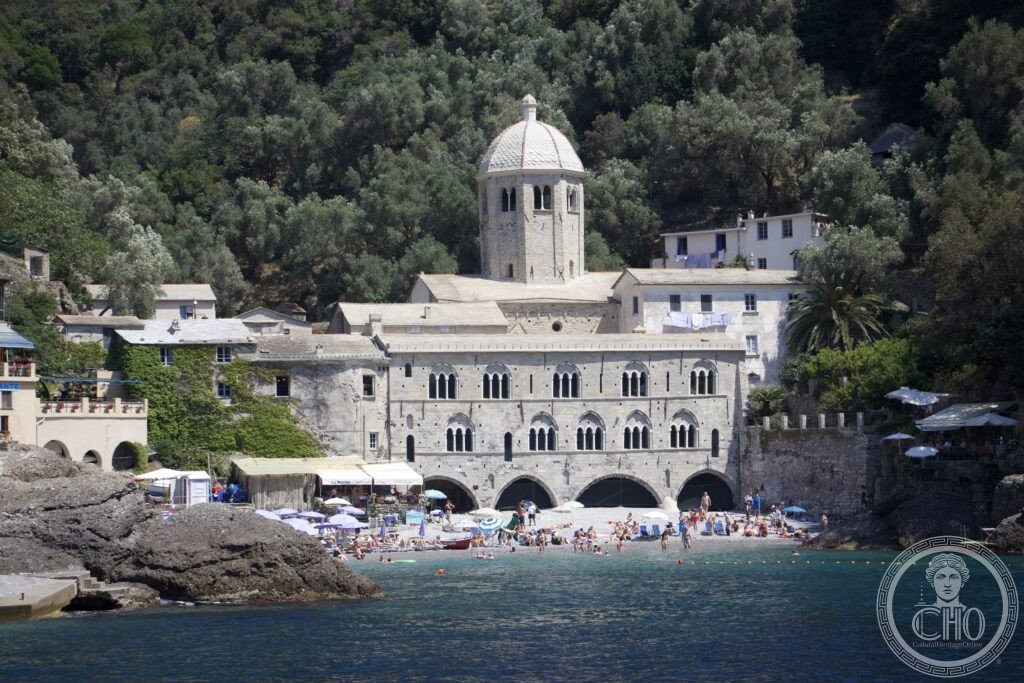
Abbazia di San Fruttuoso
L’Abbazia di San Fruttuoso (FAI dal 1983) è tra i luoghi più romanticamente inaccessibili d’Italia — un’abbazia benedettina del IX sec. incastrata in una cala circondata dal promontorio di Portofino, raggiungibile solo in barca o a piedi, con il Cristo degli Abissi che veglia sui fondali a 17 metri di profondità.
At a glance
Abbazia di San Fruttuoso Camogli Liguria (the most precisely Abbazia di San Fruttuoso zone Camogli Genova Liguria Italy 44.3294 N 9.1589 E FAI Fondo Ambiente Italiano managed since 1983 CE: the site (the Abbey of San Fruttuoso: one of the most unusually situated monasteries in Italy; the cove (the “Cala di San Fruttuoso”: a natural bay formed by the geology of the Portofino Promontory (the Monte di Portofino Regional Nature Park: 1999 CE; 1,056 hectares); the bay access (the bay is accessible only in 2 ways: (1) by boat (the traghetto from Camogli port (Golfo Paradiso ferry company; the Camogli–San Fruttuoso route: 25 min; €16 return; runs April–November, daily; maximum weather-dependent; the last boat: 18:00)); (2) on foot (the 3 hiking routes: (a) from Camogli via Punta Chiappa: 4 km, 2h30 (the most demanding: 400 m elevation change); (b) from Portofino village: 3.5 km, 1h30 (easier: 150 m elevation); (c) from Ruta (the mountain village): 6 km, 2h45)); the Cristo degli Abissi (the “Christ of the Abyss”: the underwater bronze statue (2.5 m tall; weight: 1.3 tonnes; casting: the Fonderia Artistica Battaglia of Milan, 1954 CE; the bronze alloy: 90% copper + 10% tin + trace manganese (a Muntz alloy variant for seawater corrosion resistance); the designer: Guido Galletti (1911-1980 CE; a Genoese sculptor trained at the Accademia Ligustica di Belle Arti); the location: at 17 m depth, 25 m from the abbey beach; GPS: 44.3289, 9.1595; the history of the statue: the initiative came from the diving pioneer Duilio Marcante (1909-1984 CE) who organized the dive to place the statue on August 22, 1954 CE; the statue was raised in 2003-2004 CE for restoration (the bronze had developed a 2 cm thick sea-concretion layer of coralline algae and bryozoans) and returned to the seabed in 2004 CE).
Key facts
- Il Cristo degli Abissi: perché fu la prima statua religiosa deposta permanentemente sul fondale marino del Mediterraneo e come ha cambiato il turismo subacqueo in Italia: the Cristo degli Abissi innovation (the statue was the first permanent religious underwater installation in the Mediterranean (the distinction from earlier underwater art: the Greek and Roman bronzes recovered from the sea (es. il Riace Warriors, 1972 CE: originally fallen from a ship c.400 BCE; the Antikythera mechanism; the bronze horse of Artemision) were LOST underwater accidentally, not PLACED there; the Cristo degli Abissi was the first intentional permanent installation of a large figurative bronze in the sea)); the diving tourism impact (the statue’s placement in 1954 CE transformed San Fruttuoso from a destination for sailors and hikers into Italy’s first diving pilgrimage site; the annual pilgrimage dive (the “Benedizione del Mare” (Blessing of the Sea) held every last Sunday of July at San Fruttuoso since 1955 CE: divers gather at the Cristo + fishermen on boats above + the Abbot of San Fruttuoso on the abbey jetty; the 2023 CE event: 2,400 divers (a record); the visibility at the Cristo (average underwater visibility in August at San Fruttuoso: 15–25 m (the best in Liguria: the bay is sheltered from the Tramontana which carries sediment; the depth 17 m is above the thermocline in summer (22-23°C above the halocline; 14-16°C below)); the corrosion cycles of the Cristo (the Cristo was raised for restoration twice: 2003-2004 CE (corrosion + biological fouling) and 2018 CE (anchor chain replacement)))
- GPS (Abbazia di San Fruttuoso, spiaggia): 44.3294° N, 9.1589° E
History
Dalla traslazione delle reliquie 711 CE ai Benedettini IX sec. ai Doria XV sec. al FAI 1983 (the most precisely Abbazia di San Fruttuoso zone history: the foundation legend (the legend of the translation of the relics: the traditional account (first written record: the 14th century CE chronicle of Jacopo da Varagine (c.1228-1298 CE; the Archbishop of Genoa who wrote the “Legenda Aurea” (Golden Legend)): the relics of Saint Fructuosus of Tarragona (martyred c.259 CE in Hispalis/Seville; the same Fructuosus whose martyrdom is recorded by the earliest surviving complete hagiography in Latin (the “Acta proconsularia”, c.260 CE)) were transported from Hispalis to the Ligurian coast c.711 CE (to escape the Islamic conquest of Spain (711 CE)); the monks carrying the relics were directed to the cove of San Fruttuoso by a miraculous sea-storm that stranded their boat there); the Benedictine foundation (the real history: a Benedictine community was established at San Fruttuoso c.800-850 CE (the Carolingian period): the first documentary mention of the abbey is in a charter of Louis II of Italy (emperor 855-875 CE) dated 860 CE: “monasterium Sancti Fructuosi in litore Ligurie”; the Doria family (the Doria of Genoa became the protectors of the abbey from 1239 CE: Martino Doria (c.1200-1269 CE) restored the abbey after it was damaged by a storm in 1238 CE; the Doria tower (the circular tower visible in the hero photo: built by the Genoese statutes for the Doria c.1400-1420 CE as a lookout tower and arsenal for the family’s commercial fleet; the tower is 15 m high × 6 m internal diameter); the FAI (1983 CE: the FAI acquired the abbey from the Doria family for €1 and a 99-year lease (renewable); the restoration: 1984-1992 CE)).
What you see
L’abbazia, la torre Doria, la cripta, la spiaggia, e il Cristo degli Abissi (the most precisely Abbazia di San Fruttuoso zone visit (2–3 hours if arriving by boat): the arrival (the ferry from Camogli docks at the small stone jetty (5 m × 20 m) at the NE corner of the cove; the view on arrival: the cove is 200 m × 80 m; the abbey (the main structure) is on the right (north); the Doria tower is behind the abbey; the pebble beach is in front); the abbey exterior (the Romanesque-Gothic facade: built 1245-1275 CE (the primary phase); the specific feature: the “loggiato” (the open arcade of 3 pointed arches above the facade) — a unusual combination of Romanesque round arches at ground level + Gothic pointed arches at the loggia; the color: the local Portofino dolomite (grey-green) + Veronese red limestone (the 4 column capitals in Verona red marble)); the interior (the nave (1 nave + 1 aisle; 22 m × 9 m; the nave floor: uneven slate slabs of Lavagna (the “ardesia” of Liguria: metamorphic slate quarried near Lavagna (GE) from c.1200 CE)); the Doria tombs (the tombs of 11 members of the Doria family in the north wall niches (13th-15th century CE); the most important: the tomb of Lamba Doria (d. 1323 CE; the Genoese admiral who won the Battle of Curzola (1298 CE; the battle at which Marco Polo was captured — Polo was on a Venetian galley that was defeated by Lamba Doria)); the dive to the Cristo (the Cristo degli Abissi: accessible for scuba divers from the beach; the minimum diving qualifications: PADI Open Water or equivalent; the recommended visibility season: July–October; local dive center: Camogli Sub (c.3 km from San Fruttuoso by boat); the surface view: the statue is visible from the surface in calm conditions with a mask (free-dive: depth 17 m)).
Practical information
- Come raggiungere l’Abbazia di San Fruttuoso da Camogli e Portofino e quando andare per vedere il Cristo degli Abissi in immersione: il trasporto (Genova Brignole → Camogli: Trenitalia (25 min; €3.20; ogni 30 min); Camogli porto → San Fruttuoso: traghetto Golfo Paradiso (25 min; €16 A/R; apr-ott; il traghetto non parte se il vento è >4 Beaufort (18 km/h): verificare le previsioni meteo il giorno prima)); la visita (il FAI: biglietto €7 (soci FAI gratis); apr-ott 10:00-17:30; nov-mar solo sab-dom 10:00-15:30); il Cristo degli Abissi (la stagione migliore per le immersioni: luglio-ottobre (visibilità 15-25 m); il centro immersioni a Camogli: Camogli Sub (Via XX Settembre 36; l’immersione guidata al Cristo (2h; 2 diver min; €60 incluso noleggio); la Benedizione del Mare (l’ultima domenica di luglio: l’evento con 2.000+ sommozzatori); il percorso escursionistico (l’alternativa senza barca: Portofino → San Fruttuoso sentiero 3 (1h30 a piedi; segnavia CAI bianco-rosso; dislivello 150 m; calzature da trekking; non escursionismo estremo))))
Getting there
Traghetto da Camogli (25 min, €16 A/R; apr-ott). A piedi da Portofino: sentiero 3 (1h30). GPS: 44.3294, 9.1589. Biglietto FAI €7. Apr-ott 10 AM–5:30 PM.
Nearby
- Portofino — 3 km a piedi (il borgo dei pescatori liguri più fotografato al mondo; il Castello Brown (1557 CE); la Piazzetta; il traghetto Portofino–Santa Margherita Ligure–Rapallo (€8))
- Camogli (il Museo Marinaro + la processione dei ceri) — 25 min traghetto (il museo dei diorami di barca ligure; la Sagra del Pesce (seconda domenica di maggio: la frittura di pesce nel tegame più grande del mondo (2 m diametro; 500 kg di acciughe))
Gallery
Sources
- Wikipedia, Abbey of San Fruttuoso; Christ of the Abyss; Guido Galletti, accessed June 2026
- FAI Fondo Ambiente Italiano, Abbazia di San Fruttuoso, fondoambiente.it, accessed June 2026
- Jacopo da Varagine. Chronicon Genuense, c.1296 CE (primary source for the San Fruttuoso foundation legend)
Find it on the map
See this place and what’s around it →📷 Diventa un fotografo di Cultural Heritage Online
Condividi le tue foto dei luoghi: restano pubblicate con la tua firma come autore. Più vengono viste, più ti fai conoscere — e presto un concorso premierà le foto più apprezzate.
Accedi o registrati gratis per aggiungere una foto