
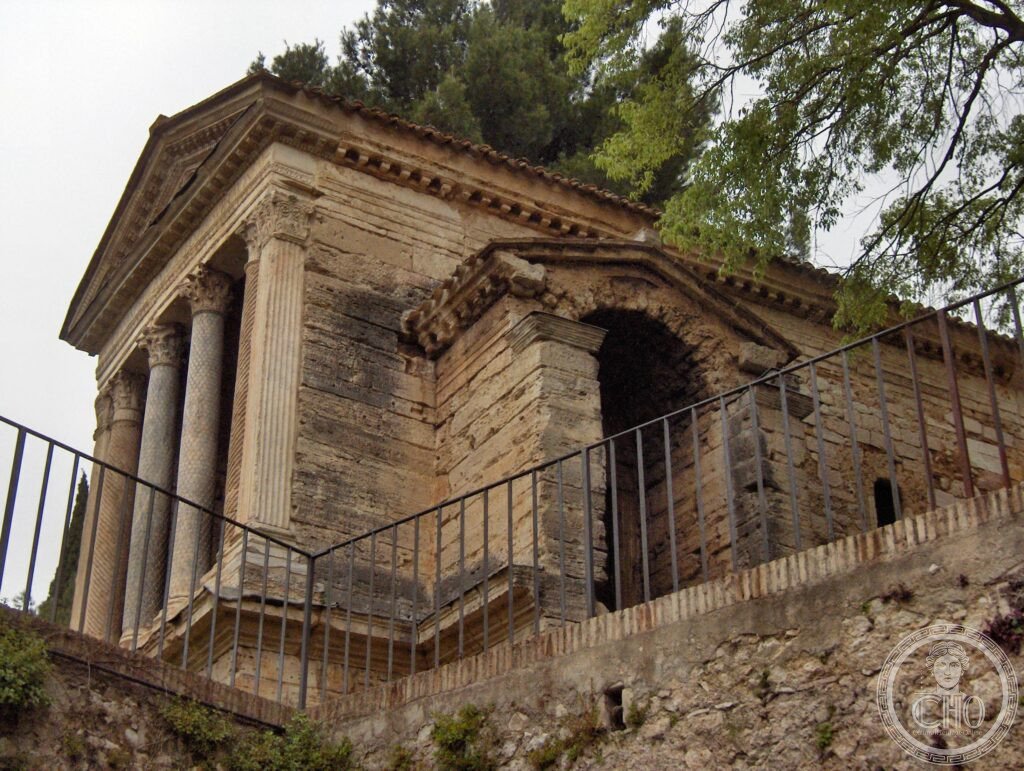
Beside the Via Flaminia, a tiny four-columned building was taken for centuries as a Roman temple to the river god Clitumnus. Twentieth-century scholarship reattributed it to Lombard Spoleto, and its faded apse frescoes are counted among the earliest surviving images of Christ in Italy.
At a glance
The Tempietto del Clitunno stands on a low stone podium reached by four steps, its façade carried on four Corinthian columns in white limestone quarried on Monte Subasio, the same stone used at the Basilica of Assisi. The shafts are left unfluted, an anomaly for Corinthian work, and the capitals appear to have been reused from an earlier Roman building on the same site. A triangular pediment above bears a cross-shaped incision, and the single doorway keeps its original carved lintel, decorated with Lombard interlace ribbon-work and a central palm motif.
For centuries travellers, Goethe among them, took the building for the Roman temple of Clitumnus described by Pliny the Younger. In 1943 the art historian Friedrich Wilhelm Deichmann argued in the Römisches Jahrbuch für Kunstgeschichte that the interlace carving and the apse frescoes were incompatible with Roman work and pointed instead to a Lombard origin around 740, a dating that some scholars still debate in favour of a fourth-century Christian date.
Key facts
- Location: Via Flaminia, Campello sul Clitunno, province of Perugia, Umbria.
- Construction: most likely Lombard, around 740 CE, though a fourth-century Christian origin has also been argued.
- Structure: four Corinthian columns in white Subasio limestone on a stepped podium, with a triangular pediment and a single door bearing a carved Lombard interlace lintel.
- Interior: eighth-century apse frescoes showing Christ Pantocrator flanked by Saints Peter and Paul, painted with the rare white-highlight technique known as maculae albae.
- Setting: the Fonti del Clitunno, a spring-fed lake celebrated by Virgil and Pliny the Younger, lie a short walk to the south.
- Status: part of the UNESCO World Heritage inscription Longobards in Italy, Places of Power, listed in 2011 under reference 1318.
History
The Clitumnus spring was one of the most visited religious sites of central Italy in Roman times, with an oracle whose responses, according to Pliny the Younger, were written on wooden tablets set afloat on the water. A Roman inscription found at the site in 1836, reading Divo Clitumno Sacrum, confirms that a temple to the river god once stood there. When the Lombard duchy of Spoleto took control of the area in the eighth century, the pagan site was converted to Christian use: the carved door lintel and the apse frescoes are usually dated to this period by comparison with the Tempietto Longobardo at Cividale and Santa Maria Foris Portas at Castelseprio.
From at least the eighteenth century, when Goethe visited and described it as a perfectly preserved Roman temple, the building was read as the very shrine Pliny had mentioned. That identification held until 1943, when Deichmann’s stylistic analysis reassigned it to the Lombard period. The building was inscribed by UNESCO in 2011 as part of the serial site Longobards in Italy, Places of Power.
What you see
Approaching up the four steps of the podium, the visitor meets the columns at close range, close enough to see that the shafts were never fluted, an unusual choice for Corinthian work. The carved lintel over the door shows the Lombard interlace ribbon pattern with a palm at its centre. Inside, through the entrance, the apse fresco shows a frontal Christ holding an open book inscribed with the Greek text of John 8:12, flanked by Peter and Paul in attitudes of prayer; the raised white dots used to model the flesh, best seen in good light, are a technique documented in Italian painting of the sixth to eighth centuries and later abandoned.
A short walk south along the Via Flaminia brings the visitor to the Fonti del Clitunno, a spring-fed lake long associated with the white cattle that Virgil says drank its waters before Roman sacrifices. White ducks live on the lake today, a survival of the same tradition of keeping pale animals at the spring. A stone bench on the north shore is pointed out by local guides as the spot where Byron is said to have sat while composing the Clitumnus stanzas of Childe Harold’s Pilgrimage, though no document confirms the tradition.
Practical information
- Access: the Tempietto is opened by a custodian on request; opening times vary by season and are best checked with the local tourist office or the site’s official channels before visiting.
- Guidance: explanations are normally given in Italian only, with no audio guide or printed English material available on site.
- Combine with: the Fonti del Clitunno lie a short walk south and can be visited in the same outing.
Getting there
Campello sul Clitunno lies on the Via Flaminia between Spoleto and Foligno, and the Tempietto stands directly on this road. A local SSIT bus service connects Spoleto and Foligno and stops in the area; timetables should be checked locally.
Nearby
- Fonti del Clitunno — about 200 metres south, the spring-fed lake celebrated by Virgil and Pliny the Younger, with public access to the shore.
- Basilica di San Francesco, Assisi — around 15 kilometres north, built from the same white Subasio limestone as the Tempietto’s columns.
Sources
- Pliny the Younger, Letters
- Virgil, Georgics
- Goethe, Italian Journey
- Byron, Childe Harold’s Pilgrimage
- Carducci, Odi Barbare
- Friedrich Wilhelm Deichmann, Römisches Jahrbuch für Kunstgeschichte (1943)
- UNESCO World Heritage List
Find it on the map
See this place and what’s around it →📷 Become a Cultural Heritage Online photographer
Share your photos of places: they stay published under your name as the author. The more they're seen, the more you get noticed — and soon a contest will reward the most appreciated photos.
Log in or sign up free to add a photoIs this page about you?
This page is read by travellers and heritage enthusiasts who find it on Google. Tell us how you are connected to this place and we will take it from there.