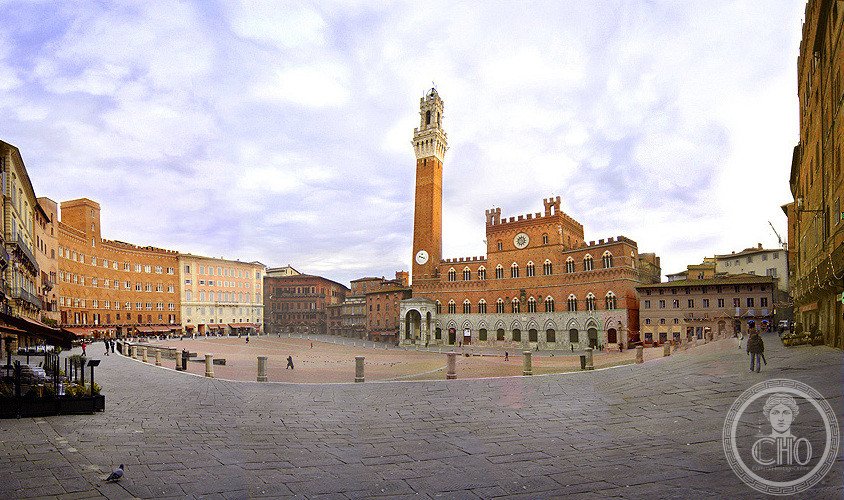
Siena: Centro Storico
Il Centro Storico di Siena (UNESCO 1995) è il museo vivente della pittura senese del Trecento — la città che negli anni 1280–1348 CE produsse Duccio di Buoninsegna, Simone Martini e i Lorenzetti in successione, rifiutò deliberatamente la prospettiva naturalistica di Giotto e invece portò all’estremo la sofisticazione cromatica e la spiritualità dorata della tradizione bizantina, e poi fu decimata dalla Peste Nera (1348 CE) proprio al culmine del suo sviluppo, preservando nel Palazzo Pubblico il più importante ciclo di affreschi laici del Medioevo europeo.
At a glance
Siena centro storico (the most precisely Siena zone Siena Toscana Italy 43.3188 N 11.3307 E UNESCO WHS 1995 reference 717: the Palio di Siena (the most famous medieval horse race in the world; the Palio delle Contrade: 2 races per year (2 July: Palio di Provenzano; 16 August: Palio dell’Assunta); the race (10 horses + riders, one for each of the 10 contrade (out of 17 contrade total; 7 are excluded from each race by lottery); the track (the 3 laps of the Piazza del Campo; 333 m per lap = 999 m total; the race lasts approximately 75–90 seconds; the most dangerous point: the Curva di San Martino (the tightest turn, at the right angle on the south side of the Campo); horses often fall here (a horse that falls can still win if it completes the course — the jockey is optional); the specific tradition (the Palio is the most serious event in Sienese civic life: the contrade are the 17 medieval neighborhoods of Siena (reduced from 42 original contrade before 1675 CE; the current 17 were established by the Balia of Siena in 1675 CE); each contrada has its own church, museum, fountain, and government; alliances and rivalries between contrade are centuries old; the Aquila (Eagle) and the Pantera (Panther) are traditional allies; the Torre (Tower) and the Balzana (two-color field) are traditional rivals; the most famous enmity: Nicchio (Shell) vs Valdimontes (a contrada dissolved in 1675 CE, the enmity was transferred to the Tartuca (Tortoise)); the palio cloth (the drappellone: the banner hand-painted on silk for each race; the artists who have created the drappellone include: Giorgio de Chirico (1955), Josef Albers (1969), Emilio Pucci (1994), Maurizio Cattelan (1999); the collection of historic drappelloni in the Palazzo Pubblico museum is the most complete collection of medieval and modern iconography in any Italian civic museum); the Lorenzetti frescoes in the Palazzo Pubblico (the Allegoria del Buono e Cattivo Governo (Ambrogio Lorenzetti, 1338–39 CE): the largest surviving secular fresco cycle in medieval Europe; the 3 panels (Allegory of Good Government + Effects of Good Government in the City and Country + Effects of Bad Government): 14 m × 7.7 m each; the “Effects of Good Government in the City” panel (the most frequently reproduced): the only surviving medieval painting of a functioning city (Siena c.1338 CE) showing: merchants, workers, children playing, women dancing, masons at work on buildings, a school in session (the teacher visible through an open window), traders at market stalls).
Key facts
- Il Duomo di Siena e la Libreria Piccolomini (1502 CE, Pinturicchio) — la più raffinata biblioteca rinascimentale di uso privato che si possa visitare: il Duomo di Siena (the Cattedrale di Santa Maria Assunta: the most ornate Gothic cathedral interior in Italy (the white and black striped marble columns and walls, the hexagonal pulpit by Nicola Pisano (1265–68 CE; the first signed and dated sculptural masterpiece in medieval Italy: the 6 narrative reliefs are the most naturalistic sculpture between ancient Rome and the early Giotto; the inscription on the base: “Anno milleno bis centum sexageno octavo Nicola Pisanus sculpsit hanc preclarissimam pelvim” (in the year 1268 Nicola Pisano sculpted this most remarkable bowl); the Pavimento del Duomo (the marble intarsia floor: 56 marble inlaid panels (1369–1547 CE; approximately 40 different artists including Pinturicchio, Domenico Beccafumi, Francesco di Giorgio Martini); the floor is covered with wooden boards for most of the year to protect it; it is uncovered for approximately 6 weeks in August–September each year (the exact dates change annually; check opcsiena.it for the current year’s schedule)); the Libreria Piccolomini (inside the Duomo, left aisle; the most important visual programme of the Piccolomini pope Pius III (Aeneas Silvius Piccolomini’s nephew, elected pope for only 26 days in 1503 CE; died before completing any significant papal programme); the 10 scenes (Pinturicchio, 1502–08 CE): the life of Pope Pius II (Aeneas Silvius Piccolomini (1405–64 CE), the most cultivated pope of the 15th century): the color (the Pinturicchio palette in the Libreria is the most brilliant in any intact fresco cycle (the intense ultramarine blues and vermillion reds are preserved because the room had shuttered windows and was never used for the library function after the first decade; the books are displayed in glass cases and were never shelved on the open walls); the specific observation (the 2nd panel, “Aeneas Silvius at the Basel Council (1432 CE)”: the figure of the young Piccolomini is identifiable by the red hat; the landscape background is one of the earliest painted Sienese hill landscapes in the Umbrian painting tradition))
- GPS (Piazza del Campo): 43.3188° N, 11.3307° E
History
Dalla fondazione etrusca alla Repubblica dei Nove alla sconfitta di Montaperti alla Peste Nera all’UNESCO 1995 (the most precisely Siena zone history: the Sienese Republic (1125–1555 CE: from the expulsion of the Bishop of Siena (who had ruled the city as secular lord) to the final Sienese surrender to Florence (1555 CE); the specific peak (the Governo dei Nove (1287–1355 CE): the constitutional oligarchy of 9 merchants who governed Siena for 68 years; the specific requirement: each member of the Nove had to be a merchant (no nobility, no clergy) — the most explicitly bourgeois civic government in medieval Europe before the Medici); the Battle of Montaperti (4 September 1260 CE: the decisive battle between Siena (allied with the Ghibellines and the Hohenstaufen Emperor Manfred of Sicily) and Florence (Guelph); the Sienese defeated the Florentines decisively (the specific tradition: the Sienese commander Buonaguida Lucari barefoot and with a rope around his neck in surrender, offered the city to the Virgin Mary before the battle — the Virgin’s protection is the theological basis of the entire Sienese civic religion including the Palio); the Sienese dominance lasted only 9 years (1269 CE: the Guelphs retook power in Tuscany); the Monte dei Paschi (1472 CE: the Monte di Pietà di Siena was founded by the Republic of Siena as a state pawnshop to provide interest-free or low-interest loans to the poor; it received the right to lend at interest in 1624 CE; it is the world’s oldest surviving bank (in continuous operation since 1472 CE)); the Plague of 1348 (the Black Death killed approximately 50,000–80,000 of Siena’s approximately 100,000 inhabitants in 1348 CE (50–80% mortality; among the highest documented in any European city); both Pietro Lorenzetti and Ambrogio Lorenzetti died in the epidemic (their death dates are not precisely known but are placed at 1348 CE); the catastrophic loss froze Sienese art at its 1348 peak; no new major school emerged (the Ambrogio Lorenzetti workshop was not replaced; the Simone Martini lineage continued only through his brother-in-law Lippo Memmi)); 1995 CE UNESCO inscription reference 717.
What you see
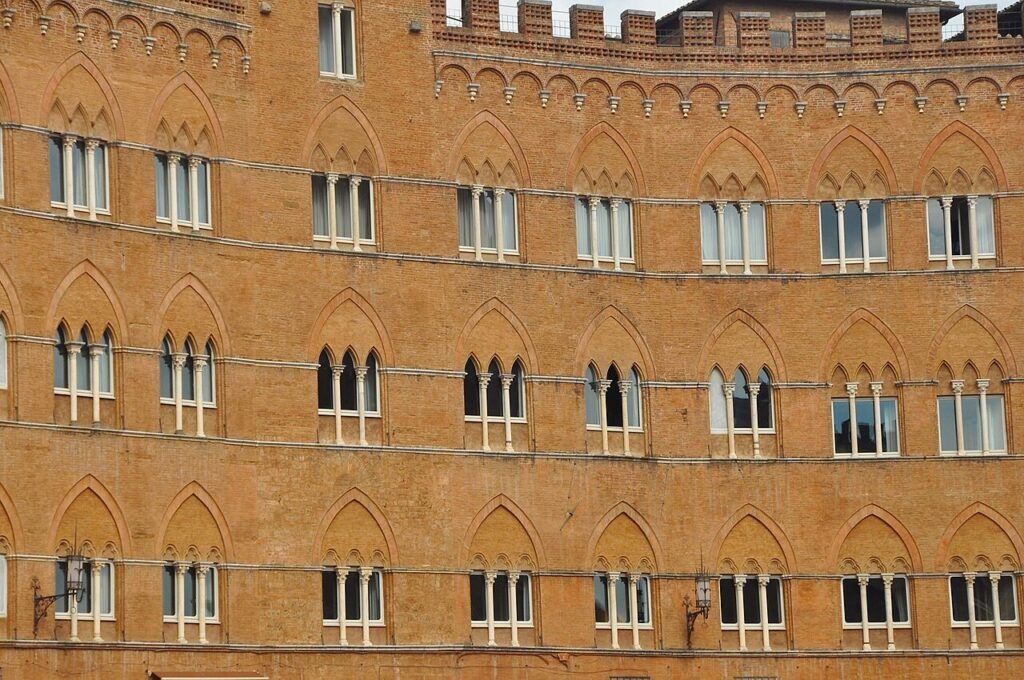
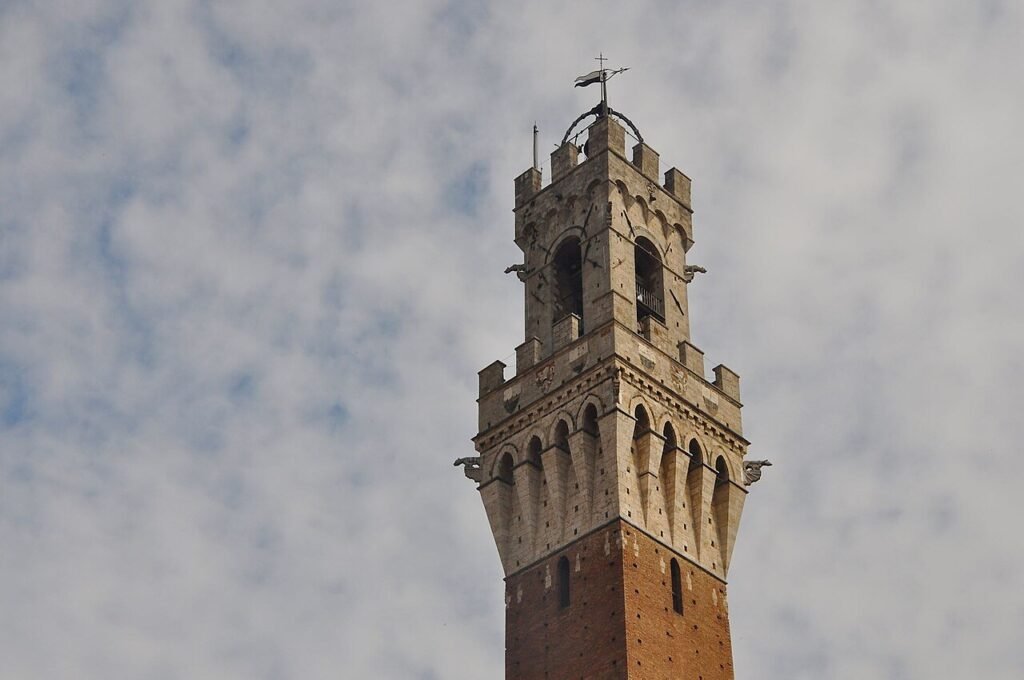
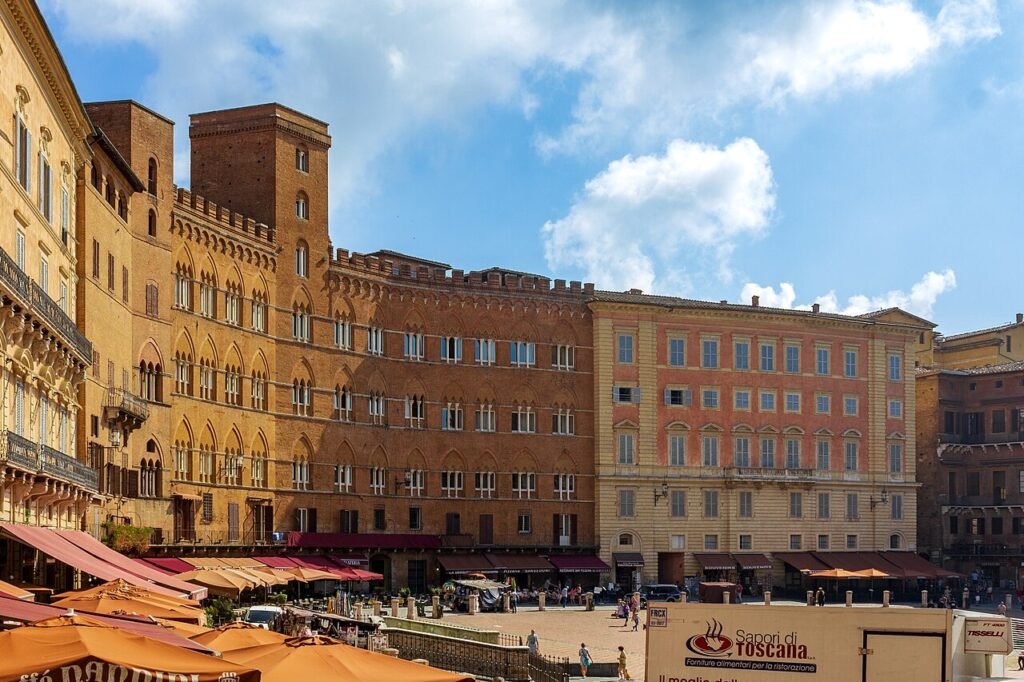
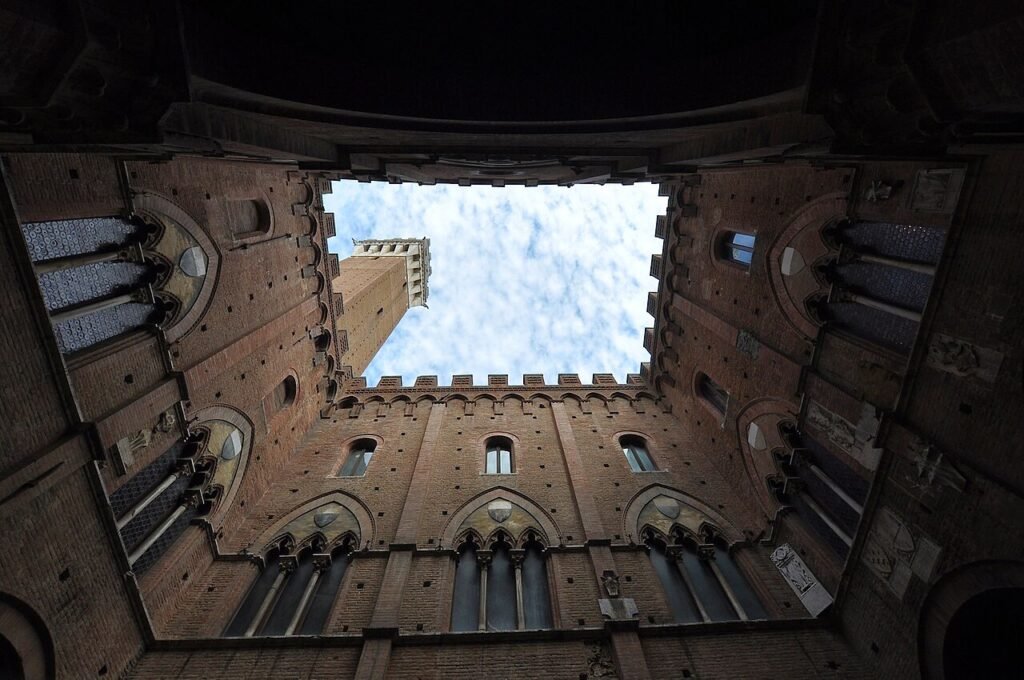
La Piazza del Campo, il Palazzo Pubblico (Lorenzetti), il Duomo e la Libreria Piccolomini, e il Museo dell’Opera (Duccio) (the most precisely Siena zone visit (1.5–2 days): Day 1 (the Piazza del Campo circuit): 9 AM: Palazzo Pubblico + Torre del Mangia (Piazza del Campo 1; open daily 10 AM–7 PM; €10 museum + €20 museum+tower or €13 tower only; the Sala del Mappamondo (Simone Martini Maestà 1315 CE + Guidoriccio da Fogliano fresco 1328/1440 CE (the most contested attribution in 14th-century Italian painting); the Sala dei Nove (Ambrogio Lorenzetti, Allegoria del Buono e Cattivo Governo, 1338–39 CE); the tower ascent: 503 steps; the view: the entire bowl of the Piazza del Campo from 88 m; the 17 contrade flags visible from the tower); 12 PM: the Campo (sit in the Campo for at least 30 min; the acoustic phenomenon: the shell-shape of the Campo creates a natural amphitheatre that concentrates sound at the center; a whisper from the Palazzo Pubblico steps is audible at the opposite fountain (the Campo’s acoustic properties were studied by Raf Pelli and published in JASA 2001)); 2 PM: Duomo complex (the Battistero di San Giovanni (the baptistery under the apse of the Duomo; the marble baptismal font (1417–31 CE): the 6 gilded bronze reliefs by Ghiberti (Baptism of Christ + St John in Prison), Donatello (Feast of Herod — the first Renaissance perspective relief (the Herod banquet table recedes into a painted wall in the background; the first time a sculptor used artificial perspective in bronze)), Jacopo della Quercia (Birth of St John + Annunciation of St John to Zacharias + Presentation of the Baptist’s Head)); the Duomo (the striped nave; the Nicola Pisano pulpit; the Libreria Piccolomini); the Museo dell’Opera (Piazza del Duomo 8; open daily 10:30 AM–7 PM; €8; the Duccio Maestà (the front and back of the Maestà altarpiece removed from the Duomo in 1771 CE; the 43 panels of the predella showing the life of Christ; the Virgin Enthroned panel (148.5 cm × 93 cm): the most analyzed painting of the Trecento; the gold ground technique at its most sophisticated)).
Practical information
- Dove guardare il Palio da Siena e come prenotare: the Piazza del Campo during the Palio (the 2 races: 2 July (Palio di Provenzano: runs 7–8 PM; the trial races (prove) begin on 29 June at 9 AM) + 16 August (Palio dell’Assunta: runs 7–8 PM; the trials begin on 13 August); the access (the Piazza del Campo is divided into 2 sections during the Palio: (1) the free standing area in the center (the “piazza”): free access, very crowded; you must arrive by 2 PM (5 hours before the race) to secure a good position; no toilets, no shade, no food; medical services are inside the barrier; (2) the grandstand (the “palchi”): rented wooden stands on the perimeter of the Campo, built by the contrade for the race; prices range from €300 to €1,200 per seat for a window on a palco; the best palchi (the northeast section between the Torre della Mangia and the Palazzo Pubblico; this section faces the Mossa (starting line) and the Casato (finish line) simultaneously); the contrada tickets (contact the individual contrada associations at least 4 months in advance: the Società Esecutori Pie Disposizioni coordinates ticket access (+39 0577 289601)); the trial races (the 6 trial races (prove) in the 3 days before the Palio are less crowded (the Campo is open but not packed until the final prove on race day); the trial races last 2–3 minutes each and are the best way to see the horses and riders at close range without a 5-hour wait))
Getting there
Autobus Siena Mobilità da Firenze Santa Maria Novella (75 min, €9, ogni 30 min). Trenitalia da Roma via Chiusi (3h, €22). Il centro storico è ZTL; parcheggio Fontebecci o San Francesco (€2/ora) + autobus navetta gratuita. GPS Campo: 43.3188, 11.3307.
Nearby
- San Gimignano — 30 km nord-ovest (UNESCO WHS 1990; 14 torri medievali; Ghirlandaio Ultima Cena 1475; Vernaccia di San Gimignano DOCG; bus Tiemme da Siena 1h €4.30)
- Pienza: Città Ideale del Rinascimento — 45 km sud-est (UNESCO WHS 1996; Rossellino 1459-62; papa Pio II (Piccolomini); Pecorino di Pienza; bus Tiemme da Siena 1h20 €5.10)
Gallery


Sources
- Wikipedia, Siena; Piazza del Campo; Palio di Siena; Palazzo Pubblico, Siena; Libreria Piccolomini, accessed June 2026
- UNESCO, Historic Centre of Siena, WHS reference 717, inscribed 1995
- Borsook, Eve. The Mural Painters of Tuscany. Oxford: Clarendon Press, 1980 (the definitive account of the Lorenzetti and Martini frescoes)
Find it on the map
See this place and what’s around it →📷 Diventa un fotografo di Cultural Heritage Online
Condividi le tue foto dei luoghi: restano pubblicate con la tua firma come autore. Più vengono viste, più ti fai conoscere — e presto un concorso premierà le foto più apprezzate.
Accedi o registrati gratis per aggiungere una foto