

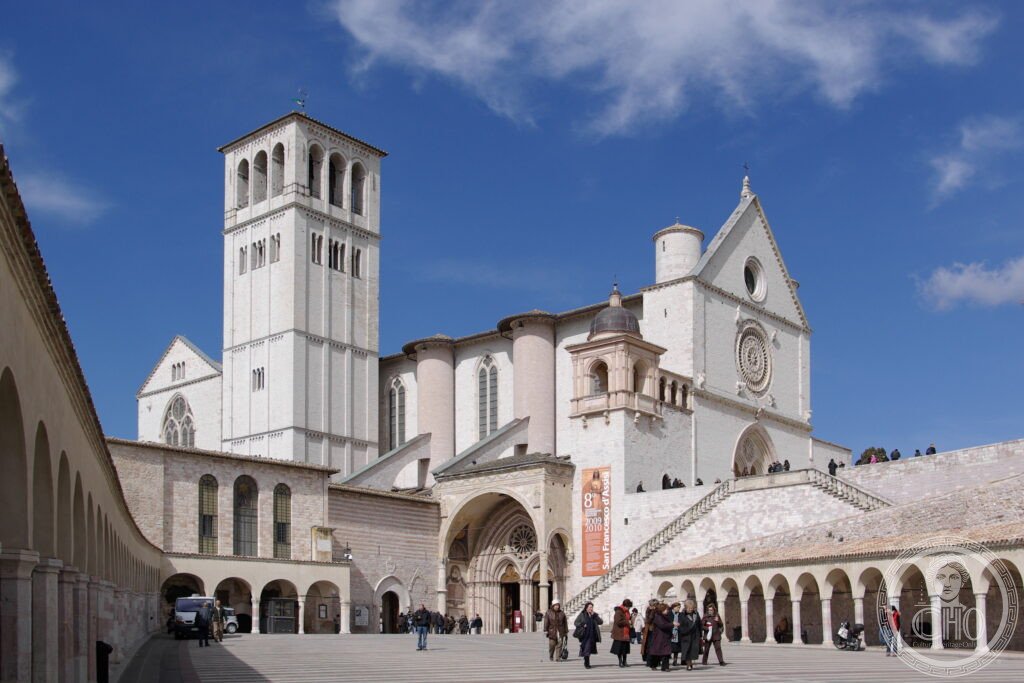
Two churches built one above the other hold the tomb of Francis of Assisi and, in the upper church, Giotto’s cycle of twenty-eight scenes from his life. The paintings mark a turning point in Western art, moving figures away from flat Byzantine convention towards weight, expression and believable space.
At a glance
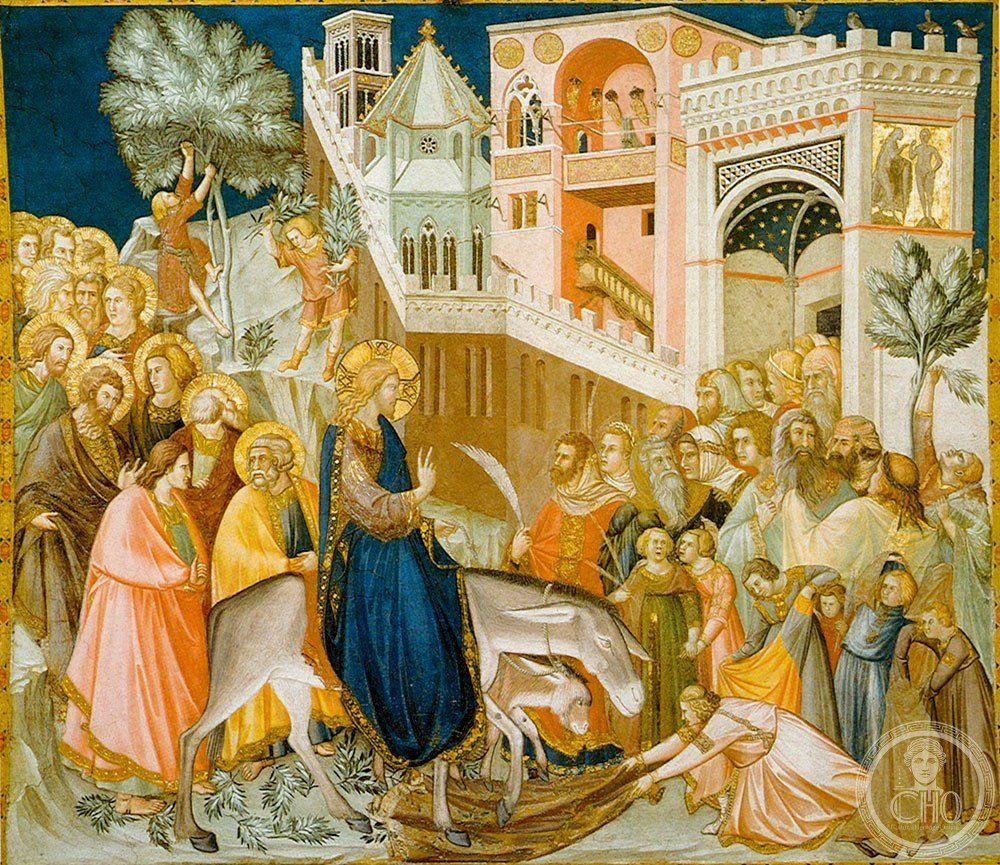
The Basilica di San Francesco is in fact two churches stacked one on the other. The lower church, the older of the two, holds the crypt with the tomb of Francis and chapels frescoed by Simone Martini and Pietro Lorenzetti. The upper church, a Gothic hall with a single nave, carries the celebrated cycle attributed to Giotto di Bondone showing the life of the saint, set beneath two further registers of biblical scenes painted by Cimabue and other Roman and Tuscan masters.
A separate, free-standing bell tower stands to the north of the complex, and to the south the Sacro Convento, the Franciscan friary, forms a fortified platform that gives the basilica its distinctive silhouette above the Umbrian plain.
Key facts
- Location: Via San Francesco, Assisi, Province of Perugia, Umbria.
- Structure: two superimposed churches, the lower completed around 1230 and consecrated by Pope Gregory IX, the upper begun around 1239 and completed around 1253.
- Tomb: the crypt beneath the lower church holds the sarcophagus of Francis, with his four earliest companions, Rufino, Angelo, Masseo and Leo, buried in the corner niches.
- Frescoes: Simone Martini’s scenes of St Martin of Tours and Pietro Lorenzetti’s Passion cycle in the lower church; Giotto’s twenty-eight-scene Legend of St Francis in the upper church nave, painted around 1295–1300 after the Legenda Maior of Bonaventure of Bagnoregio.
- Bell tower: a free-standing campanile dated to 1239, standing apart from the basilica to the north.
- UNESCO status: inscribed as a World Heritage Site in 2000 under reference 990, covering Assisi, the Basilica of San Francesco and other Franciscan sites.
History
Francis, son of the cloth merchant Pietro di Bernardone, renounced his inheritance before the Bishop of Assisi and went on to found a brotherhood of friars, given oral approval by Pope Innocent III in 1209. In 1224, at the hermitage of La Verna in Tuscany, he is recorded as having received the stigmata, the wounds of Christ, which he kept hidden until his death. Gregory IX canonised him in Assisi in July 1228, two years after his death, and the following day laid the first stone of the basilica; construction proceeded under Elias of Cortona. The lower church was consecrated in 1230 and the upper church completed around 1253.
On 26 September 1997 an earthquake struck the region, and the aftershock that followed within hours brought down part of the campanile and the vault of the upper church. Frescoes by Cimabue in the vault, showing angels and St Jerome, fell in thousands of fragments; four people died, including two friars and two journalists who had entered the church to report on the initial damage. The fallen plaster was recovered, catalogued and reassembled over roughly a decade using pattern-matching technology, restoring a substantial part of the original painted surface. The complex was inscribed on the UNESCO World Heritage List in 2000.
What you see
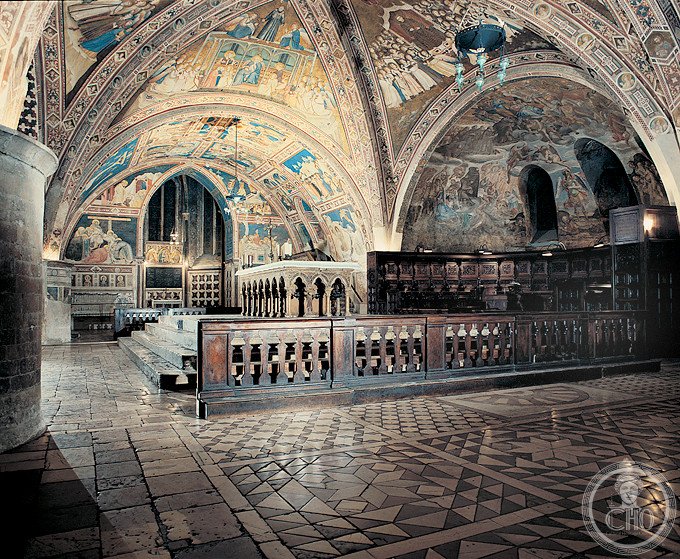
The lower church is entered through a Gothic arched portal on the right side of the facade, fitted with its original wooden door of around 1284. Inside, the first chapel on the left holds Simone Martini’s scenes of the life of St Martin of Tours, painted in a palette using a distinctive Franciscan blue pigment. In the left transept, Pietro Lorenzetti’s Passion cycle, including the Crucifixion and Deposition, is counted among the most expressive religious painting of its century in Italy. A staircase descends from the nave to the crypt, where the stone sarcophagus of Francis rests in a Romanesque setting, with his four companions buried around it.
The upper church is a single Gothic nave of four bays and an apse, its lower walls carrying Giotto’s twenty-eight scenes from the life of Francis, painted above two further registers of Old and New Testament subjects begun by Cimabue and continued by other workshop painters. The cycle is noted for its attempts at architectural depth, individualised facial expression and figures that appear to carry physical weight, qualities largely absent from earlier Western painting.
Shoulders and knees must be covered throughout the basilica; coverings are available at the entrance for visitors who need them, and the rule is applied without exception.
Practical information
- Dress code: covered shoulders and knees are required for all visitors; friars at the entrance provide coverings if needed.
- Entrance: the lower church is reached through the portal on the right side of the facade at piazza level; the upper church is reached separately.
- Opening times and access: these vary and are best checked directly with the basilica or the Sacro Convento before visiting.
Getting there
The basilica stands on Via San Francesco in Assisi, in the Province of Perugia, Umbria. It occupies the western edge of the town, with the Sacro Convento forming its fortified southern flank above the plain below.
Nearby
- Sacro Convento — the Franciscan friary adjoining the basilica, its crenellated walls forming the fortress-like base of the complex.
- La Verna — a mountain hermitage in Tuscany, the site where Francis is said to have received the stigmata in 1224.
Sources
- UNESCO World Heritage Centre (reference 990)
- Legenda Maior of Bonaventure of Bagnoregio
- Giorgio Vasari (1550)
- Heinrich Wölfflin (1899)
- Bellosi and Zanardi technical analysis (c.1975)
Gallery
Find it on the map
See this place and what’s around it →📷 Become a Cultural Heritage Online photographer
Share your photos of places: they stay published under your name as the author. The more they're seen, the more you get noticed — and soon a contest will reward the most appreciated photos.
Log in or sign up free to add a photoIs this page about you?
This page is read by travellers and heritage enthusiasts who find it on Google. Tell us how you are connected to this place and we will take it from there.