
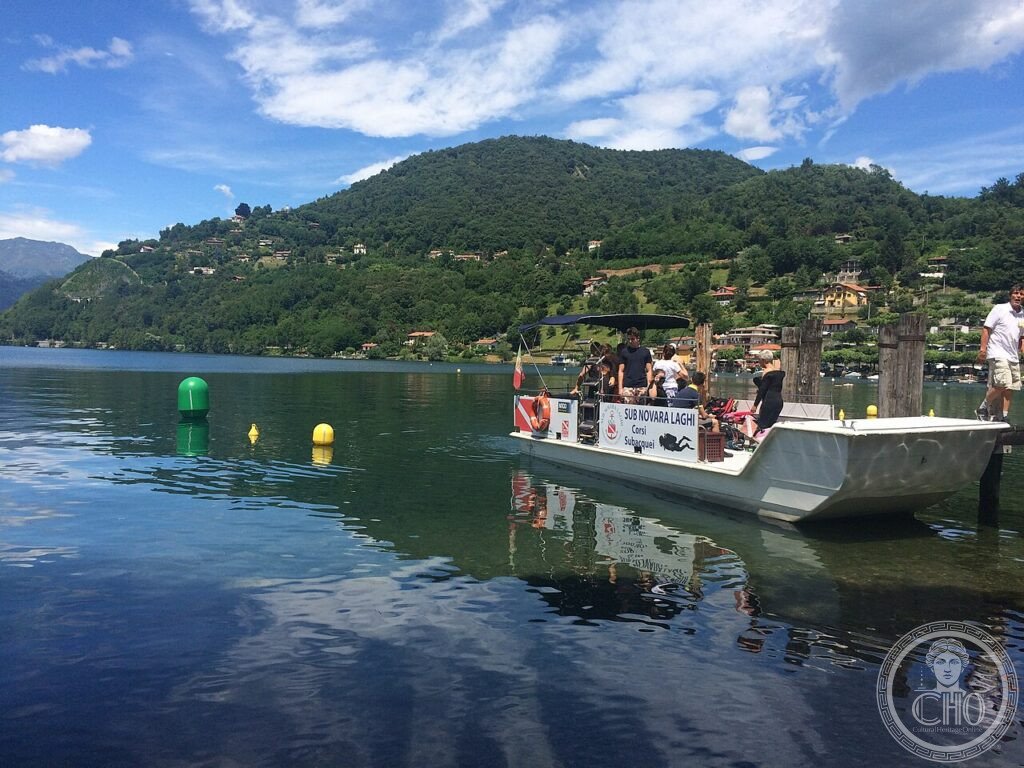
Twenty chapels climb a wooded hill above Lake Orta, each holding a life-size terracotta tableau from the life of St Francis of Assisi. It is the only one of Italy’s nine Sacri Monti built around a saint rather than the life of Christ, and the only one with a lake and an island as its backdrop.
At a glance
The Sacro Monte di Orta forms part of the Sacri Monti of Piedmont and Lombardy, a serial group of nine sacred mountains built across northern Italy between 1491 and the mid-18th century as a devotional response to the Protestant Reformation, offering pilgrims who could not reach Jerusalem a physical, walkable version of the holy places. Orta is the only one of the nine dedicated entirely to a saint: the Franciscan friars of the Osservanza founded it in 1591 to tell the life of St Francis of Assisi across twenty chapels.
The hill stands directly above Lake Orta, the westernmost and least known of the Lombard lakes, entirely contained within Piemonte. Below it sits the Isola di San Giulio, home to a Romanesque basilica with roots going back to the 4th century and to a working Benedictine convent.
Key facts
- Type: devotional complex of 20 chapels on a wooded hill
- Theme: the life of St Francis of Assisi, told across the 20 major episodes of Bonaventure of Bagnoregio’s Legenda Maior
- Built: 1591–1770, founded by the Franciscan Osservanza
- Contents: 376 life-size painted terracotta figures and frescoed chapel interiors
- Status: part of the Sacri Monti of Piedmont and Lombardy, inscribed on the UNESCO World Heritage List in 2003 (reference 1068, a nine-site serial inscription)
- Setting: overlooking Lake Orta and the Isola di San Giulio
History
The Sacro Monte was founded in 1591 by the Franciscan Observant friar Girolamo Cuticchio, who chose the hill above the lake despite initial resistance from the Bishop of Novara, who feared it would draw donations away from existing pilgrimage routes. The bishop’s approval came on condition that the friars also build a permanent friary at the foot of the hill.
Construction of the twenty chapels stretched from 1591 to 1770, funded not by a single patron but by pilgrimage donations and by noble families, including the Borromeo, Visconti and Fagnano, who each sponsored individual chapels. The gaps in the timeline reflect the pace of patronage rather than any difficulty in building.
The Napoleonic administration suppressed the Franciscan friary at the base of the hill between 1799 and roughly 1817, leaving the chapels without resident custodians for about two decades before the friars returned. The Sacro Monte di Orta was inscribed on the UNESCO World Heritage List in 2003 as part of the wider Sacri Monti series.
What you see
The walk up from Piazza Motta follows the lake path to Via al Sacro Monte before climbing through the twenty chapels in narrative order, each one hidden from the last so that every scene appears as a sudden discovery at a bend in the path. The sequence runs from Francis’s birth in Assisi to his canonisation by Pope Gregory IX. Chapel 5, showing Francis renouncing his father’s wealth before the Bishop of Assisi, is generally considered the finest: its terracotta figures, by the Milanese sculptor Cristoforo Prestinari, are set against frescoes by Melchiorre d’Enrico in a mock Romanesque episcopal hall, and its bishop’s face is cited in the literature as the most naturalistic in the entire Sacri Monti series. At the summit stands the Franciscan friary church, frescoed by Rinaldo Abeldis, with a terrace looking out over the lake and the island.
Below the hill, Orta San Giulio’s Piazza Motta opens onto the water on three sides, framed by the frescoed loggia of the 16th-century Palazzo della Comunità and by the 17th-century Palazzo dei Medici d’Orta. A short boat crossing reaches the Isola di San Giulio, where the Romanesque basilica houses a black marble pulpit carved with the four evangelists, and the resident Benedictine nuns sell jams, liqueurs and local olive oil from the monastery.
Practical information
- Access to the chapels: free, open during daytime hours that vary by season; current times are best checked with the local tourist office or the Sacro Monte’s own visitor information.
- Getting to the island: a short motorboat crossing runs from Piazza Motta; check locally for current timetables and fares.
- Basilica di San Giulio: open to visitors on a reduced schedule, with Sunday morning Mass welcoming outside visitors; confirm times before travelling.
- Walking time: the ascent from the lakeside to the chapels takes roughly twenty minutes on foot.
Getting there
Orta San Giulio is reached from Milan by rail to Novara followed by a local bus to the village, or by car via the A8/A26 motorway leaving at the Borgomanero exit. From Stresa on Lake Maggiore it can also be reached by road along the SP299. Current timetables and fares for train and bus connections are best checked directly with the operators.
Nearby
- Isola di San Giulio — a short boat ride from Orta’s lakefront, with its Romanesque basilica and Benedictine convent.
- Orta San Giulio village — at the foot of the Sacro Monte, centred on the lakeside Piazza Motta.
- Isola Bella and the Borromean Islands — on Lake Maggiore near Stresa, with the Borromeo family’s Baroque palace and terraced garden.
Sources
- UNESCO World Heritage Centre
- Legenda Maior, Bonaventure of Bagnoregio
Find it on the map
See this place and what’s around it →📷 Become a Cultural Heritage Online photographer
Share your photos of places: they stay published under your name as the author. The more they're seen, the more you get noticed — and soon a contest will reward the most appreciated photos.
Log in or sign up free to add a photo