
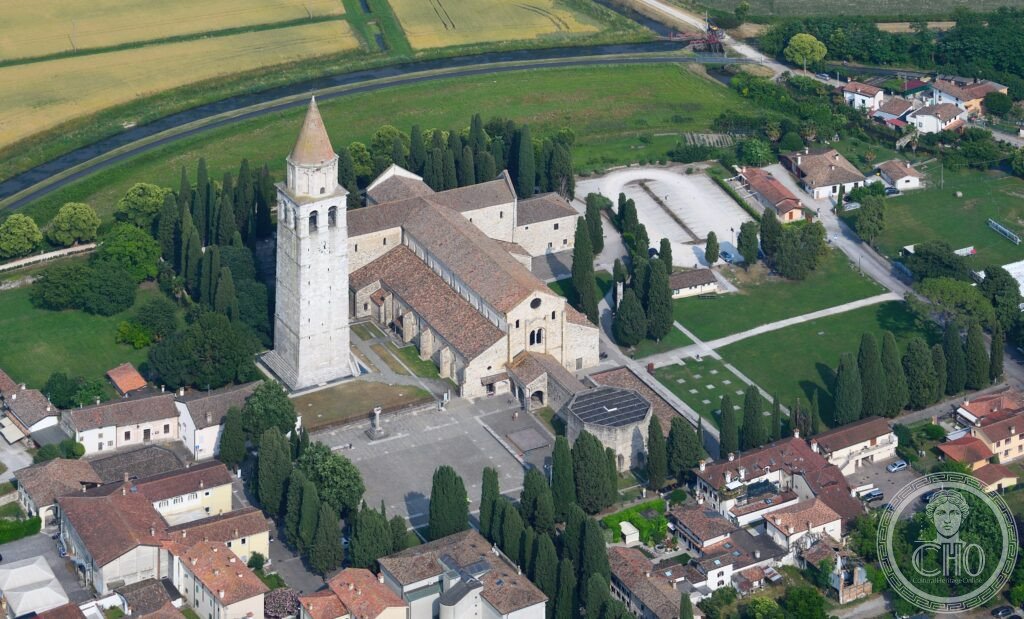
Beneath a Romanesque basilica in a quiet town near Trieste lies the largest and earliest paleochristian floor mosaic in existence, sealed by earth for centuries after Attila’s sack and now walked over on a raised timber path.
At a glance
Aquileia was founded as a Roman colony in 181 BCE as a forward base against Gaulish incursions in the Po plain. It grew into the capital of the Regio X Venetia et Histria and, by the 1st and 2nd centuries CE, into one of the largest cities of the Western Roman Empire, alongside Rome, Carthage and Lugdunum. It served as the commercial hub of the Amber Road, the overland route bringing Baltic amber to the Adriatic, and its archaeological museum holds the largest collection of Roman amber objects in the world.
Its Christian history is equally significant. The Bishop of Aquileia claimed apostolic foundation through Mark the Evangelist, a tradition not supported by historical sources but politically important at the time. Aquileia hosted the Council of Aquileia in 381 CE, chaired by Ambrose of Milan, which condemned Arian bishops from the Danube region. The Patriarchate of Aquileia held jurisdiction from the Adriatic to the Danube, and its authority was contested for centuries by a rival patriarchate based at Grado.
Key facts
- Founded: 181 BCE as a Roman colony
- Population peak: around 100,000 by 100 CE, one of the four largest cities of the Western Roman Empire
- Mosaic floor: over 700 square metres of original 4th-century tessellated floor, in two main phases dated to around 308–319 CE and 388–407 CE
- Bell tower: built in the 11th century, 73 metres high, the tallest surviving Romanesque bell tower in Italy
- UNESCO status: inscribed as a World Heritage Site in 1998, reference 825
History
The Roman colony grew from a military outpost into one of the empire’s major cities, served by a river port on the Natissa linked to the Adriatic by canals, and by a monumental forum whose north colonnade still stands in the excavated piazza. Its wealth relied heavily on the amber trade, with raw material worked locally by craftsmen and re-exported as finished objects.
In 452 CE Attila the Hun sacked Aquileia, an event described as the most complete destruction of a Roman city in Italian history. Much of the population fled to the lagoon islands, a movement that would eventually lead to the founding of Venice. The city was partially rebuilt but never regained its former size.
The Patriarchate that followed moved its seat first to Grado in 568 CE and back to Aquileia in 698 CE. Patriarch Poppo built the present Romanesque basilica on the ruins of the 4th-century church between 1019 and 1042 CE, and the bell tower was raised in 1031 CE. Pope Benedict XIV abolished the Patriarchate in 1751, dividing the territory between the Archbishoprics of Udine and Gorizia. Aquileia was inscribed as a UNESCO World Heritage Site in 1998, under reference 825.
What you see
Inside the basilica, visitors walk the nave on a raised wooden walkway set above the original mosaic floor, protecting the tesserae from foot traffic. The floor’s two phases include the Theodore mosaic, with its Jonah cycle showing the prophet cast into the sea, swallowed and later resting under a gourd vine, and the figure known as “Victor with Rooster,” read as a symbol of Christ’s triumph over death. Ten named donor portraits survive in mosaic form, among the earliest known instances of named donors in Christian art. The later Chromatius mosaic added vine scrolls, birds and marine scenes in the southern hall. The floor was buried under debris after the Hunnic sack of 452 CE and was not excavated until 1909–1912, meaning the surface had never been walked on or relaid.
Beneath the high altar, the crypt holds early 14th-century frescoes depicting the lives of Christ, the Virgin and the local martyred bishops Hermagoras and Fortunatus, along with four column shafts reused from the earlier Theodore-era basilica.
Climbing the bell tower means 105 steps with no lift. From the top, the Adriatic coast is visible in clear weather, along with the Carso plateau to the east, the town’s fortified walls below, and the excavated Roman forum columns to the north. A short walk from the basilica, the Museo Archeologico Nazionale houses the amber collection, including several thousand objects from the 1st to 4th centuries CE, among them a finely carved amber head of Augustus.
Practical information
- Access: the basilica and crypt are open to visitors; a guided flashlight tour of the mosaic can be arranged at the ticket desk to reveal the relief texture of the tesserae. Check the official site for current hours and admission.
- Museum: the Museo Archeologico Nazionale is a short walk from the basilica; check opening times separately.
- Bell tower: reached by 105 steps with no lift.
Getting there
Aquileia has no direct rail station; the nearest is Cervignano del Friuli, around 8 kilometres away, reachable by Trenitalia from Trieste or Venice. A SAF bus connects Cervignano station to Aquileia in around 15 minutes, or the town can be reached by car via the A4 motorway, exiting at Palmanova and following the SR352 for the final stretch.
Nearby
- Grado — around 12 kilometres south, the destination of Aquileia’s refugees after the 452 CE sack, now a beach resort with the 6th-century Basilica di Sant’Eufemia and its own fine mosaic floor, and the Basilica di Santa Maria delle Grazie with a 5th-century apse; reachable by SAF bus.
- Cividale del Friuli — around 35 kilometres north, a UNESCO World Heritage Site inscribed in 2011 for its Lombard heritage, including the 8th-century Tempietto Longobardo; reachable by train from Udine.
- Trieste — around 40 kilometres east, the largest city in Friuli-Venezia Giulia, home to the Risiera di San Sabba, the only Nazi-era death camp in Italy, now a memorial site.
Sources
- UNESCO
Find it on the map
See this place and what’s around it →📷 Become a Cultural Heritage Online photographer
Share your photos of places: they stay published under your name as the author. The more they're seen, the more you get noticed — and soon a contest will reward the most appreciated photos.
Log in or sign up free to add a photoDo you manage this place?
This page is read by travellers and heritage enthusiasts who find it on Google. Keep it accurate — and make it work for you. Free for non-profit heritage institutions.