
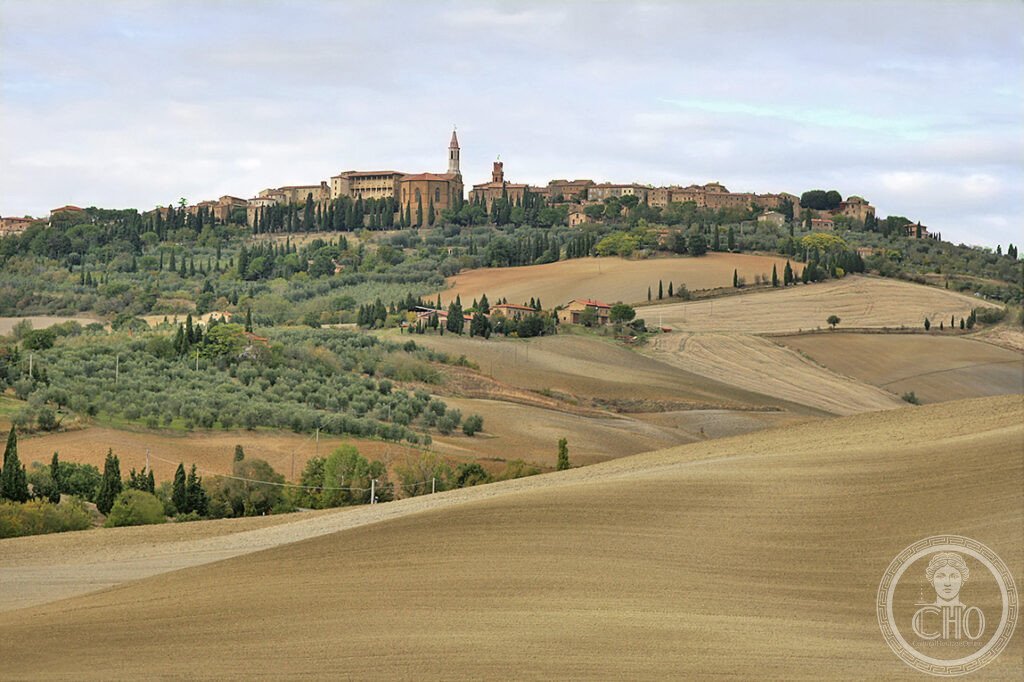
In three years a Sienese hill village called Corsignano became Pienza, rebuilt for Pope Pius II as a working demonstration of Alberti’s ideal Renaissance city. Its cathedral, papal palace and trapezoidal square still stand exactly as Bernardo Rossellino left them, making Pienza the most complete surviving example of humanist urban planning in Europe.
At a glance
Pienza owes its existence to one man’s biography. Enea Silvio Piccolomini, born in Corsignano in 1405, rose from humanist scholar and diplomat to poet laureate, bishop, cardinal and finally Pope Pius II. Once elected, he commissioned the architect Bernardo Rossellino to rebuild his birthplace as a working expression of Leon Battista Alberti’s treatise De Re Aedificatoria, with its principles of an orthogonal street plan, proportioned buildings and monumental civic space.
The building campaign ran from 1459 to 1462 and produced the Duomo, the Palazzo Piccolomini, the Palazzo Borgia and the Palazzo Ammannati in the time Pius had specified. The cost far exceeded the original estimate; Pius himself wrote in his autobiography, the Commentarii, that he was angry at the overrun but said nothing because the buildings were beautiful.
Key facts
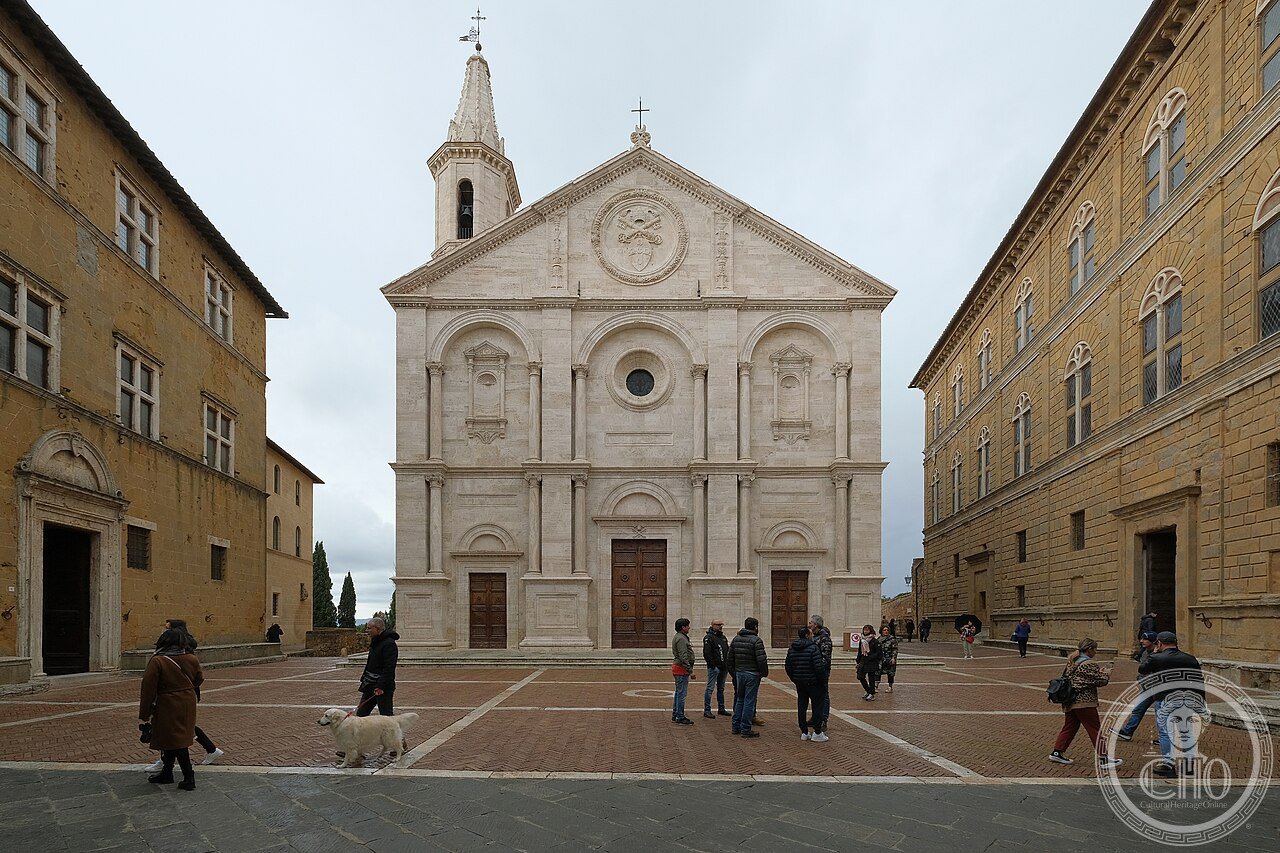
- Duomo di Pienza: built 1459–1462 to Rossellino’s design, a hall church with nave and side aisles of equal height, a form Pius admired from his travels in Germany and Austria.
- South wall lean: the cathedral’s south wall, built on the steep drop into the Val d’Orcia, began tilting outward within decades of completion and has been buttressed since the 17th century.
- Stained glass: the original 1462 Sienese glass survives in the lunettes above the Duomo’s large Gothic windows.
- Pecorino di Pienza: the local sheep’s milk cheese, sold fresh, semi-aged or aged, from shops along the Via Rossellino.
- Location: Piazza Pio II, at approximately 43.0769° N, 11.6778° E.
History
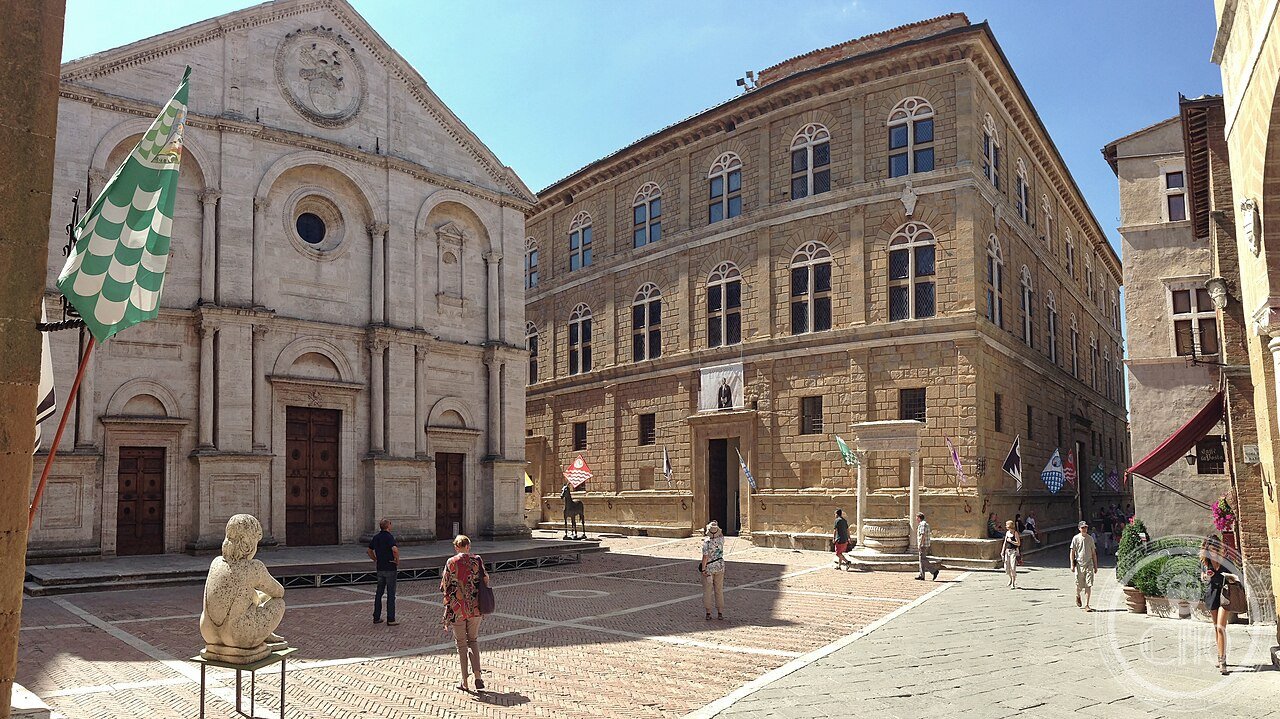
Before Rossellino’s arrival, Corsignano was a modest hilltop settlement dating to the Lombard period, with irregular streets, a Palazzo del Podestà and the Romanesque Pieve di Corsignano, where Enea Silvio Piccolomini was baptised in 1405. That church still stands outside the walls and is reckoned the best-preserved Romanesque building in the Val d’Orcia. Rossellino’s three-year campaign reshaped the centre around a new axis, the Via Rossellino, leading to a trapezoidal Piazza Pio II framed by the Duomo, the Palazzo Piccolomini, the Palazzo Borgia and the Palazzo Ammannati. In 1462 Pius II issued a papal bull renaming Corsignano as Pienza, raising it to a bishopric and forbidding any alteration of the new buildings on pain of excommunication, an early instance of formal heritage protection. The town was inscribed on the UNESCO World Heritage List in 1996.What you see
The Piazza Pio II is not a true rectangle: its sides diverge slightly and the square widens towards the cathedral, a device that exaggerates the perspective when approached along the Via Rossellino. Inside the Duomo, the hall-church interior is lit by large Gothic windows and lined with five altarpieces commissioned in 1461 from five different Sienese painters, each instructed to work to the same size and gold ground so the two aisles read as a single unified scheme.
The Palazzo Piccolomini, opposite the cathedral, keeps its piano nobile and a hanging garden on a loggia that opens onto the Val d’Orcia, with a well-head in the courtyard carved with the Piccolomini crescent moon. Along the Via Rossellino itself, cheese shops selling Pecorino di Pienza begin at the town gate and continue towards the piazza.
Practical information
- Visiting the Duomo and piazza: both are freely accessible; the Palazzo Piccolomini’s interior rooms are visited on a paid tour, with current arrangements and prices published by the palace itself.
- Getting around: the historic centre is compact and best explored on foot from Piazza Pio II.
- Local produce: Pecorino di Pienza can be bought and tasted at shops along the Via Rossellino.
Getting there
Pienza sits in the Val d’Orcia south-east of Siena. By road, the route runs south from Siena on the SS2 Via Cassia to San Quirico d’Orcia, then east on the SP146 into Pienza. Public transport links from Siena are limited and seasonal; travellers relying on buses should check current timetables with the regional operator before setting out.
Nearby
- Pieve di Corsignano — just outside the walls, the Romanesque church where Pius II was baptised.
- San Quirico d’Orcia — a short drive along the SP146, on the route from Siena.
- Montalcino — reachable within the same Val d’Orcia touring circuit.
Sources
- UNESCO World Heritage List
- Pius II, Commentarii
- Leon Battista Alberti, De Re Aedificatoria
- Papal bull “Pius papa Secundus”
Gallery
Find it on the map
See this place and what’s around it →📷 Become a Cultural Heritage Online photographer
Share your photos of places: they stay published under your name as the author. The more they're seen, the more you get noticed — and soon a contest will reward the most appreciated photos.
Log in or sign up free to add a photo