
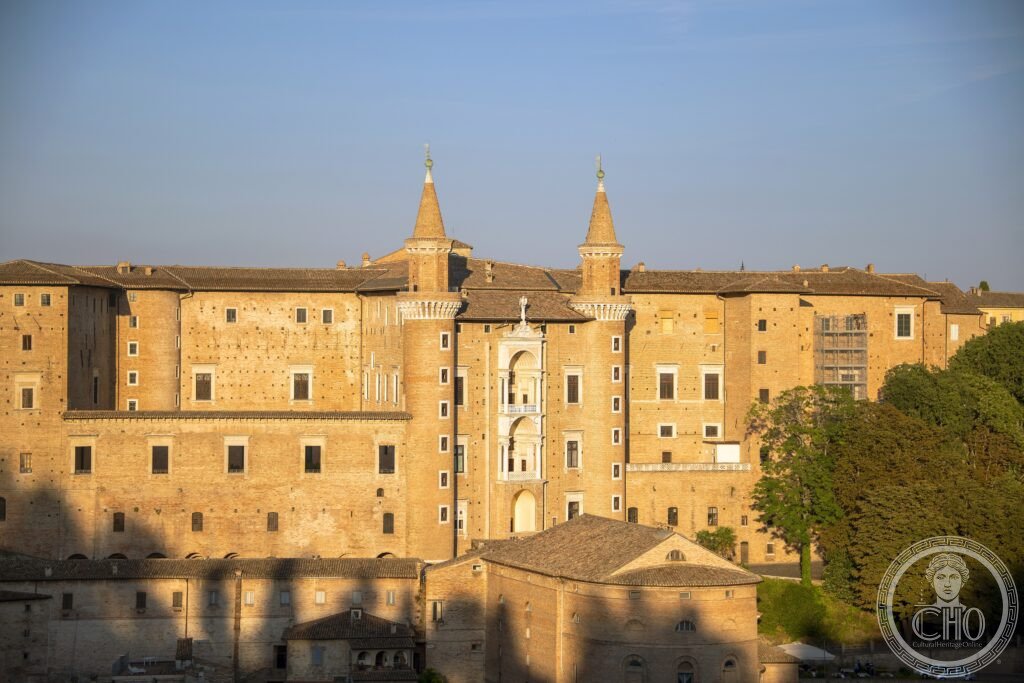
Urbino: Centro Storico e Palazzo Ducale
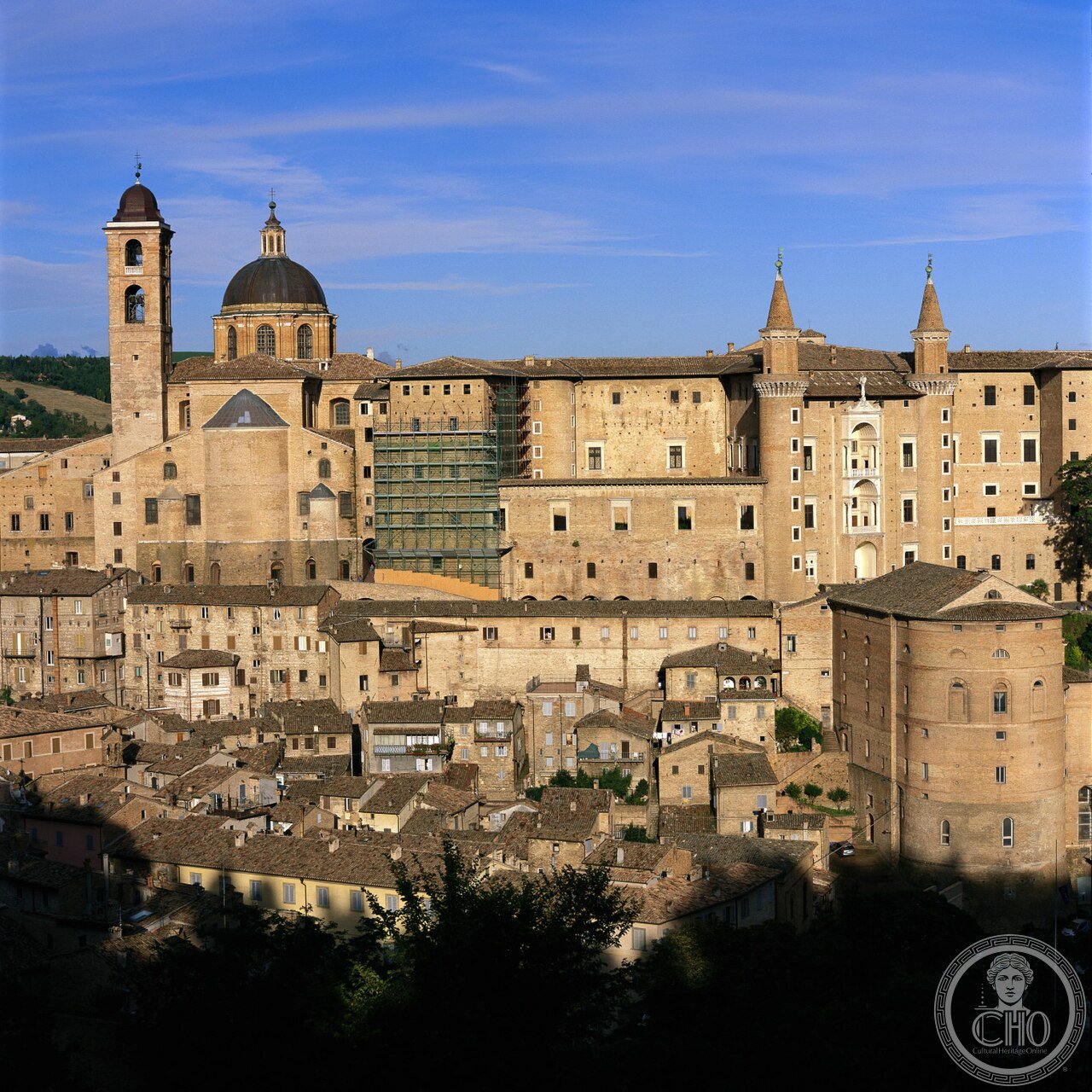
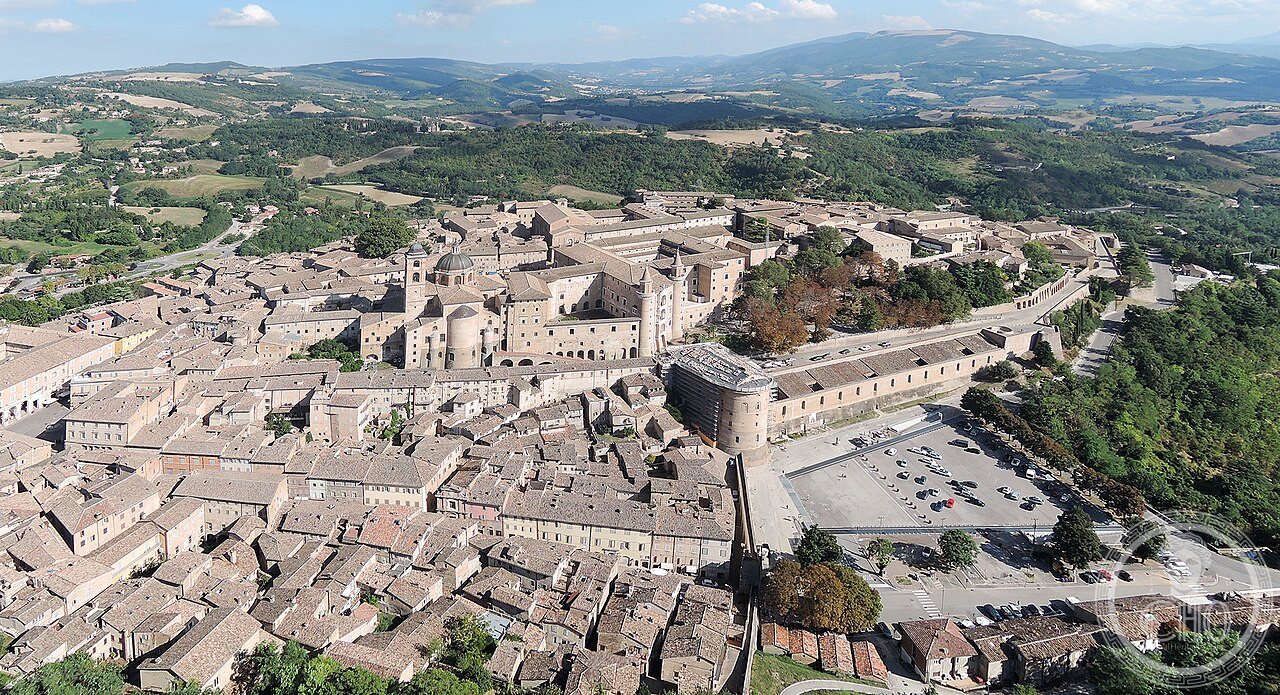
Urbino (UNESCO 1998) is the most complete surviving example of a 15th-century Italian Renaissance court city — built by Federico da Montefeltro (1422–1482 CE) on a hilltop in the Marche, where the Palazzo Ducale (Luciano Laurana, from 1466 CE), the Studiolo (the most intellectually ambitious small room in Italian Renaissance art), and the birthplace of Raphael (1483 CE) together document the precise moment when humanist learning, mercenary warfare, and artistic patronage fused into the Renaissance ideal of the “perfect prince.”
At a glance
Urbino centro storico (the most precisely Urbino zone Urbino Marche Italy 43.7262 N 12.6369 E UNESCO WHS 1998 reference 828: the Federico da Montefeltro court (the specific biography: Federico da Montefeltro (born 1422 CE; Count of Urbino 1444 CE; Duke of Urbino 1474 CE; died 1482 CE); the most successful condottiere of the 15th century CE (a condottiere is a mercenary general who contracts his forces to city-states; Federico’s company fought for Florence, Milan, the Papacy, and Naples; his specific fee at his peak career: approximately 80,000 ducats per year — the equivalent of approximately 2,500 kg of gold per year; the specific investment of this income: the Palazzo Ducale construction and the library); the library (Federico’s library at the time of his death (1482 CE) contained approximately 1,000 manuscripts — the largest private humanist library in Italy at that date; Vespasiano da Bisticci, the Florentine bookseller, documented that Federico employed 30–40 scribes simultaneously to copy texts from originals borrowed from the Vatican and other collections; Federico explicitly refused to have printed books in his library — all manuscripts; the library was acquired by the Vatican in 1657 CE and is now the Biblioteca Apostolica Vaticana (the Urbinate codices))); the Renaissance ideal (Baldassare Castiglione (1478–1529 CE) wrote Il Cortegiano (The Book of the Courtier; 1528 CE; published 1528 CE; composed as a dialogue set in the Urbino court of 1506 CE; the book describes the ideal Renaissance gentleman: skilled in arms, eloquent in speech, accomplished in music and art, graceful in movement, witty in conversation; the specific influence: the most widely read Italian prose work of the 16th century CE; 57 Italian editions by 1600 CE; translated into English (Thomas Hoby, 1561 CE), French, Spanish, Latin, German)).
Key facts
- The Studiolo of Federico da Montefeltro and why its intarsia panels are the most technically ambitious decorative programme of the Italian Renaissance: the Studiolo (the private study of Federico da Montefeltro; located in the Palazzo Ducale (1st floor; north-west tower room); approximately 3.6 m × 3.6 m floor area; 3.6 m ceiling height); the intarsia (the wall panels (approximately 2 m high × 2.4 m wide on all 4 walls above dado level) are covered in intarsia: marquetry of wood in different colors and grains cut and assembled to create the illusion of three-dimensional objects in perspective (without any painting); the subjects of the intarsia panels: books open on a lectern (the books appear to be open to a readable page, with visible text and illumination); weapons and armor on a shelf (a mace, a helmet, a sword hilt); musical instruments (a lute, a cittern, a pipe organ keyboard); scientific instruments (an astrolabe, an armillary sphere, a quadrant; mathematical treatises); the combined iconographic programme: the attributes of the perfect Renaissance prince (arms for the condottiere, books for the humanist, music for the cultivated gentleman, science for the rational administrator)); the Juste de Gand portraits (the 28 “Famous Men” (Illustri Uomini) painted portrait series: 28 standing half-length portraits of famous men of antiquity and the Renaissance (Moses, Solomon, Homer, Aristotle, Plato, Cicero, etc.) painted on panels installed above the Studiolo intarsia; painter: Juste de Gand (Joos van Wassenhove; c.1460–c.1480 CE; a Flemish painter who came to the Urbino court from Ghent); the collaboration: some portraits are attributed to Pedro Berruguete (a Spanish painter also at the court (c.1477–1482 CE)); 14 of the original 28 panels are in the Galleria Nazionale delle Marche in the Palazzo Ducale; 14 are in the Louvre)
- GPS (Palazzo Ducale): 43.7262° N, 12.6369° E
History
From the Lombard settlement to the Montefeltro County to the Della Rovere Duchy to the Papal annexation (the most precisely Urbino zone history: the medieval period (Urbino appears in medieval sources from the 9th century CE as a Lombard settlement (Urbs Metaurensis / Urbinum); the County of Urbino was created in the 10th century CE; the Montefeltro family acquired the county in 1213 CE)); the Montefeltro period (1213–1508 CE: the Montefeltro family held the county (and from 1474 CE the duchy) for 295 years; the peak period: Federico da Montefeltro (1444–1482 CE); the 2nd peak: Guidobaldo da Montefeltro (1482–1508 CE; Federico’s son; less militarily successful but equally intellectually ambitious; Baldassare Castiglione spent 12 years (1504–1516 CE) at the Guidobaldo court and set the Cortegiano dialogues in this period)); the Della Rovere period (1508–1631 CE: Guidobaldo died without heir; the duchy passed to Francesco Maria I della Rovere (his nephew; a della Rovere cardinal appointed him; the della Rovere held the duchy for 123 years)); the Papal annexation (1631 CE: Francesco Maria II della Rovere (the last Duke of Urbino) ceded the duchy to the Papacy at his death as the last act of his life; Urbino became a Legation of the Papal States; the academy (the Università degli Studi di Urbino, founded 1506 CE, the oldest university in the Marche region) survived the annexation and remains the dominant institution in the city)); 1998 CE UNESCO inscription reference 828.
What you see
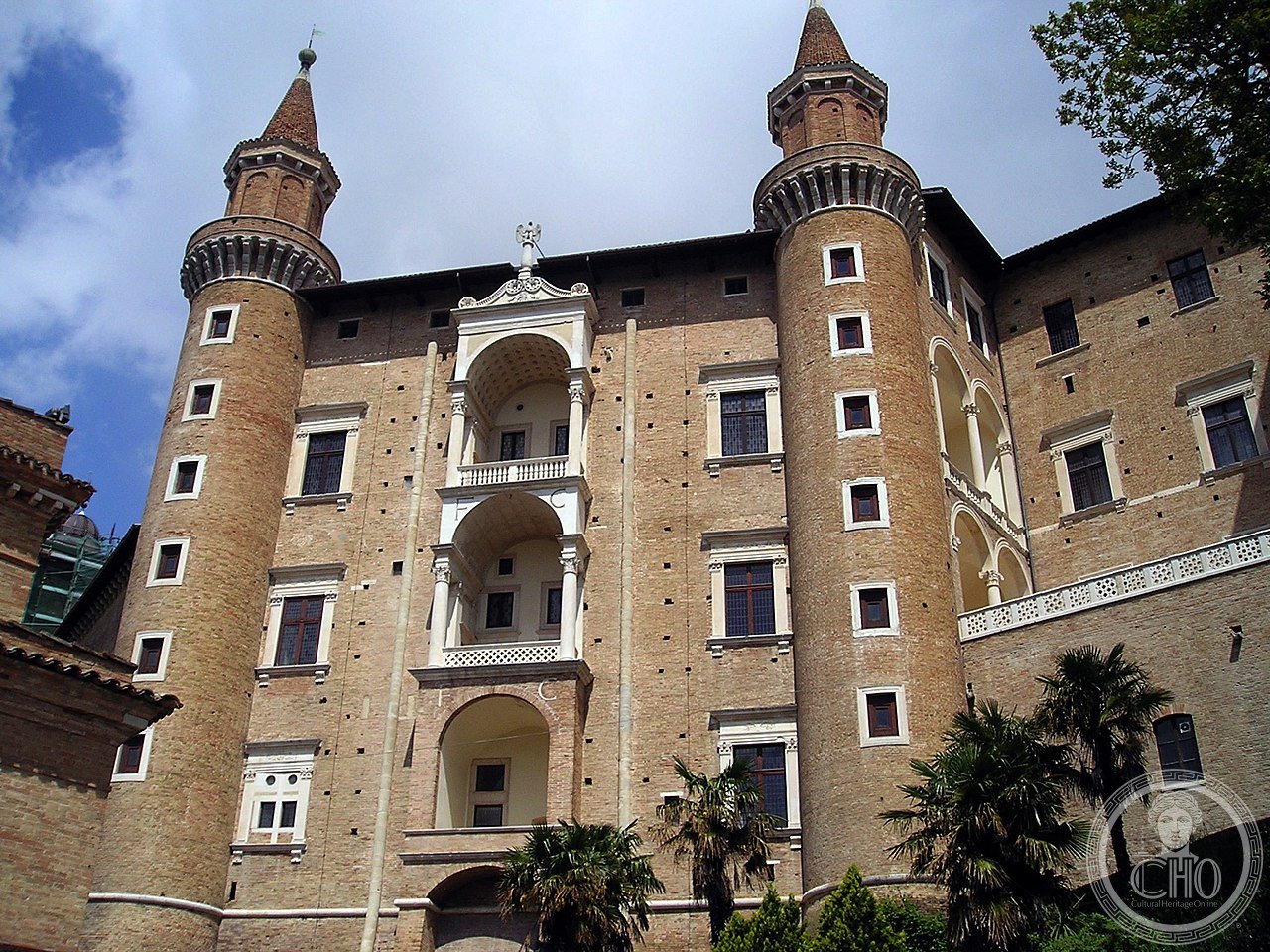
Palazzo Ducale, Studiolo, Piero della Francesca’s Flagellation, and the Casa di Raffaello (the most precisely Urbino zone visit (full day)): 1) Galleria Nazionale delle Marche in the Palazzo Ducale (Piazza Duca Federico; open Tue–Sun 8:30 AM–7:30 PM (summer); €13; the essential works: the Studiolo (the permanent installation of the intarsia panels with the 14 Famous Men portraits; accessible from the 1st floor of the palace at the end of the Sala degli Angeli; approximately 20 min; the low-level ambient light is intentional — the intarsia trompe-l’œil works best in reduced light; the Flagellation of Christ (Piero della Francesca; c.1455–1465 CE; 59 cm × 81 cm; oil-tempera on panel; in Room 7; the smallest and most discussed work in the Galleria; the composition: Christ being flagellated is in the background left, in a precisely measured architectural space; in the foreground right, 3 figures talk in a group (no direct relationship between the 2 scene sets); the specific technical achievement: the perspective construction (verified by mathematical analysis in the 20th century CE) is perfectly consistent throughout the 2 distinct spaces of the composition; the 3 foreground figures remain unidentified)); the Torricini facade (the east facade between the 2 cylindrical towers; best viewed from the gardens below the palace (the Rampa delle Vigne garden; free access)); 2) Casa di Raffaello (Via Raffaello 57; open daily; €4; the room in which Raphael was born (April 6, 1483 CE); the fresco of the Madonna attributed to Raphael’s father Giovanni Santi (or possibly the young Raphael himself); the Raphael portraits of his parents).
Practical information
- Getting to Urbino (no direct train) and combining with the Piero della Francesca trail: transport (Urbino has no railway station; the closest rail connection is Pesaro (35 km east; Frecciarossa from Bologna 1h30, €20; from Rimini 30 min €7); from Pesaro: Adriabus regional bus to Urbino (50 min; 4–6 buses per day; check adriabus.eu); or taxi from Pesaro station (€40); or car rental); the Piero della Francesca trail (the “Itinerario Pierfrancescano”: the 8 locations where Piero della Francesca’s main works are preserved in their original or near-original setting; Urbino (the Flagellation); Sansepolcro (Piero’s birthplace; the Museo Civico with the Resurrection fresco (1450–1463 CE) — famously described by Aldous Huxley in 1925 as “the greatest painting in the world”)); Arezzo (the Legend of the True Cross fresco cycle in San Francesco (1448–1466 CE); the largest and most complex fresco cycle by Piero); Monterchi (the Madonna del Parto (1459 CE); a pregnant Virgin in a tent held open by 2 angels)); the Urbino festival circuit (the Urbino International Music Courses (Corsi Internazionali di Musica di Urbino): July–August annually; chamber music concerts in the Palazzo Ducale courtyards; the Mercatello sul Metauro (30 km): the Palio (horse race on wooden track with no horses, only human runners); the last Saturday of August)
Getting there
No train station. Bus from Pesaro (50 min, Adriabus) or Rimini. Pesaro: Frecciarossa from Bologna 1h30 (€20) or Rimini 30 min (€7). Palazzo Ducale: €13, Tue-Sun 8:30-19:30. GPS: 43.7262, 12.6369.
Nearby
- Rimini — 60 km northeast (Tempio Malatestiano (Alberti 1450–1468 CE; the first humanist funerary temple); the Ponte di Tiberio (21 CE; best-preserved ancient Roman bridge in northern Italy); Trenitalia from Pesaro 30 min)
- Arezzo — 120 km southwest (the Piero della Francesca Legend of the True Cross (1448–1466 CE; the most complex Piero fresco cycle; reserved entry required (pierodellafrancesca.it; max 25 visitors/30 min); the Museo Nazionale del Medioevo con le ceramiche; Trenitalia from Pesaro 2h)
Gallery
Sources
- Wikipedia, Urbino; Palazzo Ducale, Urbino; Federico da Montefeltro; Studiolo of Federico da Montefeltro; Flagellation of Christ (Piero della Francesca), accessed June 2026
- UNESCO, Historic Centre of Urbino, WHS reference 828, inscribed 1998
- Castiglione, Baldassare. Il Libro del Cortegiano. Venice: Aldus, 1528 (modern ed.: London: Penguin, 1976)
Find it on the map
See this place and what’s around it →📷 Diventa un fotografo di Cultural Heritage Online
Condividi le tue foto dei luoghi: restano pubblicate con la tua firma come autore. Più vengono viste, più ti fai conoscere — e presto un concorso premierà le foto più apprezzate.
Accedi o registrati gratis per aggiungere una foto