
Cilento, Paestum e Velia

Paestum Greek temples Doric Poseidonia Hera Neptune Temple 5th century BCE Campania Cilento UNESCO 1998
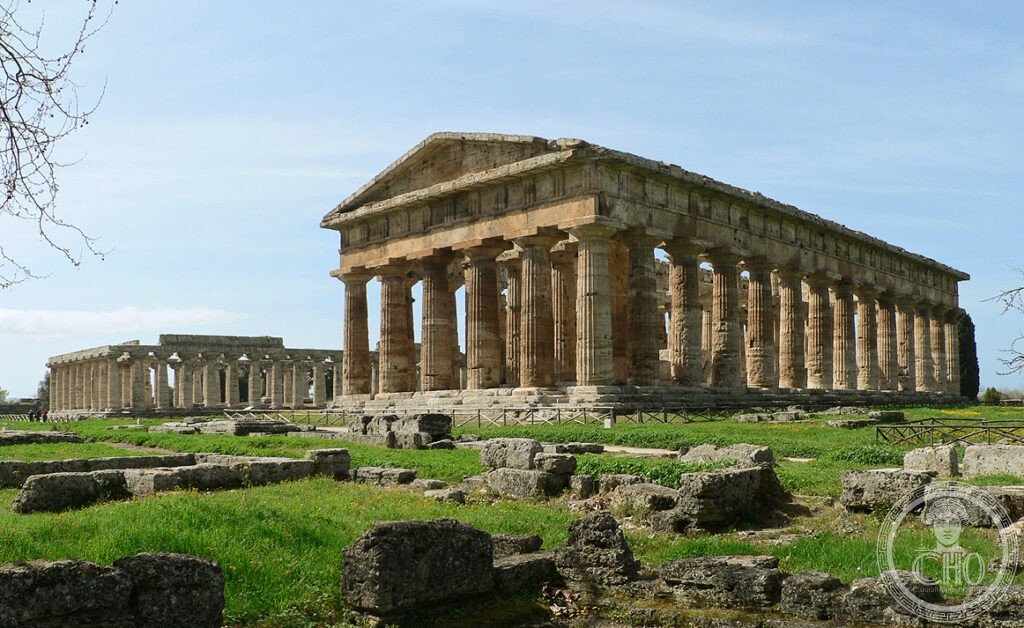
Paestum (Poseidonia), Comune di Capaccio Paestum, Province of Salerno, Campania, Italy. The Temple of Neptune (Tempio di Nettuno; c.450 BCE; Doric order; 36 m × 60 m; 6 × 14 columns; the best-preserved Doric temple in the world outside the Parthenon; the frontal elevation shows the full colonnade and entablature without later interventions — the columns retain their original entasis (the slight convex curvature of the column shaft that corrects for the optical illusion of concavity in a straight shaft); the pediment tympanum is lost but the entablature cornice and triglyphs are intact). UNESCO World Heritage Site 1998 (reference 842). Photo via Wikimedia Commons.
Paestum (Poseidonia), Province of Salerno, Campania, Italy · Greek colony c.600 BCE (Sybaris); 3 Doric temples: Hera I c.550 BCE + Athena c.500 BCE + Neptune c.450 BCE; Velia (Elea; Parmenides, Zeno); Certosa di Padula; UNESCO WHS 1998 (ref 842)

Cilento, Paestum e Velia

Paestum and the Cilento (UNESCO 1998) contain the three best-preserved Doric Greek temples outside Greece — Poseidonia (Paestum), founded c.600 BCE by colonists from Sybaris, preserves the complete architectural evolution of the Doric order over 100 years (Hera I c.550 BCE, Athena c.500 BCE, Neptune c.450 BCE) in a state unmatched anywhere in the ancient Greek world, while 40 km south, Velia (Elea) was the birthplace of Parmenides and Zeno, whose philosophy of being and paradoxes founded Western logic.

At a glance

Cilento, Vallo di Diano e Alburni con Paestum e Velia (the most precisely Paestum zone Paestum Campania Italy 40.4207 N 15.0049 E UNESCO WHS 1998 reference 842: the inscribed area (the UNESCO serial inscription covers 3 sites within the Cilento and Vallo di Diano National Park (the second-largest national park in Italy: 181,048 ha; the Cilento is the peninsular headland south of the Gulf of Salerno): (1) Paestum (the ancient Poseidonia; founded c.600 BCE by Greek colonists from Sybaris (a Magna Graecia city on the Gulf of Taranto); the 3 temples within the city walls (still standing; the walls are 4.75 km long and substantially intact)); (2) Velia (the ancient Elea; founded c.540 BCE by Phocaean Greek refugees from the Persian conquest of their Anatolian city Phocaea (modern Foça, Turkey); 30 km south of Paestum on the Campanian coast); (3) the Certosa di Padula (the Carthusian monastery of San Lorenzo at Padula; founded 1306 CE; the largest monastery in southern Italy; the cloister (the second-largest in Italy after the Great Cloister of the Certosa di Pavia); the specific anecdote: the cloister was used for a temporary airport in 1951 CE to receive the King of Spain; the kitchen contains 300 years of institutional cooking apparatus); the Cilento context (the national park landscape: the calcareous limestone massif of the Cilento mountains behind the coastal strip; the coastline alternates between sandy beaches and rocky cliffs; the Mediterranean maquis vegetation (lentisk, mastic, strawberry tree); the Cilento diet was identified by Ancel Keys in the 1950s CE as the origin of the Mediterranean diet — Keys conducted his Seven Countries Study partly in the villages of Cilento).

Key facts

  • The Doric order at Paestum and what the 100-year evolution from Hera I (c.550 BCE) to Neptune (c.450 BCE) teaches about the refinement of the classical temple: the three temples (the specific order: Tempio di Hera I (“Basilica”; c.550 BCE; 9 × 18 columns; the earliest of the 3 and the most archaic in its proportions: the columns are very wide at the base and taper sharply — 5.25 m base diameter tapering to 3.33 m at the top; the entasis (the outward bulge of the column shaft) is extremely exaggerated; the columns look “swollen” (the name Basilica was a Renaissance misidentification; it is now confirmed as a Hera temple)); Tempio di Atena (“Cerere”; c.500 BCE; 6 × 13 columns; the transitional temple: the Doric order proportions are more refined (the columns are slimmer); the entablature incorporates Ionic elements in the frieze (a Magna Graecia local practice)); Tempio di Nettuno (Neptune; c.450 BCE; 6 × 14 columns; the mature Classical Doric: the proportions are perfect — the column diameter-to-height ratio (approximately 1:5) is the standard for the Classical Doric order; the entasis is subtle; the temple is identified as a Hera temple by the excavation evidence (terracotta votive plaques for Hera found in the sanctuary precinct) despite its 18th-century name of “Neptune”)); Velia (Elea; Parmenides (born c.510 BCE; the founder of ontology (the philosophical study of being and existence); the Poem on Nature (Peri Phýseos) argued that being is one, eternal, and unchanging — the foundational claim of Western metaphysics; Zeno of Elea (c.490–430 BCE; Parmenides’ student; the 40 paradoxes (only 8 survive; the most famous: Achilles and the Tortoise (Achilles can never catch the tortoise because the distance between them is infinitely divisible); the Arrow Paradox (a flying arrow is motionless at every instant); the paradoxes were designed to defend Parmenides’ monism against the evidence of the senses)); the Eleatic school was the precursor of Platonic and Aristotelian metaphysics)
  • GPS (Temples, Paestum): 40.4207° N, 15.0049° E

History

From Sybaris colony to Lucanian conquest to Roman city to medieval abandonment to Bourbon rediscovery (the most precisely Paestum zone history: the Sybarite colony (c.600 BCE: colonists from Sybaris (the wealthiest city in Magna Graecia, on the Gulf of Taranto, destroyed by Croton in 510 BCE) founded Poseidonia on the Gulf of Salerno; the name (the city was dedicated to Poseidon (god of the sea)); the 3 temples were built within the first 150 years of the colony (c.550–450 BCE)); the Lucanian conquest (c.400 BCE: the Lucanians (an Oscan-speaking people from the Apennine interior) conquered the Greek cities of southern Italy in the late 5th century BCE; Poseidonia became “Paistom” (the Oscan version of the name); the cultural evidence: the Lucanian-period painted tombs (325–250 BCE; the Tomba del Tuffatore (Diver’s Tomb) was found in 1968 CE in a Lucanian cemetery outside the city walls; the paintings show a symposium scene and a diver leaping from a platform — the most famous pre-Hellenistic figurative painting in Italy; it is in the Museo Nazionale di Paestum)); the Roman period (273 BCE: the Roman colony of Paestum was established; the city remained important in the Republican period; the Forum replaced the Agora); the medieval abandonment (the city was gradually abandoned from the 6th century CE due to malaria (the drainage canals of the Roman period silted up) and Saracen raids; by the 9th century CE the city was abandoned; the temples survived because they were too massive to quarry for building materials); the Bourbon rediscovery (1746 CE: the road from Naples to Calabria was extended through the site; the temples were “rediscovered” by Bourbon engineers; Johann Joachim Winckelmann and Goethe visited in the 1770s–80s and wrote about the ruins (Goethe: “I must confess that [the temples] initially seemed alien to me”)); 1998 CE UNESCO inscription reference 842.

What you see

The 3 Doric temples, the forum, the city walls, the Museo Nazionale di Paestum (the most precisely Paestum zone visit (3 hours minimum)): the entrance (Via Magna Graecia 919, Paestum; open daily 8:30 AM to sunset; €13 temples + museum combined; the route (from the south entrance, the first temple visible is the Tempio di Hera I (Basilica): the 9 columns of the south side are immediately dramatic — the archaic proportions are visible from 100 m; the Tempio di Atena (Cerere; isolated on the northern edge of the site; the Ionic frieze elements best visible from the east side); the Tempio di Nettuno (the most visited; approach from the east end where the full colonnade is visible with the Tempio di Hera I as background — this is the classic Paestum photograph); the Forum (between the temples; the travertine pavement of the Roman forum overlays the Greek agora; the underground sanctuary (hypogaeum) of the unknown deity (a Doric naiskos under the forum pavement — a ritual space that predates the Roman forum by 400 years; the Museo Nazionale di Paestum (adjacent to the site; the Tomba del Tuffatore (the painted panels of the “Diver’s Tomb” (325 BCE): the symposium scene and the diver — the most discussed pre-Hellenistic paintings in Italy; the room is specifically lit and climate-controlled); the Lucanian-period painted tombs (the collection is the largest surviving group of Magna Graecia tomb paintings)).

Practical information

  • Getting to Paestum from Naples and combining with Velia and the Cilento coast: train from Naples Centrale to Paestum (Trenitalia; 1h30; €7; take the Sapri-direction train; hourly); the site is 1.5 km from the station (flat walk; 20 min; the road is not ideal for walking — taxi available at the station for €8); the summer season (the Paestum temples are in a lowland plain with no shade; summer visits (June–September) require early morning start (open at 8:30 AM; arrive by 9 AM before the heat builds; closed from the midday heat; reopen at 5 PM for the evening light (the most dramatic light for the temples is the last 2 hours before sunset in summer — the Doric columns turn amber in the low light)); the Velia extension (40 km south of Paestum; bus (CSTP regional bus from Paestum toward Sapri; 1h; every 2 hours; check cstp.it); or car (40 min on SS18); the Elea site is smaller and less touristed than Paestum; the Porta Arcaica (the 5th-century BCE monumental gate) and the Acropolis ruins are the main sights; the Parmenides-Zeno philosophical monuments (2020 CE installation) are on the Acropolis; the Certosa di Padula (50 km east; Val di Diano; open Tue–Sun 9 AM–6 PM; €5; the second-largest cloister in Italy; 550 m perimeter))

Getting there

Train from Naples Centrale to Paestum (1h30, €7, hourly). 1.5km walk or taxi from station. Open daily 8:30am-sunset, €13 (temples+museum). Velia: 40km south, bus CSTP (1h) or car. GPS temples: 40.4207, 15.0049.

Nearby

  • Costiera Amalfitana — 60 km north (UNESCO WHS 1997; Ravello + Amalfi + Positano; the medieval maritime republic (9th–11th century CE); the Amalfi paper mills (13th century CE — the oldest paper-making tradition in Italy)); bus or ferry from Salerno
  • Pompeii e Ercolano — 90 km north (UNESCO WHS 1997; the Vesuvius eruption of 79 CE; Trenitalia Circumvesuviana from Naples Centrale (Pompeii 45 min, Ercolano 15 min))

Sources

  • Wikipedia, Paestum; Temple of Hera, Paestum; Velia (ancient city); Parmenides, accessed June 2026
  • UNESCO, Cilento and Vallo di Diano National Park with the Archaeological Sites of Paestum and Velia, and the Certosa di Padula, WHS reference 842, inscribed 1998
  • Holloway, R. Ross. The Archaeology of Ancient Sicily. London: Routledge, 1991 (chapter on Paestum)

Hero image: Temple of Neptune, Paestum, Campania, Italy, Wikimedia Commons. Editorial text © Cultural Heritage Online, 2026.

📷 Diventa un fotografo di Cultural Heritage Online

Condividi le tue foto dei luoghi: restano pubblicate con la tua firma come autore. Più vengono viste, più ti fai conoscere — e presto un concorso premierà le foto più apprezzate.

Accedi o registrati gratis per aggiungere una foto
📋 Copy & share on social
Scroll to Top