
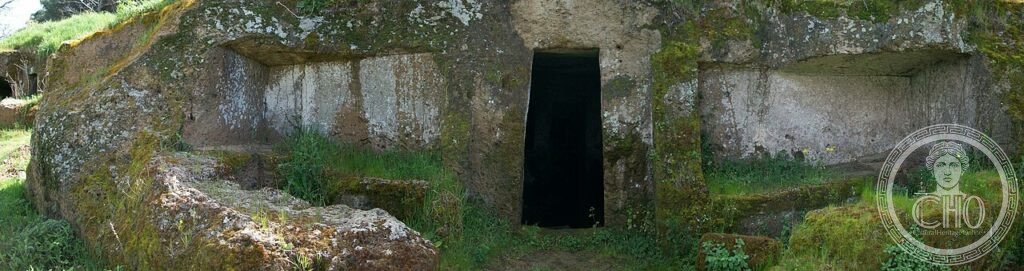
At Cerveteri, the Banditaccia necropolis carves an entire Etruscan city for the dead out of tufa rock, its tumulus tombs reproducing the domestic interiors of the living with stone beds, pillars and carved roof beams. Together with Tarquinia’s painted tombs, it offers the fullest surviving record of Etruscan civilisation.
At a glance
The Necropoli della Banditaccia at Cerveteri and the Necropoli di Monterozzi at Tarquinia form a serial UNESCO World Heritage inscription of two Etruscan burial grounds. Cerveteri’s tombs are tumuli, circular earthen mounds cut into tufa rock, their interiors carved to imitate Etruscan houses down to stone furniture and roof beams. Tarquinia’s tombs are rock-cut chambers without mounds, many of them painted, and it is this painting that makes Monterozzi exceptional.
The two sites sit roughly forty kilometres apart on the Lazio coast and are usually visited separately or combined in a single day by car, since there is no direct public transport link between them.
Key facts
- Location: Banditaccia necropolis, Cerveteri, and Monterozzi necropolis, Tarquinia, Lazio
- Civilisation: Etruscan, active roughly from the 9th to the 1st century BCE
- Cerveteri highlight: the Tomba dei Rilievi, its pilasters and ceiling covered in stucco reliefs of household objects
- Tarquinia highlight: painted tombs including the Tomba dei Leopardi and the Tomba della Caccia e Pesca
- Recognition: inscribed on the UNESCO World Heritage List in 2004, reference 1158
History
Both sites begin in the Villanovan period of the 9th and 8th centuries BCE, when the dead were cremated and buried in biconical urns within simple pit graves. Tarquinia’s Villanovan phase is especially significant, since the city is among the oldest attested Etruscan settlements and possibly the oldest of the twelve cities of the Etruscan League, which also included Cerveteri, known then as Caere.
In the Orientalizing period of the 7th century BCE, Etruscan aristocratic families grew wealthy on trade with the eastern Mediterranean and the Near East. The Regolini-Galassi Tomb at Cerveteri, dated to around 650 BCE and discovered in 1836, preserved one of the most complete assemblages from this period, including a gold pectoral now considered the largest surviving Etruscan gold object, alongside Phoenician faience and Greek bronzes; the finds are held in the Vatican Gregorian Etruscan Museum.
The Archaic and Classical periods, from the 6th to the 4th century BCE, produced the painted tombs of Tarquinia. Roman conquest of Etruria in the 3rd century BCE brought the Etruscan city-states under Roman control, though burial in a hybrid Etrusco-Roman style continued in some cemeteries into the 2nd century CE.
What you see
At Banditaccia, visitors walk marked paths through a landscape of tumulus tombs arranged like streets in a city, some with names, mirroring the layout of the Etruscan settlement that once stood above. The Tomba dei Rilievi is the most fully decorated chamber at Cerveteri, its stucco reliefs depicting an inventory of daily Etruscan life: kitchenware, weapons, musical instruments, games and a dog carved beneath one of the stone benches. The Tomba della Cornice shows the simpler, earlier form, a single rectangular chamber whose gabled ceiling is carved to reproduce the roof beams of a real house.
At Monterozzi, the tombs are flat to the surface and reached by a descending staircase. Only a portion of the roughly two hundred painted tombs are open to visitors at any time, on a rotation intended to limit humidity from visitor breath. The Tomba dei Leopardi shows a banquet scene with three couples reclining on dining couches, musicians and servants, and two leopards facing each other above the diners, in a palette of terracotta, sea-green, deep red and black. The Tomba della Caccia e Pesca, the oldest of the accessible painted tombs, shows a hunting scene above a fishing scene with dolphins and birds, an early attempt at spatial depth in Italian painting. The Museo Nazionale Tarquiniense in Palazzo Vitelleschi holds further material, including the terracotta frieze of winged horses from the Ara della Regina sanctuary.
Practical information
- Access: both necropolises have marked paths; ground is flat but the tufa surface is uneven, so sturdy footwear is recommended
- Tomb rotation at Tarquinia: only a limited number of painted tombs are open on any given day and the selection changes periodically to manage conservation, so check which tombs are viewable before visiting
- Combined visits: the two sites can be combined in a single day with a car, but there is no direct public transport between them
- Tickets and hours: consult the official site or local tourism authority for current opening times and admission arrangements
Getting there
Cerveteri and Tarquinia both lie within reach of Rome by train, with onward travel to each necropolis by taxi or on foot from the local station. There is no direct bus or rail connection between the two towns, so travellers wishing to see both sites in one day generally need a car.
Nearby
- Museo Nazionale Tarquiniense — in Tarquinia itself, holding finds from the necropolis including the winged-horse terracotta frieze
- Vatican Gregorian Etruscan Museum — Rome, home to the Regolini-Galassi Tomb finds from Cerveteri
- Caere (ancient Cerveteri) — the Etruscan city that the Banditaccia necropolis was built to serve, once one of the twelve cities of the Etruscan League
Sources
- UNESCO
Find it on the map
See this place and what’s around it →📷 Become a Cultural Heritage Online photographer
Share your photos of places: they stay published under your name as the author. The more they're seen, the more you get noticed — and soon a contest will reward the most appreciated photos.
Log in or sign up free to add a photoDo you manage this place?
This page is read by travellers and heritage enthusiasts who find it on Google. Keep it accurate — and make it work for you. Free for non-profit heritage institutions.