
Palermo Arabo-Normanna

Palermo Arabo-Normanna Cappella Palatina Roger II 1130 gold mosaics Norman-Arab-Byzantine synthesis Sicily UNESCO 2015
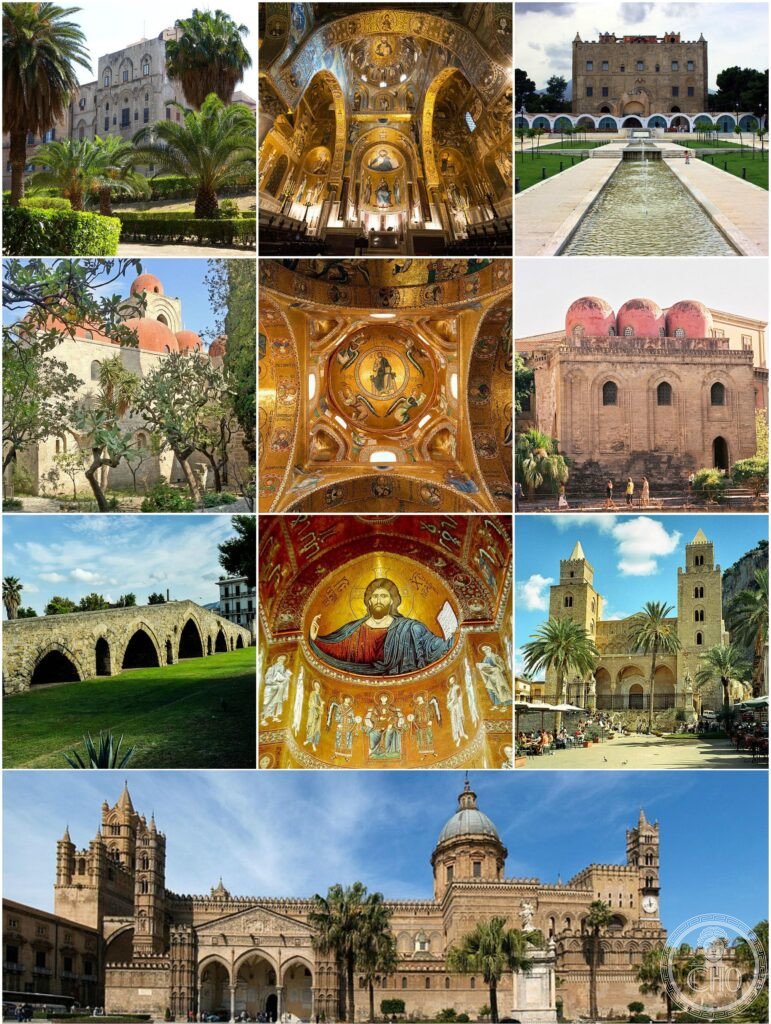
Cappella Palatina (Palatine Chapel), Palazzo dei Normanni, Piazza del Parlamento, Palermo, Sicily, Italy. The nave interior looking east (built 1130–1143 CE for King Roger II of Sicily (1095–1154 CE; the first king of the Norman Kingdom of Sicily; the most powerful ruler in the Mediterranean after the Byzantine Emperor and the Abbasid Caliph)): the ceiling (the muqarnas stalactite wooden ceiling (1132–1140 CE) — the finest muqarnas ceiling outside Cairo; the muqarnas is the Islamic architectural technique of 3D geometric cellular vaulting; the ceiling was painted with figural scenes by Arab craftsmen (the scenes are secular — courtly life, hunting, musicians — the iconographic programme is the most important surviving document of the Fatimid artistic tradition outside Egypt)); the mosaics (the Byzantine gold-ground mosaic cycle covering every wall and the apse (1143–1172 CE) — the largest and most complete Byzantine mosaic programme in western Europe outside the Hagia Sophia in Istanbul). Part of UNESCO World Heritage serial inscription “Arab-Norman Palermo and the Cathedral Churches of Cefalù and Monreale” (reference 1487, inscribed 2015). Photo via Wikimedia Commons.
Palermo, Sicily, Italy · Roger II 1130–1154; Byzantine mosaics + Islamic muqarnas ceiling + Norman architecture = unique triple synthesis; UNESCO WHS 2015 (ref 1487, serial 9 monuments)

Palermo Arabo-Normanna

The Arab-Norman Palermo (UNESCO 2015) monuments are the most extraordinary surviving examples of the 12th-century culture that flourished under Roger II — the Norman king who unified Muslim, Byzantine, and Latin Christian artistic traditions in a single court, commissioning buildings where Arab muqarnas ceilings hang above Byzantine gold mosaics in Norman architectural forms, a synthesis without precedent in Western European history and with no comparable successor.

At a glance

Palermo Arabo-Normanna (the most precisely PalermoAraboNormanna serial Palermo Sicily Italy 38.1117 N 13.3543 E UNESCO WHS 2015 reference 1487 serial 9 monuments: the 9 inscribed monuments (4 in Palermo + the cathedrals of Cefalù and Monreale + the bridges at Amiraglia, S. Leonora, and dell’Ammiraglio (the river bridges are the only surviving Norman bridges in Italy)): Palermo: (1) Cappella Palatina (the primary monument; the private chapel of Roger II in the Palazzo dei Normanni; 1130–1143 CE); (2) La Martorana (S. Maria dell’Ammiraglio; Via Maqueda/Piazza Bellini; built 1143 CE by George of Antioch (the Roger II grand admiral; of Syrian-Greek origin — the person responsible for more Norman Mediterranean policy than any single general or diplomat); the mosaics of the Martorana are the most refined Byzantine mosaics in Italy after those of Ravenna (5th–6th century CE) and possibly the finest in the world (the gold ground is a higher-purity gold than Ravenna; the tesserae are smaller; the figural handling is more emotionally expressive)); (3) Palazzo dei Normanni (the palace complex; the exterior + the Cappella Palatina interior); (4) the Zisa (the Arabic word for “magnificent”; 12th-century Arab-Norman palace in the western suburbs of Palermo; the exterior is a simple cube of local golden stone; the interior: the Fountain Hall (the sala della fontana) with a muqarnas vault above the central water feature — the most complete surviving muqarnas room in a secular building outside the Alhambra in Granada); Cefalù Cathedral (90 km east of Palermo; 1131–1267 CE; the mosaics in the apse (1148 CE): the Christ Pantocrator in the apse — the most imposing single Byzantine mosaic image in the western world (the apse is 14m wide; the Christ face is 3m in height from hairline to chin)); Monreale Cathedral (8 km south of Palermo; 1174–1184 CE; the complete Byzantine mosaic cycle covering 6,000 sq m of wall surface — the largest mosaic cycle in the world; includes the 10.9m-high Christ Pantocrator in the main apse (larger than Cefalù), the Old Testament cycle in the nave (the most complete Old Testament mosaic cycle in medieval western art), and the cloister (1172–1189 CE; 228 twin marble columns, every capital different (the capitals range from Corinthian standard to figural scenes of the Months, the Animals, the Labors of Hercules, and the specific Norman iconography of knights and falconers))).

Key facts

  • The Cappella Palatina muqarnas ceiling and why it is the most important surviving document of Fatimid art outside Egypt: the muqarnas ceiling of the Cappella Palatina (the nave ceiling; 1132–1140 CE; the precise dating is based on the Arabic inscription in the nave (the inscription gives the date 1143 CE for the consecration of the chapel; the ceiling itself was installed earlier, during the construction of the nave shell)): the structure (the muqarnas is a 3D cellular vaulting technique invented in the Islamic world in the 10th–11th century CE (the earliest surviving muqarnas: the Samanid tomb at Bukhara, 10th century CE); the Palermo muqarnas is the most complex surviving example outside the Islamic world: 2,736 individual cells forming 8 concentric horizontal rings around the central medallion of the nave; the structural technique: each cell is a small wooden pyramid set at a specific angle and depth to create the overall stalactite visual effect when viewed from below); the paintings (the cells are painted with figural and geometric scenes: the primary content is secular (not religious): hunting scenes (falconry, deer hunting), courtly scenes (musicians, dancers, enthroned figures), geometric and botanical patterns; the iconographic source is the Fatimid art tradition of 11th–12th century Egypt (the comparison is with the Fatimid carved ivory objects in the Treasury of the Cathedral of Pisa (looted from Egypt in 1063 CE) and the painted ceilings of the Fatimid palace in Cairo (no longer surviving; recorded in 13th-century descriptions)); the specific significance: the ceiling is the only surviving Fatimid-tradition painted ceiling in a royal secular commission outside Egypt (all the Egyptian originals have been destroyed); it was commissioned by a Christian Norman king for a Christian chapel — the most explicit document of Roger II’s deliberate multi-cultural patronage policy)
  • GPS (Cappella Palatina): 38.1117° N, 13.3543° E

History

From Roger I’s 1072 conquest to the 12th-century artistic synthesis to 2015 UNESCO (the most precisely PalermoAraboNormanna serial 1072 CE Norman conquest of Palermo: Roger I (Roger I of Sicily; 1031–1101 CE; the first Norman ruler of Sicily; the younger brother of Robert Guiscard; he completed the conquest of Sicily from the Kalbid emirate of Palermo in 1091 CE after 30 years of military campaigns; the specific historical context: at the time of the Norman conquest, Sicily had been Islamic for 250 years (the Arab conquest 827–902 CE) and before that had been Byzantine for 300 years (535–827 CE) and Roman for 600 years before that; the Norman conquest added a 4th cultural layer to an already stratified island; the Norman policy was specifically NOT to destroy the existing Muslim and Byzantine Greek communities: Muslim administrators continued to run the fiscal system; Byzantine artists continued to make mosaics; Arabic continued as an official court language alongside Latin and Greek); Roger II (1095–1154 CE; the son of Roger I; the unifier of southern Italy and Sicily into the Kingdom of Sicily (1130 CE, the royal title granted by Pope Anacletus II); the specific context of the Cappella Palatina commission: Roger II was simultaneously overlord of Norman French barons (the military aristocracy from Normandy who conquered Sicily), Byzantine Greek monks (the religious community of the Basilian monasteries), and Arab Muslim scholars and administrators (the court language was Arabic for administrative documents, Greek for religious matters, and Latin for papal and Western European correspondence); the Cappella Palatina was deliberately designed to speak to all three communities: the muqarnas ceiling (Arab artisans for Arab court culture); the Byzantine gold mosaics (Greek artists for Orthodox Christian congregation); the Norman architectural forms (French stone-masons for the Frankish barons)); 1194 CE the Hohenstaufen conquest (the Norman dynasty ended with William II; the Kingdom passed to the Hohenstaufen (Henry VI) through marriage; the Arab-Norman artistic synthesis ended; the 13th-century buildings of Frederick II (Castel del Monte, Lucera) represent a different synthesis (Holy Roman Empire + southern Italy) without the specifically Fatimid component); 2015 CE UNESCO inscription reference 1487.

What you see

The Cappella Palatina interior, the Martorana mosaics, and the Zisa fountain hall (the most precisely PalermoAraboNormanna serial visit — minimum 2 days in Palermo + day trip to Monreale or Cefalù: Day 1 Palermo: 1) Cappella Palatina (Palazzo dei Normanni; Piazza del Parlamento; the entrance is via the palace courtyard; €12; timed entry slots every 15 minutes (the chapel allows a maximum of 40 people at once due to conservation requirements; the acoustic effect of 40 people breathing in a small stone-and-mosaic space is specific and irreplicable); the viewing sequence: enter from the royal box (the western entrance used by the king; the position from which the entire east end is visible simultaneously — the golden apse mosaic + the Christ Pantocrator + the muqarnas ceiling all in one view; this is the viewing angle that Roger II experienced; it is the correct viewing position for the artistic programme)); 2) La Martorana (Piazza Bellini; Via Maqueda; free; the mosaics in the narthex show Roger II being crowned by Christ (the most important single mosaic in Sicily — it is the only surviving Norman-period image of Roger II; the crown and the clothes are distinctly Byzantine; the inscription is in Greek; Roger II is presented as a Byzantine emperor, not a Norman king)); 3) the Zisa (Piazza Zisa; 15-minute walk or taxi; €6; the fountain hall (sala della fontana) is the primary attraction; the muqarnas vault above the water feature is the most complete surviving secular muqarnas room in the Mediterranean outside the Alhambra); Day 2 Monreale (bus from Palermo (Bus 389 from Piazza dell’Indipendenza; 40 min; €1.40); the Cathedral (6000 sq m of mosaics; 3 hours minimum); the cloister (228 columns; 1 hour); the panorama terrace (the view of the Conca d’Oro (the Golden Shell — the name for the orange and lemon grove basin around Palermo; now largely built over but still partially visible from the Monreale terrace)).

Practical information

  • Getting to Palermo and the Cappella Palatina timed entry system: transport: Trenitalia from Rome Termini (11h overnight; the “Intercity Notte” Palermo train; €40–60 with sleeping car; the train crosses to Sicily by the Messina strait ferry (the train is loaded onto the ferry at Villa San Giovanni and unloaded at Messina; the crossing takes 35 min; most passengers sleep through it)); Ryanair/easyJet/Vueling flights from Rome, Milan, Turin, or Bologna to Palermo Falcone-Borsellino airport (1h; €20–80; the airport express bus to Palermo center 50 min); within Palermo: the Cappella Palatina (Palazzo dei Normanni; Piazza del Parlamento; bus 105 or Linea Rossa tourist bus from central Palermo); timed entry: the Chapel is open Monday–Saturday 8:15 AM–5:45 PM, Sunday 8:15 AM–1 PM; entry every 15 minutes; maximum 40 people per slot; advance booking strongly recommended in summer (book at federicosecondo.it; €12 for the combined Cappella + Palazzo Reale ticket; the booking system allows selection of the specific time slot); the Martorana (Piazza Bellini; open Monday–Saturday 9 AM–6 PM; free; no booking required; the best time is 10 AM–12 PM when the angle of the sun illuminates the gold mosaics in the apse); the Zisa (Piazza Guglielmo il Buono 4; open daily 9 AM–6 PM; €6; no booking required)

Getting there

Flights to Palermo Falcone-Borsellino (50 min airport bus to center). Train Rome (11h overnight, €40-60). Cappella Palatina: Piazza del Parlamento, bus 105. Timed entry €12, book at federicosecondo.it. GPS: 38.1117, 13.3543.

Nearby

  • Monreale Cathedral — 8 km south (same UNESCO serial 2015; 6,000 sq m Byzantine mosaics + 228-column cloister; bus 389 from Palermo, 40 min, €1.40)
  • Cefalù Cathedral — 70 km east (same UNESCO serial 2015; 1148 CE Christ Pantocrator mosaic in apse (3m-high face); Trenitalia from Palermo 1h; smaller scale than Monreale, more intimate experience)

Sources

  • Wikipedia, Arab-Norman Palermo; Cappella Palatina; Roger II of Sicily; La Martorana; Zisa, accessed June 2026
  • UNESCO, Arab-Norman Palermo and the Cathedral Churches of Cefalù and Monreale, WHS reference 1487, inscribed 2015
  • Tronzo, William. The Cultures of his Kingdom: Roger II and the Cappella Palatina in Palermo. Princeton: Princeton University Press, 1997

Hero image: Cappella Palatina, Palermo, Sicily, Italy, Wikimedia Commons. Editorial text © Cultural Heritage Online, 2026.

📷 Diventa un fotografo di Cultural Heritage Online

Condividi le tue foto dei luoghi: restano pubblicate con la tua firma come autore. Più vengono viste, più ti fai conoscere — e presto un concorso premierà le foto più apprezzate.

Accedi o registrati gratis per aggiungere una foto
📋 Copy & share on social
Scroll to Top