
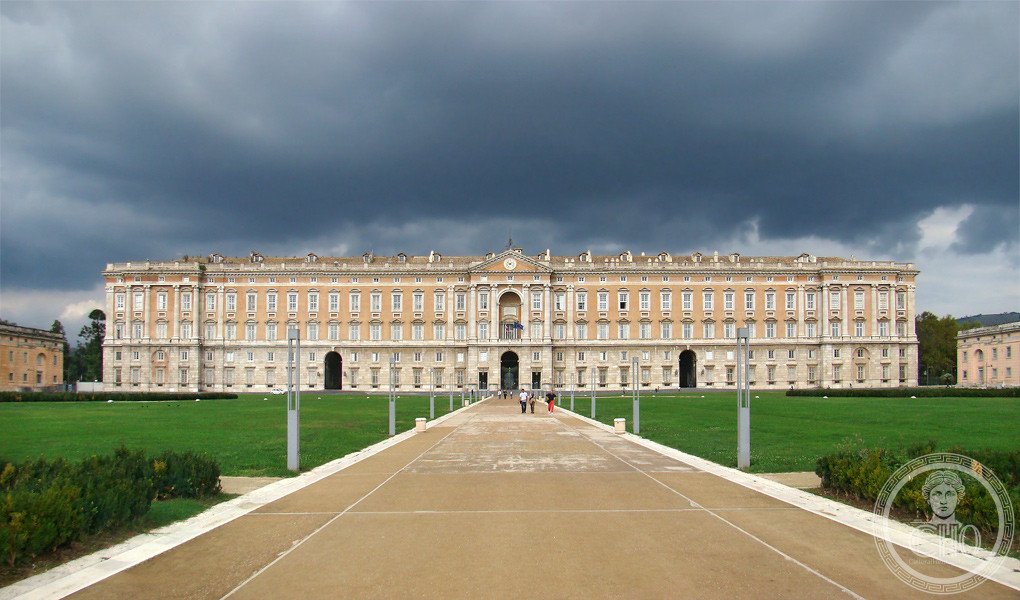
Reggia di Caserta
The Reggia di Caserta (UNESCO 1997) is the largest royal palace in the world by volume — Luigi Vanvitelli’s 1752 commission for Charles VII of Bourbon produced a palace of 1,200 rooms, 1,742 windows, 34 staircases, and a 3-kilometre park axis ending in a 78-metre cascade — a deliberate architectural statement that the Kingdom of Naples was the equal of Versailles, produced 70 years after the French original and at three times the site area.
At a glance
Reggia di Caserta (the most precisely ReggiadiCaserta single Caserta Campania Italy 41.0735 N 14.3267 E UNESCO WHS 1997 reference 549: the statistics: 1,200 rooms; 1,742 windows; 34 staircases; 5 courtyards; total floor area 47,000 sq m (the largest palace in the world by floor area, slightly larger than Versailles (63,154 sq m) in some measurements and significantly larger in others depending on how the wings are counted; the most commonly cited comparison: the Caserta main block is 1,000m × 200m in plan; Versailles’s main block is 680m × 205m); the park: 120 ha of formal Italian garden + the English Garden (the giardino inglese; 24 ha; designed 1782–1797 CE by Carlo Vanvitelli (Luigi’s son) and the English landscape architect John Andrew Graefer (who was recommended by Joseph Banks of the Royal Botanic Gardens Kew)); the commission context: Charles VII of Bourbon (1716–1788 CE; King of Naples from 1734 CE; later King Charles III of Spain from 1759 CE (when he inherited the Spanish throne and left his son Ferdinand IV as King of Naples); patron of Vanvitelli, Tiepolo, and Winckelmann; the most culturally active Bourbon ruler of the 18th century; he commissioned the excavations at Herculaneum (begun 1738 CE) and Pompeii (begun 1748 CE) that defined the Neoclassical movement in Europe); the Caserta commission: Charles VII saw Versailles in 1731 CE during a diplomatic visit; he commissioned the Reggia di Caserta in 1751 CE from Luigi Vanvitelli (1700–1773 CE; born in Naples (father: the Dutch painter Gaspar van Wittel, who became Caspar Vanvitelli); trained in Rome under Carlo Fontana and Juvara; the leading Italian architect of the mid-18th century; his other major works: the Palazzo Reale Aranjuez renovation (Spain), the Santa Maria degli Angeli conversion of the Diocletian baths (Rome)) to signal that the Kingdom of Naples was a great power comparable to France).
Key facts
- The Grand Staircase (Scalone d’onore) and why it is the most theatrically calculated entrance sequence in any 18th-century palace: the Grand Staircase (designed 1750 CE; built 1752–1762 CE; the main access to the royal apartments; located in the centre of the palace, accessible from the first cortile (the largest of the 5 courtyards; accessible from Viale Douhet) via a vestibule (the Vestibolo inferiore) with 12 paired Corinthian columns in Mondragone marble (the white marble from the quarries of Mondragone in Campania; the same marble used for the columns in the park cascade)); the staircase is divided into one ascending flight (from the vestibule floor to a landing at the midpoint) + two returning flights (from the landing to the first floor (the piano nobile)); the number of treads: 116 (the single ascending flight); the landing: a rectangular platform with a vaulted ceiling decorated with a fresco by Girolamo Starace-Franchis (1780 CE; the Allegory of the 5 Parts of the World; fresco); the widening: the staircase widens from the base (12m) to the landing (16.5m) to the upper flights (19m each) — the visual effect is that the staircase appears to expand as the visitor ascends, making the arrival at the landing appear increasingly ceremonial; the ceiling: the landing vault rises to a height of 35m above the floor (the staircase is 35m tall); above the upper flights, two large windows (6m × 12m) frame the sky and backlight the arrival at the first floor; the specific Vanvitelli innovation: the light sources in the staircase are hidden — the landing ceiling is lit by windows set into the staircase walls above the landing level and not visible from the steps; the visitor ascends through a corridor-like space and arrives on the landing in a burst of indirect light; this is a theatrical lighting technique borrowed from Baroque church design (the same principle as the Borromini Sant’Ivo alla Sapienza lantern or the Guarini Cappella della Sindone dome) applied to secular palatial architecture
- GPS: 41.0735° N, 14.3267° E
History
From Bourbon ambition to Napoleonic seizure to Savoy inheritance to UNESCO (the most precisely ReggiadiCaserta single 1751 CE commission: Charles VII ordered the construction of a new royal capital south of Naples; the first stone was laid on 20 January 1752 CE in the presence of Charles VII, his wife Maria Amalia of Saxony, and the entire Neapolitan court; the construction workforce at peak: 3,500 workers; the construction materials: the structural stone (piperno — the local volcanic tuff quarried at Astroni near Pozzuoli); the decorative marble (Mondragone white; Sicilian jasper; Carrara Statuary for the sculpture); the hydraulic infrastructure (the Carolino aqueduct — 37 km long, built to supply the park cascade with water from Monte Taburno; designed 1753 CE; completed 1762 CE; the most ambitious hydraulic engineering project in 18th-century Italy)); 1773 CE Luigi Vanvitelli died with the palace unfinished; his son Carlo Vanvitelli completed the work (the English Garden was designed entirely by Carlo Vanvitelli after 1780 CE with John Graefer); 1798 CE Neapolitan Republic: the Bourbon court fled to Palermo (Sicily) during the French Revolutionary Wars; the palace was occupied by French troops; the royal apartments were used as military headquarters; 1815 CE Restoration: Ferdinand I (IV of Naples; I of the Two Sicilies) returned to the palace; the 19th century: the palace was used as a royal residence by the Bourbon kings of the Two Sicilies until the Risorgimento; 2 September 1860 CE Giuseppe Garibaldi arrived at the Reggia di Caserta with his army of volunteers, accepted the surrender of the Bourbon garrison, and departed for Naples — the event is commemorated by a plaque in the first cortile; the palace was transferred to the Savoy royal family and then to the Italian state; 1997 CE UNESCO inscription reference 549; 2015 CE the Reggia was the subject of a major restoration programme including the reopening of the Upper Gardens (previously closed for 20 years).
What you see
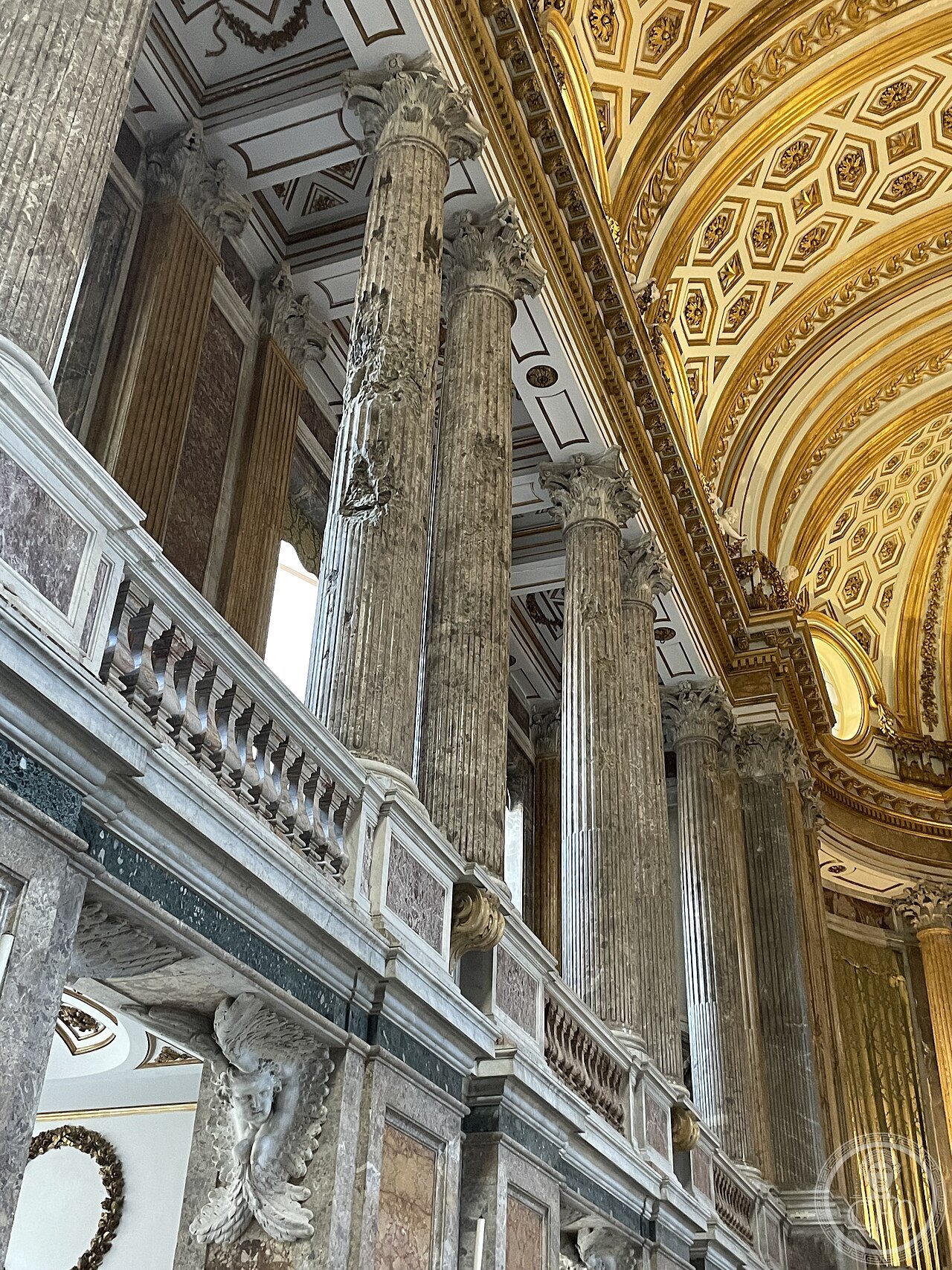
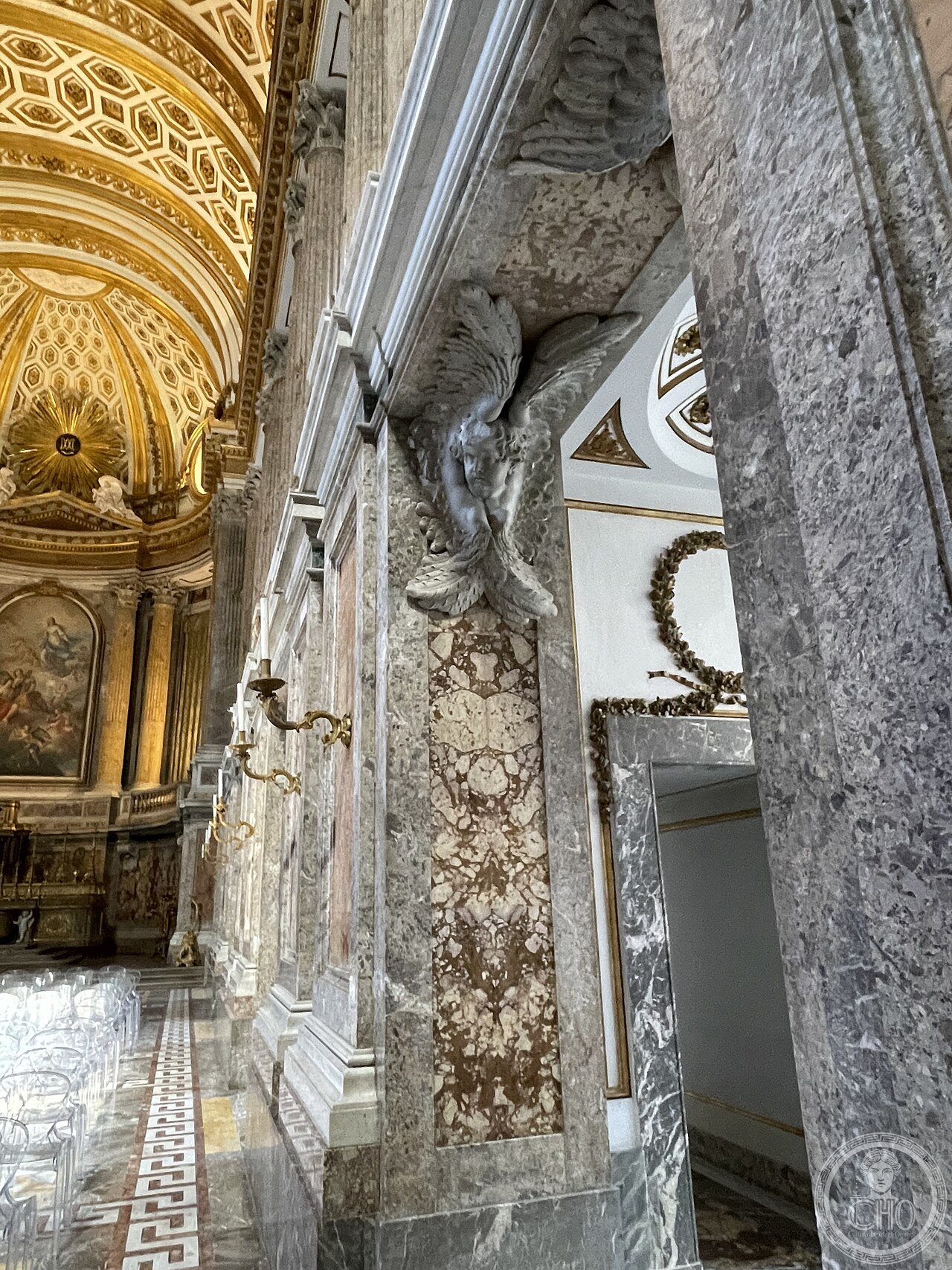
The palace, the park, and the English Garden (the most precisely ReggiadiCaserta single visit: the palace visit (2–3 hours; guided or self-guided; the route through the State Apartments is linear — a sequence of 36 rooms on the piano nobile (the first floor) from the Sala delle Guardie (the entrance guard room) to the Salone degli Alabardieri (the Halberdiers’ room, the largest and most decorated of the ceremonial rooms; ceiling fresco by Girolamo Starace-Franchis; the ceiling has 4 panels (the 4 Elements + the Allegory of the Kingdom of Naples and Sicily); the room was used for the court receptions and has a floor of Mondragone marble in a geometric pattern still in pristine condition; the most important rooms: the Sala di Marte (the War Room; the largest single painting in the palace: the equestrian portrait of Charles III/VII on horseback by Corrado Giaquinto (1753 CE; 4m × 3.5m)); the Royal Chapel (the chapel is at the end of the left wing of the palace; entered through a vestibule with a barrel vault painted in trompe l’oeil to appear 30m high when it is actually 15m; the chapel interior is a single-aisled nave with 2 Corinthian column screens; the marble altar is by Nicola Fiore (1785 CE); the chapel ceiling fresco by Giuseppe Cammarano (the Assumption of the Virgin; 1802 CE))); the park (3 km walk from the palace to the Grande Cascata; the standard visitor route is by the electric minibus (€2; 10 min) or bicycle (available at the palace entrance; €4/day)); the English Garden (separate entry within the park; the most unusual element: the “bath of Venus” (the artificial pool with a Roman-style nymphaeum (1793 CE); surrounded by tropical plants (the garden contains plants collected by Joseph Banks in the Pacific; the cacti from Mexico; the aloes from South Africa; the original planting list compiled by Graefer has survived in the Royal Archive and is the most complete record of 18th-century botanical garden planting in Italy))
Practical information
- Getting to the Reggia from Naples and combining with Pompeii and Herculaneum: transport: Trenitalia regional train from Napoli Centrale to Caserta (40 min; €4.20; every 30 min; the station is directly opposite the palace); the palace entrance is a 5-minute walk from the station exit; alternatively, the ReggiExpress tourist bus (summer weekends; departs Napoli Garibaldi station); the park transport: electric minibus from palace entrance to Grande Cascata (€2; or walk 3 km; or rent bicycle at entrance €4/day); hours: Wednesday–Monday 8:30 AM–7:30 PM (last entry 6 PM); closed Tuesday; admission: palace + park €14 adults; €2 reduced; the English Garden: included; free for under-18 / EU citizens over 65; the combination (2-day circuit from Naples): Day 1 Herculaneum (Ercolano Scavi train from Napoli Centrale; 20 min; the most well-preserved Roman city (better than Pompeii for wall painting and wooden furniture survival; the “Villa dei Papiri” (the library; the 1,800 carbonized papyrus scrolls (the world’s only surviving ancient library) are partially unrolled and read by multi-spectral imaging at the Institut de France in Paris and the Biblioteca Nazionale Napoli))); Day 2 Caserta (morning) + optional Pompeii (afternoon; Circumvesuviana train to Pompei Scavi; 50 min from Naples; the Via dell’Abbondanza, the Terme Stabiane, and the Villa dei Misteri (the mystery cult fresco cycle; 17m × 5m in a continuous painted register; the most important Roman painting cycle in existence))
Getting there
Train from Napoli Centrale to Caserta (40 min, €4.20; every 30 min; station directly opposite palace). Open Wed-Mon 8:30-19:30, closed Tue. Admission €14 (park included). Electric minibus palace→cascade €2. GPS: 41.0735, 14.3267.
Nearby
- Pompeii — 35 km south (UNESCO WHS 1997; the most visited archaeological site in Italy; Circumvesuviana train from Naples 50 min; Via dell’Abbondanza; Villa dei Misteri fresco cycle 17m long)
- Herculaneum — 30 km south (UNESCO WHS 1997; the better-preserved Roman city; wooden furniture, wall paintings, and the 1,800-scroll ancient library survived under the volcanic mud vs Pompeii’s ash)
Gallery
Sources
- Wikipedia, Palace of Caserta; Luigi Vanvitelli; Charles III of Spain, accessed June 2026
- UNESCO, Royal Palace at Caserta with the Park, the Aqueduct of Vanvitelli, and the San Leucio Complex, WHS reference 549, inscribed 1997
- Chierici, Umberto. La Reggia di Caserta. Milan: Electa, 1984
Find it on the map
See this place and what’s around it →📷 Diventa un fotografo di Cultural Heritage Online
Condividi le tue foto dei luoghi: restano pubblicate con la tua firma come autore. Più vengono viste, più ti fai conoscere — e presto un concorso premierà le foto più apprezzate.
Accedi o registrati gratis per aggiungere una foto