

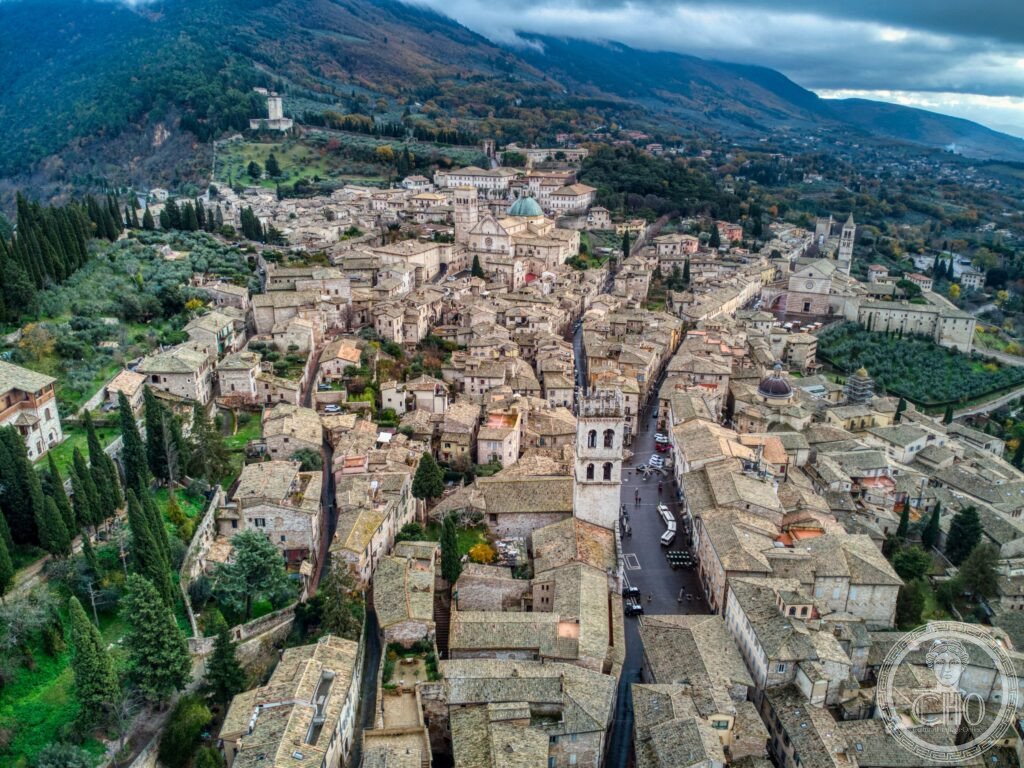
Below the walls of Assisi, a 64-hectare stretch of oak and holm-oak woodland survives as the working landscape Francis of Assisi once walked. A restored medieval watermill, a creek trail and open meadows connect the Basilica above to the valley floor below, largely unchanged in outline for eight centuries.
At a glance
The Bosco di San Francesco occupies the north-facing slope beneath the Basilica di San Francesco, descending from the city walls of Assisi into the valley of the Rio Tescio. The property covers around 64 hectares, made up of roughly 50 hectares of oak woodland and 14 hectares of meadow and creek terraces, and sits at elevations between about 380 and 500 metres.
The FAI, Italy’s national trust for landscape and heritage, has managed the site since 2010, when it acquired the land from the Franciscan friars of the Sacro Convento. Admission is free, funded instead by donations, making it unusual among FAI properties. A circuit combining the Sentiero del Bosco and the Sentiero del Mulino covers about 3 kilometres and can be walked at an easy pace in around ninety minutes, mostly flat with a short climb to the upper viewpoint.
Key facts
- Location: Assisi, Province of Perugia, Umbria
- Managed by: FAI – Fondo Ambiente Italiano, since 2010
- Size: approximately 64 hectares, woodland and meadow
- Landmark: the Molino delle Braci, a medieval watermill restored between 2011 and 2013
- Admission: free, with donations accepted
History
Francis of Assisi grew up on the slopes of Monte Subasio, and the valley now occupied by the Bosco is identified in early Franciscan sources as one of the areas where he walked and meditated. The woodland is referred to in early chronicles, including Tommaso da Celano’s Vita Prima of 1228 and Bonaventura da Bagnoregio’s Legenda Maior of 1263, in connection with the tradition of Francis preaching to the birds, though the Fioretti di San Francesco, written around 1327, places that episode near Bevagna; local tradition from the fourteenth century onward has associated it with this valley instead.
From 1228, when construction of the Basilica began, until 2010 the valley formed part of the agricultural estate of the Sacro Convento, worked by the Franciscan friars as farmland and forest for roughly eight centuries. The FAI acquired the property in 2010, funding the purchase through public fundraising and a major donation, and carried out restoration before opening the site to visitors in 2011 and 2012.
What you see
The entrance lies on Via Antonio Cristofani, running below the city wall beneath the Sacro Convento, and is marked with FAI signage. The Sentiero della Radura leads through oak woodland dominated by pubescent oak, with a canopy that regrew after felling in the late nineteenth century; the oldest trees in the Bosco are holm-oaks estimated at 150 to 200 years old. Birdsong is a notable feature of the woodland in the morning, with blackbirds, nightingales between April and June, and both green and great spotted woodpeckers recorded on the site.
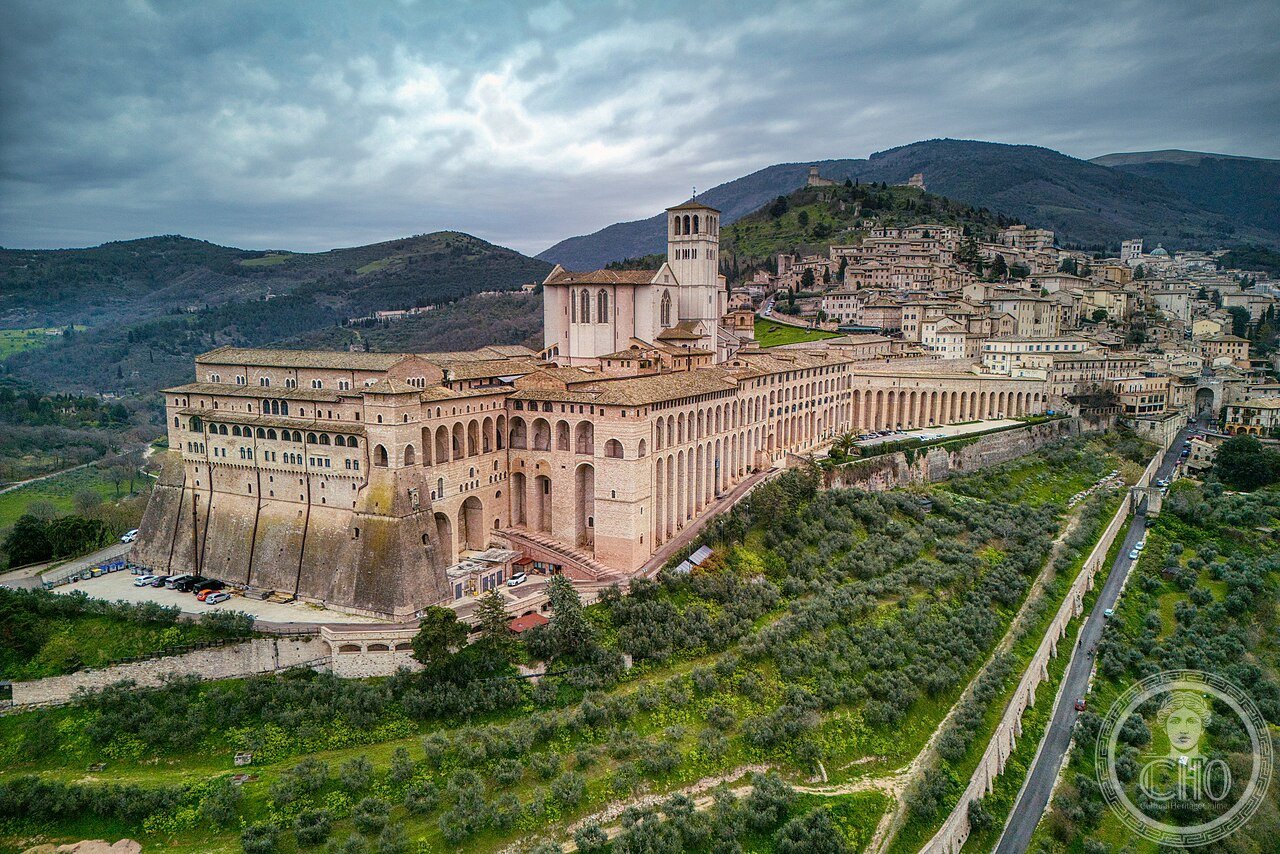
The Sentiero del Mulino descends on a stone-paved track, laid with the local Subasio limestone used throughout medieval Assisi, to the valley floor and the Molino delle Braci. This medieval watermill, first documented in a Sacro Convento land register of 1253 and in use producing flour until the fifteenth century, has been restored to working order, its horizontal waterwheel representative of a type common in Umbrian mills before the fifteenth century. From the Terrazza viewpoint above, the view opens north towards the Tiber plain, with the Basilica di San Francesco visible to the east above the city walls, its lower church apse level with the forest canopy beneath it.
Practical information
- Admission: free entry; donations welcome; check the FAI’s official channels for current visiting arrangements
- Mill demonstrations: milling of stone-ground emmer wheat flour has been shown on Sunday mornings between April and October, with a miller in period costume
- Walking circuit: around 3 kilometres combining the Forest Path and the Mill Path, mostly level with one short ascent
- Combined itinerary: can be linked to a wider Assisi Franciscan walking circuit of about 7 kilometres via the Via delle Fonti
Getting there
The Bosco di San Francesco is entered from Via Antonio Cristofani, running along the northern face of Assisi’s city wall below the Sacro Convento, close to the Basilica di San Francesco.
Nearby
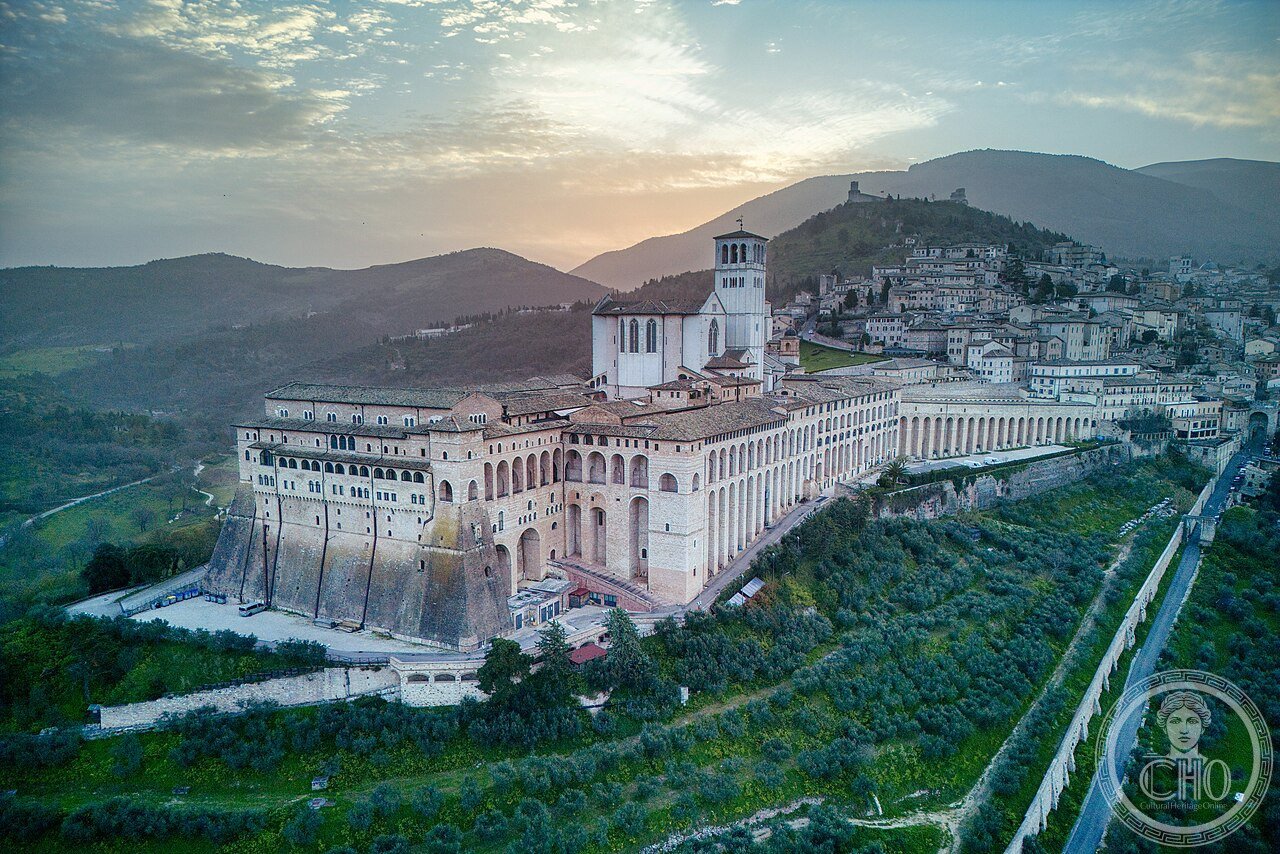
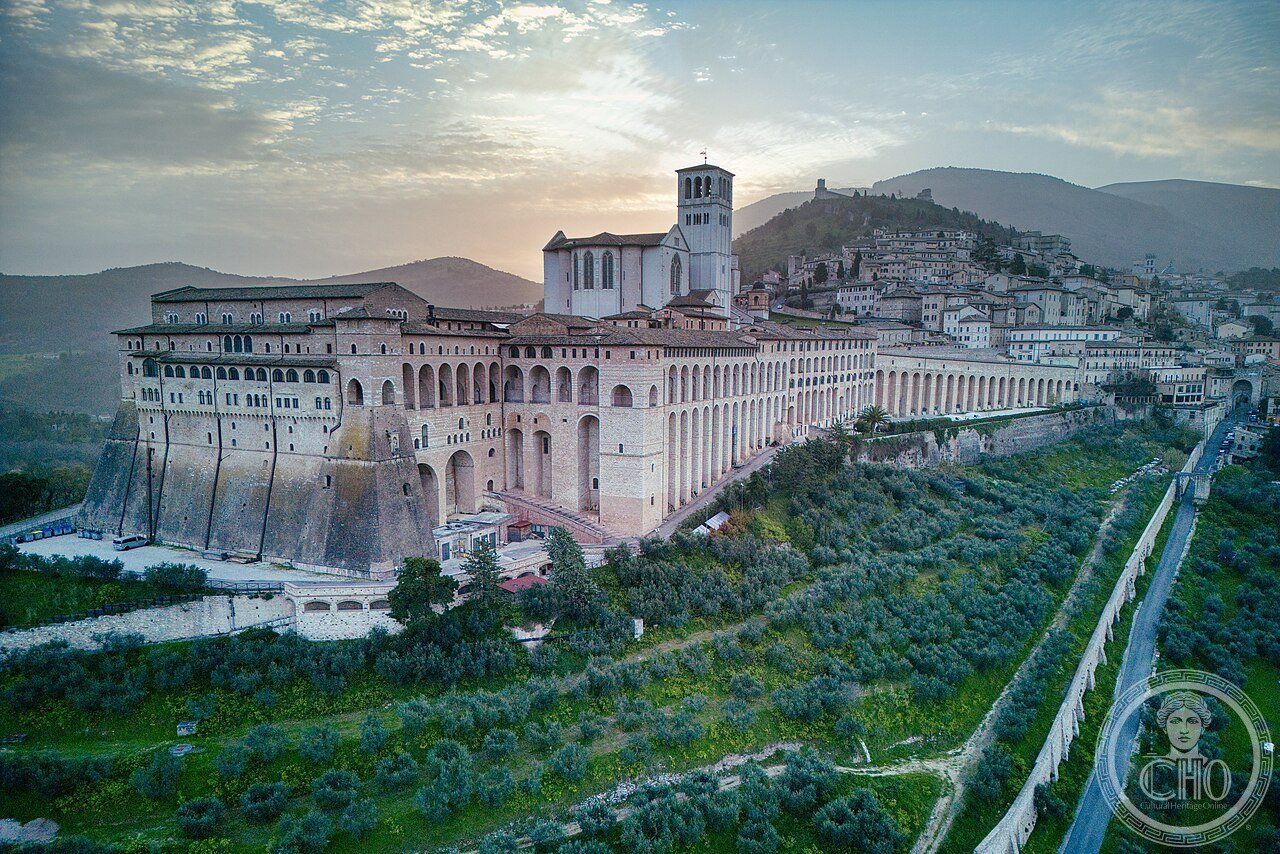
- Basilica di San Francesco — directly above the woodland, the 13th-century Franciscan complex whose walls border the property
- Sacro Convento — the monastery attached to the Basilica, former owner of the estate until 2010
- Rivotorto sanctuary — a 17th-century Franciscan site in the valley below
- Rio Tescio — the creek running along the valley floor, a tributary of the Chiascio and in turn of the Tiber
Sources
- FAI – Fondo Ambiente Italiano
- Tommaso da Celano, Vita Prima
- Bonaventura da Bagnoregio, Legenda Maior
- Fioretti di San Francesco
Gallery
Find it on the map
See this place and what’s around it →📷 Become a Cultural Heritage Online photographer
Share your photos of places: they stay published under your name as the author. The more they're seen, the more you get noticed — and soon a contest will reward the most appreciated photos.
Log in or sign up free to add a photo