
Villa Romana del Casale

Villa Romana del Casale Piazza Armerina 4th century Roman mosaic floor Bikini Girls Circus Maximus Sicily UNESCO 1997
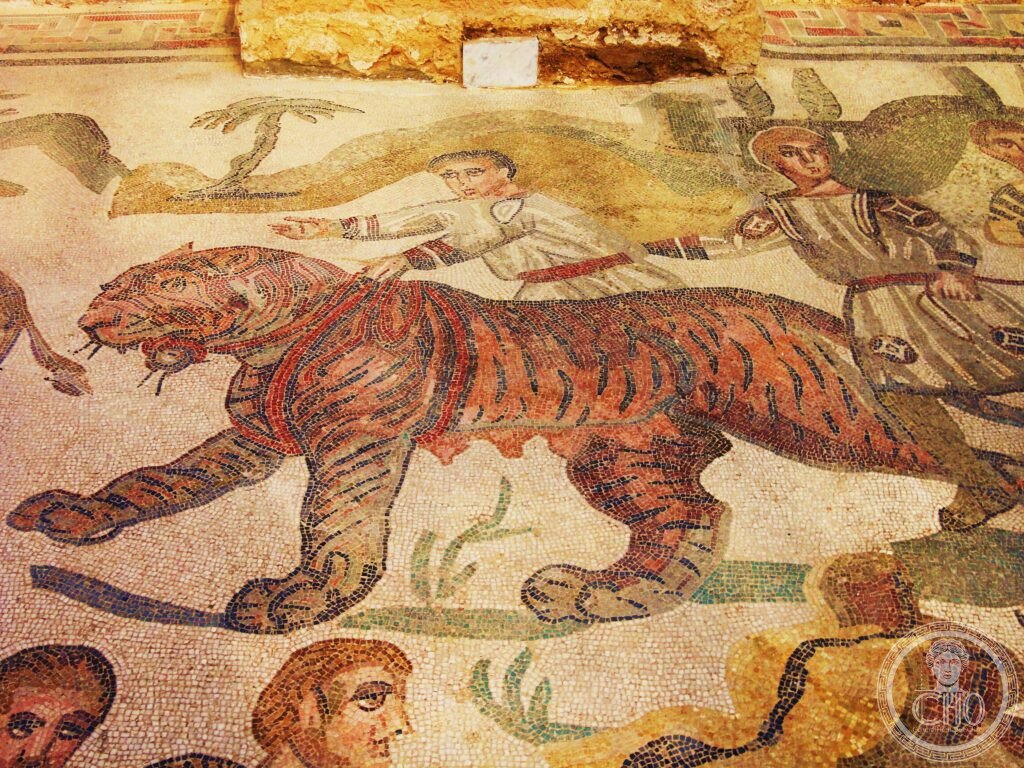
Villa Romana del Casale (4th century CE; the corridor of the Great Hunt — the 60m long mosaic floor showing the capture, transport, and display of wild animals from Africa (elephants, rhinoceroses, tigers) and the Middle East for the Roman arena; the most detailed visual documentation of Roman amphitheatre animal supply logistics in any surviving artwork; the floor area of this corridor is 330 sq m and constitutes a single continuous narrative read left to right), Piazza Armerina, Enna, Sicily, Italy. UNESCO World Heritage Site 1997. Photo via Wikimedia Commons.
Piazza Armerina, Enna, Sicily, Italy · 4th century CE (c.310–340 CE); 3,500 sq m surviving mosaic floor; largest intact Roman mosaic in the world; Bikini Girls mosaic (earliest known depiction of athletic women in two-piece garments); UNESCO WHS 1997 (reference 832)

Villa Romana del Casale

The largest and most elaborate surviving Roman mosaic floor in the world — the Villa Romana del Casale (UNESCO WHS 1997) preserves 3,500 square metres of 4th-century CE mosaic in near-perfect condition, including the Great Hunt corridor (60m long; the most detailed Roman mosaic of animal capture from Africa for arena display), the Bikini Girls mosaic (the earliest known depiction of women in two-piece athletic garments), and the Circus Maximus scene (40 metres long; the most detailed representation of Roman chariot racing in any medium).

At a glance

Villa Romana del Casale (the most precisely VillaRomana single Piazza-Armerina Enna Sicily Italy 37.3963 N 14.3497 E UNESCO WHS 1997 reference 832 4th century CE construction c.310–340 CE on the site of an earlier 2nd–3rd century CE Roman villa; the patron: probably Maximianus Herculius the co-emperor of Rome (286–305 CE) but this is a scholarly debate not a proven fact (the size and quality of the villa is consistent with imperial patronage; the mosaics show scenes of African animal hunting that match Maximianus’s known African campaigns; but no inscription names the owner); the villa covers approximately 3,500 sq m of mosaic floor (the surviving floor is the largest intact Roman mosaic programme in the world; the total original mosaic area was estimated at 4,500 sq m — 22% was destroyed in the 12th century CE when a landslide buried the villa; the buried condition (1m of clay and earth) is what preserved the mosaics; when unburied between 1950 and 1960 CE they were in remarkable condition; the subsequent debate about the transparent roof structures that now protect the floors is ongoing — the structures distort the viewing angles of the mosaics and are under review by UNESCO)).

Key facts

  • The Bikini Girls mosaic (the Room of the Ten Maidens and why it is the most discussed single room of the villa among non-specialists): the Sala delle Ragazze in Bikini (the Room of the Girls in Bikini; Ambiente 30 in the archaeological numbering; 4.5m × 6m; 10 female figures depicted in two separate athletic scenes) shows 10 women in strophium (chest band) and subligaculum (lower hip wrap) performing 5 different athletic activities: weight-lifting (a figure holds two stone weights above head — the Roman halteres, equivalent to dumbbells; the exact same exercise still used in modern athletics); discus throwing; running; a ball game (the figure is throwing a ball to a colleague off the right frame of the mosaic); and crowning a winner with a laurel branch and a palm frond; the mosaic was described in sensationalist language by popular press when it was cleared in the 1950s CE (“the Roman bikini girls!”) and the characterization stuck; the actual significance is scholarly: it is the earliest known representation of women engaged in competitive athletics in any surviving visual art; the Roman strophium is not equivalent to a modern bikini top (it was a functional athletic garment worn exclusively for athletics, not a beach or leisure garment) but the visual similarity to modern swimwear generated the popular name; the women depicted are not identified by name or status but their depiction in the same spatial and compositional frame as the male athletes elsewhere in the villa suggests they were female athletes of equivalent social status — not servants or performers
  • GPS: 37.3963° N, 14.3497° E

History

From imperial villa to Arab farmhouse to UNESCO mosaic (the most precisely VillaRomana single 2nd CE century original villa: the earliest archaeological evidence on the site is a 2nd century CE rural villa of moderate scale (pottery and tile fragments; no mosaic from this phase survives intact); the 4th century CE transformation: the original villa was demolished and replaced by a much larger building programme c.310–340 CE; the scale of the construction (the triclinium apse with its mosaics; the peristyle; the private baths; the connection corridor; the Great Hunt corridor) requires a patron of substantial wealth; the African mosaicists: the style of the mosaics (the flat-ground composition; the elongated figures; the specific colour palette; the treatment of animal anatomy) is consistent with North African workshops from Carthage (modern Tunisia) rather than Italian or Sicilian workshops; the mosaicists were brought from North Africa — the only comparable mosaics in quality and style are in the Bardo National Museum in Tunis and in the Piazza della Vittoria in Palermo; the commission of African mosaicists for a Sicilian villa demonstrates the commercial connections between Sicily and North Africa in late Roman period 440 CE the Western Roman Empire: Sicily was part of the empire but increasingly isolated; the villa may have been abandoned in the 5th century CE 902 CE Arab conquest of Sicily: the Arab geographer Ibn Hawqal mentioned a large ancient building in the interior of Sicily in his account of c.970 CE; the building described may be the villa 1160 CE Norman-era: an earthquake or flood collapsed the hill above the site and buried the villa under approximately 1m of mud and clay; the burial is what preserved the mosaics 1881–1890 CE first excavations by Saverio Cavallari (Director-General of Antiquities of Sicily); identified as a major Roman site but not systematically excavated 1929–1940 CE first systematic excavations by Paolo Orsi; 1950–1960 CE the definitive excavation and consolidation of the mosaics by Gino Vinicio Gentili; the transparent protective roof structures built in the 1970s CE are the structures currently in place (now under review) 1997 CE UNESCO inscription reference 832).

What you see

The Great Hunt corridor, the Circus Maximus, the Bikini Girls room, and the triclinium apse (the most precisely VillaRomana single visit circuit (the visit follows a raised walkway above the mosaic floor level throughout the entire villa; the walkway was built in the 1970s CE to allow visitor movement without floor contact; the height above the floor is 1.5–2m which distorts the mosaic viewing angle — the ideal viewing of Roman floor mosaics is from floor level looking down from normal height, which is impossible in the current protective configuration); the circuit (2 hours minimum; more for photography): 1) Entrance through the peristyle (the central courtyard; 17m × 17m; the mosaic floor of the peristyle is a geometric carpet pattern in black-and-white tesserae — the only purely geometric floor in the villa; all other floors are figural); 2) Private baths (3 rooms; the tepidarium, frigidarium, and caldarium; the floor mosaics show sea creatures (fish, dolphins, sea nymphs) appropriate for a bathing environment; the specific room: the Sala della Pesca (Room of Fishing) — small circular room with a mosaic of putti fishing from boats); 3) The Great Hunt corridor (Corridoio della Grande Caccia; 60m × 5m; the continuous narrative mosaic of animal capture and transport: the left end is in Africa (elephants, rhinoceroses, lions netted and crated); the right end is in the Middle East (tigers in India; a phoenix — the only phoenix depicted in Roman floor mosaic); the central figure (a man in a military officer’s costume with an elaborate decorated cloak — the paludamentum of a senior Roman officer) is usually identified as the villa owner/patron); 4) Room of the Ten Maidens (the Bikini Girls room; the shortest visit (4.5m × 6m) but most photographed space in the villa; the 10 athletes are depicted on the long walls; the winner of the athletic competition receives a laurel crown and a palm frond in the central panel); 5) The Circus Maximus mosaic (the largest figural mosaic in the villa; 40m × 5m; depicts 4 chariot teams (red/blue/green/white — the same 4 factiones of the historical Roman circus) racing at the Circus Maximus; the starting gates (carceres), the central barrier (spina) with monuments, the turning posts (metae), and the accident at the far turn are all depicted; the most detailed Roman depiction of chariot racing in any surviving medium); 6) The triclinium apse (the formal dining room; the largest single mosaic space; the floor mosaic shows the Labours of Hercules; the apse shows the Gigantomachy (the battle between the Olympian gods and the Giants) — the most ambitious mythological programme in the villa)).

Practical information

  • Getting there from Palermo or Agrigento: Palermo to Piazza Armerina: no direct train; either bus (Interbus; Palermo to Piazza Armerina; 2h45m via Enna; check schedule at interbus.it) or rent a car from Palermo airport (90 min); Agrigento to Piazza Armerina: by car 1h10m (SS189 via Mazzarino — the most direct route through the Sicilian interior; very few tourist facilities on this route: fuel in Mazzarino; the Valle dei Templi at Agrigento is 60 km from the villa — the most logical combination visit); from Catania: 1h30m by car or 2h by bus; the villa opening times (9 AM–7 PM daily; last admission 6 PM; €10 adults; the guided tour in English is available at 10 AM, 12 PM, and 3 PM for €5 additional; the guided tour covers the rooms that require specific interpretation (the Circus Maximus chariot teams; the Great Hunt North African geography)); photography (the protective roof structures produce uneven lighting; the best natural light in the mosaic is 10 AM–12 PM when the overhead light is most direct; the Bikini Girls room is the most evenly lit space year-round due to its east-facing aspect); the town of Piazza Armerina (5 km from the villa; the historic centre is 12th–17th century; the Duomo (17th century baroque) on the highest point of town; the palio dei normanni festival (August 12–14 annually; the Norman conquest of Sicily re-enacted with crossbowmen and horse parade — the only medieval tournament festival in the Sicilian interior))

Getting there

From Palermo: bus Interbus 2h45m or rental car 90 min. From Agrigento: car 1h10min (pair visit with Valle dei Templi). From Catania: car 1h30min. Open 9-19 daily, €10. Guided tour English 10/12/15 (+€5). Best light 10-12 AM. GPS: 37.3963, 14.3497.

Nearby

  • Valle dei Templi, Agrigento — 60 km south-west (UNESCO WHS 1997; the 7 Greek temples on the ridge above Agrigento; the Temple of Concordia (c.440 BCE; the best-preserved Greek Doric temple in the world outside the Athens Acropolis — more complete than any surviving temple in mainland Greece; all 34 columns standing; the reason it survived: converted to a Christian church in 597 CE, which meant the interior and colonnade were maintained rather than quarried for stone); the Almond Blossom Festival (February; when the almond trees in the Valle dei Templi flower simultaneously, the ridge becomes a mass of white and pink blossom against the yellow limestone columns — the most photographed seasonal event in Sicily))
  • Enna — 30 km north (the highest provincial capital in Italy at 931m; the Castle of Lombardia (13th century Norman castle; the tallest medieval castle in Sicily; the view of Etna from the castle towers on clear days); the Duomo (14th–17th century; the most important medieval church in the Sicilian interior; the silver treasury with Baroque ex-votos))

Sources

  • Wikipedia, Villa Romana del Casale; Roman mosaics; Maximianus Herculius, accessed June 2026
  • UNESCO, Villa Romana del Casale, WHS reference 832, inscribed 1997
  • Gentili, Gino Vinicio. La Villa Erculia di Piazza Armerina. Rome: Istituto Poligrafico e Zecca dello Stato, 1952

Hero image: Villa Romana del Casale, Piazza Armerina, Sicily, Italy, Wikimedia Commons. Editorial text © Cultural Heritage Online, 2026.

📷 Diventa un fotografo di Cultural Heritage Online

Condividi le tue foto dei luoghi: restano pubblicate con la tua firma come autore. Più vengono viste, più ti fai conoscere — e presto un concorso premierà le foto più apprezzate.

Accedi o registrati gratis per aggiungere una foto
📋 Copy & share on social
Scroll to Top