
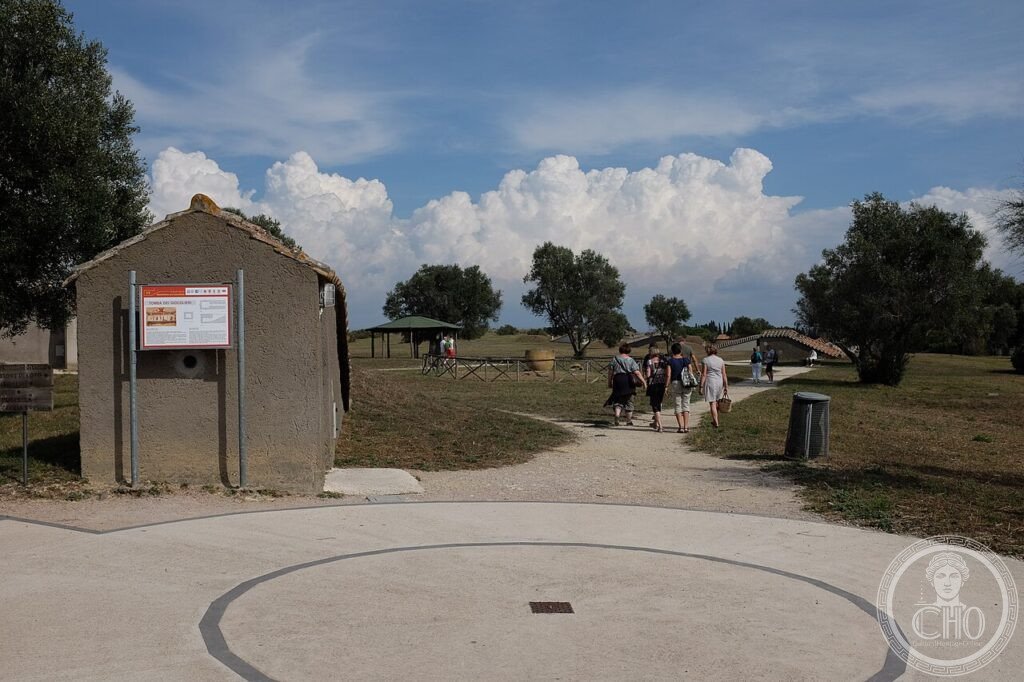
Two Etruscan cities of the dead face one another across Lazio: Tarquinia’s Monterozzi necropolis holds the richest surviving collection of Etruscan tomb paintings, while Cerveteri’s Banditaccia necropolis lays out its tumuli in streets and blocks that mirror the living city above. Together they form the most complete picture left of how the Etruscans imagined the afterlife.
At a glance
At Tarquinia, the Monterozzi necropolis contains thousands of tombs cut into the tufa, of which a working group is currently open to visitors while the rest remain sealed for conservation. Around two hundred of these tombs are painted, making the site the only place where large-scale Etruscan wall painting survives at all: the Etruscans painted widely on wood and cloth too, but only the tomb walls, sealed from the moment of burial until their rediscovery, kept their colour.
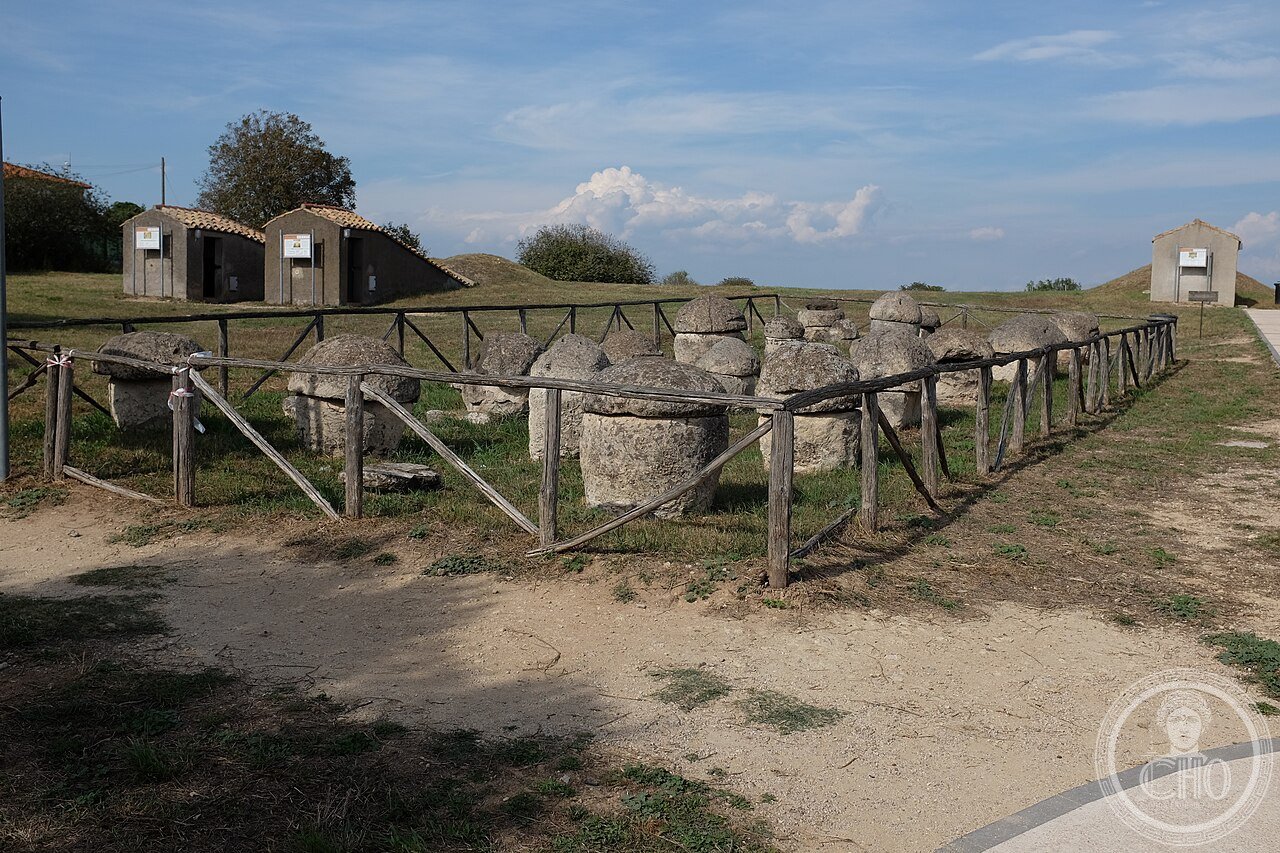
At Cerveteri, the Banditaccia necropolis spreads across some 400 hectares. Its tumuli, circular earth mounds raised on stone bases, are set out along streets and in blocks that copy the plan of the Etruscan city of Caere above. The largest of them, the Tumulo dei Carri, is about 35 metres across and dates to the 9th–7th centuries BCE. The arrangement reflects an Etruscan idea that the dead lived on in a city that had to be built and organised just as carefully as the city of the living.
Key facts
- Tomb of the Leopards: painted around 480–470 BCE at Tarquinia and discovered in 1875, its back wall shows two confronted leopards flanking a stylised tree, a composition adapted from Greek ‘mistress of animals’ imagery.
- Banquet scene: the same tomb’s rear wall shows men and women reclining together at a symposium, evidence often cited for the comparatively high social standing of Etruscan women beside their Greek contemporaries.
- Pigments: the painters used several distinct colours including Egyptian Blue, a pigment made from copper calcium silicate and traded through Phoenician intermediaries.
- Technique: the Leopards tomb was painted in fresco secco, on dry plaster, which allowed correction and overpainting, unlike the wet-plaster technique used in some other tombs such as the Tomba della Caccia e Pesca.
- Tumulo dei Carri: at Cerveteri, the largest tumulus in the Banditaccia necropolis, roughly 35 metres in diameter.
History
The Etruscan civilisation took shape in central Italy between the Arno and the Tiber from around the 9th century BCE, growing out of the earlier Villanovan Iron Age culture rather than arriving from elsewhere, as later genetic study of Etruscan remains has supported against the ancient claim, recorded by Herodotus, of an origin in Lydia. Their language survives in inscriptions that can be read but not fully understood; the longest known text, the Liber Linteus Zagrabiensis, was reused as linen wrapping for an Egyptian mummy and is now held by the Zagreb Museum of Archaeology.
The 7th century BCE marked the height of Etruscan wealth, when contact with the eastern Mediterranean introduced painted tombs, elaborate bronze work and the distinctive black bucchero pottery; the first painted tombs at Tarquinia date from this period. Etruscan kings ruled early Rome, and Tarquinia’s own rulers included two of them, while Etruscan practices such as the triumph, the fasces and the toga passed into Roman civic life. Rome’s conquest of Etruscan territory began with the fall of Veii in 396 BCE and was complete by 200 BCE.
The painted tombs re-entered history in the modern era: a Jesuit priest recorded several in the late 17th century, and 18th-century Grand Tour excavations, including work associated with the Scotsman Gavin Hamilton, led to some tombs being removed and sold abroad before Italian legislation halted the trade. The Tomb of the Leopards came to light in 1875, and the site was inscribed as a UNESCO World Heritage property, jointly with Cerveteri, in 2004.
What you see
At Tarquinia, the visit to the Monterozzi necropolis is a walk across open ground punctuated by narrow stairways cut into the rock, each leading down into a single tomb chamber. A working selection of the painted tombs is open at any time, kept under controlled conditions to protect the pigments, which are highly sensitive to changes in humidity after centuries sealed underground. Among them are the Tomba dei Leopardi with its banqueting scene, the Tomba della Caccia e Pesca with its naturalistic hunting and fishing frieze, the Tomba delle Leonesse with dancing figures between heraldic beasts, and the Tomba degli Auguri with its wrestling athletes, the earliest known image of an Etruscan ritual game.
The Museo Nazionale Tarquiniese, housed in the Palazzo Vitelleschi close to the necropolis, holds material excavated from the tombs and complements a visit to the site itself.
At Cerveteri, the Banditaccia necropolis is walked rather than entered underground for the most part: its interest lies in the town-planning of the dead, streets and piazzas of tumuli laid out to answer the streets of Caere above, with the Tumulo dei Carri as its most imposing single monument.
Practical information
- Access: only a portion of the painted tombs at Tarquinia is open to visitors at any given time; check current access and any conservation closures with the site’s official channels before travelling.
- Conditions underground: the tombs are entered by steep, narrow stairways and are managed to limit humidity change, so groups may be paced or tombs rotated.
- Combined visit: the Museo Nazionale Tarquiniese and the necropolis are usually treated as a single visit given their proximity.
- Tickets and times: current admission arrangements, opening times and any combined tickets should be checked directly with the managing authority rather than assumed from older listings.
Getting there
The Monterozzi necropolis lies a short distance from the centre of Tarquinia and is reached by local bus or taxi. The Banditaccia necropolis is similarly close to Cerveteri’s town centre. Both sites are in Lazio, within reach of Rome, and visitors typically plan a day for each necropolis given the walking involved on site.
Nearby
- Museo Nazionale Tarquiniese — housed in the Palazzo Vitelleschi near the Monterozzi necropolis, with finds from the painted tombs.
- Cerveteri town centre — close to the Banditaccia necropolis, built on the site of ancient Caere, the city the tumuli were laid out to mirror.
Sources
- UNESCO
- Museo Nazionale Tarquiniese
- Zagreb Museum of Archaeology
Gallery
Find it on the map
See this place and what’s around it →📷 Become a Cultural Heritage Online photographer
Share your photos of places: they stay published under your name as the author. The more they're seen, the more you get noticed — and soon a contest will reward the most appreciated photos.
Log in or sign up free to add a photoIs this page about you?
This page is read by travellers and heritage enthusiasts who find it on Google. Tell us how you are connected to this place and we will take it from there.