
Necropoli Etrusche di Tarquinia e Cerveteri

Tarquinia Etruscan necropolis tomb paintings Monterozzi banquet dancers birds 7th 4th century BCE Lazio UNESCO 2004
Interior of the Tomba della Caccia e Pesca (Tomb of Hunting and Fishing; c.510 BCE; Tarquinia; Monterozzi necropolis; the painted frieze shows a hunter throwing a stone at birds while another boat-borne fisherman holds a line; the sea is rendered as a deep blue-green band below and sky as pale blue above; the precision of bird species (the great blue heron identifiable by neck curve and wing spread) marks this as one of the most naturalistically observed Etruscan tomb paintings; the painting technique: the pigments were applied to fresh plaster in a single session — the Etruscan painters worked without underdrawing, applying the final colours directly to wet lime), Monterozzi necropolis, Tarquinia, Viterbo, Lazio, Italy. UNESCO World Heritage Site 2004. Photo via Wikimedia Commons.
Tarquinia and Cerveteri, Lazio, Italy · Etruscan civilization 9th–2nd century BCE; Monterozzi necropolis Tarquinia (painted tombs 7th–4th BCE); Banditaccia necropolis Cerveteri (tumuli street plan); UNESCO WHS 2004 (reference 1158 serial)

Necropoli Etrusche di Tarquinia e Cerveteri

The two largest surviving Etruscan necropolises in the world — Tarquinia (UNESCO WHS 2004, serial nomination) holds the most important collection of Etruscan tomb paintings in existence, while Cerveteri’s Banditaccia necropolis is the most urbanistically organized ancient cemetery in the Mediterranean: a city of the dead with streets, piazzas, and neighbourhoods laid out like the living city above it.

At a glance

Necropoli Etrusche (the most precisely NecropoliEtrusche serial Tarquinia-Cerveteri Lazio Italy UNESCO WHS 2004 reference 1158 2 components: Tarquinia (Monterozzi necropolis; the painted tombs; approximately 6,000 tombs excavated of an estimated 50,000 total; 200 painted tombs (the only ones currently accessible to visitors — the others are sealed for conservation); the tomb paintings represent the only large-scale Etruscan painting tradition to survive; the Etruscans painted extensively on walls but the painted wood, cloth, and non-tomb-wall surfaces have all perished; the tombs preserve the painting because they were sealed immediately after the burial and not opened until the 18th CE century) + Cerveteri (Banditaccia necropolis; 400 hectares; the tumuli — circular earth mounds with stone bases covering the burial chambers — are arranged in streets and blocks that reproduce the street plan of the living Etruscan city of Caere (Cerveteri) above; the largest tumuli (Tumulo dei Carri; 35m diameter) date to the 9th–7th centuries BCE; the Etruscan concept: the dead live in a city parallel to the living city and the necropolis must be organized as such — the most explicit archaeological example of the Etruscan afterlife concept as mirror-city)).

Key facts

  • The Tomb of the Leopards (Tomba dei Leopardi; c.480–470 BCE) and why it represents the peak of Etruscan tomb painting technique: the Tomb of the Leopards at Tarquinia (discovered 1875 CE; main chamber 4m × 3m × 2.5m; painted on all 3 walls and the ceiling) is identified by the two confronted leopards painted on the pediment of the back wall flanking a tree (the specific visual: two spotted leopards face each other symmetrically, separated by a stylized tree; the composition is adapted from the Greek “mistress of animals” iconographic schema but using leopards rather than the typical lions); the most important wall: the back wall shows a banquet scene (5 reclining figures on cushioned couches; men and women reclining together — a scene that shocked 18th-century European archaeologists who assumed Etruscan women were concubines rather than guests; the reclining women are now understood as a distinctive Etruscan social practice where elite women participated in symposia as equals, unlike the Greek practice where only hetairai (courtesans) were present at male symposia; this is the most frequently cited evidence that Etruscan elite women had a social status equivalent to men — significantly higher than in contemporary Greek society); the technical achievement: the painters of the Leopards tomb used 7 distinct pigments including a blue made from Egyptian Blue (copper calcium silicate — a pigment manufactured in Egypt since 2500 BCE; the Etruscans traded for it through Phoenician intermediaries); the paint application is fresco secco (on dry plaster rather than wet; the distinction matters because fresco secco allows overpainting and correction while buon fresco does not; the Etruscan painters used a technique that gave them flexibility the contemporary Greeks did not use in their tomb paintings)
  • GPS Tarquinia: 42.2486° N, 11.7654° E (Monterozzi necropolis)
  • GPS Cerveteri: 42.0000° N, 12.1000° E (Banditaccia necropolis)

History

From Etruscan civilization to rediscovery to UNESCO heritage (the most precisely NecropoliEtrusche serial 9th BCE century: the Etruscan civilization (Etrusci; the Greeks called them Tyrsenoi or Tyrrheni — the Tyrrhenian Sea is named after them) developed in central Italy between the Arno and the Tiber rivers in the 9th century BCE; the Etruscans were not a single ethnic group with an origin from outside Italy (the ancient debate: Herodotus said they came from Lydia in Asia Minor; Dionysius of Halicarnassus said they were indigenous; modern DNA evidence (2019 CE study of Etruscan remains) shows they were descended from Bronze Age Italian populations with no significant Anatolian migration) but a cultural complex that developed in situ from the Villanovan culture of the Iron Age; the Etruscan language: written in a Greek-derived alphabet but not related to any other known language family; readable (scholars can transliterate) but not fully understood; the longest surviving Etruscan text: the Zagreb mummy linen (liber linteus zagrabiensis; an Etruscan ritual text written on linen strips used as mummy bandages in Egypt; now in Zagreb Museum of Archaeology; approximately 1,200 words survive) 7th BCE century: the period of maximum Etruscan wealth and cultural production; the Orientalizing period (the influence of eastern Mediterranean cultures via Phoenician trade) introduced the painted tomb tradition, the production of elaborately decorated bronze vessels, and the bucchero pottery (the distinctive grey-black burnished ceramic unique to Etruscan production); the Tarquinia painted tombs begin in this period (c.670 BCE first painted tombs) 600–400 BCE: the Archaic and Classical periods; the tomb paintings of this period (Tomba dei Leopardi; Tomba della Caccia e Pesca; Tomba dei Danzatori) are the most aesthetically important; the Etruscan influence on Rome: the three Etruscan kings of Rome (Tarquinius Priscus c.616–579 BCE; Servius Tullius c.578–535 BCE; Tarquinius Superbus c.534–509 BCE) were from Tarquinia; the specifically Roman institutions that the Etruscans introduced include: the triumph (the military victory parade); the fasces (the bundle of rods with an axe that became the Roman symbol of authority — and the symbol of the Italian Fascist movement from which it takes its name); the toga; gladiatorial combat; the circus with chariot racing 396 BCE Rome captured Veii (the most southerly Etruscan city) beginning the systematic Roman conquest of Etruscan territory that was completed by 200 BCE 1697 CE first systematic excavation of Tarquinia tomb paintings (a Jesuit priest, P. Kircher, documented 3 painted tombs in a Latin text); 18th CE century major discoveries by Scotsman Gavin Hamilton and others; the painted tombs began to be sold to wealthy Grand Tour visitors — several were physically removed and taken to England, France, and Germany before Italian protective legislation stopped the trade 1875 CE Tomb of the Leopards discovered (one of the most important finds of the century); the first photographs of Etruscan tomb paintings taken in the 1870s CE 2004 CE UNESCO WHS serial nomination reference 1158).

What you see

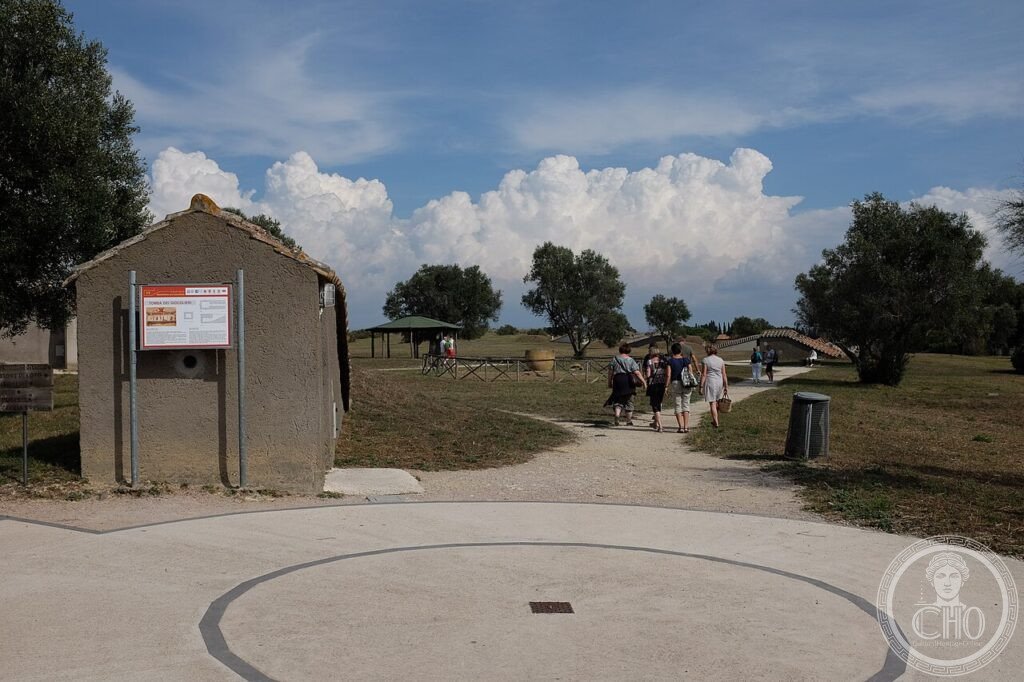
Monterozzi painted tombs (Tarquinia), Banditaccia tumuli (Cerveteri), and the Museo Nazionale (the most precisely NecropoliEtrusche serial Tarquinia visit (1.5–2 hours for the necropolis + 1 hour for the museum): the Monterozzi necropolis (2km from Tarquinia town centre; bus or taxi; open 8:30 AM–7:30 PM; closed Monday; €10 adults; the visit is organized as a surface walk through the necropolis with access to 13–15 painted tombs via individual underground accesses (vertical stairs cut into the tufa rock; each tomb accessed by 3–5 steps); the tombs are kept at a controlled temperature and humidity (the main threat to Etruscan painted tombs is moisture variation — when tombs were first opened in the 18th century the oxygen exposure caused rapid deterioration of the pigments; modern management seals the tombs between visitor groups); the key tombs to see: Tomba dei Leopardi (c.480 BCE; the most famous); Tomba della Caccia e Pesca (c.510 BCE; the naturalistic hunting/fishing scenes); Tomba delle Leonesse (c.520 BCE; female figures dancing between two opposing leopard/lioness heraldic figures); Tomba degli Auguri (c.530 BCE; wrestling athletes; the earliest surviving depiction of an Etruscan ritual game)); the Museo Nazionale Tarquiniese (Palazzo Vitelleschi; Piazza Cavour 1; 10 min walk from the necropolis; €10 adults or combined ticket with necropolis €15; the carved stone sarcophagus of Magnate (4th century BCE; the most elaborately carved Etruscan sarcophagus outside Rome; the lid figure (the reclining banquet pose of the deceased) is 2.4m long; the alabaster coloring is original); the winged horses (Cavalli Alati; 4th century BCE; terracotta relief from the Ara della Regina temple of Tarquinia; the most frequently reproduced Etruscan artwork after the She-Wolf); Cerveteri visit (the Banditaccia necropolis; 30 min from Rome by train + bus; the surface walk through the tumuli streets takes 1.5–2 hours; the interior of the largest tumuli accessible; the Tomba dei Rilievi (Tomb of the Reliefs; closed to general public but viewable through the grill; the interior walls covered with carved and painted stucco reliefs of all the objects of Etruscan daily life: kitchen utensils, weapons, games, pets; the most detailed inventory of Etruscan domestic culture in any single space)).

Practical information

  • Getting there and visiting both sites: from Rome: Tarquinia (Termini or Roma San Pietro to Tarquinia station by Trenitalia; 1h15m by Intercity or 1h45m by Regionale; from station take taxi or walk 3km to necropolis; the town of Tarquinia itself is medieval and worth 30 min for the Palazzo Vitelleschi museum and the town walls); Cerveteri (Roma San Pietro or Roma Ostiense to Cerveteri-Ladispoli; 40 min; from station: bus 4km to the town; the Banditaccia necropolis is 2km from town centre; the combination of Cerveteri + Tarquinia in one day from Rome is difficult (3h30m total travel) — better to dedicate a day to each with a night in Tarquinia or the Maremma area; the best single-day option from Rome is Cerveteri alone (40 min train + 30 min bus = more manageable round trip)); the photography challenge of Etruscan painted tombs: flash photography strictly prohibited in all painted tombs (the flash pigments are documented to accelerate deterioration at specific wavelengths; only available-light photography permitted; the light in the tombs is the lowest-intensity conservation lighting possible; a smartphone will capture some detail but will miss the colour range; professional photographers must apply in advance to the Soprintendenza); the combination with other sites (Viterbo: 25 km from Tarquinia; the medieval thermal baths city (the Bullicame thermal spring (referred to by Dante in Inferno 14.79); the Palazzo dei Papi (the most completely surviving 13th century Papal court building in Italy); the Museo Nazionale Etrusco di Villa Giulia in Rome (the largest collection of Etruscan objects in the world — 12,000 objects including the Apollo of Veii terracotta statue (510 BCE; the most important surviving Etruscan monumental sculpture) and the Ficoroni Cista (engraved bronze marriage gift c.330 BCE; the most elaborate surviving Etruscan bronze engraving; the inscription identifies the maker as Novios Plautios of Rome who made it for Dindia Macolnia of Praeneste — the only signed Etruscan bronze))

Getting there

From Rome Termini: Tarquinia 1h15min by Intercity, then taxi/bus to necropolis. Cerveteri: 40 min from Roma San Pietro. Necropolis open 8:30-19:30 (closed Monday). Combined ticket Tarquinia necropolis+museum €15. No flash photography. GPS Tarquinia necropolis: 42.2486, 11.7654.

Nearby

  • Civita di Bagnoregio — 60 km north-east (the dying city: a medieval hilltop town on a tufa pinnacle that is slowly eroding; accessible only by a 300m footbridge; the population has dropped from 2,000 (12th CE century) to 12 permanent residents (2023 CE); the town was founded by the Etruscans on a tufa block that the earthquakes and rains are slowly disintegrating; UNESCO candidature ongoing; a specific Italian case study in how landscape fragility and human habitation interact)
  • Viterbo — 25 km (the only medieval city in central Italy with its complete medieval walls and a complete medieval papal court building (Palazzo dei Papi; 1267 CE; the loggia above the square is the longest loggia in medieval central Italy; the site of the longest papal conclave in history: 1268–1271 CE; 33 months; the cardinals were locked in until they elected Gregory X; the Viterbesi eventually removed the roof to force a decision — the origin of the word “conclave” (from Latin “with a key”)))

Sources

  • Wikipedia, Tarquinia necropolis; Banditaccia necropolis; Etruscans; Tomb of the Leopards; Etruscan language, accessed June 2026
  • UNESCO, Etruscan Necropolises of Cerveteri and Tarquinia, WHS reference 1158, inscribed 2004
  • Haynes, Sybille. Etruscan Civilization. Los Angeles: Getty Publications, 2000

Hero image: Tarquinia Etruscan necropolis painted tomb, Lazio, Italy, Wikimedia Commons. Editorial text © Cultural Heritage Online, 2026.

📷 Diventa un fotografo di Cultural Heritage Online

Condividi le tue foto dei luoghi: restano pubblicate con la tua firma come autore. Più vengono viste, più ti fai conoscere — e presto un concorso premierà le foto più apprezzate.

Accedi o registrati gratis per aggiungere una foto
📋 Copy & share on social
Scroll to Top