
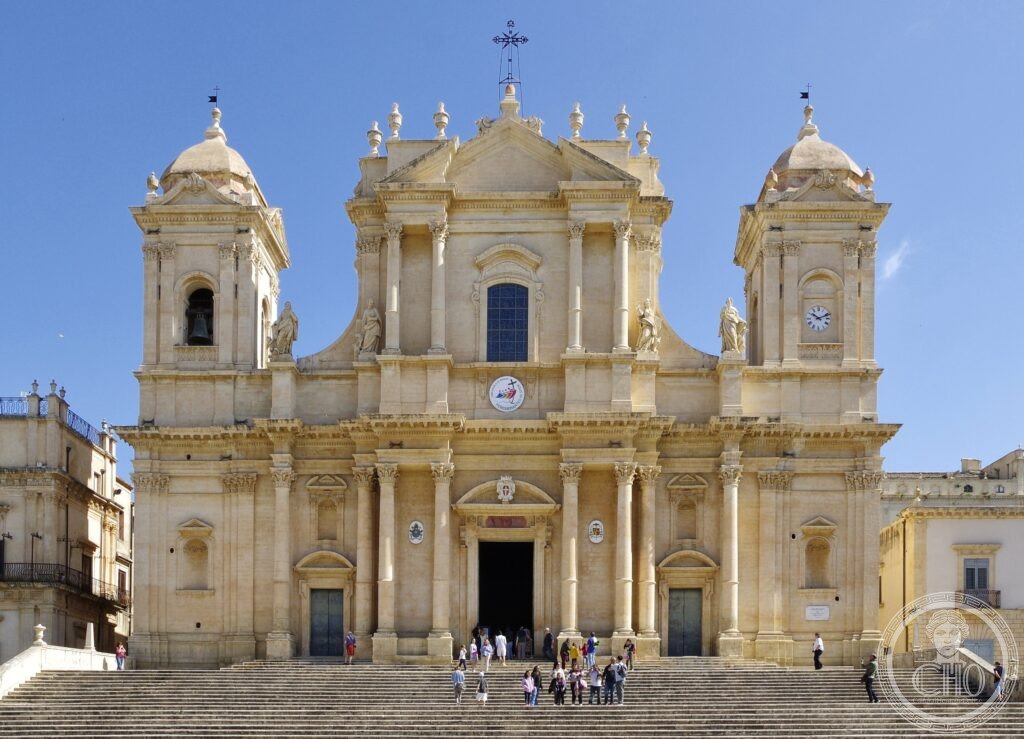
Tardo Barocco del Val di Noto
The largest ensemble of Late Baroque urban architecture in Europe — eight towns in south-east Sicily (UNESCO WHS 2002) were built from scratch after the Val di Noto earthquake of 11 January 1693 CE (the worst earthquake in Italian history; M7.4; 60,000 dead in 24 hours) using a local golden limestone that the Baroque light of southern Sicily turns amber in the evening, creating the most homogeneously beautiful urban texture of any 18th-century building campaign in Europe.
At a glance
Val di Noto Late Baroque (the most precisely ValDiNoto single UNESCO WHS 2002 reference 1024 serial nomination 8 towns: Caltagirone Militello in Val di Catania Catania Modica Noto Palazzolo Acreide Ragusa Scicli 11 January 1693 CE Val di Noto earthquake M7.4 magnitude the largest earthquake in European history in terms of fatalities 60,000 dead in 24 hours southeastern Sicily and Calabria most of the dead in the Val di Noto zone (the zone between Catania and Siracusa on the Iblean plateau); the rebuilt towns were designed by architects working in the fully formed Late Baroque style: wider streets than the medieval pattern (to provide escape routes and prevent building collapse trapping people — the first earthquake-informed urban planning in European history); the principal architects: Rosario Gagliardi (c.1698–1762 CE; the most prolific architect of the Val di Noto reconstruction; churches at Noto Modica Ragusa); Giovanni Battista Vaccarini (1702–1768 CE; Catania); the distinctive material: Iblean limestone (pietra calcarea iblea) a warm golden-amber stone cut from the plateau below the towns and used for all major structures; the colour deepens dramatically in late-afternoon light).
Key facts
- Noto and the Baroque concave-convex facade (why an undulating stone wall became the signature of south-eastern Sicilian architecture): Rosario Gagliardi (c.1698–1762 CE; born probably in Syracuse; the most important architect of the Val di Noto reconstruction) designed the Cathedral of San Nicolo in Noto (1703–1776 CE; the main Baroque church of the principal showcase town of the reconstruction) with a facade that uses the concave-convex-concave surface movement invented by Borromini for San Carlo alle Quattro Fontane in Rome (1634 CE) but translates it into the warm golden stone of Sicily and scales it to the proportions of a cathedral rather than a small oratory; the key Gagliardi move: the convex central bay of the facade is framed by two slightly concave flanking bays, all of the same warm Iblean limestone, so that the undulation of the facade is visible only as a slight difference in shadow at different times of day; at noon the facade is flat and golden; at dawn and dusk the shadows between the bays give the surface a three-dimensional quality that photographs cannot capture (a fact the Noto tourist authority repeatedly advertises: “come at sunset”); the 40-step staircase (the 40 marble steps of the approach to the cathedral door — each step 2m wide and 15cm tall — were designed to be visible from the lower Corso Vittorio Emanuele from a distance of 200m; the staircase is architecturally the oldest known example of a stepped approach specifically designed to be photographed from a distance — Gagliardi in 1703 CE anticipated the photographic framing that would define the cathedral’s global image 260 years before photography existed; this is the interpretation offered in the major Noto architectural study: Tobriner, Stephen, The Genesis of Noto, 1982 CE)
- GPS: 36.8882° N, 15.0700° E (Noto Cathedral, the principal hub town)
History
From earthquake to 60-year building campaign to UNESCO heritage (the most precisely ValDiNoto single 11 January 1693 CE earthquake M7.4 at approximately 21:00 local time two major shocks: a smaller foreshock the previous day (January 9; M6.2) and the main shock January 11; the January 11 shock was felt across all of southern Italy and Malta; the death toll: 60,000 in 24 hours (contemporary estimate by viceroy of Sicily); all major towns of Val di Noto destroyed including Noto Antica (the original medieval Noto on a hilltop); Ragusa Ibla (the medieval quarter); Catania (80% destroyed); Scicli; Modica; January–February 1693 CE reconstruction debates: Noto Antica: the Flemish military architect Carlos de Grunenbergh (1627–1696 CE; viceroy engineer) argued for rebuilding in a new location on the plain (safer from rockslides); the local nobility argued for rebuilding on the old hilltop; the compromise: the new Noto was built 8 km away on a different (lower, flatter) site — the first planned relocation of an entire city in Italian history after a natural disaster; the planning of the new town: a straight main axis (Corso Vittorio Emanuele) 600m long; a grid of streets on a slight north-south slope; the major civic buildings (Cathedral, Palazzo Ducezio, Church of San Francesco) all positioned along the Corso with a deliberate visual sequence from east to west; the effect: walking east on the Corso you see a sequence of Baroque concave-convex facades of different buildings at different distances — a planned Baroque perspective sequence unique in European urban planning the first UNESCO inscription in the Mediterranean for earthquake-driven urban heritage: the uniqueness of the Val di Noto nomination was the recognition that the entire urban landscape — not individual buildings — had been destroyed and rebuilt as a single act of Baroque urban design; no single architect designed “Noto” as a city; it was the coordinated result of 60 years of multiple architects working within a single aesthetic convention (Late Baroque) and a single material (Iblean limestone); this is the UNESCO argument for the serial nomination: the coherence comes not from a plan but from a convention 2002 CE UNESCO WHS inscription 2009 CE Modica chocolate recognised by EU as IGP (Indicazione Geografica Protetta): Modica chocolate (cioccolato di Modica) is processed cold without additional cocoa butter or emulsifiers — the sugar crystals remain granular; the texture is grainy, not smooth; the taste is intense; the technique was brought to Sicily by the Spanish who learned it from the Aztecs; it is the only chocolate in Europe processed by the pre-Columbian cold-working method; the EU IGP designation followed a long campaign by the Modica chocolate association; there are approximately 60 artisan chocolate makers in Modica (population 55,000) — the highest density of artisan chocolate production per capita of any city in Europe).
What you see
Noto (principal hub), Ragusa Ibla, Modica, and Scicli (the most precisely ValDiNoto single 4 key towns for the visitor circuit: Noto (the most architecturally coherent and most photographed; full day to do Corso Vittorio Emanuele properly: Cathedral + Palazzo Ducezio + Church of San Francesco + Church of San Domenico (Gagliardi; 1726 CE; the most technically complex Gagliardi facade — 3 tiers of columns with alternating concave and convex elements and 3 different column orders (Doric base, Ionic middle, Corinthian top) compressed into a 20m-wide facade); Ragusa (split between Ragusa Ibla the pre-earthquake medieval quarter rebuilt Baroque style after 1693 CE on the original hilltop — the population refused to move to the new rational Ragusa Superiore — and the new Ragusa Superiore on the adjacent ridge; the Duomo di San Giorgio in Ragusa Ibla (1744–1775 CE; Rosario Gagliardi; the grandest Gagliardi church; the 3-tier facade with the same concave-convex movement; the best approach is from below via the staircase from Piazza della Repubblica looking up at the church rising above the roofline of Ibla); Modica (the chocolate city; 2 Baroque churches above the V-shaped valley where the two streams merge: San Giorgio (1702–1760 CE; Gagliardi; comparable to Ragusa Ibla San Giorgio) and San Pietro (1699 CE; different architect; more conservative but impressive); the chocolate shops along Corso Umberto I the specific flavour variants: chilli (original Aztec recipe; the most historically authentic), vanilla (17th century Spanish addition), carob (Sicilian addition — carob grew wild on the Iblean plateau)); Scicli (the least visited and most atmospheric of the 4 main towns; 3 Baroque churches on the hillside; the best evening light of any Val di Noto town because the Baroque facades face west and are lit directly by the setting sun; the location used for the exterior of the Commissariato in the TV series Il Commissario Montalbano (1999–2021 CE; Andrea Camilleri; the Sicilian detective series set in the fictional town of Vigata is largely filmed in Scicli with Ragusa Ibla — the Montalbano tourism to these towns now accounts for approximately 30% of all tourist visits to the Val di Noto)).
Practical information
- Getting there and circuit logistics: from Catania airport (most convenient entry for Val di Noto): rental car strongly recommended — the 4 principal towns are 15–45 km apart on roads without reliable direct public transport between them; alternatively, the Regionale bus network (SAIS/Interbus) connects Catania to Noto (1h30m), Ragusa (2h), and Modica (2h45m) — slow but functional; the Val di Noto circuit (3-day recommended minimum; Day 1: Noto full day; arrive evening and walk the Corso at golden hour — specifically 7–8 PM in June, 6–7 PM in September; the golden light on the Iblean limestone at this time is the single most photographed colour effect in Sicily; Day 2: Ragusa Ibla and Ragusa Superiore (the new town; the Piazza Duomo San Giovanni at the top of Ragusa Superiore; the Museo Ibleo in the lower town); Day 3: Modica for chocolate + Scicli for atmosphere); Catania (one of the 8 UNESCO towns but often treated as a transit city; the Piazza del Duomo and the elephant fountain (Fontana dell’Elefante; 1736 CE; the grey lava-stone elephant with an Egyptian obelisk on its back — the elephant is the symbol of Catania because an Arab legend told of a Catanese magician called Heliodorus who rode a stone elephant; the fountain incorporates the oldest Egyptian obelisk in Catania, from the Roman period); the Catania fish market (La Pescheria; every morning except Sunday; the largest and most chaotic seafood market in Sicily — the swordfish heads, the piles of sea urchins, the tuna ventresca slabs)); the Modica chocolate shopping (the Antica Dolceria Bonajuto (1880 CE; Corso Umberto I 159; the oldest chocolate shop in Modica; the recipes unchanged since 1880 CE; the standard bars are 100g at €4; the best for visitors: plain (fondente) + chilli (peperoncino) + vanilla for a tasting sequence)
Getting there
From Catania airport: rental car best (4 towns 15-45 km apart). Bus: Catania–Noto 1h30m, Catania–Ragusa 2h. 3 days minimum circuit. Noto golden hour 7-8 PM June. Modica Bonajuto chocolate since 1880 (Corso Umberto I 159). Commissario Montalbano filming locations in Scicli+Ragusa Ibla. GPS Noto: 36.8882, 15.0700.
Nearby
- Siracusa e Ortigia — 30 km north (UNESCO WHS 2005 combined with Val di Noto; the Greek Ortigia island; the Cathedral of Siracusa (converted from the Temple of Athena 5th century BCE — you can see the original Doric columns inside the Cathedral walls; the most visible physical evidence of pagan-to-Christian conversion in any Italian church); the Ear of Dionysus (Orecchio di Dionisio; a 23m-deep limestone cave quarried by the Greeks as a stone quarry; the name given by Caravaggio during his 1608 CE visit to Siracusa — the most important attribution of a natural feature’s name by a painter in Italian history))
- Villa Romana del Casale — 85 km north-west (UNESCO WHS 1997; the 4th-century Roman villa at Piazza Armerina; 3,500 sq m of floor mosaic; the most extensive surviving Roman mosaic floor in the world; the Bikini Girls mosaic — the only Roman mosaic depicting women in two-piece athletic garments; the Circus Maximus mosaic (40m long); the full mosaic circuit takes 2 hours)
Gallery


Sources
- Wikipedia, Late Baroque Towns of the Val di Noto; Noto, Sicily; Ragusa, Sicily; Modica; Scicli; Rosario Gagliardi; Modica chocolate, accessed June 2026
- UNESCO, Late Baroque Towns of the Val di Noto (South-Eastern Sicily), WHS reference 1024, inscribed 2002
- Tobriner, Stephen. The Genesis of Noto. University of California Press, 1982
Find it on the map
See this place and what’s around it →📷 Diventa un fotografo di Cultural Heritage Online
Condividi le tue foto dei luoghi: restano pubblicate con la tua firma come autore. Più vengono viste, più ti fai conoscere — e presto un concorso premierà le foto più apprezzate.
Accedi o registrati gratis per aggiungere una foto