
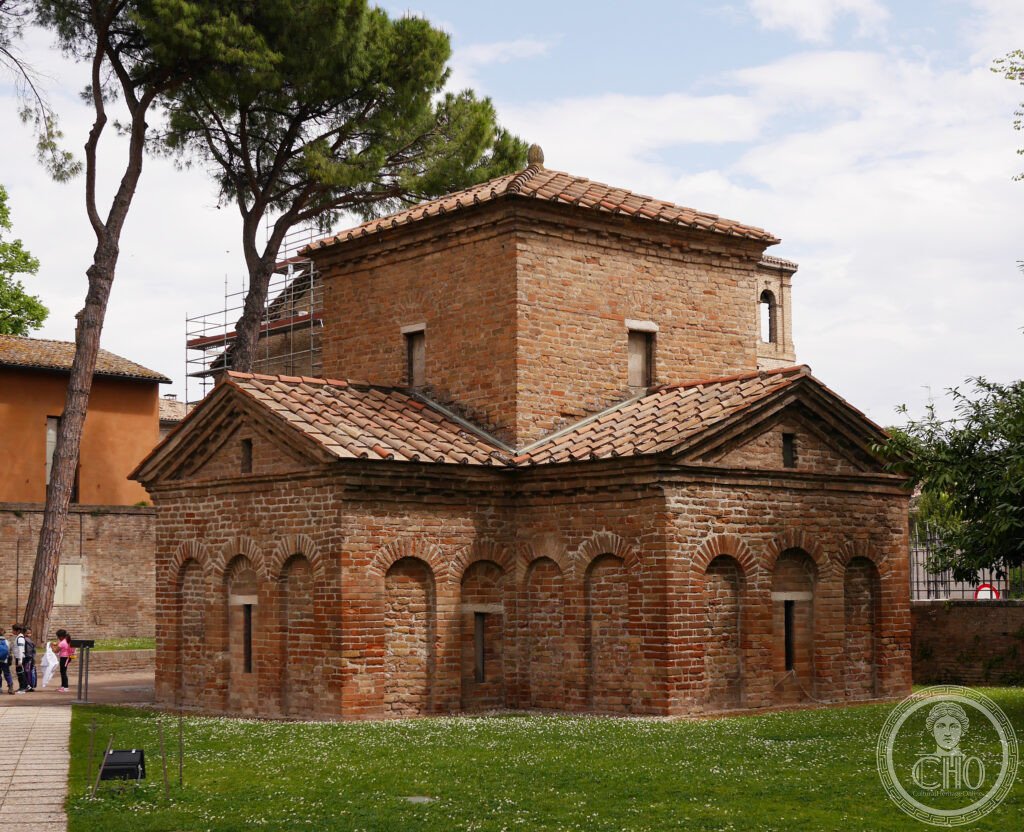
Ravenna holds the largest and best-preserved group of early Christian and Byzantine mosaics outside Constantinople, built across a century and a half while the city served in turn as capital of the Western Roman Empire, the Ostrogothic Kingdom and the Byzantine Exarchate of Italy.
At a glance
Eight monuments in and around Ravenna make up the Early Christian Monuments of Ravenna, inscribed on the UNESCO World Heritage List in 1996. They span the Mausoleum of Galla Placidia, the Neonian Baptistery, the Archbishop’s Chapel, the Mausoleum of Theodoric, the Basilica di Sant’Apollinare Nuovo, the Arian Baptistery, the Basilica di San Vitale and the Basilica di Sant’Apollinare in Classe, the last standing five kilometres south of the city centre. All eight are open to visitors, and combined tickets covering several sites are available.
The Mausoleum of Galla Placidia, with its star-studded blue dome, draws the largest number of visitors among the group, while the Mausoleum of Theodoric is the most architecturally unusual, roofed with a single monolithic stone dome quarried in Istria and brought to Ravenna by sea.
Key facts
- Location: Ravenna, Emilia-Romagna, Italy
- Monuments: eight early Christian and Byzantine buildings dated 425–549 CE
- Recognition: UNESCO World Heritage Site, inscribed 1996, reference 788
- Historical role: capital of the Western Roman Empire 402–476 CE, then of Ostrogothic Italy 493–540 CE, then of the Byzantine Exarchate of Italy 540–751 CE
- Highlight: the Mausoleum of Galla Placidia’s vault, covered with roughly 800 gold stars on a deep blue ground, is thought to be the earliest intact mosaic interior in Europe
History
Ravenna’s marshy, sea-accessible but landward-difficult position kept it safe when Rome itself was sacked by the Visigoths in 410 CE. Galla Placidia, daughter of Theodosius I and briefly married to a Visigothic king before becoming regent for her son Valentinian III, ruled the Western Empire from Ravenna between 425 and 437 CE and began its most intensive campaign of mosaic building, including her own mausoleum, completed around 430 CE. Bishop Neon later restored and decorated the Neonian Baptistery, whose domed Baptism of Christ, surrounded by a procession of the twelve apostles, is considered the earliest intact dome mosaic anywhere.
In 476 CE Romulus Augustulus, the last Western Roman emperor, was deposed by Odoacer. Theodoric the Great, an Ostrogoth, conquered Italy and made Ravenna his capital from 493 CE, commissioning the Basilica di Sant’Apollinare Nuovo as his court church around 504 CE. After the Byzantine general Belisarius reconquered the city from the Goths in 540 CE, the Basilica di San Vitale was dedicated in 547 CE under Emperor Justinian I, becoming the first fully Byzantine church built in Italy. The Basilica di Sant’Apollinare in Classe followed in 549 CE, standing in what was then the port of Classis. The Lombards ended Byzantine rule in Ravenna in 751 CE, and the monuments were collectively inscribed as a UNESCO World Heritage Site in 1996.
Dante Alighieri, exiled from Florence in 1302 CE, spent his last three years in Ravenna at the court of Guido Novello da Polenta and died there in September 1321 CE, six months after finishing the Paradiso. Florence has repeatedly asked for his remains to be returned, including a formal request in 1934 CE, and Ravenna has refused every time. Dante is buried in a small tomb opposite the Basilica di San Francesco, where an eternal flame burns on oil sent annually by the city of Florence.
What you see
At the Mausoleum of Galla Placidia, the barrel-vaulted nave leads to a central crossing where the vault glows deep blue under concentric rings of gold stars around a central cross, an effect best seen in the soft early light that filters through the alabaster windows. The adjoining Neonian Baptistery has a domed roundel showing the Baptism of Christ encircled by the twelve apostles, with faces of unusual expressiveness for their date.
San Vitale is the most architecturally complex of the group, built on a centrally planned octagonal plan with green and white marble columns and foliate capitals. Its apse carries the two mosaics for which the church is best known: Justinian I with his court on one wall, flanked by bishops and guards bearing the Chi-Rho on their shields, and Empress Theodora with her ladies-in-waiting on the other, her crown rendered in individually sized and coloured glass tesserae to suggest depth without linear perspective. The arch columns before the apse are original marble brought from Constantinople.
At Sant’Apollinare Nuovo, three registers of mosaic run along the nave: scenes from the life of Christ above, a procession of twenty-six martyrs in white on gold in the middle, and a procession of twenty-two virgins moving from the port of Classe toward the New Jerusalem below. Close inspection of the middle register shows where figures were reworked during the Byzantine period to remove Arian imagery from the Theodoric-era originals. The nearby Mausoleum of Theodoric is roofed by a single stone weighing enough that no crane of the period could plausibly have lifted it, its two large radial cracks a lasting puzzle of its construction.
Practical information
- Tickets: combined passes covering several monuments and individual entries are sold; current prices and combinations are best checked on the official Ravenna mosaics website
- Booking: timed entry slots for the Mausoleum of Galla Placidia can be booked online and are advisable in busier periods
- Photography: not officially permitted inside the Mausoleum of Galla Placidia, though enforcement varies
- Dante’s tomb: located on Via Dante Alighieri opposite the Basilica di San Francesco, accessible at all hours
Getting there
The main monuments cluster in Ravenna’s historic centre and can be visited on foot, with the Mausoleum of Theodoric a short walk further out. The Basilica di Sant’Apollinare in Classe lies about five kilometres south of the centre, in the town of Classe.
Nearby
- Basilica di Sant’Apollinare in Classe — five kilometres south, in the former port of Classis, dedicated in 549 CE
- Mausoleum of Theodoric — a short walk from the city centre, roofed with a single monolithic stone dome
- Basilica di San Francesco — in the centre, opposite Dante’s tomb
Sources
- UNESCO
Gallery
Find it on the map
See this place and what’s around it →📷 Become a Cultural Heritage Online photographer
Share your photos of places: they stay published under your name as the author. The more they're seen, the more you get noticed — and soon a contest will reward the most appreciated photos.
Log in or sign up free to add a photo