
Paestum

Paestum Italy Campania Greek Doric temples Poseidonia Magna Graecia UNESCO
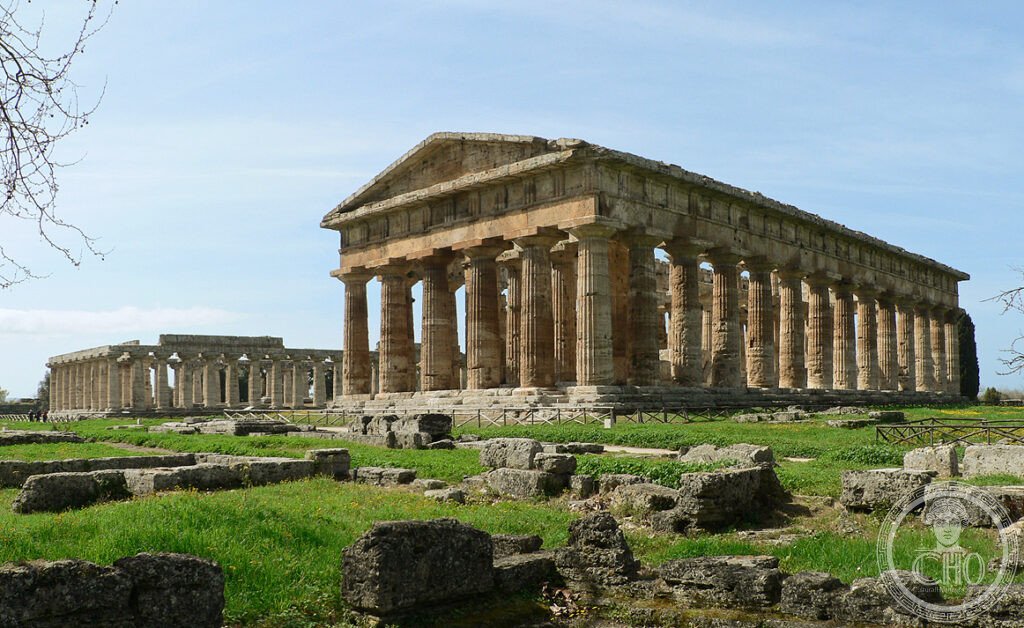
The Temple of Hera II (also known as the Temple of Neptune/Poseidon; ca. 460-450 BCE; Doric order; 6 × 14 columns; the interior naos colonnade (rare surviving double colonnade dividing the interior into three aisles visible through the doorway); the ochre Travertine limestone columns weathered to a warm honey colour in the evening light) and the Temple of Hera I (the “Basilica”; ca. 550 BCE; the earliest of the three temples; 9 × 18 columns; the unusual odd-number front colonnade creating a central column on the front axis — a Doric convention retained from early Greek temple design) viewed together across the Paestum precinct, Campania, Italy. UNESCO World Heritage Site 1998. Photo via Wikimedia Commons.
Salerno Province, Campania, Italy · Greek colony Poseidonia 600 BCE; three Doric temples; best-preserved outside Greece; Lucanian Tomb paintings; UNESCO WHS 1998

Paestum

The finest surviving Greek temples outside Greece itself — Paestum (ancient Poseidonia; Campania, Italy; UNESCO WHS 1998) is a flat coastal plain 90 km south of Naples where three perfectly proportioned Doric temples (ca. 550 BCE, 500 BCE, and 460 BCE) stand in a row in their original positions, surrounded by intact Greek city walls, visible from each other and from the surrounding flat fields of buffalo mozzarella country, in a landscape setting no Greek site on the mainland can match.

At a glance

Paestum (the most precisely PaestumItaly single Salerno Province Campania Italy Magna Graecia Gulf of Salerno coastal plain 90 km south Naples 40 km south Salerno ancient Poseidonia founded by Greek colonists from Sybaris 600 BCE 525 BCE Sybarites Sybarites Greek city Calabria southeastern Italy Sybaris known excessive luxury sybaritic modern English adjective from Sybaris founded Poseidonia 600 BCE Greek colony rich agricultural coastal plain 450 BCE Lucanians Italian indigenous non-Greek population from Apennine mountains captured Poseidonia renamed Paiston Latin Paestum 273 BCE Roman conquest Roman colony Paestum major Roman colonial city 400 600 CE late antique period Saracen raids 9th century CE malaria gradual abandonment swamps formed 9th 18th century CE site forgotten buried vegetation 1746 CE road builders discovered Paestum ruins local discovery 1750 CE first archaeological investigation UNESCO WHS 1998 UNESCO heritage in any UNESCO world heritage site)).

Key facts

  • Why Paestum’s temples are better preserved than the Parthenon (the argument for the finest Doric temples anywhere): the comparison between Paestum and Athens’s Acropolis is more balanced than it might seem: (1) Number of temples: Paestum has 3 temples still standing; the Acropolis has 4 (Parthenon, Erechtheion, Athena Nike, Propylaea) but the Propylaea is a gateway, not a temple; (2) Doric purity: the Parthenon (448-432 BCE) is technically Doric but uses optical refinements (entasis, slight column inclination, curved stylobate, wider end columns) that make it the most refined but least typical example of Doric — Paestum’s Temple of Hera II (ca. 460 BCE) is larger, earlier, and more typically Doric in its proportions; (3) Structural integrity: the Parthenon was used as a gunpowder store in 1687 CE and exploded (the Venetian bombardment under Morosini destroyed the cella and the roof; only the colonnade stands); Paestum’s temples have their cellas intact (no gunpowder); (4) Landscape setting: the Athenian Acropolis is surrounded by a modern city of 4 million people; Paestum stands in a flat agricultural coastal plain — the three temples visible simultaneously from every direction, as they would have appeared to arriving Greek ships in 500 BCE; this landscape isolation makes Paestum the most photographically powerful and experientially authentic ancient Greek site in the Mediterranean
  • GPS: 40.4210° N, 15.0040° E

History

From Sybarite colony to Lucanian city to Roman colony to medieval abandonment (the most precisely PaestumItaly single 700 600 BCE first wave Greek colonization Magna Graecia southern Italy 600 BCE Poseidonia founded by settlers from Sybaris Calabria not directly from Greece Greek colony of a Greek colony second generation colony 600 BCE founded by Sybarites themselves Greek colonists settled Sybaris first Calabria then sent further colonists to Poseidonia 550 BCE Temple Hera I Basilica oldest temple 9 columns front unusual odd number 500 BCE Temple Athena misnamed Demeter or Ceres cult archaeological evidence Athena not Demeter worshipped 460 BCE Temple Hera II Neptune Poseidon largest best preserved 450 BCE golden age Poseidonia 400 BCE Lucanians non-Greek Oscan-speaking Italic people from Apennines captured Poseidonia Lucanian renamed Paiston Lucanian period 400 273 BCE Lucanian Tomb Paintings period extraordinary Lucanian fresco paintings on stone slab tomb walls only surviving figurative painting ancient South Italy 273 BCE Roman conquest Roman colony Paestum thriving Roman town Roman forum temple Roman amphitheater visible Roman grid over Greek grid 1st century BCE Paestum declined as Rome grew malarial coastline less attractive 400 CE Vandal raids 500s CE Byzantine briefly 9th century CE Saracen raids malaria swamps 9th 18th century CE forgotten under vegetation 1746 CE road builders road from Salerno Naples discovered ruin 1750 CE Ferdinand IV King Naples visited ordered excavation 1752 CE first drawing by Soufflot Jean-Laurent Legeay French architects 1752 CE major rediscovery European Grand Tour 18th century CE Paestum replaced Rome as the place to understand Greek Doric architecture because no visitors could visit Greece Athens Ottoman occupation 1830 CE Greece independence 1998 CE UNESCO UNESCO heritage: the Lucanian Tomb Paintings of Paestum (the only surviving ancient figurative paintings in southern Italy): during the Lucanian period (400-273 BCE), the wealthy Lucanian inhabitants of Paestan society (non-Greek, Oscan-speaking Italic people who had captured the city in ca. 400 BCE) adopted the Greek practice of decorating tombs with figurative paintings — but with specifically Lucanian imagery (athletic games: chariot races, boxing matches, wrestlers; ritual banquet scenes (symposion, reclined on couches with wine); combat scenes: warriors in bronze armour on horseback; female dancers): 26 painted stone slab tombs (out of approximately 600 Lucanian tombs excavated at Paestum) have been found with figurative paintings; these are displayed in the Paestum National Museum; they represent the only continuous body of ancient figurative painted imagery surviving from Magna Graecia, since all Greek painting on wood and plaster has been lost; the Tomb of the Diver (ca. 480 BCE; the only pre-Lucanian painted tomb; possibly Greek or mixed Greek-Italic; the famous image of a man diving into a body of blue water — the only surviving ancient Greek painting of a diver, widely interpreted as a metaphor for the passage from life to death) is the most reproduced single ancient image from all of Magna Graecia)) — the most precisely PaestumItaly single 600 BCE Poseidonia Sybarites colony of a colony 550 BCE Temple Hera I 9 front columns odd unusual 460 BCE Temple Hera II largest best preserved Doric 400 BCE Lucanians captured Paiston renamed 273 BCE Roman colony grid over Greek grid 9th century CE Saracen malaria swamps forgotten 1746 CE road builders discovered 1752 CE Soufflot Legeay French architects Grand Tour Paestum 26 painted Lucanian tombs Paestum Museum Tomb of the Diver 480 BCE only surviving ancient Greek diving painting metaphor death 1998 UNESCO heritage in any UNESCO world heritage site)).

What you see

The three Doric temples, the city walls, the forum, and the Paestum Museum (the most precisely PaestumItaly single Temple Hera I Basilica 550 BCE oldest 9 front columns odd number unusual Greek Doric 18 side columns travertine limestone honey-warm colour evening light heavy stocky early Doric proportions columns swell visible heavy entasis early archaic style Temple Athena 500 BCE hexastyle 6 front columns oldest temple in Paestum with marble elements metopes in limestone but some marble decorative elements attic height Ionic interior columns important mixed order precedent Temple Hera II Neptune 460 BCE largest 6 front 14 side Doric columns interior double colonnade dividing into three naves rare surviving two-storey interior colonnade visible standing inside doorway finest Doric temple Italy standing walls floor cella visible intact Greek city walls 5 km perimeter intact circuit travertine limestone walls 4 gates visible 9th century CE walls partly incorporated Roman Forum paved stone Paestum Roman forum 2nd century BCE Roman forum south of the Greek temples superimposed Roman city grid visible amphitheater partially excavated 1st century BCE Roman amphitheater south edge site Paestum National Museum outside entrance to site best collection Magna Graecia Greek ceramics Lucanian tomb paintings 26 painted tombs Tomb of the Diver 480 BCE man diving blue water only surviving ancient Greek painting diver life death metaphor UNESCO heritage: the Three Temples of Paestum and the discovery of authentic Doric architecture (why European architects went to Paestum in 1750-1800 CE rather than Athens): in the 1750s CE, Greek architecture was still inaccessible to European architects and designers (the Ottoman occupation of Greece made travel to Athens difficult and dangerous; the Parthenon was a Turkish garrison); Paestum, easily accessible from Naples, became the laboratory of Greek Doric architecture for the entire European Neoclassical movement; the French architects Soufflot (the future architect of the Paris Panthéon, 1758-1790 CE) and Legeay drew the Paestum temples in 1752 CE; the German painter Piranesi included Paestum in his engravings (1778 CE); the English architect Robert Adam visited in 1755 CE; and the German art historian Winckelmann (the founder of modern art history, 1717-1768 CE) cited Paestum temples as the reference for authentic Doric proportions; the result: every Doric column in every neoclassical building in Europe and America built between 1760 and 1840 CE is ultimately derived from the measurement surveys of the Paestum temples by French and English architects)) — the most precisely PaestumItaly single Temple Hera I Basilica 550 BCE 9 front 18 side heavy archaic entasis Temple Athena 500 BCE 6 front Ionic interior mixed order precedent Temple Hera II Neptune 460 BCE 6 front 14 side double interior colonnade rare two-storey colonnade finest Doric Italy 5 km Greek walls intact 4 gates 1st century BCE Roman forum amphitheater Paestum Museum 26 Lucanian painted tombs Tomb Diver 480 BCE Soufflot Legeay 1752 CE Piranesi 1778 Winckelmann Doric proportions reference neoclassical 1760 1840 CE UNESCO heritage in any UNESCO world heritage site)).

Practical information

  • Getting there: from Naples: Trenitalia direct train (Salerno line; 1h30m; €7.50; from Naples Centrale to Paestum station — the station is 1 km from the temples; no bus needed from the station; simply walk through the site entrance); or car from Naples (90 km; 1h15m on the A3 motorway to Battipaglia exit, then SS18); from Salerno: train (40 min; €3.50); the site (€12 adults; daily 8:30 AM-7:30 PM (last entry 6 PM); includes the Paestum Museum across the road from the site entrance; the museum is essential — the Lucanian tomb paintings and the Tomb of the Diver are arguably as important as the temples); visiting time (minimum 2h for site + museum; 3h preferable; the site is exposed and flat — shade is minimal in summer; hats and water essential in July-August; spring (March-April) is optimal for colour — the flat plain around the temples is covered in wildflowers and buffalo-grass meadows; evening light in September-October on the honey-coloured travertine columns is the most photographically rewarding time of day))

Getting there

From Naples: direct train 1h30m (€7.50). From Salerno: 40 min (€3.50). Entry €12 (includes museum). Open 8:30 AM-7:30 PM. Museum essential for Lucanian paintings. Allow 3h. Best: spring (wildflowers) or September evenings. GPS: 40.4210, 15.0040.

Nearby

  • Velia (Elea) — 40 km south (the ancient Greek philosophical colony (540 BCE founding by refugees from Phocaea in Asia Minor); birthplace of the pre-Socratic philosophers Parmenides (515-445 BCE) and Zeno of Elea (490-430 BCE); Parmenides established Western philosophy’s first arguments for the logical impossibility of change and plurality; Zeno invented the paradoxes (Achilles and the Tortoise; the Flying Arrow) that shaped Greek and Islamic mathematics; the Porta Rosa (the earliest surviving stone round arch in Italy: 4th century BCE, 440 years before the Romans claimed to invent the arch); lesser-visited than Paestum but philosophically extraordinary)
  • Cilento coast — the stretch of coast south of Paestum (UNESCO WHS 1998 jointly with Paestum as “Cilento and Vallo di Diano National Park with the Archaeological Sites of Paestum and Velia and the Certosa di Padula”; wild coast with dramatic sea stacks (faraglioni) at Acciaroli and Marina di Camerota; the Certosa di Padula (the largest Baroque Charterhouse monastery in Italy; 320 rooms; 84 km² complex; 1306 CE founding; the kitchen where 20,000 eggs were used for a single omelette for Charles V in 1535 CE))

Sources

  • Wikipedia, Paestum; Temple of Hera, Paestum; Lucanian tomb paintings; Tomb of the Diver, accessed June 2026
  • UNESCO, Cilento and Vallo di Diano National Park with the Archaeological Sites of Paestum and Velia, WHS reference 842, inscribed 1998

Hero image: Paestum temples, Campania, Italy, Wikimedia Commons. Editorial text © Cultural Heritage Online, 2026.

📷 Diventa un fotografo di Cultural Heritage Online

Condividi le tue foto dei luoghi: restano pubblicate con la tua firma come autore. Più vengono viste, più ti fai conoscere — e presto un concorso premierà le foto più apprezzate.

Accedi o registrati gratis per aggiungere una foto
📋 Copy & share on social
Scroll to Top