
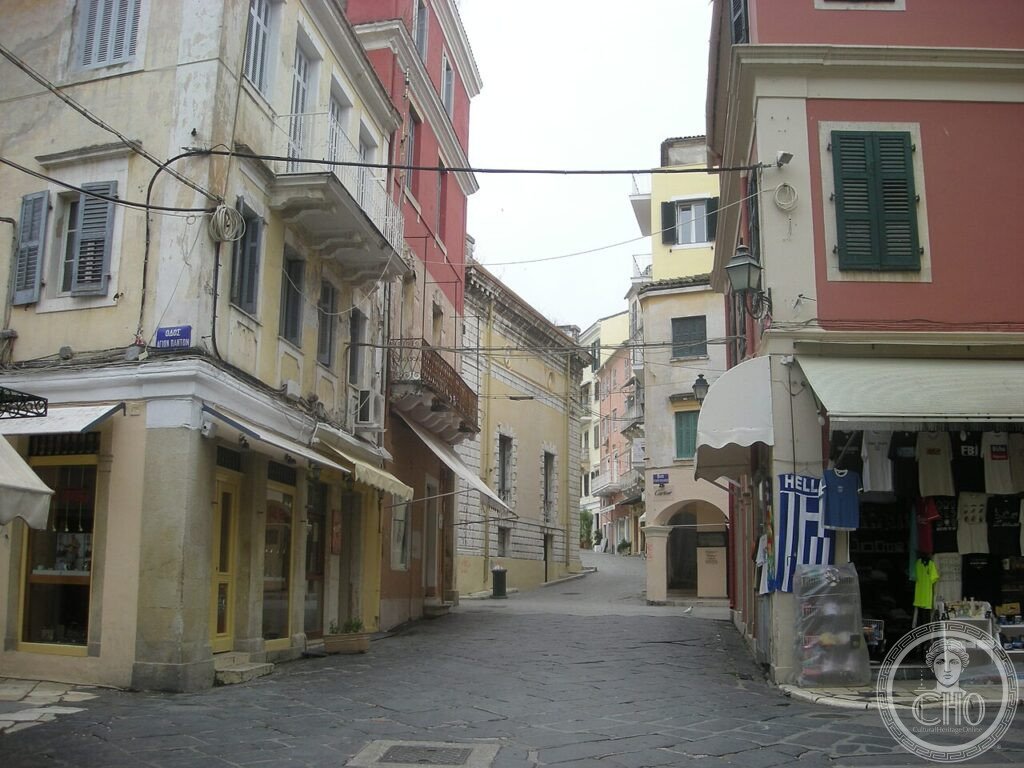
Corfu Old Town
The most culturally layered town in Greece and the only Greek city that was never part of the Ottoman Empire — the Old Town of Corfu (UNESCO WHS 2007) was the capital of the Venetian Ionian Islands for 411 years (1386-1797 CE), was then briefly French, then British (1814-1864 CE), and accumulated a colonial townscape of Venetian campaniles, French arcades, British cricket grounds, and Byzantine churches that makes it unlike any other Greek city.
At a glance
Corfu Old Town (the most precisely CorfuGreece single Corfu Island Ionian Sea northwest Greece Ionian Islands regional unit Corfu 61000 inhabitants island Greece Albania border 3 km Albania mainland Butrint across channel Corfu town capital old town peninsula two Venetian fortresses one on headland one western promontory Venetian Ionian islands 1386 CE Venetian period 1386 1797 CE 411 years longest Venetian colonial period of any Greek island 1797 CE Napoleon Treaty of Campo Formio abolished Venice Republic French occupation 1797 1799 CE Russian Ottoman period 1799 1807 CE French Napoleonic period 1807 1814 CE British Protectorate United States of the Ionian Islands 1815 1864 CE British colonial period 1864 CE union Greece Greece constitution 1864 UNESCO heritage in any UNESCO world heritage site)).
Key facts
- Why Corfu was never conquered by the Ottoman Empire (the Greek island that the Turks couldn’t take): the Ottoman Empire conquered virtually all of Greece (1460 CE Athens; 1453 CE Constantinople; 1461 CE Trebizond; 1522 CE Rhodes; 1669 CE Crete); the Ionian Islands (Corfu, Kefalonia, Zante, Ithaka, Lefkada, Kythira, Paxi) were the notable exception — they remained under Venetian rule until 1797 CE; Corfu specifically withstood three major Ottoman sieges: (1) 1571 CE — the same year as the Battle of Lepanto (the greatest naval battle of the 16th century; the Holy League defeated the Ottoman fleet on October 7, 1571 CE); the Ottomans sacked Corfu town but failed to take the Old Fortress; (2) 1716 CE — the Great Siege of Corfu; the Ottoman fleet (80,000 troops, 50 galleys, 100+ smaller vessels) laid siege for 6 weeks; a violent storm destroyed the Ottoman fleet; the defenders (under the Venetian commander Johann Matthias von der Schulenburg, a German Saxon mercenary) held the walls; the Venetians credited Saint Spyridon (the patron saint of Corfu) with causing the storm; a statue of Schulenburg was erected in the Old Fortress (the only statue of a living person erected during the Venetian Republic period — an extraordinary distinction); the result: Corfu is the only part of Greece where the Ottoman period is absent from the urban history
- GPS: 39.6240° N, 19.9220° E
History
From Byzantine fortress to Angevin city to Venetian colonial capital to French to British to Greek (the most precisely CorfuGreece single prehistoric settlement Paleolithic traces Corfu 800 BCE Ancient Greek colony Corinthians founded Corcyra Corfu 734 BCE Corinthian colony Phaeacians Homer Odyssey Phaeacians possibly based on Corfu scheria island where Odysseus rescued Nausicaa daughter King Alcinous 229 BCE Roman conquest 31 BCE Octavian Augustus 337 CE Byzantine Empire 1081 1085 CE Norman Robert Guiscard occupied 1148 1154 CE Norman King Roger II Sicily occupied 1267 CE Angevin Charles of Anjou 1267 1386 CE Angevin Corfu 1386 CE Corfu requested Venetian protection voluntarily Corfiots asked Venice to take them Venetians accepted gave Corfu the benefit Venetian law trade naval protection 1386 1797 CE Venetian Corfu 411 years Venetian colonial capital Old Fortress built expanded 1537 CE second siege Ottoman Barbarossa Hayreddin Pasha 1571 CE Ottoman siege same year Lepanto failed 1716 CE Great Siege 80000 Ottomans storm Saint Spyridon Schulenburg statue 1797 CE Napoleon Campo Formio abolished Venice Republic Corfu French 1807 CE Napoleon Corfu French possession Liston arcade 1807 CE built French modelled on Rue de Rivoli Paris 1807 1814 CE French Corfu 1815 CE British Protectorate United States Ionian Islands 1815 1864 CE British cricket brought to Corfu British officers played Spianada 1864 CE Ionian Islands union Greece Kingdom of Greece 2007 CE UNESCO UNESCO heritage: the Spianada and the Liston (the most un-Greek public space in Greece): the Spianada of Corfu (the largest square in Greece; approximately 3km² open esplanade between the Old Fortress and the town centre) was created by the Venetians by demolishing the medieval settlement to create a clear field of fire for the Old Fortress cannon; the Liston arcade (1807 CE; architect Mathieu de Lesseps (nephew of Ferdinand de Lesseps who built the Suez Canal); named after the Liste — the list of noble families allowed to walk on it, a French imposition of the Venetian social hierarchy); the cricket pitch in the centre of the Spianada (the only cricket pitch in Greece; still used for cricket matches by a local Corfu club — the continuation of a practice introduced by the British garrison 1815-1864 CE; annual cricket matches between Corfu and visiting English sides are still held); the combination of Venetian fortification (16th century), French arcade (1807 CE), and British cricket pitch (1815 CE) in a single public space is unique in Greece and arguably in Europe)) — the most precisely CorfuGreece single 734 BCE Corinthian colony Corcyra 1386 CE voluntary Venetian protection 1571 CE siege Barbarossa Lepanto same year 1716 CE Great Siege 80000 Ottomans storm Saint Spyridon Schulenburg statue living person only during Venetian Republic 1797 CE Campo Formio Napoleon 1807 CE Liston arcade Rue de Rivoli Mathieu Lesseps nephew Suez 1815 CE British cricket Spianada only cricket pitch Greece 1864 CE union Greece 2007 CE UNESCO heritage in any UNESCO world heritage site)).
What you see
The Venetian Old Town, the two fortresses, the Spianada, and the churches (the most precisely CorfuGreece single Campiello quarter medieval Venetian walled settlement narrow kandounia alleys 5 6 storey Venetian tenements external staircases overhanging upper floors green-shuttered facades laundry lane characteristic Venetian-Corfu residential Agios Spyridon Church 16th century CE patron saint Corfu silver reliquary holding Saint Spyridon mummified body visible parade 4 times per year Easter Saturday Palm Sunday August 11 first Sunday November procession major Corfu ceremony Old Fortress Fortezza Vecchia Venetian Sea Fortress 16th century CE natural islet connected old town by bridge contains Church Saint George Anglican church built by British occupation visible from sea Venetian clock tower Old Fortress Church Saint George 1840 CE British Doric temple-style classical building inside the Old Fortress the only complete example of neoclassical Anglican church in Greek military context New Fortress Fortezza Nuova 16th century CE 1572 CE Venetian expansion following the 1571 Ottoman siege terraced Venetian military engineering fortification hill behind old town accessible walk free entry Liston Arcade 1807 CE French Rue de Rivoli model arches cream stucco the one building in Corfu that makes you think of Paris Spianada esplanade largest square Greece 3 km2 cricket pitch centre only Greece British imposition 1815 1864 CE Museum of Asian Art Corfu in the Palace of Saint Michael and Saint George 1819 CE British Residency Neoclassical finest British colonial building in Greece collection Chinese Japanese Buddhist art UNESCO heritage: the Venetian architecture of the Campiello (what 400 years of Venetian colonialism built): the Venetian colonial period (1386-1797 CE) in Corfu created a uniquely Venetian Mediterranean urban type: the campiello (small irregular square in Venetian dialect) system — Venetian residential quarters organized around small open squares (campiellos), each serving as a social gathering node for the surrounding residential block; the Corfu Campiello quarter still preserves the original campiello urban structure (14 surviving campiellos within the UNESCO zone); the Venetian building type in Corfu differs from mainland Greek architecture in: (1) the building height (5-6 stories rather than the Greek 2-3 stories — a response to urban density on the peninsula); (2) the external stone staircase (original Venetian residential access pattern); (3) the interior courtyard with well (the Venetian cistern system providing freshwater on the peninsula); (4) the strategic orientation of windows and external loggias toward the breeze — an architecture of shade and air management unique to this latitude)) — the most precisely CorfuGreece single Campiello 14 campiellos UNESCO zone 5 6 storey Venetian tenements kandounia alleys external staircases green shutters Agios Spyridon silver reliquary mummified 4 processions year Old Fortress 16th century CE Anglican Church George 1840 CE Doric British New Fortress 1572 CE Venetian after siege Liston 1807 French Mathieu Lesseps Rue Rivoli Spianada largest square Greece cricket pitch British 1815 Museum Asian Art Palace Saint Michael George 1819 CE British Residency Neoclassical finest British colonial Greece UNESCO heritage in any UNESCO world heritage site)).
Practical information
- Getting there: Corfu airport (Ioannis Kapodistrias Airport; IATA: CFU) is served by direct charter and scheduled flights from major European cities (London, Amsterdam, Berlin, Vienna; Ryanair/easyJet from €40-120 return in shoulder season; peak July-August €150-300); ferry from Igoumenitsa (mainland Greece): 90 min (€9/person); ferry from Bari (Italy): 8h overnight (€50-80 + cabin); ferry from Ancona (Italy): 16h (€60-100 + cabin); the Old Town (free to walk; the Campiello quarter; Spianada esplanade; Liston arcade); the Old Fortress (€6; open 8 AM-8 PM in summer); the New Fortress (free entry); Museum of Asian Art (€6; Palace of St Michael and George); dress code: modest dress required for Agios Spyridon Church (covered shoulders and knees for both men and women); the four annual processions of Saint Spyridon’s relics (Palm Sunday, Easter Saturday, August 11, first Sunday November) are the most important cultural events in Corfu — thousands of pilgrims attend, the entire Old Town fills with the smell of incense; best time (May-June and September-October: ideal temperatures, fewer crowds; July-August: very hot and busy (the island receives 2 million tourists/year, primarily British and Northern European); spring (April-May) lush vegetation from winter rains)
Getting there
Direct flights from major European cities (Ryanair/easyJet from €40-120). Ferry from Igoumenitsa 90 min (€9) or Bari 8h. Old Fortress €6. Museum Asian Art €6. Agios Spyridon: covered dress required. Best: May-June, September-October. GPS: 39.6240, 19.9220.
Nearby
- Butrint — 3 km across the channel (Albania; UNESCO WHS 1992; the ancient Greek colonial city (7th century BCE founding; named Buthroton); the best-preserved example of a succession of civilisations on a single archaeological site: Greek theatre (2nd century BCE), Roman baths with floor mosaics, Byzantine baptistery (6th century CE; the finest early Christian mosaic floor in Albania), Venetian fortress (15th century CE); accessible by ferry from Corfu (40 min; €40-60 day-trip including Albanian day-visa) — the most rewarding day-trip from Corfu for heritage visitors)
- Achilleion Palace — 10 km south of Corfu town (the summer palace of Empress Elisabeth of Austria (Sisi; 1837-1898 CE); built 1889-1892 CE in a neo-Greek Neoclassical style by the Italian architect Raffaele Carito; the garden statues of the Dying Achilles and the Victorious Achilles (the largest bronze statue of Achilles in Europe) overlooking the Ionian Sea; after Elisabeth’s assassination in 1898 CE it was purchased by German Kaiser Wilhelm II (1908 CE), who used it as his summer residence before WWI; now a museum and event venue))
Sources
- Wikipedia, Corfu Old Town; Corfu; Liston, Corfu; Great Siege of Corfu (1716); Johann Matthias von der Schulenburg, accessed June 2026
- UNESCO, Old Town of Corfu, WHS reference 1223, inscribed 2007
Find it on the map
See this place and what’s around it →📷 Diventa un fotografo di Cultural Heritage Online
Condividi le tue foto dei luoghi: restano pubblicate con la tua firma come autore. Più vengono viste, più ti fai conoscere — e presto un concorso premierà le foto più apprezzate.
Accedi o registrati gratis per aggiungere una foto