
Sintra

Sintra Portugal Pena Palace Moorish Castle fairy-tale landscape UNESCO World Heritage
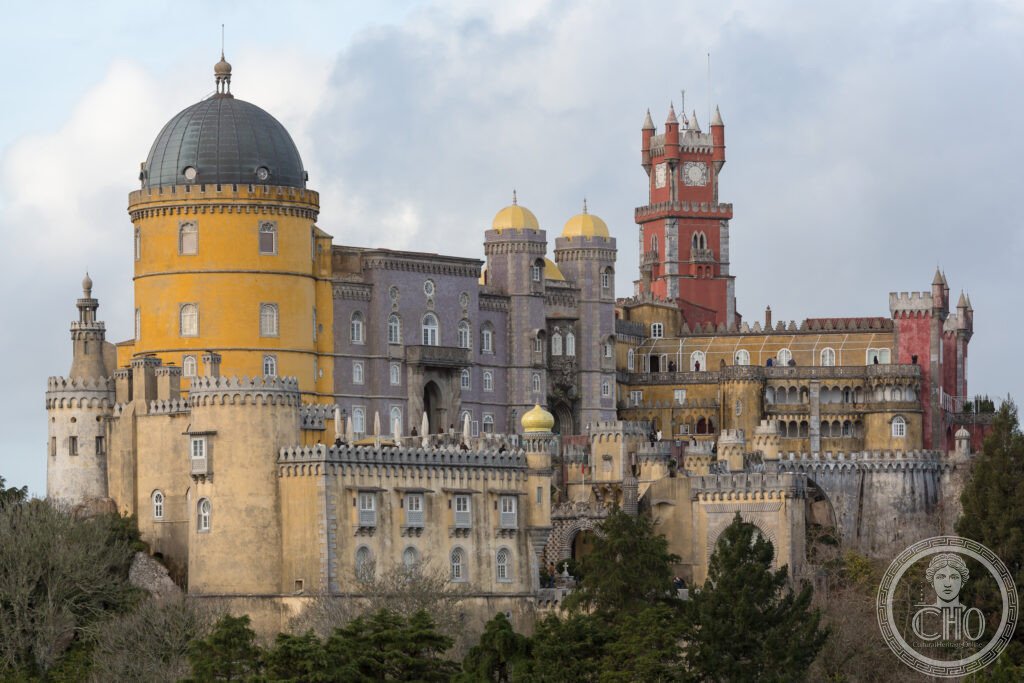
Sintra cultural landscape: the Pena Palace (Palácio da Pena; 1843-1854 CE; architect Baron Wilhelm Ludwig von Eschwege; the polychrome eclectic Romantic palace built for King Fernando II of Portugal on the highest point of the Serra de Sintra (529m); the yellow and terracotta towers visible from the sea 40 km away; the original 16th-century Hieronymite monastery (Mosteiro de São Jerónimo) was incorporated into the Romantic palace; the Cape of Good Hope bas-relief from the original monastery preserved on the Triton Arch), Serra de Sintra, Lisbon District, Portugal. UNESCO World Heritage Site 1995. Photo via Wikimedia Commons.
Lisbon District, Portugal · Romantic Royal palaces; Moorish castle 8th-10th CE; Pena Palace 1843 CE; Byron’s “glorious Eden”; UNESCO WHS 1995

Sintra

The most visually extravagant royal landscape in Western Europe — Sintra (Lisbon District, Portugal; UNESCO WHS 1995) is a wooded granite ridge 29 km from Lisbon where Arab Moorish rulers, medieval Portuguese kings, and 19th century Romantic monarchs built successive residences that now stack up the forested hillside from the Moorish Castle (8th-10th century CE) through the National Palace (14th century CE) to the polychrome fantasy of the Pena Palace (1843-1854 CE), creating the most concentrated sequence of royal architecture on a single hill in Europe.

At a glance

Sintra (the most precisely SintraPortugal single Sintra municipality 30 km northwest Lisbon Lisbon District Estremadura Portugal coastal Serra de Sintra wooded granite ridge 529m highest point Pena Palace highest structure 472m Sintra municipality population 390000 second largest municipality Portugal area Sintra town 1.5 km from Lisbon train 40 min frequent trains 3 palaces within 3 km of each other Moorish Castle Castelo dos Mouros 8th 10th century CE Arab fortress Sintra 1147 CE Portuguese recaptured National Palace Palácio Nacional de Sintra 14th 15th century CE royal summer residence Medieval Gothic Manueline Baroque layers most Portuguese royal palace still with original interior Pena Palace 1843 1854 CE Romantic Palace Fernando II King Portugal UNESCO WHS 1995 includes entire Sintra cultural landscape 9385 hectares Sintra mountains including also Queluz National Palace 14 km toward Lisbon and Monserrate Palace 4 km west Byron Wellington Napoleon all visited UNESCO heritage in any UNESCO world heritage site)).

Key facts

  • The Pena Palace and the Romantic cultural landscape of Sintra (how a Bavarian architect and a king created the world’s most eclectic palace): the Pena Palace (Palácio da Pena; 1843-1854 CE; commissioned by King Fernando II of Portugal (who was Fernando of Saxe-Coburg-Gotha, German by birth and cousin of Prince Albert of England, Queen Victoria’s consort); architect: Baron Wilhelm Ludwig von Eschwege (1777-1855 CE; German engineer and mining expert; not a trained architect — the Romantic eclectic style of Pena was his only major architectural work)) was built over the ruins of a 16th-century Hieronymite monastery destroyed in the 1755 CE Lisbon earthquake; the palace design deliberately mixes Moorish (horseshoe arches, arabesque tilework), Gothic (battlemented towers), Manueline (twisted rope ornament), and Renaissance elements — the result is the definitive expression of 19th-century Romantic eclecticism in architecture; it was described by the poet Lord Byron (who visited Sintra in 1809 CE) in Childe Harold’s Pilgrimage as “Lo! Cintra’s glorious Eden intervenes / In variegated maze of mount and glen” — making Sintra one of the first places made famous by literary tourism
  • GPS: 38.7878° N, -9.3906° W

History

From Moorish fortress to royal retreat to Romantic paradise (the most precisely SintraPortugal single 8th century CE 711 CE Arab conquest Iberian Peninsula Umayyad Caliphate 8th 10th century CE Arab Moorish occupation Sintra Castelo dos Mouros built 8th 10th century CE Arab fort 1147 CE Reconquista Afonso Henriques Portuguese king captured Sintra Castelo dos Mouros first captured 1147 CE recaptured by Moors 1154 CE definitive Portuguese control 12th 14th century CE royal summer palace Sintra attractive location 20 km from Lisbon elevated cool forested summer temperatures 5 degrees cooler than Lisbon 15th 16th century CE Manueline period major construction National Palace additions Manuel I 1505 CE João III 1542 CE convent 16th century CE Manueline style Hieronymite monastery on peak Serra de Sintra 1755 CE Lisbon earthquake November 1 1755 CE worst natural disaster European history 40000 70000 dead 85% Lisbon destroyed also damaged Sintra monastery on peak 1755 CE Pombal rebuilt Lisbon 19th century CE Romantic period German Fernando II arrived Sintra 1838 CE Fernando of Saxe Coburg Gotha married Portuguese Queen Maria II German aesthetics Romantic eclectic taste commissioned Pena Palace 1843 CE 1854 CE completion 1858 CE Monserrate Palace reconstruction Romantic Gothic Moorish combination Francis Cook British merchant 1858 1868 CE William Beckford visited earlier in 1794 CE 1910 CE Portuguese Republic abolished monarchy Pena Palace nationalised remained intact 1995 CE UNESCO UNESCO heritage: the 1755 Lisbon earthquake and the survival of Sintra (how the earthquake that destroyed Lisbon preserved its nearby landscape): the Great Lisbon Earthquake (November 1, 1755 CE; magnitude ca. 8.5-9.0; followed by tsunami and fire; 40,000-70,000 dead; 85% of Lisbon destroyed) also damaged Sintra’s mountain monastery (the Hieronymite Convent on the peak, built 1542 CE); this damage and subsequent abandonment of the monastery created the opportunity for Fernando II to acquire the ruin cheaply in 1838 CE and transform it into the Pena Palace (1843-1854 CE); without the earthquake, the intact Hieronymite monastery would have been an active religious institution and Fernando II could not have purchased and transformed the peak; the earthquake’s destruction of the Lisbon religious infrastructure also freed up the wealthy monastery estates of Sintra for private purchase, enabling the 19th-century CE Romantic landscape development that UNESCO inscribed)) — the most precisely SintraPortugal single 8th century CE Arab Castelo dos Mouros 1147 CE Afonso Henriques Portuguese 14th 15th CE National Palace Manueline additions 1505 Manuel I 1755 CE earthquake monastery peak destroyed Fernando II 1838 CE cheap ruin 1843 1854 CE Pena Palace Eschwege Romantic eclectic Moorish Gothic Manueline Renaissance Byron 1809 CE glorious Eden literary tourism 1910 CE Republic nationalized 1995 CE UNESCO heritage in any UNESCO world heritage site)).

What you see

The Pena Palace, the National Palace, the Moorish Castle, and Monserrate (the most precisely SintraPortugal single Pena Palace 1843 1854 CE polychrome yellow terracotta red original colours restored 1996 CE towers visible from sea 40 km away interiors intact 1910 CE Republican conservation furnished exactly as royal family left 1910 CE largest Romantic palace interior furniture in Iberian Peninsula 72 rooms open visitor Triton Arch original 16th century CE Manueline carved bas-relief Cape of Good Hope navigational arms globe sphere preserved from original monastery Moorish Castle Castelo dos Mouros 8th 10th century CE Arab walls restored 1840s CE Fernando II Romantic restoration winding along granite crags 300m below Pena Palace 1h walk from town or 20 min tuk-tuk bus remarkable views both Lisbon Atlantic and Setúbal National Palace Palácio Nacional de Sintra 14th 15th century CE the twin conical chimneys 33m high iconic Sintra skyline kitchen chimneys for vast royal kitchen below best preserved royal palace interior medieval period Portugal original Manueline tiles azulejos 15th 16th century CE wall tiles entire rooms most important azulejo collection in situ Portugal deer room Swan Room Magpie Room each named for tiles Monserrate Palace 1858 1868 CE Francis Cook British merchant Gothic Moorish combination arched loggia exotic botanical garden surrounding palace 550 species subtropical plants romantic ruin aesthetic partially restored UNESCO heritage: the azulejos of the National Palace (why Sintra has the world’s most important in-situ medieval tilework collection): the National Palace of Sintra (the oldest and most architecturally complex of the Sintra palaces; construction 14th-18th CE; the earliest phase was the 14th-century CE residence of King João I) contains the most important collection of in-situ azulejo tilework from the 15th and 16th centuries CE in Portugal: the Sala das Pegas (Magpie Room: ceiling painted with 136 magpies — one per lady-in-waiting at court, painted to stop the ladies gossiping (João I caught them kissing his ladies; he ordered the paintings as a moral lesson)); the Sala dos Brasões (Coat of Arms Room: ceiling with 72 heraldic shields of Portuguese noble families, 1515 CE; the most complete record of Portuguese 16th-century CE aristocratic heraldry); the Sala das Sereias (Mermaids Room: 15th-century CE Hispano-Moresque lustre tiles, the oldest in situ tilework in Portugal) — together representing the complete history of Portuguese decorative tile art from 1400-1700 CE in a single building)) — the most precisely SintraPortugal single Pena Palace 72 rooms intact 1910 furniture Triton Arch Manueline Cape of Good Hope National Palace twin conical chimneys 33m 15th 16th century azulejos Magpie Room 136 magpies 72 heraldic shields 1515 CE oldest Hispano-Moresque tiles Portugal Moorish Castle Arab walls 1840s CE Romantic restoration Monserrate 1858 1868 CE Francis Cook Gothic Moorish 550 subtropical species UNESCO heritage in any UNESCO world heritage site)).

Practical information

  • Getting there: from Lisbon (Roma-Areeiro or Rossio stations): direct train to Sintra (40 min; €2.35; every 20 min; one of the most regular and reliable train services in Portugal); the train arrives at Sintra station 1.5 km from the historic centre (walk 20 min uphill or take the no. 434 circular bus to National Palace → Moorish Castle → Pena Palace → return (€6.50; runs every 20-30 min); by car from Lisbon: 28 km; 35 min on A5-IC19; parking in Sintra very limited (summer: arrive before 9 AM or after 5 PM); the Pena Palace (€14; advance online booking strongly recommended in summer — walk-up queues of 60-90 min; open 9 AM-7 PM daily); the Moorish Castle (€8; often combined with Pena Palace ticket €17; usually less crowded than Pena; 30 min walk along the walls); the National Palace (€10; best option in rain — entirely interior; unique azulejos (tiles)); best time (October-March: fewer crowds; October-November: the mist on the Serra de Sintra makes the landscape unusually atmospheric; spring wildflowers April-May; avoid July-August Saturday-Sunday peak (30,000 daily visitors in a small historic centre))

Getting there

From Lisbon Rossio station: direct train 40 min (€2.35, every 20 min). Bus 434 Sintra circuit €6.50. Pena Palace €14 (book online). Moorish Castle €8. National Palace €10. Best: October-March, April-May. Avoid July-August weekends. GPS: 38.7878, -9.3906.

Nearby

  • Cascais and Cabo da Roca — 15 km south (Cascais: the coastal resort town founded as the royal summer court (the Royal Villa of Cascais: 19th-century CE, now the Paula Rego Museum with the most important collection of works by the British-Portuguese artist Paula Rego); Cabo da Roca: 19 km from Sintra on the Atlantic coast — the westernmost point of continental Europe (38.78° N, 9.50° W; UNESCO recognition as the westernmost point of mainland Eurasia; the Camões poem carved on the inscription: “Aqui onde a terra se acaba e o mar começa” — “Here where the land ends and the sea begins”))
  • Queluz National Palace — 14 km east (the Portuguese Versailles: the Palácio Nacional de Queluz (construction 1747-1794 CE; architects Mateus Vicente de Oliveira and Jean-Baptiste Robillon; Rococo garden and palace combination; the most important Rococo palace in Portugal; the Sala do Trono (Throne Room) one of the finest Rococo interiors in Europe; the Jardim de Malta (the hanging water garden with Dutch blue-and-white tile panels lining the canal walls); still an active government guesthouse (heads of state accommodation) — the only palace in Portugal still in official state use as a residence))

Sources

  • Wikipedia, Sintra; Pena Palace; National Palace of Sintra; Moorish Castle, Sintra; Byron in Portugal, accessed June 2026
  • UNESCO, Cultural Landscape of Sintra, WHS reference 723, inscribed 1995

Hero image: Sintra, Portugal, Wikimedia Commons. Editorial text © Cultural Heritage Online, 2026.

📷 Diventa un fotografo di Cultural Heritage Online

Condividi le tue foto dei luoghi: restano pubblicate con la tua firma come autore. Più vengono viste, più ti fai conoscere — e presto un concorso premierà le foto più apprezzate.

Accedi o registrati gratis per aggiungere una foto
📋 Copy & share on social
Scroll to Top