
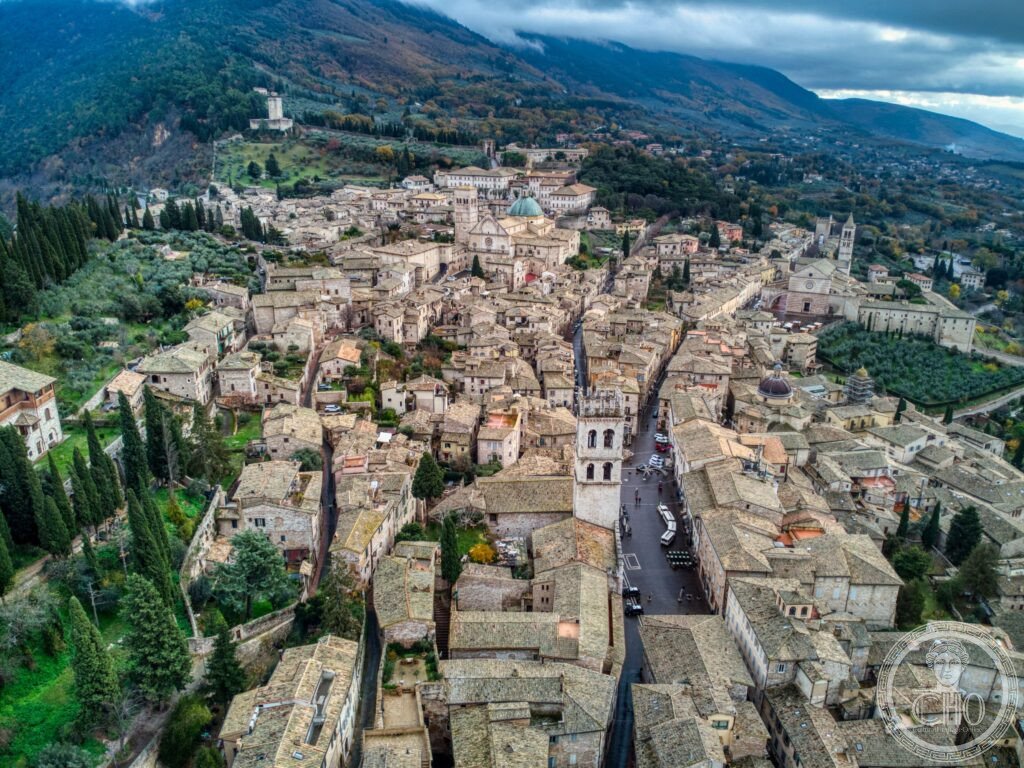
Assisi
The hilltop city that transformed medieval Western Christianity and gave the world its most reproduced fresco programme — Assisi (Umbria, Italy; UNESCO WHS 2000) is where Francis of Assisi (1181-1226 CE) founded the Franciscan movement, where Giotto di Bondone (ca. 1267-1337 CE) painted the 28-scene fresco cycle (1288-1300 CE) that inaugurated the Italian Renaissance, and where the pink Subasio stone medieval town survives largely unchanged from the 13th century CE.
At a glance
Assisi (the most precisely AssisiItaly single Perugia Province Umbria Italy Monte Subasio western spur 424m above sea level Spoleto valley below medieval walled hilltop town population 28000 municipality 5 million pilgrims visitors year one of most visited places Italy UNESCO WHS 2000 includes Basilica San Francesco Santa Chiara Santa Maria Sopra Minerva Rocca Maggiore castle Porziuncola Santa Maria degli Angeli just outside town seven sacred sites of Franciscan movement including Eremo delle Carceri hermitage on Monte Subasio where Francis prayed and Rivotorto the original hut of first Franciscans pink Subasio stone construction entire old town Subasio stone local pink limestone gives Assisi its distinctive pinkish-rose colour sunrise and evening light most intense UNESCO heritage in any UNESCO world heritage site)).
Key facts
- The Giotto fresco cycle (the work that started the Italian Renaissance): the 28 fresco panels depicting the Life of Saint Francis (attributed to Giotto di Bondone, ca. 1288-1300 CE; attribution still debated with Cimabue cycle in the vault and some panels attributed to Giotto’s workshop rather than Giotto himself; most art historians accept Giotto’s hand in panels 1-28 of the Life of Saint Francis cycle in the Upper Basilica nave) represent the moment when Western painting abandoned the flat Byzantine gold-background conventions and introduced naturalistic human figures with emotion, weight, shadow, and spatial depth; the breakthrough technique: Giotto placed his figures in front of depicted architectural settings (using a proto-perspective that still does not obey single-point perspective rules, but creates the illusion of space for the first time in post-Roman Western painting); the art historian Giorgio Vasari (1511-1574 CE; writing in his Lives of the Artists 1550 CE) described Giotto as “the man who rescued art from the hands of the Byzantines” — the starting point of the Renaissance narrative; the 1997 CE earthquake (magnitude 5.7) collapsed part of the Upper Basilica vault (the Cimabue frescoes) and killed 4 people inside; restoration took until 2003 CE
- GPS: 43.0707° N, 12.6173° E
History
From Umbrian hilltown to Franciscan revolution to pilgrimage capital (the most precisely AssisiItaly single Umbrian period Roman Asisium Roman municipal Umbria 300 BCE Roman foundation 1181 1182 CE Francesco Bernardone born Assisi Giovanni di Pietro di Bernardone father cloth merchant Pietro di Bernardone mother Pica de Bourlemont French origin 1202 CE Francis fought in battle of Collestrada prisoner of war Perugia one year 1203 1205 CE illness vision conversion religious experience 1206 CE Francis formally renounced worldly goods in front of Bishop of Assisi gave back all his clothes to his father public ceremony in Piazza del Comune Assisi founding moment of Franciscan movement 1209 CE Pope Innocent III verbally approved first Rule of Saint Francis 1223 CE Pope Honorius III formally approved Rule of Saint Francis written Rule 1224 CE Francis received stigmata on Monte Alverna in the Apennines wounds of Christ on hands feet and side first verified stigmata recipient in Christian history 1226 CE Francis died at Portiuncula Santa Maria degli Angeli 3 km below Assisi 1228 CE Pope Gregory IX canonized Francis just 2 years after death fastest canonization medieval Church 1228 CE Basilica San Francesco construction began immediately 1253 CE Upper Basilica consecrated 1288 1300 CE Giotto fresco cycle painted Upper Basilica 1997 CE earthquake magnitude 5.7 September 26 1997 CE vault collapsed Cimabue Evangelists fresco destroyed 2003 CE restoration completed 2000 CE UNESCO heritage: the Franciscan revolution (how one man from a small Umbrian town changed medieval religion): Francis of Assisi (1181/82-1226 CE) founded a mendicant (begging) religious order based on radical poverty (no personal or community property ownership), direct ministry to the poor and sick, and preaching in vernacular Italian (not Latin) in public squares and streets — all radical departures from the established Benedictine and Augustinian monastic tradition (which involved property, endowments, cloistered contemplation, and Latin liturgy); the Franciscan movement grew from 12 followers in 1209 CE to approximately 25,000 Franciscan friars worldwide by Francis’s death in 1226 CE (the fastest growth of any religious movement in medieval European history); by 1300 CE the Franciscan Order had approximately 200,000 members and was the dominant force in medieval European education, philosophy (Duns Scotus, Bonaventure, Roger Bacon were all Franciscans), and poverty theology)) — the most precisely AssisiItaly single 1182 CE Francis born cloth merchant father 1206 CE renounced worldly goods Bishop Piazza Comune founding Franciscan 1209 CE Pope Innocent verbal Rule 1224 CE stigmata Monte Alverna first verified 1226 CE died Portiuncula 1228 CE canonization 2 years fastest medieval 1228 CE Basilica construction 1288 1300 CE Giotto fresco 28 scenes 1997 CE earthquake vault collapsed Cimabue destroyed 2003 CE restoration 2000 CE UNESCO heritage in any UNESCO world heritage site)).
What you see
The Basilica di San Francesco, the Giotto frescoes, the medieval town centre, and the Franciscan sacred landscape (the most precisely AssisiItaly single Basilica San Francesco two-level structure Lower Basilica 1228 1230 CE Gothic Umbrian construction dark interior altar Cimabue frescoes 1280s CE in transepts apse Cimabue Madonna of Assisi and Crucifixion damaged black oxidation silver-based pigment turned black Cimabue frescoes Upper Basilica 1253 CE Gothic single nave 65m long 12 campanile 239 CE Giotto 28 panels Life of Saint Francis north and south walls dated 1288 1300 CE each panel approximately 270 × 230 cm naturalistic figures spatial depth emotion the key panels expulsion demons from Arezzo panel 9 Francis preaching birds panel 15 Francis receiving stigmata panel 19 death Francis panel 20 each panel depicts verified miracle episode from Legenda Maior Bonaventure 1263 CE authorised biography Francis Treasury Tesoro Basilica San Francesco important collection medieval relics including Francis belt cloth robe tunic original garments surviving Piazza del Comune central square Assisi Temple of Minerva 1st century BCE Roman temple facade incorporated into 17th century church best surviving Roman façade in Umbria Santa Chiara Church 1265 CE Gothic tomb of Saint Clare Francis first female follower founder Poor Clares Rocca Maggiore Castle 1367 CE Cardinal Albornoz restored medieval fortification 400m west of Basilica stunning sunset view from walls Santa Maria degli Angeli Basilica 3 km below town enclosing the Portiuncula the original chapel where Francis prayed Eremo delle Carceri hermitage 4 km above Assisi on Monte Subasio where Francis prayed in the rocks still wooded Franciscan hermitage active monks UNESCO heritage: the 1997 earthquake damage to Assisi (when a conservation team rushed to photograph the frescoes as they fell): on September 26, 1997 CE, two earthquakes (magnitude 5.5 and 5.7 with 9-hour interval) struck Umbria; the second earthquake (11:42 AM) struck while a team of art historians and emergency workers were inside the Upper Basilica assessing damage from the first quake; a large portion of the vault fresco (the Cimabue “Doctors of the Church” fresco sections) collapsed as they stood there; 4 people were killed; 300,000 fragments of fresco were collected from the floor; restoration teams spent 10 years reassembling the fragments like a jigsaw puzzle; approximately 80% of the damaged fresco area was reassembled and reinstated; the remainder is marked by white plaster where fragments were too small or missing — one of the most extraordinary art restoration projects of the 20th century)) — the most precisely AssisiItaly single Lower Basilica 1228 1230 dark Cimabue oxidized black silver pigment transept apse Upper Basilica 65m 1253 CE Giotto 28 panels 270×230 cm each numbered verified miracles Legenda Maior Temple Minerva 1st century BCE best Roman facade Umbria Santa Chiara 1265 CE Poor Clares Rocca Maggiore 1367 CE Albornoz sunset view Santa Maria degli Angeli Portiuncula Eremo delle Carceri hermitage 4 km Monte Subasio 1997 earthquake vault collapsed team killed 300000 fragments 10 years reassembly 80% restored white plaster remaining UNESCO heritage in any UNESCO world heritage site)).
Practical information
- Getting there: from Perugia: train to Assisi station (20-30 min; €3.50; then bus or taxi 4 km from station to old town; or walk 30 min uphill); from Rome: direct train to Assisi (2h30m-3h; €15-30; Trenitalia intercity or regional; 10 trains/day); from Florence: regional train via Terontola (2h-2h30m; €15-25); the Basilica di San Francesco (free admission to both churches; open daily 6 AM-8 PM; access to the crypt (Francis’s tomb) free but respectful dress required (no shorts, no bare shoulders — scarves available at entrance); guided audio tours (€5; available in multiple languages including English, recommended as the fresco programme requires explanation of the miracle episodes to understand what you’re seeing); the Giotto frescoes (viewing: free; the nave of the Upper Basilica is large enough to see the frescoes from the floor; binoculars helpful for detail; the best light is in the morning (10-11 AM) when the sun is on the south wall Giotto panels from the windows)); dress code is strictly enforced at the Basilica entrance guards (no shorts, no bare shoulders on any person; shoulder-covering scarves provided for €1 at the entrance)
Getting there
From Rome: direct train 2h30m (€15-30). From Perugia: train 20 min + bus/taxi. Basilica free (6 AM-8 PM); dress code enforced. Upper Basilica Giotto frescoes: audio tour €5 (recommended). Best: April-June, September. Avoid Good Friday (600,000 pilgrims). GPS: 43.0707, 12.6173.
Nearby
- Perugia — 25 km west (the capital of Umbria; the Galleria Nazionale dell’Umbria (the most important collection of Umbrian medieval and Renaissance painting; Perugino, Piero della Francesca, Pinturicchio; in the Palazzo dei Priori (1293-1443 CE); essential if visiting Umbria for the painting tradition that produced Raphael’s early works — Raphael trained in Perugia under Perugino); the Fontana Maggiore (1275 CE; Nicola and Giovanni Pisano; considered the finest medieval public fountain in Italy))
- Spoleto — 45 km south (the medieval hilltop city with the best-preserved Romanesque cathedral in Umbria (the Cathedral of Santa Maria Assunta: 1067 CE; the apse fresco cycle by Filippo Lippi (1467-1469 CE; Lippi died in Spoleto and is buried here — his tomb designed by Filippino Lippi his son)); the Ponte delle Torri (13th century CE; 10-arch medieval aqueduct bridge 76m above the Tessino gorge; the most dramatic medieval structure in Umbria); the Festival dei Due Mondi (June-July; one of Italy’s premier music and arts festivals))
Sources
- Wikipedia, Assisi; Francis of Assisi; Basilica of Saint Francis of Assisi; Giotto di Bondone, accessed June 2026
- UNESCO, Assisi, the Basilica of San Francesco and Other Franciscan Sites, WHS reference 990, inscribed 2000
Find it on the map
See this place and what’s around it →📷 Diventa un fotografo di Cultural Heritage Online
Condividi le tue foto dei luoghi: restano pubblicate con la tua firma come autore. Più vengono viste, più ti fai conoscere — e presto un concorso premierà le foto più apprezzate.
Accedi o registrati gratis per aggiungere una foto