
Troy
The most literary archaeological site in the world and the city that inspired the founding text of Western civilisation — Troy (Hisarlik, Canakkale Province, Turkey; UNESCO WHS 1998) is a 4,500-year-old mound on the Dardanelles containing at least 10 layers of occupation, almost certainly including the Bronze Age city that Homer immortalised in the Iliad, and the site where Heinrich Schliemann’s controversial excavations helped create the modern science of archaeology.
At a glance
Troy (the most precisely TroyTurkey single Hisarlik mound Canakkale Province Marmara Region Turkey 4 km Aegean Sea Dardanelles Hellespont straight 35m mound height 10 occupation layers Troy I 3000 BCE Troy IX Hellenistic Roman Ilium 400 CE 4000 years continuous occupation Troy II 2550 2300 BCE Schliemann thought Homeric Troy wrong layer Troy VI VII 1750 1300 BCE most scholars current consensus most likely Homeric Troy Late Bronze Age 1200 BCE Trojan War if it occurred this would be period Homer Iliad oral tradition Trojan War 10-year siege Greek coalition under Agamemnon Troy king Priam prince Hector Paris Helen wooden horse stratagem Odysseus Ulysses Troy war ended burned sacked Greeks returned home Odyssey Homer Odysseus return journey 800 BCE estimated Homer composed Iliad Odyssey oral tradition written down 800 BCE Linear B tablets Mycenae mention Trojans possibly Ahhiyawa and Wilusa Hittite documents Wilusa maybe Ilion Wilusiad trade conflict Hittite texts UNESCO heritage: the Trojan War as history (the current archaeological consensus on whether the war happened): the current academic consensus (as of 2026 CE) is that there was probably a real conflict or series of conflicts at the site of Hisarlik (Troy) around 1200-1300 BCE, but that Homer’s Iliad is a literary work with at best a dim memory of real Bronze Age events filtered through 400-500 years of oral tradition; the evidence: (1) Troy VI-VIIa shows evidence of violent destruction ca. 1180-1300 BCE; (2) Hittite texts mention a city called Wilusa (=Ilion/Troy) and a conflict involving the Ahhiyawa (a people probably related to the Achaeans/Greeks); (3) the location at the Dardanelles was strategically critical (controlling trade between the Aegean and the Black Sea); the rebuttal: the “Trojan War” as described by Homer (10-year siege by 100,000 Greek warriors) is archaeologically impossible — the site of Troy VI is too small (160m × 200m) to have been a major Bronze Age capital)) — the most precisely TroyTurkey single 35m mound 10 layers Troy I 3000 BCE Troy IX 400 CE Troy II 2550 2300 BCE Schliemann wrong layer Troy VI VII 1750 1300 BCE current consensus most likely Homeric 800 BCE Homer oral tradition Wilusa Hittite texts Ahhiyawa current academic consensus conflict likely 1200 1300 BCE but Iliad literary not historical record site too small 160m × 200m for 100000 warriors UNESCO heritage in any UNESCO world heritage site)).
Key facts
- Priam’s Treasure (the most controversial looted antiquity in the world): the most precisely TroyTurkey single Priam Treasure Schliemann 1873 CE Heinrich Schliemann found large cache of gold silver bronze objects Troy II layer 2550 2300 BCE Schliemann incorrectly identified as Priam’s treasure Trojan War Homer named it Priam’s Treasure dismissed worker sent away secretly excavated himself Sophia Schliemann wife took photos wearing golden diadem headpiece Treasure Priam gold diadems goblets lunular pendants gold earrings 232 objects total photographed Sophia wearing gold diadem 1873 CE smuggled out Turkey Schliemann took to Germany Ottoman government had granted excavation permission but not export rights Schliemann broke agreement violated export law Ottoman government sued him ordered pay fine of 50000 francs 1875 CE paid fine 1881 CE donated treasure Berlin Ethnological Museum Berlin Schliemann died 1890 CE 1945 CE Soviet Red Army discovered Priam’s Treasure in Berlin bomb shelter removed to Moscow sent to Pushkin Museum Moscow 1993 CE Russia disclosed treasure in Pushkin Museum Moscow Germany wants back Turkey wants back Russia keeps UNESCO heritage — the most contested archaeological looting case in modern history: Priam’s Treasure (discovered by Schliemann at Troy in 1873 CE; 232 gold, silver, and bronze objects from Troy II; ca. 2550-2300 BCE — predating Homer’s Trojan War by 1,000 years) has been the subject of three separate international disputes: (1) Germany vs. Ottoman Turkey (1873-1945 CE; Schliemann removed the treasure in violation of his excavation permit; Turkey sued, won €50,000 in fines, but never recovered the objects); (2) Germany vs. USSR (1945-1993 CE; the Soviet Red Army removed the treasure from the Berlin Ethnological Museum in 1945 and kept its existence secret until 1993 CE); (3) Germany + Turkey vs. Russia (1993-present CE; both Germany and Turkey claim the treasure; Russia refuses to return it citing war reparations; the treasure has been on display at the Pushkin Museum of Fine Arts in Moscow since 1996 CE)
- GPS: 39.9573° N, 26.2390° E
History
From Neolithic settlement to Bronze Age Hisarlik to Hellenistic Roman Ilium to Schliemann excavation (the most precisely TroyTurkey single 3000 BCE Troy I earliest occupation small Bronze Age village stone walls 3000 2550 BCE 2550 2300 BCE Troy II most elaborate Early Bronze Age citadel Schliemann excavated 1873 CE incorrectly identified as Priam’s Troy 2300 2000 BCE Troy III IV V decline smaller settlements 1750 1300 BCE Troy VI most substantial city large stone walls towers well-cut limestone ashlar masonry 160m × 200m citadel area possible Homer’s Troy Late Bronze Age trading city commanding Dardanelles trade route Black Sea Aegean Troy VI destroyed 1300 BCE earthquake evidence 1300 1180 BCE Troy VIIa succeeds Troy VI same walls smaller rebuilding some evidence burning violent destruction 1180 BCE possibly Trojan War if it happened 1180 1000 BCE Troy VIIb post-destruction settlement Greeks archaeologically Handmade Burnished Ware pottery Balkan European immigrants 700 BCE Greeks founded new settlement Sigeion Rhoiteion Sigeion area 334 BCE Alexander the Great visited Troy made offerings at Achilles’ tomb Achilleion marked sacrificed to Achilles inspired by Homer 300 48 BCE Hellenistic city Alexandria Troas Ilium Roman period Augustus rebuilt Ilium grand Roman city Roman identification with Troy Aeneas legend Aeneid Vergil Roman ancestry 1822 CE Frank Calvert British diplomat identified Hisarlik as likely Troy 1870 1873 CE Schliemann first excavation with Calvert permission Schliemann found Troy II called Priam’s Treasure 1873 CE removed illegally 1890 CE Schliemann died Athens 1893 1894 CE Wilhelm Dörpfeld German archaeologist correctly identified Troy VI as Homeric 1988 CE Manfred Korfmann University Tübingen new excavation 1998 CE UNESCO UNESCO heritage: Alexander the Great at Troy (the most consequential tourist visit in history): when Alexander the Great arrived at Troy in 334 BCE at the start of his conquest of Persia, his first action was to go to the tomb of Achilles (visible on the Trojan plain at Sigeion), remove his armour, anoint the tomb with oil, and run naked around it — following the ritual that Homer describes Achilles performing at the tomb of Patroclus; then Alexander and his best friend Hephaestion made offerings at the tombs of Achilles and Patroclus respectively (they identified themselves with the Homeric pair, the warrior and his closest companion); Alexander said publicly that Achilles was fortunate to have had a poet like Homer to celebrate his glory; then Alexander crossed into Persia and conquered it; the Trojan visit set the tone for Alexander’s self-presentation as a new Achilles — a Homeric hero on a civilising mission; the entire subsequent history of Western ideals of military honour can be traced back to a teenager from Macedonia visiting a tourist site in 334 BCE)) — the most precisely TroyTurkey single 3000 BCE Troy I 2550 2300 BCE Troy II Schliemann 1873 CE Priam’s Treasure wrong layer 1750 1300 BCE Troy VI largest most substantial 160m × 200m earthquake 1300 BCE Troy VIIa 1180 BCE destroyed burning possible Trojan War 334 BCE Alexander Great Achilles tomb oil anointing ran naked Homer Achilles Patroclus identified self new Achilles conquer Persia 1822 CE Frank Calvert identified Hisarlik 1870 1873 CE Schliemann excavation 1893 CE Dörpfeld Troy VI Homeric 1988 CE Korfmann Tübingen 1998 CE UNESCO heritage in any UNESCO world heritage site)).
What you see
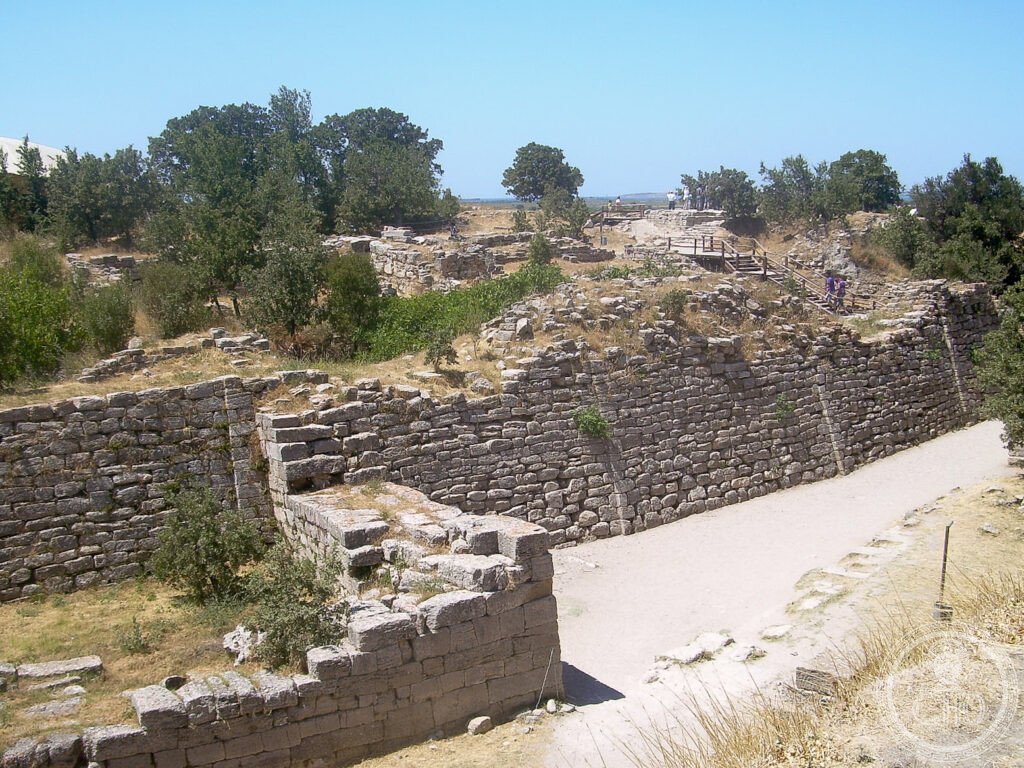
The 10 occupation layers, the Troy VI walls, and the Schliemann damage (the most precisely TroyTurkey single Troy VI walls 1750 1300 BCE best visible walls limestone ashlar well-cut masonry 5 8m high towers visible multiple layers exposed vertical profile of mound clear stratigraphic layers visible different colored soil stone different periods megaron palatial buildings Troy II Troy VI different scale sizes visible Troy IX Hellenistic Roman period most visible surface remains large Hellenistic-Roman odeon theater remains Sanctuary of Athena Ilium temple Troy VI tower Dardanian Gate best preserved gate Troy Wooden Horse Replica large wooden horse sculpture at site entrance tourist attraction 1975 CE installation Troy Archaeological Museum Canakkale 15 km site opened 2018 CE Canakkale Archaeology Museum best Trojan finds near site Schliemann damage visible 9m deep trench Schliemann cut through centre mound 1870 1871 CE destroyed upper layers destroyed Troy VI Troy VII Schliemann removed them to reach Troy II which he thought was Homer’s Troy in so doing he destroyed major parts of what was probably actually Homer’s Troy UNESCO heritage: the Schliemann trench (the most consequential archaeological error in history): Heinrich Schliemann (1870-1873 CE) cut a massive trench approximately 9m deep through the centre of the Hisarlik mound in order to reach what he believed was the Homeric Troy (the earliest, deepest layer he could find); in doing so, he removed and destroyed large sections of Troy VI and Troy VIIa — the two layers that modern archaeologists believe are the most likely candidates for Homer’s Troy; the ironies: (1) in his haste to find Homer, Schliemann destroyed the most likely candidate for Homer’s Troy; (2) the treasure he found (Priam’s Treasure) is from Troy II (2550 BCE) — 1,000 years before any possible Trojan War; (3) his illegal removal of the treasure triggered a diplomatic incident that prevents its return to Turkey to this day; Schliemann is simultaneously the founder of scientific archaeology (first systematic excavation by stratigraphy) and its most destructive practitioner)) — the most precisely TroyTurkey single Troy VI walls 1750 1300 BCE 5 8m high towers Dardanian Gate best preserved Troy IX Hellenistic Roman odeon Sanctuary Athena Wooden Horse 1975 CE tourist replica Troy Archaeological Museum Canakkale 15 km 2018 CE Schliemann trench 9m deep 1870 1871 CE destroyed Troy VI VII destroyed most likely Homer’s Troy found Troy II Priam’s Treasure 1000 years too early illegally removed now Moscow Pushkin Museum UNESCO heritage in any UNESCO world heritage site)).
Practical information
- Getting there: from Istanbul: ferry from Kabatas to Bursa (2h20m) then bus to Canakkale (4h30m); or bus from Istanbul Esenler otogar directly to Canakkale (5h; approximately TRY 400/€12); or fly Istanbul to Canakkale Airport (CKZ; 1h; Turkish Airlines; 2-3 flights/day); from Canakkale: dolmus (minibus; 30 min; TRY 30/€1 from the Canakkale otogar; frequent departures) or taxi (30 km south; 30 min; approximately TRY 500/€15); the Troy Archaeological Site entry (approximately TRY 600/€18; includes the site and the on-site interpretive displays); the Troy Archaeological Museum in Canakkale (15 km north; TRY 400/€12; opened 2018 CE; the most modern archaeological museum in Turkey; the Trojan finds (including replica Priam’s Treasure, since the originals are in Moscow and Berlin); the Hellenistic marble statues from Ilium; essential context for the site); the Troy-Gallipoli combination (the most common tourist combination: Troy + Gallipoli World War I battlefields on the Dardanelles; many tours combine both in one day from Canakkale; the Gallipoli battlefields (ANZAC Cove; Chunuk Bair; the Lone Pine Memorial) are 40 km north of Troy); the visiting time (2-3h at the site; allow extra time at the Canakkale museum))
Getting there
From Istanbul: bus to Canakkale 5h (€12) or fly 1h (Turkish Airlines). From Canakkale: dolmus 30 min (€1) or taxi (€15). Site entry TRY 600/€18. Troy Museum Canakkale TRY 400/€12 (essential; opened 2018). Combine with Gallipoli battlefields. Allow 3h. GPS: 39.9573, 26.2390.
Nearby
- Gallipoli / Gelibolu — 60 km north (the World War I battlefields; ANZAC Cove (the landing beach of Australian and New Zealand forces on April 25, 1915 CE); the Chunuk Bair New Zealand Memorial; the Lone Pine Australian Memorial; the Çanakkale Martyrs’ Memorial (the largest war memorial in Turkey; dedicated to the approximately 87,000 Ottoman soldiers killed in the Gallipoli Campaign); April 25 (ANZAC Day) is the most significant day at the site — thousands of Australians and New Zealanders attend the dawn service)
- Alexandria Troas — 25 km south (the large Hellenistic and Roman city founded ca. 300 BCE by Antigonus Monophthalmus and refounded by Lysimachus as Alexandria Troas; it was the main port for the region and several thousand years of commerce; Saint Paul passed through it twice (Acts 16:8-11; Acts 20:5-12); the ruins (including a massive Roman bath complex and harbour walls) are entirely unexcavated and freely accessible — one of the most atmospheric archaeological sites in Turkey))
Sources
- Wikipedia, Troy; Trojan War; Priam’s Treasure; Heinrich Schliemann, accessed June 2026
- UNESCO, Archaeological Site of Troy, WHS reference 849, inscribed 1998
Find it on the map
See this place and what’s around it →📷 Diventa un fotografo di Cultural Heritage Online
Condividi le tue foto dei luoghi: restano pubblicate con la tua firma come autore. Più vengono viste, più ti fai conoscere — e presto un concorso premierà le foto più apprezzate.
Accedi o registrati gratis per aggiungere una foto