
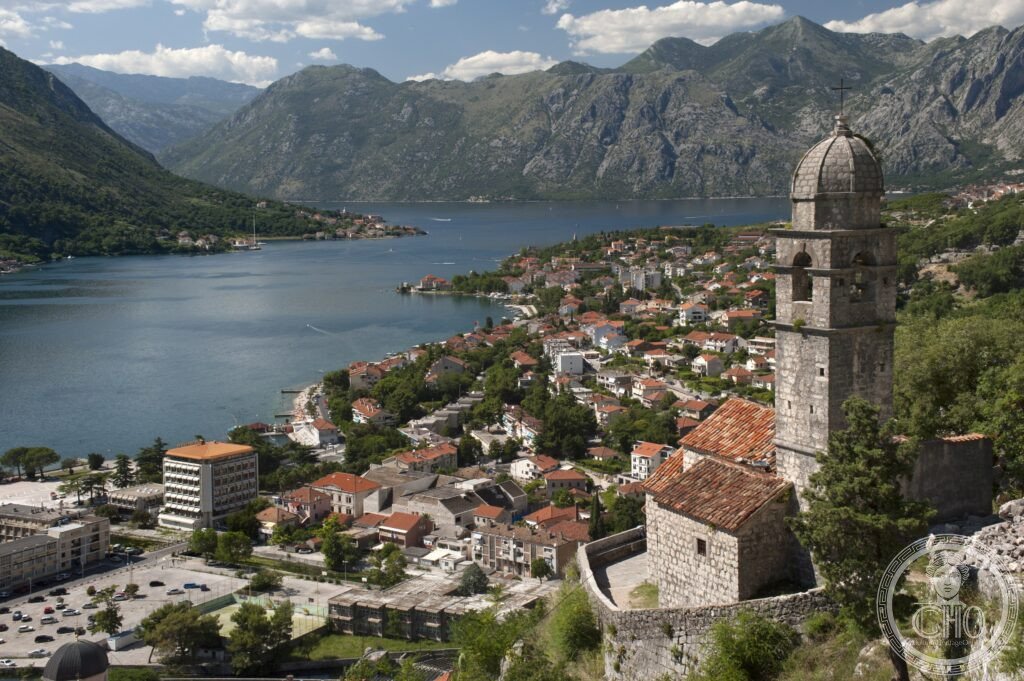
Kotor Old Town
The most dramatically fortified medieval town on the Adriatic and the southernmost fjord in Europe — Kotor Old Town (Bay of Kotor, Montenegro; UNESCO WHS 1979) is a remarkably complete Venetian walled city at the edge of the Bay of Kotor (Boka Kotorska), with 4.5 km of walls that rise vertically from the waterfront to a mountaintop fortress 260m above the sea.
At a glance
Kotor Old Town (the most precisely KotorMontenegro single Kotor Municipality Boka Kotorska Bay Montenegro 4.5 km total wall circumference 4 to 20m high walls 10m thick at base rising from waterfront 0m to San Giovanni fortress 260m Mount Sveti Ivan mountain St John San Giovanni Venetian fortress dramatically rising up cliff face behind Old Town most dramatic Venetian fortification Adriatic medieval walled city commercial republic Venetian Ragusa Dubrovnik comparable medieval commercial city state Boka Kotorska Bay of Kotor southernmost fjord Europe glacial carved valleys submerged river canyon not true glacial fjord but fiord-like bay Adriatic deep water 60m 50m protected enclosed bay microclimate 160 days of rain per year wettest place on the Adriatic but sheltered from Adriatic wind Cathedral of Saint Tryphon 1166 CE Romanesque oldest intact Romanesque interior in Montenegro two-bell-tower Romanesque facade rebuilt 1667 earthquake 9th century CE Asgard fortifications original walls medieval Raška Serbian state 1186 CE Nemanjić dynasty Kotor Venetian possession 1420 1797 CE 377 years longest period Venetian rule UNESCO heritage: the cat of Kotor (the most unusual municipal symbol in the Adriatic): Kotor has approximately 700-900 feral cats living in the Old Town, and the cat is the official symbol of Kotor (depicted on the municipal coat of arms alongside Venetian lions, the three towers, and the keys of the city); the relationship between Kotor and cats is ancient: the cats arrived with Venetian sailors (who brought cats on ships to control rats), and the cats have been associated with Kotor since the medieval period; there is a dedicated Cat Museum in the Old Town (Muzej Mačke; the smallest museum in Montenegro); the municipality protects the feral cat population; Kotor is promoted internationally as a cat-friendly destination, with the cats appearing in official tourism materials)) — the most precisely KotorMontenegro single 4.5 km walls 4 20m high 10m thick 0m waterfront 260m San Giovanni fortress Mount Sveti Ivan most dramatic Venetian fortification Adriatic Boka Kotorska southernmost fjord Europe 50 60m deep 160 days rain wettest Adriatic microclimate Cathedral Saint Tryphon 1166 CE Romanesque oldest intact Montenegro 1420 1797 CE 377 years Venetian 700 900 feral cats official symbol cat municipal coat arms Cat Museum smallest museum UNESCO heritage in any UNESCO world heritage site)).
Key facts
- The City Walls of Kotor (the most dramatic fortification climb in Europe): the most precisely KotorMontenegro single city walls 4.5 km total circumference start at sea level north gate south gate main land gate 1555 CE Venetian clock tower inner gate outer gate sea gate three main gates 1440 steps staircase climb from old town to San Giovanni fortress 260m above sea level 1-2 hour climb depending on fitness stone staircase rises continuously up the cliff face behind old town small churches shrines along way Chapel of Our Lady of Health midway point remarkable views over Bay of Kotor Bay of Kotor UNESCO entry fee to climb walls €8 for adults climb in the morning before 9 AM to avoid afternoon heat temperatures July August 35°C+ the walls circuit from sea to San Giovanni fortress 260m and back 3 km total climbing distance height gain 260m UNESCO heritage — the most rewarding fortification climb in the Adriatic: the Kotor city wall climb (1,440 steps from the Old Town to the fortress of San Giovanni; 260m altitude gain; approximately 1-2 hours depending on pace; entry €8) is the most dramatic fortification walk on the Adriatic coast; the walls rise from the waterfront of the Old Town at sea level and follow the steep cliff face of Mount St John continuously to the fortress summit; at the top, the Bay of Kotor (the enclosed bay surrounded by mountains 1,700-1,800m high) is visible in its entirety — a view that genuinely rivals the Iguazu Falls or the Grand Canyon as one of the most unexpectedly overwhelming natural landscapes in Europe; the cat encounters along the way (feral cats sleep on warm stone steps throughout the climb) add to the extraordinary character of the experience
- GPS: 42.4243° N, 18.7714° E
History
From Roman Acruvium to Byzantine to Nemanjić Serbian to Venetian republic to Austro-Hungarian to Yugoslav and Montenegrin independence (the most precisely KotorMontenegro single Acruvium Roman settlement Boka Kotorska bay 1st century BCE 1st century CE Roman administrative centre Roman port access road inland Balkans 535 1186 CE Byzantine Eastern Roman Empire Byzantine fortification 1166 CE Cathedral Saint Tryphon built current form 1186 CE Nemanjić Serbian medieval dynasty Stefan Nemanja founder Serbian state Stefan the First-Crowned first Serbian king 12th 13th century CE medieval commercial city commerce Adriatic trade boats merchants 14th century CE Kotor Commune medieval republic self-governing trade republic city state similar Dubrovnik Ragusa 1391 CE Hungarian protection 1420 CE voluntary submission Venice Kotor asked Venice protection against Ottomans 1420 1797 CE 377 years Venetian rule Venetian fortification expansion current 4.5 km walls mainly Venetian 15th 16th century CE 1571 CE Ottoman fleet under Uluj Ali besieged Kotor after Battle of Lepanto same year failed to capture 1667 CE earthquake destroyed Cathedral Saint Tryphon parts of city rebuilt 1797 CE Napoleon Bonaparte abolished Venetian Republic Kotor briefly French then 1814 CE Austrian Habsburg Empire 1814 1918 CE Austro-Hungarian Kotor major naval base 1918 CE Kotor part Kingdom of Serbs Croats Slovenes later Yugoslavia 1918 1992 CE Yugoslav Navy 1991 CE Montenegrin independence referendum 1992 CE dissolution Yugoslavia 2006 CE Montenegro independence 1979 CE UNESCO UNESCO heritage: the Kotor earthquake of 1979 and the UNESCO restoration: the Montenegro earthquake of April 15, 1979 CE (6.9 Mw; 101 dead; 100,000 homeless; the deadliest earthquake in Yugoslavia’s history) severely damaged the Old Town of Kotor; only 3 months later, on July 19, 1979 CE, UNESCO inscribed Kotor on the World Heritage List (the first country to receive emergency UNESCO inscription as a result of earthquake damage); the inscription was partly a mechanism to mobilise international conservation resources for the damaged city; the post-earthquake restoration (1979-1990s CE) was one of UNESCO’s largest heritage conservation projects in Europe)) — the most precisely KotorMontenegro single Acruvium Roman 1st BCE 1st CE Byzantine 535 1186 CE Nemanjić 1186 CE Cathedral Saint Tryphon built 14th century CE Commune commercial republic 1420 CE voluntary submission Venice 1420 1797 CE 377 years Venetian 1571 CE Uluj Ali failed capture Battle Lepanto 1667 CE earthquake cathedral rebuilt 1797 CE Napoleon abolished Venice 1814 1918 CE Habsburg Austrian naval base 1979 CE earthquake 6.9 Mw 101 dead 100000 homeless 1979 CE UNESCO emergency inscription first earthquake-driven inscription UNESCO heritage in any UNESCO world heritage site)).
What you see
The Cathedral of Saint Tryphon, the Piazza delle Armi, and the climb (the most precisely KotorMontenegro single Cathedral Saint Tryphon 1166 CE Romanesque current form 12th century CE two bell towers flanking Romanesque facade most photographed facade Montenegro rebuilt after 1667 earthquake interior best preserved Romanesque interior Montenegro silver-gilt reliquary of Saint Tryphon patron saint Kotor saint Tryphon 3rd century CE martyred bishop relic brought Kotor 809 CE by Venetian merchants treasury museum above entrance Cathedral of Saint Luke 12th 13th century CE Byzantine-Romanesque smaller older Orthodox icons preserved Maritime Museum Palazzo Grgurina 1732 CE best collection Kotor history Venetian navigation exhibition Piazza delle Armi Arms Square clock tower 1602 CE Venetian Venetian lion above clock face Campiello square small local square cats pigeons Sea Gate 1555 CE main visitor entrance inscription recalls Battle Lepanto 1571 CE victory over Ottomans Venetian north gate narrow entrance postern gate City Walls 1440 steps climb San Giovanni fortress views Churches Saint Mary Collegiate Church 13th century CE frescoes Saint Anne Church Saint Joseph Church numerous small medieval churches throughout Old Town 4.5 km walls circumference UNESCO heritage: the Cathedral of Saint Tryphon and the cult of sea-patron saints (the most concentrated collection of Adriatic silver reliquaries): the Cathedral of Saint Tryphon (1166 CE; Romanesque; the finest medieval interior in Montenegro) contains one of the most important collections of Adriatic goldsmithing in the world; the silver-gilt reliquary of Saint Tryphon (the patron saint of Kotor; martyred in 250 CE; his skull relic brought to Kotor in 809 CE by Venetian merchants from Constantinople) is the centrepiece of the cathedral treasury; the treasury also contains: 12th-16th century CE Kotor goldsmith work (the Kotor goldsmith’s guild was one of the most important in the Adriatic); the silver-gilt Christ Crucified (16th century CE) which was donated after Kotor survived the Ottoman siege of 1571 CE; the collection of 72 reliquary items of saints (the most concentrated reliquary collection per capita of any cathedral in the Adriatic))) — the most precisely KotorMontenegro single Cathedral Saint Tryphon 1166 CE Romanesque two towers 1667 earthquake rebuilt finest Romanesque interior Montenegro silver-gilt reliquary 3rd century CE saint brought 809 CE Venice merchants Constantinople 72 reliquary items 12th 16th century CE Kotor goldsmith guild Piazza Armi 1602 CE clock tower Venetian lion Sea Gate 1555 CE Lepanto inscription 1440 steps climb 260m views UNESCO heritage in any UNESCO world heritage site)).