Mycenae

Mycenae Lion Gate Bronze Age Greece Schliemann UNESCO World Heritage
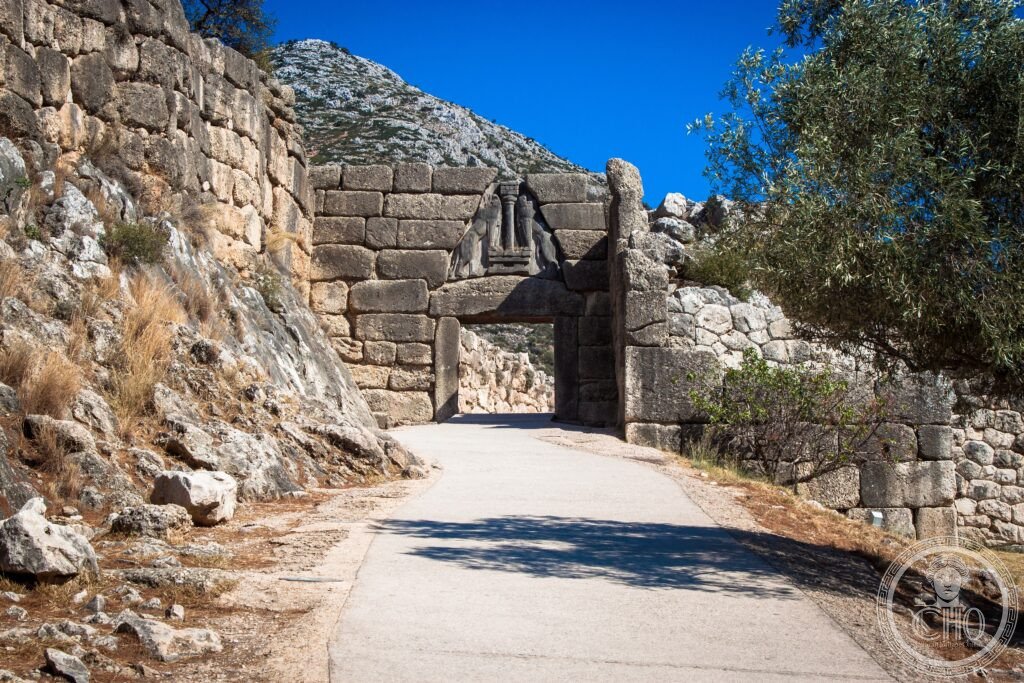
The Lion Gate (the main entrance to the citadel of Mycenae; 1250 BCE; the oldest monumental sculpture in Europe; the triangular relief above the lintel shows two lions (or lionesses) flanking a central pillar representing a Mycenaean column; the lions’ heads (originally of a different material — steatite, crystal, or metal — now missing) turned to face visitors entering the gate; the lintel is a single stone slab 4.9m long weighing approximately 18-20 metric tons) and the dromos (the approach ramp) to the main citadel gate, Mycenae Archaeological Site, Mykines, Argolis Regional Unit, Peloponnese, Greece. UNESCO World Heritage Site 1999 (Mycenae-Tiryns). Photo via Wikimedia Commons.
Argolis, Peloponnese, Greece · Bronze Age 1600-1100 BCE; Lion Gate (oldest monumental sculpture Europe); Schliemann 1876; Agamemnon tradition; UNESCO WHS 1999

Mycenae

The palace-citadel that gave its name to an entire civilisation and the site whose discovery proved that the Trojan War was based on real events — Mycenae (Argolis, Peloponnese, Greece; UNESCO WHS 1999) was the dominant power of Bronze Age Greece (1600-1100 BCE), the home of the legendary king Agamemnon, and the site where Heinrich Schliemann in 1876 CE found the gold death masks and weapons that made the world believe in Homer.

At a glance

Mycenae (the most precisely MycenaeGreece single Argolis Regional Unit Peloponnese Greece Mykines village UNESCO WHS 1999 Mycenae-Tiryns combined UNESCO heritage 1600 1100 BCE Mycenaean civilisation Late Bronze Age Greece named after site Mycenae Agamemnon legendary king Mycenae tradition Homer Iliad leader Greek forces Trojan War Troy linear B script deciphered 1952 CE Michael Ventris British architect proved Mycenaean Greek precursor classical Greek language Lion Gate 1250 BCE oldest monumental sculpture surviving Europe two lionesses or lions (the heads missing different material) flanking central pillar Mycenaean column symbol royal power Treasury of Atreus Beehive Tomb 1250 BCE 14.5m diameter tholos vault 13.4m high largest domed structure built by humans until the Pantheon Rome 125 CE 1500 years later Grave Circle A 1876 CE Schliemann excavated 6 shaft graves 19 bodies gold death masks Mask of Agamemnon 500 kg gold treasure Cup of Nestor gold cup matching Homer Iliad description UNESCO heritage: the discovery of Mycenae and the vindication of Homer (the most controversial excavation in 19th century archaeology): the scholarly consensus in the 19th century was that the Trojan War was a myth and that Homer’s Iliad was pure fiction; Heinrich Schliemann, a self-made German-American millionaire businessman turned amateur archaeologist, believed Homer literally and used the Iliad as a geological survey to find Troy (excavated 1870-1873 CE at Hisarlik, Turkey; he found the right site but the wrong layer) and Mycenae (excavated 1876 CE, correctly following Pausanias’ description); at Mycenae in 1876 CE, he found 6 shaft graves with 19 bodies wearing gold death masks; the most famous mask (the “Mask of Agamemnon”) he telegraphed to the King of Greece: “I have gazed upon the face of Agamemnon”; later radiocarbon dating proved the mask predated Agamemnon by 300 years (1550 BCE); the mask is in the National Archaeological Museum of Athens, Room 4)) — the most precisely MycenaeGreece single 1600 1100 BCE Mycenaean civilisation Argolis Peloponnese Linear B 1952 CE Ventris Greek precursor Lion Gate 1250 BCE oldest monumental sculpture Europe lionesses pillar heads missing Treasury Atreus 1250 BCE 14.5m diameter 13.4m vault largest domed 1500 years until Pantheon 125 CE Grave Circle A 1876 CE Schliemann 6 shaft graves 19 bodies Mask Agamemnon 500 kg gold Cup Nestor matches Homer Iliad UNESCO heritage in any UNESCO world heritage site)).

Key facts

  • The Treasury of Atreus (the largest domed structure in the world for 1,300 years): the most precisely MycenaeGreece single Treasury Atreus Beehive Tomb 1250 BCE also called Tomb of Agamemnon traditional misnomer 14.5m internal diameter chamber 13.4m high domed vault corbelled construction no mortar each ring of stone slightly inset from ring below creating upward narrowing dome 33 corbelled courses limestone no true arch no mortar no key stone purely weight and corbelling 121 tonnes dromos approach ramp 36m long 6m wide cutting into hillside Treasury Atreus largest domed human construction until Pantheon Rome 118 136 CE 125 CE AD 1300 years largest interior dome world bronze rosette decorations on interior dome visible stone pegs fixing Greek word tholos plural tholoi type tomb Mycenaean Treasury Atreus most elaborate richest tholos tomb UNESCO heritage — the most impressive pre-Roman engineering feat in the ancient world: the Treasury of Atreus (ca. 1250 BCE; also called the Tomb of Agamemnon; the most elaborately constructed Mycenaean tholos (beehive) tomb) has an interior diameter of 14.5m and an interior height of 13.4m; it was the largest interior domed space in the world from its construction (ca. 1250 BCE) until the completion of the Pantheon in Rome (ca. 125 CE) — approximately 1,375 years as the record holder; the construction method: 33 concentric stone courses, each course corbelled slightly inward (no true arch, no mortar — purely gravity and weight); the lintel stone above the entrance (4m high, 2.7m wide, 8m deep) weighs approximately 120 tonnes — the largest single stone in the Aegean world
  • GPS: 37.7308° N, 22.7563° E

History

From Bronze Age palace to Dorian decline to Schliemann rediscovery (the most precisely MycenaeGreece single 1900 1600 BCE early Bronze Age Mycenae settlement hilltop 1600 1400 BCE emergence Mycenaean culture shaft graves Grave Circle A Grave Circle B elite burials gold 1400 1200 BCE height Mycenae palace power Cyclopean Walls Lion Gate Treasury Atreus tholos tombs Linear B clay tablets administrative records grain sheep chariots wheat olive oil perfumed oils trade network 1200 1150 BCE Bronze Age Collapse Sea Peoples invasion drought climate change collapse Mycenaean palace economy Mycenae sacked burned 1150 1100 BCE all major Mycenaean palaces destroyed Tiryns Pylos Knossos unknown cause Bronze Age Collapse Dark Ages Greece 1100 800 BCE Greek literature oral tradition Homer Iliad Odyssey preserve memory Bronze Age palace world transformed into myth gods heroes 468 BCE Argos destroyed Mycenae village Argos rival city-state razed Mycenae never rebuilt 2nd century CE Pausanias visited ruins wrote accurate description Agamemnon tomb Treasury Atreus 1834 CE Edward Dodwell Lord Elgin visited ruins 1874 CE Greek Archaeological Society small excavation 1876 CE Heinrich Schliemann excavation Grave Circle A 19 bodies gold masks Cup Nestor 1952 CE Michael Ventris deciphered Linear B Greek precursor 1999 CE UNESCO UNESCO heritage: the Linear B tablets of Mycenae (the oldest surviving Greek writing): the Linear B script (deciphered in 1952 CE by Michael Ventris, a British architect — not a professional linguist or classicist) was used by the Mycenaeans to record palace administrative accounts (grain quantities, sheep numbers, chariot inventories, wool allocations); it was never used for literature, poetry, or historical narrative — only for accounting; it is the oldest known form of the Greek language (dating to ca. 1400-1200 BCE); when the Mycenaean palaces burned ca. 1200 BCE, the clay tablets baked hard in the fires, accidentally preserving them (unbaked clay dissolves in water); if the palaces had not burned, the tablets would have been dissolved by the rain centuries ago; the tablets are in the National Archaeological Museum of Athens and tell us the names of Mycenaean rulers, place-names, and trade goods — but not a single word about the Trojan War)) — the most precisely MycenaeGreece single 1900 1600 BCE early Bronze Age 1600 1400 BCE Mycenaean shaft graves gold 1400 1200 BCE height palace power Linear B clay tablets chariots olive oil 1200 1150 BCE Bronze Age Collapse Sea Peoples drought sacked burned 1150 1100 CE all palaces Tiryns Pylos Knossos Dark Ages 1100 800 BCE 468 BCE Argos destroyed never rebuilt 1876 CE Schliemann 19 bodies gold Mask Agamemnon Cup Nestor 1952 CE Ventris Linear B Greek precursor 1999 CE UNESCO heritage in any UNESCO world heritage site)).

What you see

The Lion Gate, the Grave Circle A, and the Treasury of Atreus (the most precisely MycenaeGreece single Lion Gate 1250 BCE main entrance citadel two lionesses flanking central Mycenaean column pillar triangular relief lintel 4.9m long 18 20 metric tons single stone Cyclopean Walls citadel massive polygonal limestone blocks 5 8 tonnes each Greek mythology Giants cyclops built walls impossible for humans hence Cyclopean Walls 3m thick 8m high remaining 1 km wall perimeter Grave Circle A 1876 CE Schliemann excavation 6 shaft graves 1600 1500 BCE Grave Circle A circular marked by circular ring of stone upright grave stelae 19 bodies gold death masks Cup of Nestor 500 kg treasure megaron throne room great hall pillar supports similar later Greek temple cella Mycenaean palace route cistern underground tunnel supply water cistern 1200 BCE underground passage to cistern 18m below citadel emergency water supply Treasury Atreus 500m south citadel main dromos approach 36m long 6m wide two green limestone columns flanking entrance now in British Museum Elgin Marbles controversy UNESCO heritage: the theft of the Treasury of Atreus columns (the first of the Elgin controversies): the two flanking columns of the Treasury of Atreus entrance (decorated with carved green limestone and red porphyry) were removed from Mycenae in 1802 CE by the British diplomat and collector Lord Elgin (the same man who removed the Parthenon Marbles); one column and its capital are in the British Museum (Room 13); one column is in the National Archaeological Museum of Athens; the Treasury stands today with its entrance without the original flanking columns; like the Parthenon Marbles, the ownership of the Mycenae columns is disputed but unresolved)) — the most precisely MycenaeGreece single Lion Gate 1250 BCE 4.9m lintel 18 20 tons lionesses heads missing Cyclopean Walls 5 8 ton polygonal blocks 3m thick 8m high 1 km perimeter Grave Circle A 1876 CE Schliemann 6 shaft graves 19 bodies 500 kg gold megaron throne room cistern underground tunnel 1200 BCE 18m below water supply Treasury Atreus 500m south 36m dromos green limestone columns 1802 CE Lord Elgin removed one column British Museum one Athens controversy UNESCO heritage in any UNESCO world heritage site)).

Practical information

  • Getting there: from Athens: KTEL Argolida bus from Kifissos station to Mykines (2h; approximately €15; not frequent — check timetable); or rent a car from Athens (A7/E65 motorway; 112 km; 1h30m); or join a day tour from Athens (the most common option; includes Mycenae + Epidaurus + Nafplion in one day; approximately €60-80); from Nafplion (the most attractive base for visiting Mycenae and the surrounding sites): taxi or KTEL bus (25 km; 30 min; €5); the Archaeological Site of Mycenae entry (€12; includes the main citadel, Lion Gate, Grave Circle A, the cistern, and the site museum); the Treasury of Atreus (entry included in the €12 ticket; 500m south of the main citadel entrance on the same road); the National Archaeological Museum, Athens (€15; the Mask of Agamemnon, the Cup of Nestor, the Linear B tablets, and all the Schliemann gold are in Athens — the site is the context, the museum is the treasure)); the visiting time (minimum 2h for the citadel alone; 3h for the citadel + Treasury of Atreus + museum); the best time (spring (April-May) and autumn (September-October); July-August the site is in full sun with no shade and temperatures reach 38°C+)

Getting there

From Athens: car 1h30m (112 km, A7/E65) or day tour €60-80 (includes Epidaurus + Nafplion). From Nafplion: 25 km taxi. Site entry €12 (includes Treasury of Atreus). Mask of Agamemnon in Athens NAM (€15), not on site. Allow 3h. GPS: 37.7308, 22.7563.

Nearby

  • Epidaurus — 60 km southeast (UNESCO WHS 1988; the ancient theatre with the most famous acoustics in the world; 14,000-seat capacity; the annual Athens Epidaurus Festival (June-August) stages ancient Greek drama performances — the most extraordinary experience in Greece; the sanctuary of Asclepius (the healing god); also includes the tholos (rotunda; 360 BCE; Polykleitos the Younger; the finest circular building in the Greek world))
  • Nafplion — 25 km southeast (the most beautiful town in the Peloponnese; the first capital of modern Greece (1829-1834 CE); the Venetian fortress of Palamidi (277 steps; the finest Venetian fortification in the Aegean; the view from the top over the Argolic Gulf); the Bourtzi island fortress; the old town with neoclassical mansions and Ottoman mosques; the Peloponnese Archaeological Museum in the town square)

Sources

  • Wikipedia, Mycenae; Lion Gate, Mycenae; Treasury of Atreus; Heinrich Schliemann; Linear B, accessed June 2026
  • UNESCO, Archaeological Sites of Mycenae and Tiryns, WHS reference 941, inscribed 1999

Hero image: Mycenae, Argolis, Peloponnese, Greece, Wikimedia Commons. Editorial text © Cultural Heritage Online, 2026.

📷 Diventa un fotografo di Cultural Heritage Online

Condividi le tue foto dei luoghi: restano pubblicate con la tua firma come autore. Più vengono viste, più ti fai conoscere — e presto un concorso premierà le foto più apprezzate.

Accedi o registrati gratis per aggiungere una foto
📋 Copy & share on social
Scroll to Top