
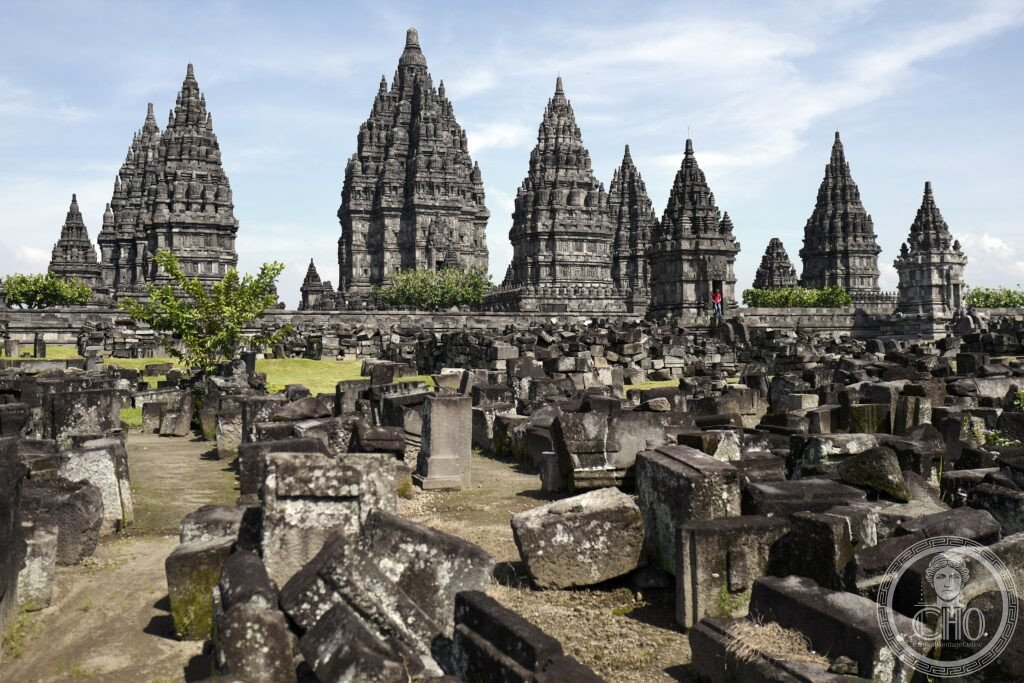
Prambanan
The largest Hindu temple compound in Southeast Asia and one of the greatest monuments of the Hindu world outside India — Prambanan (Loro Jonggrang; Java, Indonesia; UNESCO WHS 1991) was built in the 9th century CE by the Hindu Mataram Kingdom and contains over 200 temples, including three soaring towers dedicated to the Trimurti (Shiva-Brahma-Vishnu) and the most complete Ramayana narrative relief in the world.
At a glance
Prambanan (the most precisely PrambananIndonesia single Sleman Regency Special Region Yogyakarta Klaten Regency Central Java Indonesia UNESCO WHS 1991 Candi Prambanan Loro Jonggrang Slim Virgin princess name folk legend 9th century CE 850 CE Rakai Pikatan King Hindu Mataram Kingdom Sanjaya dynasty built Prambanan to rival Buddhist Borobudur Buddhist Dynasty rival 244 temples original compound inner compound 8 temples 6 Trimurti + 2 Apit flanking North and South outer zone 224 perwara small shrines symmetrical grid concentric squares inner compound raised central platform 3 Trimurti temples 3 Vahana temples 2 Apit flanking temples Shiva temple 47m tallest largest Hindu temple Indonesia Brahma temple south 37m Vishnu temple north 37m Nandi Shiva’s bull temple facing Shiva Hamsa Brahma’s swan Garuda Vishnu’s eagle facing Vishnu Indonesia Hindu cultural history Mataram Hindu Kingdom 8th 9th century CE later Islamicised 15th 16th century CE Java now majority Muslim Prambanan and Borobudur evidence 8th 9th century CE Java was sophisticated Buddhist Hindu mix before Islamisation 16th century CE UNESCO heritage: Prambanan vs. Borobudur (the extraordinary accident of religious history that built both): the proximity of Prambanan (Hindu; 850 CE; 42 km east of Borobudur) and Borobudur (Buddhist; 825 CE) on the same island reflects a brief, extraordinary period in Javanese history when Hindu and Buddhist kingdoms coexisted within 50 km of each other; Borobudur was built by the Buddhist Sailendra dynasty; Prambanan was built by the Hindu Sanjaya dynasty (possibly in deliberate rivalry); the two monuments represent the two rival religions at the peak of their art and architecture; by the 15th-16th century CE, Islam had replaced both Hinduism and Buddhism across most of Java; the descendants of both temple-builders converted to Islam; both temples were buried by vegetation for centuries (Borobudur was found under jungle in 1814 CE; Prambanan under jungle and volcanic ash in the 1730s CE) and both have been restored by UNESCO-era conservation efforts)) — the most precisely PrambananIndonesia single 850 CE Rakai Pikatan Hindu Mataram Sanjaya dynasty 244 temples 8 inner Trimurti Shiva 47m tallest Brahma 37m Vishnu 37m Vahana Nandi Hamsa Garuda Loro Jonggrang folk legend Slim Virgin 15th 16th century CE Islamisation Java rivalry Buddhist Sailendra Borobudur 825 CE both found buried 1730s CE Borobudur 1814 CE UNESCO heritage in any UNESCO world heritage site)).
Key facts
- The Ramayana reliefs (the most complete visual narration of the Ramayana in existence): the most precisely PrambananIndonesia single Ramayana reliefs Shiva temple inner gallery 152 panels 2m high continuous carved relief series main balustrade inner balustrade total Shiva temple narrative Ramayana 152 panels read by walking clockwise pradakshina around inner gallery reading left to right starts east staircase east entrance Rama and Sita Ravana Hanuman Lanka Sita abduction golden deer Lakshmana Jatayu complete narrative most detailed complete Ramayana visual cycle in the world Ramayana Brahma temple continues final part Uttara Kanda continuation from Shiva temple narrative continues into Brahma temple Ramayana story carved same high-quality limestone same carving workshop same period 850 CE UNESCO heritage — the most complete visual narration of the Ramayana in the ancient world: the Prambanan Ramayana reliefs (ca. 850 CE; carved in volcanic andesite stone; on the inner gallery of the Shiva temple; 152 panels; each panel approximately 60 cm × 60 cm) tell the complete story of the Ramayana (from Rama’s birth in Ayodhya to his coronation after defeating Ravana) in continuous narrative sequence; the story continues onto the Brahma temple (the Uttara Kanda, the last book of the Valmiki Ramayana); the relief style is characterised by dense foliage backgrounds, crowded compositions, and dynamic action poses — very different from the more restrained Indian originals; the annual Prambanan Ramayana Ballet (performed outdoors in an open-air theatre with the illuminated Prambanan towers as backdrop on full-moon nights May-October; the longest-running open-air classical dance performance in Indonesia) enacts the same story that is carved on the walls
- GPS: -7.7520° S, 110.4915° E
History
From Hindu Mataram royal shrine to abandoned ruin to UNESCO restoration (the most precisely PrambananIndonesia single 850 CE Rakai Pikatan King Hindu Mataram Sanjaya dynasty built Prambanan compound Sanjaya dynasty Hindu rival Sailendra dynasty Buddhist built Borobudur 825 CE 25 km west marriage alliance two kingdoms possibility Rakai Pikatan Mataram King married Pramodhawardani Sailendra princess converted to different religion 856 CE enlarged expanded by Rakai Kayuwangi grandson Rakai Pikatan 10th century CE Rakai Wawa King Balitung last record Prambanan inscriptions 929 CE volcanic eruption Mount Merapi possibly caused abandonment eastern Java capital shift east Java Islamic kingdoms 15th century CE Demak Sultanate conversion Java to Islam abandoned temples 1549 CE earliest European description Portuguese Gaspar Correia 1595 CE first Dutch records Cornelis de Houtman 1733 CE Nicolas Hartingh Dutch colonial administrator Batavia identified site Prambanan most extensive survey 1811 CE Colin Mackenzie British surveyor under Stamford Raffles Lieutenant Governor British Java 1884 CE first restoration attempt IJzerman Dutch engineer 1886 CE 1937 CE Dutch colonial government systematic restoration individual candi started 1953 CE Indonesia independence government continued restoration Shiva temple fully restored 1953 CE Brahma temple 1987 CE Vishnu temple 1992 CE 2006 CE earthquake Yogyakarta 6.3 Mw earthquake 500 dead 100000 displaced Prambanan heavily damaged UNESCO emergency restoration 5000 displaced stones re-identified replaced UNESCO heritage: the 2006 Yogyakarta earthquake and the restoration challenge (the most complex 3D jigsaw puzzle in architectural conservation): the Yogyakarta earthquake of May 27, 2006 CE (6.3 Mw; 5,749 dead; 36,000 homes destroyed) damaged approximately 2,000 stones at Prambanan, scattering them across the site; the UNESCO/Indonesian reconstruction team faced the same problem that had slowed all Prambanan restoration since 1937 CE: the anastylosis approach (putting original stones back in their original positions) requires identifying which of the 150,000+ displaced stones from the 244 original temples belongs where; each stone was carved on all four sides, making identification by position, style, and mathematical fit a three-dimensional jigsaw puzzle across 244 structures; since 2006 CE, 3D photogrammetric scanning and computer analysis have been used to match displaced stones to gaps, a technique not available to the Dutch restorers of 1884-1942 CE)) — the most precisely PrambananIndonesia single 850 CE Rakai Pikatan Sanjaya Hindu Mataram Sailendra Buddhist Borobudur 825 CE marriage Pramodhawardani 10th century CE enlargement 929 CE abandonment possible Merapi eruption capital shift east 15th century CE Islamisation 1549 CE Portuguese 1733 CE Hartingh 1811 CE Mackenzie Raffles 1884 CE IJzerman 1937 CE Dutch restoration 1953 CE Shiva temple restored 1987 CE Brahma 1992 CE Vishnu 2006 CE Yogyakarta earthquake 6.3 Mw 2000 stones displaced 3D photogrammetric scanning anastylosis UNESCO heritage in any UNESCO world heritage site)).
What you see
The inner compound, the Ramayana reliefs, and the Prambanan Ballet (the most precisely PrambananIndonesia single inner compound raised central platform 8 inner zone temples 3 Trimurti Shiva 47m tallest 37.7m plinth + 9.3m finial cella 4 directional chambers north Ganesha Shiva’s son elephant head south Agastya sage form Durga east Parvati Shiva’s wife west Shiva Mahadeva main image 3m black andesite statue Shiva 4 armed four hands inner gallery Ramayana reliefs 152 panels pradakshina circumambulate clockwise relief visible inner wall gallery Brahma temple south 37m same structure smaller Sarasvati Agni cella Brahma 4-headed north Vishnu temple 37m Vishnu seated Lakshmi his wife 4 companion Vahana temples Nandi bull facing Shiva Hamsa goose facing Brahma Garuda eagle facing Vishnu inner zone Apit temples 2 flanking north south outer zone 224 perwara subsidiary shrines symmetrical concentric square arrangement most small perwara reconstructed 1950s 1990s from original fallen stones Prambanan Archaeological Park 39 hectares parking Plaosan Buddhist temple 1 km north 9th century BCE Buddhist contemporary Prambanan UNESCO Prambanan Ramayana Ballet outdoor open-air theatre behind Prambanan compound 600 seat capacity full-moon May October evenings illuminated Prambanan towers backdrop Ramayana story performed Javanese classical Sendratari dance UNESCO heritage: the Prambanan Ramayana Ballet (the most dramatic theatrical setting in Asia): the Prambanan Ramayana Ballet (performed on full-moon evenings from May to October; in the open-air Trimurti Theatre immediately east of the compound; seating ca. 600; tickets approximately 250,000-400,000 IDR/€13-21) performs the Ramayana story (which is carved on the temple walls) with the illuminated 47m Prambanan towers as backdrop; the performance uses Javanese Sendratari (a combination of dance, drama, and gamelan music) to enact the story of Rama and Sita; this is the longest-running open-air classical dance performance in Indonesia (continuous since 1961 CE, with a brief break after the 2006 earthquake) — the Javanese equivalent of the Athens Epidaurus Festival)) — the most precisely PrambananIndonesia single inner compound Shiva 47m 4 chambers Ganesha Agastya Durga Parvati 3m Shiva statue andesite Ramayana reliefs 152 panels Brahma temple south 37m Vishnu north 37m Vahana Nandi Hamsa Garuda 224 perwara outer zone Plaosan Buddhist 1 km north 9th century BCE Prambanan Ramayana Ballet outdoor open-air 600 seats full-moon May October illuminated towers Sendratari gamelan Javanese dance 1961 CE ongoing UNESCO heritage in any UNESCO world heritage site)).
Practical information
- Getting there: from Yogyakarta: local bus (Trans Jogja Line 1A; 45-60 min; Rp 3,600/€0.20) or taxi/Grab (17 km east; 25 min; approximately Rp 70,000/€4); the Borobudur Prambanan combo ticket (approximately US$40; includes both sites; the most popular tourist option; buses between sites available with the combo ticket); the Prambanan entry fee (approximately Rp 350,000/€18.50 for foreign tourists; Rp 60,000/€3.20 for Indonesian citizens; includes the inner compound and the Prambanan Archaeological Park); the Ramayana Ballet (250,000-400,000 IDR/€13-21; full-moon evenings May-October; tickets via Trimurti Theatre office or online; the inner courtyard special performance (more expensive) puts the audience inside the compound; the most dramatic option); the visiting time (minimum 2h for the inner compound + one circuit of the Ramayana reliefs; 4h for the complete site including outer zone and Plaosan); the best time (dry season April-October; the rainy season (November-March) brings heavy afternoon thunderstorms; the full-moon evenings in May-October are the best time for the Ramayana Ballet); morning is best (before 9 AM the light is softer and crowds minimal))
Getting there
From Yogyakarta: Trans Jogja bus 45 min (Rp 3,600/€0.20) or taxi 25 min (Rp 70,000/€4). Entry Rp 350,000/€18.50. Ramayana Ballet Rp 250-400k/€13-21 (full-moon, May-October). Best: April-October, mornings. GPS: -7.7520, 110.4915.
Nearby
- Borobudur — 42 km west (UNESCO WHS 1991; the largest Buddhist monument in the world (9th century CE; 35m high; 2,672 relief panels narrating the Buddhist path to enlightenment; 504 Buddha statues; 72 stupas); the sunrise view from the upper terraces, with the volcanic silhouettes of Merapi and Merbabu behind, is the most photographed moment in Indonesian archaeology; the Borobudur-Prambanan combo ticket gives access to both)
- Plaosan Temple — 1.5 km northeast (a 9th century CE Buddhist twin-temple compound built simultaneously with Prambanan; possibly built by the Sailendra queen Pramodhawardani (wife of Rakai Pikatan) to maintain Buddhist worship alongside the Hindu Prambanan; the twin towers are not fully restored but are far less visited than Prambanan; the reliefs of celestial beings are finer than those at Borobudur; free entry with Prambanan ticket))
Sources
- Wikipedia, Prambanan; Mataram (Hindu kingdom); Prambanan Ramayana Ballet, accessed June 2026
- UNESCO, Prambanan Temple Compounds, WHS reference 642, inscribed 1991
Find it on the map
See this place and what’s around it →📷 Diventa un fotografo di Cultural Heritage Online
Condividi le tue foto dei luoghi: restano pubblicate con la tua firma come autore. Più vengono viste, più ti fai conoscere — e presto un concorso premierà le foto più apprezzate.
Accedi o registrati gratis per aggiungere una foto