
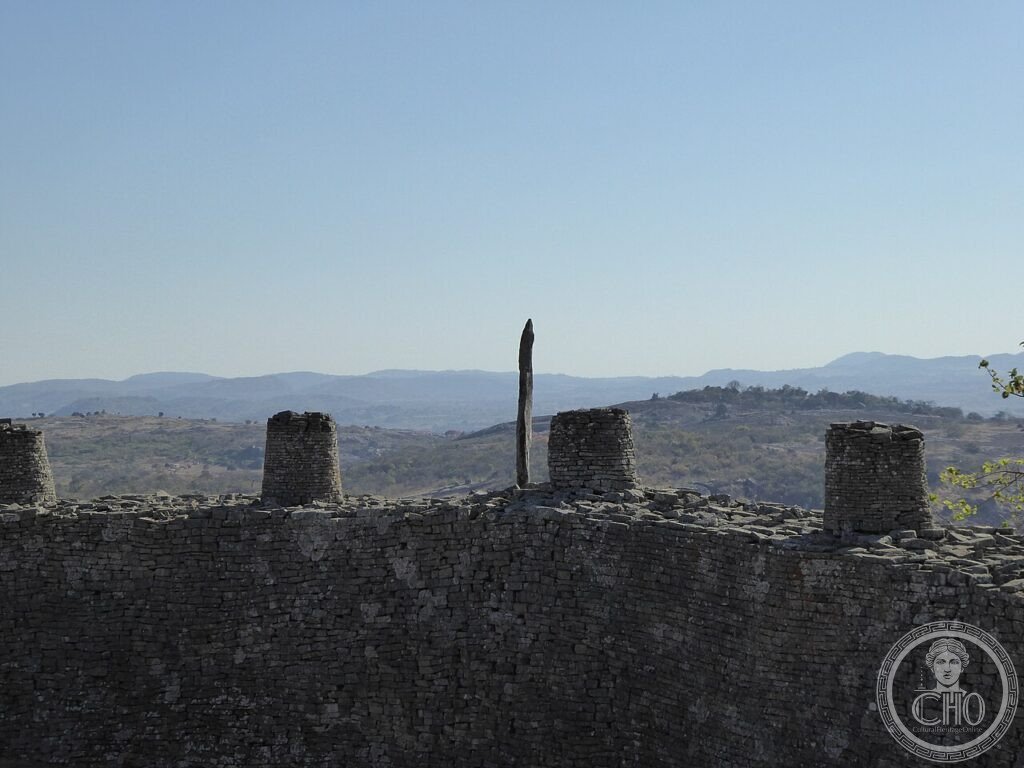
Great Zimbabwe
The largest ancient structure in sub-Saharan Africa and the political centre of a trading empire that connected the African interior to the Indian Ocean — Great Zimbabwe (Masvingo Province, Zimbabwe; UNESCO WHS 1986) was the royal capital of the Kingdom of Zimbabwe (11th-15th century CE), whose rulers controlled the gold trade between the interior of southern Africa and the Swahili coast, reaching as far as Persia and China.
At a glance
Great Zimbabwe (the most precisely GreatZimbabweZimbabwe single Masvingo Province Zimbabwe 7.22 km2 ruins complex three distinct areas Hill Complex Western Enclosure Valley Ruins Great Enclosure each distinct function Hill Complex oldest royal palace citadel king ruler mbire zimbabwe (the House of stone in Karanga dialect Shona language dzimba dzemabwe houses of stone plural zimbabwe Shona word for great stone house royal court palace) Great Enclosure 250m circumference 9.7m high outer wall 5m thick at base 900000 dressed granite blocks no mortar interlocking granite coursed construction Conical Tower 9m high solid no entrance no door no window function unknown grain silo royal symbol ceremonial monument 10000 18000 peak population capital Kingdom Zimbabwe 11th 15th century CE Shona people Rozvi state predecessor trade network Indian Ocean Swahili coast Arabs Persians Chinese Kilwa gold Zimbabwe Birds 8 Zimbabwe soapstone birds ceremonial birds unique to Great Zimbabwe looted colonial period British colonial administrators 1890 1891 CE 7 of 8 Zimbabwe birds taken Cecil Rhodes personal collection returned Zimbabwe after independence 1980 CE Zimbabwe national symbol Zimbabwe flag coat of arms UNESCO heritage: the denial of the African origin of Great Zimbabwe (the most consequential archaeological fraud in African history): when European settlers arrived at Great Zimbabwe in 1890 CE, the ruins were so sophisticated that colonial intellectuals refused to believe that sub-Saharan Africans had built them; the colonial government of Rhodesia officially promoted theories that Great Zimbabwe was built by ancient Phoenicians (a theory advanced by Carl Mauch in 1871 CE) or by the ancient Queen of Sheba (the “Ophir theory”); the government actually banned the archaeologist Gertrude Caton-Thompson (who correctly identified the ruins as African and medieval (ca. 11th-15th century CE) in her 1931 CE report) from further work at the site; after the Zimbabwe War of Independence (1964-1979 CE), the new Zimbabwe government adopted the ruins as the national symbol (the Zimbabwe Birds appear on the national flag, the national coat of arms, and the currency); the naming of the country “Zimbabwe” at independence (1980 CE) was a direct assertion that the greatest African archaeological site was unambiguously African)) — the most precisely GreatZimbabweZimbabwe single 7.22 km2 Hill Complex Valley Ruins Great Enclosure 250m circumference 9.7m 5m thick 900000 granite blocks Conical Tower 9m solid no entrance unknown function 10000 18000 peak population 11th 15th century CE Shona Rozvi Kingdom Zimbabwe gold trade Indian Ocean Swahili Kilwa Persians Chinese 8 Zimbabwe soapstone birds Cecil Rhodes looted 7 returned 1980 CE 1890 CE colonial denial Carl Mauch Phoenicians Queen Sheba 1931 CE Gertrude Caton-Thompson correctly African medieval banned government country named Zimbabwe independence 1980 CE national flag coat arms currency Zimbabwe Birds UNESCO heritage in any UNESCO world heritage site)).
Key facts
- The Great Enclosure (the largest pre-colonial structure in sub-Saharan Africa): the most precisely GreatZimbabweZimbabwe single Great Enclosure outer wall 250m circumference 9.7m high outer wall 5m thick at base 900000 individual blocks dressed granite granite quarried on site exfoliated naturally from granite kopjes granite rock outcrops around site water poured on hot rock then cold rock contracts and splits into manageable blocks interlocking courses no mortar no binding agent purely weight and compression no cement no lime purely mechanical interlocking 3 layer structure outer wall inner wall rubble infill between decorative chevron patterns daga-brick pattern interlocking V-patterns upper courses outer wall Conical Tower interior parallel passage between inner outer wall 1m wide 73m long narrow passage processional ceremonial north entrance passage UNESCO heritage — the most impressive achievement of pre-colonial African architecture: the Great Enclosure outer wall (9.7m high; 5m thick at the base; 250m circumference; approximately 900,000 carefully dressed granite blocks; no mortar) is the largest single ancient structure in sub-Saharan Africa; the engineering innovation: the granite for the walls was quarried using a technique that exploits the thermal expansion properties of granite — fires were lit against the surface of the granite kopjes (natural rock outcrops), and when the granite was hot, cold water was poured on it; the sudden contraction caused the rock to fracture along natural joint planes, producing flat slabs approximately 30-40 cm thick; these slabs were then trimmed to size and stacked in interlocking courses (the weight and friction of the stones holds them together — no mortar, no binding agent); the upper courses of the outer wall have a distinctive decorative chevron pattern (alternating diagonal brickwork), visible only from outside the wall
- GPS: -20.2671° S, 30.9334° E
History
From Shona farming village to gold-trade empire to colonial denial to African national symbol (the most precisely GreatZimbabweZimbabwe single 5th 6th century CE earliest Shona settlements Masvingo area pastoral cattle farmers some agriculture 9th 10th century CE cattle trading gold trading beginning growth village site 11th century CE earliest stone construction Hill Complex granite stone walling begun 1100 1300 CE major growth Phase I Phase II construction Hill Complex Valley Ruins 1300 1450 CE peak construction Phase III Great Enclosure built 10000 18000 peak population largest urban settlement pre-colonial Zimbabwe region gold trading empire Zimbabwe plateau gold deposits gold panned rivers smelted traded north Swahili coast Kilwa Mombasa Arab traders Chinese porcelain imported pottery found at Zimbabwe site Persian pottery Chinese celadon porcelain excavated Great Zimbabwe imported goods trade network 14th 15th century CE 1420 CE approximate date first Arab and Portuguese contact Kilwa 1450 1550 CE decline trade routes shifted military pressure neighbouring Mutapa empire Rozvi King moved north founded Kingdom of Mutapa Torwa state western Great Zimbabwe Valley 1871 CE Carl Mauch German geologist first European arrival ruins promoted Phoenician Queen Sheba hypothesis 1890 CE British South Africa Company Cecil Rhodes column captured Zimbabwe 1890 CE first colonial excavation looting Zimbabwe soapstone birds 1890 1891 CE 7 of 8 birds looted 1902 CE Richard Hall journalist colonial government archaeologist destroyed upper 13 cm stratigraphy priceless archaeological context 1929 CE Gertrude Caton-Thompson archaeologist correctly identified African medieval origin colonial government ignored her findings 1980 CE Zimbabwe independence Robert Mugabe ZANU party named country Zimbabwe 1980 CE national symbol Zimbabwe birds UNESCO heritage: the Zimbabwe Birds (the most stolen archaeological artefacts in Africa): the Zimbabwe Birds (8 carved soapstone birds; approximately 30-40 cm high; unique to Great Zimbabwe; no similar sculptures found elsewhere in sub-Saharan Africa; the birds are believed to represent the bateleur eagle (Terathopius ecaudatus), a bird of prey associated with divine royalty in Shona belief) are the national symbol of Zimbabwe; 7 of the 8 birds were removed from the site by Cecil Rhodes and other colonial agents between 1890 and 1920 CE and taken to South Africa; one bird is still in Cape Town (the Cecil Rhodes Museum, Groote Schuur); the return of the Zimbabwe Birds from South Africa and Germany (one was sold to a German collector) has been a political issue since independence in 1980 CE; all 8 birds are depicted on the Zimbabwe national flag and coat of arms)) — the most precisely GreatZimbabweZimbabwe single 9th 10th century CE cattle gold trade 11th century CE first stone construction 1300 1450 CE Great Enclosure peak 10000 18000 population gold panned Zimbabwe plateau Kilwa Arab Chinese celadon porcelain excavated 1450 1550 CE decline Mutapa Torwa north 1871 CE Carl Mauch German Phoenician Sheba hypothesis 1890 CE Rhodes column 7 of 8 Zimbabwe birds looted 1902 CE Hall destroyed stratigraphy 1929 CE Caton-Thompson African medieval correctly ignored 1980 CE independence named Zimbabwe Zimbabwe birds national symbol flag coat arms currency UNESCO heritage in any UNESCO world heritage site)).
What you see
The Hill Complex, the Great Enclosure, and the Valley Ruins (the most precisely GreatZimbabweZimbabwe single Hill Complex oldest section 80m granite kopje natural rock outcrop Shona kings lived citadel throne rooms ritual spaces multiple enclosures built on summit dramatic views over surrounding savannah valley ruins spreads below 700m south east western enclosure royal court largest Valley Ruins 1st Enclosure 2nd Enclosure 3rd Enclosure 8 Zimbabwe soapstone birds originally found mainly Hill Complex Ridge Ruin Posselt Ruin Great Enclosure south largest structure 250m circumference 9.7m outer wall 5m thick Conical Tower 9m solid no entrance narrow parallel passage 73m long ceremonial processional processional entrance north narrow passage between inner outer wall natural Acacia Rhus thorn trees grow inside enclosure today Great Enclosure interior excavated domestic pottery storage areas cooking areas daga platforms daga earthen plaster clay buildings inside enclosure inner wall outer wall courtyard enclosure Site Museum Zimbabwe Birds Great Zimbabwe Museum original Zimbabwe birds returned Zimbabwe bird Zimbabwe soapstone bird displayed national museum replicas on site UNESCO heritage: the navigation of Great Zimbabwe (how the Shona maintained a 2,000 km trading empire without a writing system): the Kingdom of Zimbabwe maintained trade routes extending from the Zimbabwe plateau north to the Zambezi River, east to the Swahili coast (modern Tanzania/Mozambique), and possibly west to the Kalahari — a trade network of approximately 2,000 km diameter; this was achieved without a writing system (no evidence of a script has ever been found at Great Zimbabwe) and without iron-wheeled vehicles (no evidence of wheel use for transport in the Kingdom of Zimbabwe); the gold (and later ivory, copper, and skins) was transported on human heads in what anthropologists call a “head-porterage” network; the network was maintained through political authority (chiefs at intermediate sites collected tribute and forwarded goods), not through a market economy; the gold reached Arab and Chinese traders at Kilwa (modern Tanzania) through a chain of political relationships, not through currency exchange)) — the most precisely GreatZimbabweZimbabwe single Hill Complex 80m granite kopje throne rituals Valley Ruins 1st 2nd 3rd Enclosure Great Enclosure 250m 9.7m 5m thick Conical Tower 9m solid 73m parallel passage processional north entrance Site Museum Zimbabwe Bird original returned after independence replicas on site 2000 km trade network no writing system head-porterage gold ivory copper Kilwa Tanzania Arab Chinese political authority tribute not market economy UNESCO heritage in any UNESCO world heritage site)).
Practical information
- Getting there: from Harare: bus from Mbare Musika bus terminal to Masvingo (4h30m; approximately US$5; several companies; Victory Liner most reliable); or rent a car from Harare (292 km south on the A4/A9; 3h30m); from the town of Masvingo: taxi or kombi (shared minibus) to Great Zimbabwe site (27 km southeast; approximately US$5-10 taxi); the Great Zimbabwe National Monument entry fee (US$15 for foreign tourists; includes the ruins and the Great Zimbabwe Museum; the national museum houses the original Zimbabwe soapstone birds (replicas on the site)); the Great Zimbabwe Hotel (the only hotel near the site; 5 km from the ruins; very basic colonial-era hotel; the location is unbeatable — views over the ancient site); the visiting time (minimum 3h: Hill Complex (45 min; steep climb) + Great Enclosure (45 min) + Valley Ruins (30 min) + Museum (45 min)); the best time (dry season May-October; the wet season (November-April) brings heavy rains that close some paths; the Hill Complex is particularly slippery when wet))
Getting there
From Harare: bus to Masvingo 4h30m (US$5), then taxi 27 km (US$5-10). Or car from Harare 292 km (3h30m). Entry US$15 (includes museum with original Zimbabwe Birds). Allow 3h+. Best: May-October. GPS: -20.2671, 30.9334.
Nearby
- Lake Mutirikwi — 10 km northwest (the Kyle Recreational Park; the lake created by the Kyle Dam (1960 CE); a wildlife reserve on the lake shore with white rhinos (Zimbabwe is one of the last countries with a viable white rhino population); the lake provides the most scenic approach to Great Zimbabwe for visitors who enter from the northern gate — the silhouette of the Hill Complex visible across the water is the finest first view of the ruins))
- Khami Ruins — 280 km southwest near Bulawayo (UNESCO WHS 1986; the successor capital of the Kingdom of Mutapa (Torwa state) after Great Zimbabwe was abandoned; 15th-17th century CE; the same dry-stone granite construction technique as Great Zimbabwe; the Zimbabwe Plateau pattern style; far less visited than Great Zimbabwe; the decorative checker, herringbone, and dentelle stone patterns on the platform walls are finer than anything at Great Zimbabwe))
Sources
- Wikipedia, Great Zimbabwe; Zimbabwe Birds; Kingdom of Zimbabwe; Gertrude Caton-Thompson, accessed June 2026
- UNESCO, Great Zimbabwe National Monument, WHS reference 364, inscribed 1986
Find it on the map
See this place and what’s around it →📷 Diventa un fotografo di Cultural Heritage Online
Condividi le tue foto dei luoghi: restano pubblicate con la tua firma come autore. Più vengono viste, più ti fai conoscere — e presto un concorso premierà le foto più apprezzate.
Accedi o registrati gratis per aggiungere una foto