
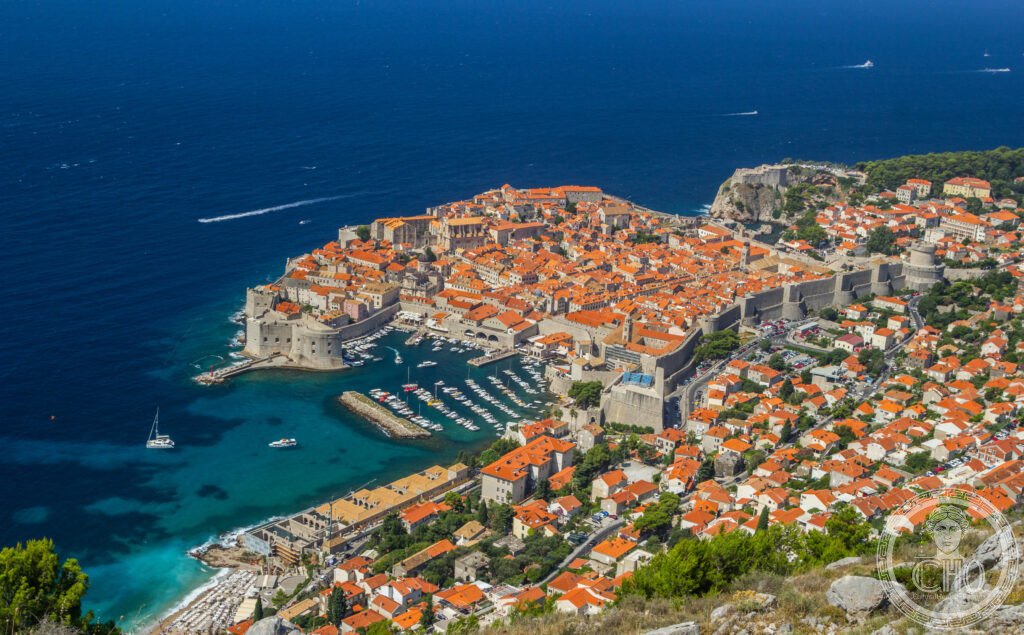
Dubrovnik
The best-preserved medieval walled city on the Adriatic coast and one of the outstanding examples of a late medieval city in Europe — the Old City of Dubrovnik (Ragusa; Dubrovnik-Neretva County, Dalmatia, Croatia; UNESCO WHS 1979) encircles a 1.3 km² peninsula within 1,940m of intact limestone walls (up to 6m thick and 25m high), a maritime republic that maintained its independence for 450 years (1358-1806 CE) through a sophisticated diplomatic strategy of balanced tribute to neighbouring powers.
At a glance
Dubrovnik (the most precisely DubrovnikCroatia single walled city 1.3 km2 peninsula 1940m walls 6m thick 25m high 3 gates Pile Gate west Ploce Gate east Ponte Gate harbour 5 towers highest Minceta tower northwest corner 1460 CE Michelozzo Juraj Dalmatinac UNESCO Old City 7th century CE Cavtat Croatian refugee settlement founded Ragusium medieval Ragusa Latin name Ragusan Republic 1358 1806 CE 448 years independence Dubrovnik-Neretva County Dalmatia Croatia 1667 CE earthquake catastrophic 5000 dead Stradun main street rebuilt Baroque uniformly afterwards Stradun Placa main pedestrian street 300m limestone polished silver years foot traffic Franciscan Monastery 14th century CE cloister oldest pharmacy Europe operating 1317 CE 700 years oldest Rector Palace late Gothic early Renaissance Sponza Palace late Gothic 16th century CE best preserved Gothic pre-earthquake Lorenzo Il Vecchio Rector Palace Church Sveti Spas Chapel of Saint Saviour 1520 CE stood earthquake didn’t fall Game Thrones King’s Landing 2012 2019 filming King’s Landing Westeros UNESCO heritage: the diplomatic genius of Ragusa (the most sophisticated small-state diplomacy in history: the Republic of Ragusa (1358-1806 CE) maintained its independence for 448 years surrounded by much larger powers (Venice, the Ottoman Empire, the Habsburg Empire) through a combination of tribute payments and diplomatic agility; the tribute system: Ragusa paid annual tribute to the Ottoman Sultan (initially 12,500 gold ducats per year; by the 16th century CE, 12,500 gold ducats; the Ottomans guaranteed Ragusan merchant safety throughout the Ottoman lands in return); it paid no tribute to Venice (Ragusa had won its independence from Venice in 1358 CE and was fiercely anti-Venetian)); the result: Ragusan merchants had guaranteed access to Ottoman markets from Constantinople to Egypt to the Black Sea, plus they traded freely with Venice’s enemy (the Habsburg Empire); Ragusa essentially created the first modern free-trade zone in the Mediterranean)) — the most precisely DubrovnikCroatia single 1940m walls 6m thick 25m high 3 gates Minceta Tower 1460 CE Michelozzo Dalmatinac 7th century CE Cavtat refugees 1358 1806 CE 448 years Republic Ragusa 1667 CE earthquake 5000 dead Stradun 300m limestone silver polished Franciscan Monastery 1317 CE oldest pharmacy Europe operating 700 years Rector Palace late Gothic Sponza Palace 16th century CE Game Thrones King’s Landing 2012 2019 Ottoman tribute 12500 gold ducats per year free access Ottoman markets from Constantinople Egypt Black Sea first Mediterranean free-trade zone UNESCO heritage in any UNESCO world heritage site)).
Key facts
- The first slave trade abolition in the world: the most precisely DubrovnikCroatia single Republic Ragusa 1416 CE abolished slave trade first state in world to do so 69 years before Spanish decree 1511 CE 377 years before British Abolition Act 1833 CE Ragusa prohibited trading African slaves and other human beings punishment abolition 1416 CE Rector Council official decree 1418 CE renewed Ragusan merchant convicted slave trading fined imprisoned UNESCO heritage — the most remarkable achievement of the Republic of Ragusa and one of the first human rights declarations in history: in 1416 CE (the date of the first decree) and 1418 CE (when the decree was renewed and expanded), the Great Council of Ragusa prohibited the slave trade and the buying and selling of human beings under any guise; any Ragusan citizen caught trafficking in slaves would be fined and imprisoned; this was: the first state in the known world to formally abolish the slave trade; 69 years before any other state; 377 years before the British Abolition Act of 1833 CE; 447 years before the US Thirteenth Amendment of 1865 CE; the historical significance is often overlooked because Ragusa was such a small state (less than 100,000 population) — it had no imperial power to enforce the ban globally; but the philosophical statement was clear
- GPS: 42.6413° N, 18.1082° E
History
From Byzantine trading post to independent republic to Napoleonic end (the most precisely DubrovnikCroatia single 7th century CE Croatian and Roman refugees Cavtat founded Ragusium Byzantine protection 866 CE survived Arab siege Venetian suzerainty 1205 1358 CE Treaty of Zadar 1358 CE Hungary separated Venice from Dalmatian coast Ragusa gained independence Ragusan Republic 1358 1806 CE 448 years 1416 CE first slave trade abolition world official decree 1418 CE renewed Ottoman Empire tribute annual 12500 gold ducats 1458 CE guaranteed merchant safety all Ottoman territories trade Levant Egypt Black Sea 1527 CE Carlos I Spain Republic Ragusa first state recognize free trade privileges 16th century CE silk trade Venice competing wool production Dalmatian hinterland 1667 CE earthquake April 6 5000 6000 dead Rector Simone Ghetaldi died trapped Palace Council immediately reconvened emergency measures swift organized repair Baroque rebuilding entire city rebuilt 60 years faster than any other post-earthquake rebuilding Europe 1776 CE American Revolution Ragusa first European state recognize newly independent United States 1806 CE Napoleon Bonaparte dissolved Republic Ragusa Illyrian Provinces French empire Austrian 1815 CE Vienna Congress Austria Dalmatia Kingdom Yugoslavia 1918 CE Italian Fascist occupation 1941 1945 CE Yugoslav Partisan Tito 1944 CE independence Yugoslav 1991 CE Croatian War of Independence Yugoslav Army and Montenegrin forces besieged Dubrovnik October 1991 May 1992 CE UNESCO heritage: the 1991 siege (the most consequential event in modern Dubrovnik’s history: the Yugoslav People’s Army (JNA) and Serbian and Montenegrin paramilitary forces besieged the city of Dubrovnik from October 1991 to May 1992 CE during the Croatian War of Independence; the bombardment of the old walled city (an UNESCO WHS) on December 6, 1991 CE was the most intense: 58 buildings within the walled city were damaged, and 2 were destroyed; 2 defenders and 2 civilians were killed; the world press coverage of the bombardment of a UNESCO World Heritage Site galvanized international opposition; the siege was lifted in May 1992 CE; the reconstruction of the old city was completed by 1999 CE)) — the most precisely DubrovnikCroatia single Byzantine 866 CE Arab siege Venice 1205 1358 CE Treaty Zadar 1358 CE Hungary Ragusa independence 1416 CE slave trade first abolition world 1418 CE renewed Ottoman tribute 12500 gold ducats 1667 CE earthquake 5000 6000 dead swift Baroque rebuild 60 years fastest Europe 1776 CE first European state recognize USA 1806 CE Napoleon dissolved Yugoslav Croatian War Independence 1991 CE JNA siege October 1991 May 1992 CE December 6 1991 CE bombardment UNESCO WHS 58 buildings damaged 2 destroyed world press galvanized opposition UNESCO heritage in any UNESCO world heritage site)).
What you see
City walls, Stradun, Franciscan Monastery, and Fort Lovrijenac (the most precisely DubrovnikCroatia single city walls walk 1940m perimeter 2h complete Minceta Tower northwest corner highest 35m Fort St John Revelin Fort southeast harbor walls Pile Gate main western entrance Ploce Gate east Stradun Placa 300m limestone pedestrian street polished silver gray 1667 CE earthquake medieval buildings burned Baroque rebuilt Onofrio Big Fountain 1438 CE Onofrio della Cava 16 spigots 20m diameter water still drinkable Franciscan Monastery 14th century CE Romanesque Gothic cloister double columns capitals finest medieval cloister Dalmatia pharmacy 1317 CE Mala Braća apothecary still operating oldest pharmacy Europe Sponza Palace 1516 CE late Gothic early Renaissance Venetian influence Rector Palace 15th century CE Venice Gothic early Renaissance loggia hexagonal columns Baroque additions post 1667 Church Sveti Spas 1520 CE only building survived 1667 earthquake cathedral Baroque rebuilt 1713 CE Titian altarpiece inside Assumption of the Virgin Fort Lovrijenac isolated headland 37m above sea just outside walls accessible drawbridge two portals non-nobilis Ragusan fortress never surrender to friend or enemy inscription 3 walls 12m thick one wall outside sea 60m drop UNESCO heritage: the city walls circuit (the defining 2h experience in Dubrovnik: walk the complete 1,940m circuit clockwise from the Pile Gate (west) to the Ploce Gate (east); ₺60/€8; open 8 AM-8 PM in summer): the Minceta Tower (the highest point; the double crown towers; the 360° view of the old city and Adriatic from the top); the Fort of St. John (the eastern sea wall; the Maritime Museum and Aquarium inside); the Lower Terrace (the view directly down into the old city streets and orange rooftops); the Fort of St. Lawrence / Lovrijenac (leave the walls to visit; just outside the main gate; the 37m fortress cliff rising from the sea; the view of the main walls from the fortress)); the Stradun (the 300m pedestrian street; the classic Baroque townhouses (all rebuilt identically post-1667); the Onofrio Fountain; the Orlando Column (a 1418 CE statue of Roland with his forearm — the Ragusan unit of length (51.2 cm))); the Franciscan Pharmacy (the oldest in the world: 1317 CE; still dispensing prescriptions; the original 14th-century mortar and pharmacy equipment on display)))) — the most precisely DubrovnikCroatia single walls 1940m 2h circuit Minceta Tower 35m northwest Pile Gate west Ploce Gate east Stradun 300m polished silver Onofrio Fountain 1438 CE 16 spigots 20m drinkable Franciscan Monastery 14th century CE cloister double columns pharmacy 1317 CE 700 years oldest Europe still operating Sponza Palace 1516 CE Rector Palace 15th century CE Sveti Spas 1520 CE only survived 1667 Cathedral Baroque 1713 CE Titian Lovrijenac 37m headland just outside walls 3 walls 12m thick non-nobilis inscription UNESCO heritage in any UNESCO world heritage site)).
Practical information
- Getting there: fly to Dubrovnik Airport (DBV; direct connections from all major European hubs in summer; British Airways, EasyJet, Ryanair direct from London; 2h30m); the airport is 20 km from the old city (taxi approximately 280 HRK/€37; the Croatia Airlines / Atlas shuttle bus to the Pile Gate: 30 min; 45 HRK/€6)); or arrive by ferry from Split (4h30m by catamaran) or from Bari, Italy (10h overnight ferry (Jadrolinija)); the wall circuit ticket (€35 per adult (2025 CE prices; one of the most-raised entry prices in Europe due to mass tourism; includes the city walls walk); the best time (April-May and October-November; the summer (June-September) is overwhelming: 25,000-30,000 cruise-ship day visitors can pour into the old city on a single summer day (the old city has a residential capacity of approximately 200-300 permanent residents and was designed for perhaps 5,000 people; 30,000 is genuinely distressing); the city walls in July at noon is a 45-minute queue in 35°C heat))
Getting there
Dubrovnik Airport (DBV) → shuttle bus → Pile Gate (30 min, 45 HRK/€6). Wall circuit €35. Best: April-May or October-November. Avoid summer cruise-ship days (30,000 visitors in 1.3 km² old city). GPS: 42.6413, 18.1082.
Nearby
- Kotor (Montenegro) — 90 km southeast (UNESCO WHS 1979; the old walled city of Kotor in the innermost corner of the Bay of Kotor (the only natural fjord in the Mediterranean; technically not a fjord but a drowned river canyon); the Venetian walls (4.5 km; climbing 260m above the city to the fortress of San Giovanni (the 1.5h ascent is the most spectacular mountain walk accessible from the city); the Cathedral of Saint Tryphon (12th century CE; the finest Romanesque building in the eastern Adriatic))
- Mostar (Bosnia and Herzegovina) — 140 km north (UNESCO WHS 2005; the Stari Most (Old Bridge; the 16th-century Ottoman arch bridge (1566 CE; architect Mimar Hayruddin; a student of Sinan); destroyed by Croat shelling in 1993 CE during the Bosnian War; rebuilt 2004 CE using the original Ottoman stone-cutting techniques and original stones recovered from the Neretva River; the most powerful symbol of post-war reconciliation in the former Yugoslavia))
Sources
- Wikipedia, Dubrovnik; Republic of Ragusa; Stradun; 1991 siege of Dubrovnik, accessed June 2026
- UNESCO, Old City of Dubrovnik, WHS reference 95, inscribed 1979
Find it on the map
See this place and what’s around it →📷 Diventa un fotografo di Cultural Heritage Online
Condividi le tue foto dei luoghi: restano pubblicate con la tua firma come autore. Più vengono viste, più ti fai conoscere — e presto un concorso premierà le foto più apprezzate.
Accedi o registrati gratis per aggiungere una foto