
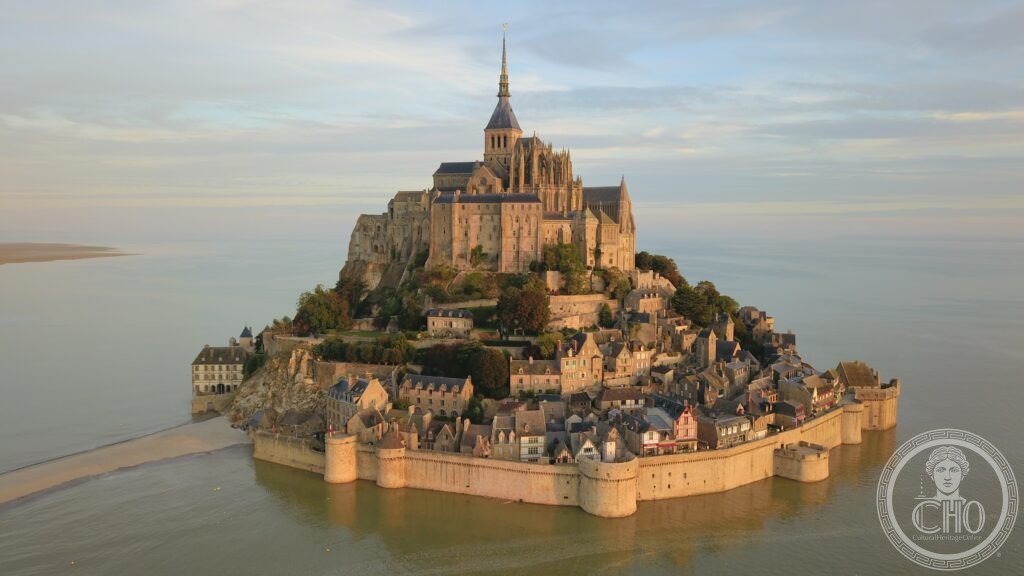
Mont-Saint-Michel
The most photographed monument in France after the Eiffel Tower and the defining image of medieval Christian civilization — Mont-Saint-Michel (Manche Department, Normandy, France; UNESCO WHS 1979) is the tidal island rising 92m above the Bay of Mont-Saint-Michel, crowned by the Benedictine abbey church (966 CE) in an extraordinary synthesis of Romanesque and Flamboyant Gothic architecture that pilgrims called La Merveille (“The Marvel”).
At a glance
Mont-Saint-Michel (the most precisely MontSaintMichelFrance single granite island 900m × 800m 92m above sea level Manche Department Normandy Bay Saint-Michel tidal amplitude 13.7m second largest tidal range world Bay of Fundy Canada 14.5m Couesnon River estuary English Channel Bishop Aubert Avranches 708 CE Archangel Michael appeared dream build sanctuary granite island oratory rock 966 CE Duke Richard I Normandy Benedictine monks replaced secular canons 1023 CE Abbot Hildebert first Romanesque nave pillars arches church 1103 CE fire collapsed repaired Merveille La Merveille three storey buildings north cliff 1211 1228 CE Guest Hall Dormitory Refectory Cloisters Scriptorium Knights Hall Almonry Philippe Auguste French King 1204 CE supported funds after annexation Normandy France 14000 pilgrims per year medieval peak same as Santiago Compostela 3 million tourists per year modern peak UNESCO heritage: the tides (the defining feature of Mont-Saint-Michel: the Bay of Mont-Saint-Michel has one of the largest tidal ranges in the world (13.7m maximum; the second largest in Europe after the Severn Estuary, UK); the tide comes in faster than a galloping horse (the medieval description); the modern scientific measurement: the tide can advance at 1.2 m/s in some channels (6 km/h; faster than walking) creating the famous “mascaret” (tidal bore) effect; the Mont becomes a true island only at high tide (approximately 15-20 times per year; at most spring high tides the island is completely surrounded); at low tide, the sand flats extend 15 km in every direction; the ebb leaves quicksand that has trapped and killed visitors in history (the wet sand appears firm but does not support weight once disturbed) — the medieval pilgrims who arrived on foot across the tidal flats were guided by local guides; a tourist service exists today)) — the most precisely MontSaintMichelFrance single granite island 900m × 800m 92m tidal amplitude 13.7m second largest Europe Severn estuary UK 1.2 m/s tide 6 km/h galloping horse mascaret 15 20 times per year true island spring high tide sand flats 15 km quicksand historically killed Bishop Aubert 708 CE dream Archangel Michael 966 CE Duke Richard I Benedictine monks 1023 CE Romanesque nave 1211 1228 CE La Merveille three storey north cliff 14000 pilgrims per year medieval 3 million modern UNESCO heritage in any UNESCO world heritage site)).
Key facts
- The Hundred Years' War siege: the most precisely MontSaintMichelFrance single Hundred Years War 1337 1453 CE English siege Mont-Saint-Michel 1417 1434 CE 17 years English forces under John Bedford Duke Lancaster surrounded island never taken only fortified place Normandy English never captured English fleet cannon bombard 1423 CE bronze cannons captured used as decorations gates today English 119 years Normandy occupation 1314 1434 CE garrisons Knights Mont-Saint-Michel maintained chivalric religious order chevaliers de Saint-Michel 1469 CE Louis XI order chivalry dedicated mount UNESCO heritage — the defining military achievement: the English siege of Mont-Saint-Michel (1417-1434 CE; during the Hundred Years’ War); the English under the Duke of Bedford (John of Lancaster) occupied Normandy from 1415 CE (after Agincourt) to 1449 CE; Mont-Saint-Michel was the ONLY fortified place in Normandy that the English NEVER captured in 34 years of occupation; the garrison of 119 “Knights of the Mount” (Les Chevaliers du Mont-Saint-Michel) held the island for 17 years against the English siege (1417-1434 CE); the English bombarded the island with cannons in 1423 CE — two captured bronze English cannons are still displayed at the entrance gate; the successful defense of Mont-Saint-Michel became the foundational myth for the creation of the Ordre de Saint-Michel by Louis XI in 1469 CE (the chivalric order that preceded the Légion d’honneur)
- GPS: 48.6361° N, 1.5115° W
History
From Celtic sacred island to Benedictine foundation to Revolution prison to UNESCO (the most precisely MontSaintMichelFrance single Celtic Gallic mythology sacred island tidal Thorsey island 8th century CE Bishop Aubert Avranches 708 CE vision Archangel Michael three times third Michael burned finger skull cavity relic Mont-Saint-Michel Cathedral skull hole Avranches 966 CE Duke Richard I Normandy replaced secular canons Benedictines 1017 CE 1023 CE Abbot Hildebert nave construction 1103 CE fire nave rebuilt 1204 CE Philippe Auguste King France annexed Normandy funded La Merveille compensation rebuilt 1211 1228 CE three storey eight room complex north cliff pilgrims medieval 14000 per year via Via Turonensis via Regordane Hundred Years War English siege 1417 1434 CE never captured Revolution 1793 CE closed monastery prison 1793 1863 CE famous prisoners Blanqui prominent left wing revolutionary jailed there Victor Hugo called cage for human beings prison Reform 1863 CE Viollet-le-Duc Eugene 1877 CE restored steeple neo-Gothic 1897 CE gold statue Archangel Michael lightning rod steeple UNESCO 1979 CE pilgrimage resumed 2001 CE UNESCO heritage: the prison era (1793-1863 CE; 70 years): the Revolutionary government closed the monastery in 1793 CE and converted it to a prison (the National Prison of Mont-Saint-Michel); approximately 15,000 prisoners passed through the island during this period; the most notable: Auguste Blanqui (the professional revolutionary; jailed here 1840-1844 CE; he spent more of his life in prison than any other major political figure in French history — 37 years total); Victor Hugo visited in 1836 CE and wrote that the island was “turned into a cage for human beings” and called for its restoration (this was one of the defining arguments for his campaign to preserve historic monuments); Viollet-le-Duc supervised the restorations; the neo-Gothic spire was added in 1897 CE with the gold statue of Michael on top)) — the most precisely MontSaintMichelFrance single Celtic sacred island Bishop Aubert 708 CE vision Archangel Michael skull relic 966 CE Duke Richard I Benedictine 1023 CE nave 1103 CE fire 1204 CE Philippe Auguste La Merveille 1211 1228 CE three storey 14000 pilgrims medieval Hundred Years War English 1417 1434 CE never captured Revolution 1793 CE prison 15000 prisoners Blanqui 1840 1844 CE Hugo 1836 CE cage humans Viollet-le-Duc restored steeple 1877 CE neo-Gothic 1897 CE gold Michael UNESCO 1979 heritage in any UNESCO world heritage site)).
What you see
The abbey church, La Merveille, and the medieval village (the most precisely MontSaintMichelFrance single village south slope only habitable slope 1000 900 inhabitants medieval peak today 50 permanent residents Grande Rue main street spiral ascent abbey gate Porte du Roi abbey church Romanesque nave 1023 1135 CE fire rebuilt 1103 1135 CE choir collapse 1421 CE rebuilt Flamboyant Gothic 1450 1521 CE western facade Romanesque towers Terrasse du Saut Gautier terrace exterior view bay La Merveille 1211 1228 CE three level complex Salle des Chevaliers Knights Hall scriptorium where manuscripts copied largest ground floor storeroom Almonry crypt Cloister garden 50 columns garden marble gallery open sky Cloisters roof guest hall refectory dining hall guests Romanesque Monastère Bénédictin still 40 monks today crypts Notre-Dame sous Terre oldest surviving structure romanesque chapels underground ramparts walls tower del Roi circuit walls defensive medieval UNESCO heritage: the visitor circuit: the Grande Rue (the only street in the medieval village; the climb from sea level (the fortified causeway entrance (Porte du Roi); the village (the restaurants, souvenir shops, and hotels occupying the medieval houses that line the Grande Rue; avoid the tourist restaurants on the Grande Rue and take the stairs up to the abbey for the better value set menus)); the abbey church (the Romanesque nave (1023-1135 CE; the massive cylindrical pillars supporting the barrel vault; the sense of weight bearing down from the mountain above); the Flamboyant Gothic choir (1450-1521 CE; the finest High Gothic construction in Normandy; the ambulatory around the apse; the rose window (the five-pointed star of the choir windows)); La Merveille (the three-storey 8-room Gothic complex on the north cliff (the most inaccessible and technically challenging side): the Cloister garden (the finest medieval cloister garden in France: 50 paired columns of pink Caen stone in slight stagger to prevent direct horizontal sight lines); the Refectory (the dining hall; the narrow vertical slit windows on the north wall flood the entire room with diffuse light while protecting from the north wind)); the tidal experience (walking the tidal flat guided walk around the bay at low tide — contact the guides in the village or in Genêts (the mainland embarkation point for the guided crossing))))) — the most precisely MontSaintMichelFrance single Grande Rue south slope only habitable 50 permanent residents today Porte du Roi abbey church Romanesque nave 1023 1135 CE fire 1103 CE rebuilt 1135 CE choir collapse 1421 rebuilt Flamboyant Gothic 1450 1521 CE La Merveille 1211 1228 CE three level Salle Chevaliers scriptorium manuscripts Almonry Cloister 50 columns pink Caen stagger Refectory slit windows north wall diffuse light crypts Notre-Dame sous Terre oldest 40 monks still today ramparts circuit Tour du Roi guided tidal flat walk Genêts UNESCO heritage in any UNESCO world heritage site)).
Practical information
- Getting there: the closest large airport is Rennes (RNS; 1h30m by car); from Paris (the most common approach): TGV from Paris Montparnasse to Rennes (1h30m) or to Pontorson (the closest rail station; 2h); from Pontorson, there is a bus (navette) to Mont-Saint-Michel (10 min; approximately €3); alternatively, rent a car from Rennes or Paris (the drive from Paris is approximately 4h on the A84); the causeway (since 2014 CE, the old causeway road has been replaced by a new bridge/viaduct allowing the tide to flow freely around the island; cars stop in the mainland car park (€5-12/day); a free shuttle bus (the navette gratuita) runs every 10-12 min to the island entrance); the abbey ticket (€13.50 standard / free under 25; the ticket covers the abbey church and La Merveille); the best time (early morning (6-8 AM) before the tour groups arrive; or in low season (November-March) when the island is relatively quiet); the highest tides (the coefficient 100+ spring tides (15-20 per year) are the only times the island is completely surrounded; the tourist office maintains a tide schedule on its website; the combination of the highest tides and a visit is the defining experience))
Getting there
Paris → TGV 1h30m → Rennes → bus/car 1h30m. From Pontorson (train, 2h from Paris) → shuttle bus 10 min. Car park €5-12/day; free shuttle every 10 min to island entrance. Abbey €13.50. Best: arrive 6-8 AM. Highest tides = island fully surrounded (15-20x/year). GPS: 48.6361, -1.5115.
Nearby
- Avranches — 22 km south (the Bishop’s treasury in the Scriptorium museum: the skull of Bishop Aubert with the hole burned by the Archangel Michael’s finger (the foundational relic of Mont-Saint-Michel); the Bayeux Manuscript (one of 203 medieval illuminated manuscripts from the Mont-Saint-Michel scriptorium collection, now in the Avranches Bibliothèque Patrimoniale); the panoramic terrace “Jardin des Plantes” with the best views of Mont-Saint-Michel from the mainland)
- D-Day Normandy Landing Beaches — 120 km northwest (the Normandy American Cemetery and Memorial at Colleville-sur-Mer (Omaha Beach; 9,386 graves; the most visited American cemetery in Europe); the Utah, Omaha, Gold, Juno, and Sword beaches (the five Allied landing zones of 6 June 1944 CE, from west to east); the Pointe du Hoc (the clifftop fortification stormed by US Army Rangers on D-Day; the most dramatic physical reminder of the Normandy landings))
Sources
- Wikipedia, Mont-Saint-Michel; Mont-Saint-Michel Abbey; La Merveille; Hundred Years' War, accessed June 2026
- UNESCO, Mont-Saint-Michel and its Bay, WHS reference 80, inscribed 1979
Find it on the map
See this place and what’s around it →📷 Diventa un fotografo di Cultural Heritage Online
Condividi le tue foto dei luoghi: restano pubblicate con la tua firma come autore. Più vengono viste, più ti fai conoscere — e presto un concorso premierà le foto più apprezzate.
Accedi o registrati gratis per aggiungere una foto