
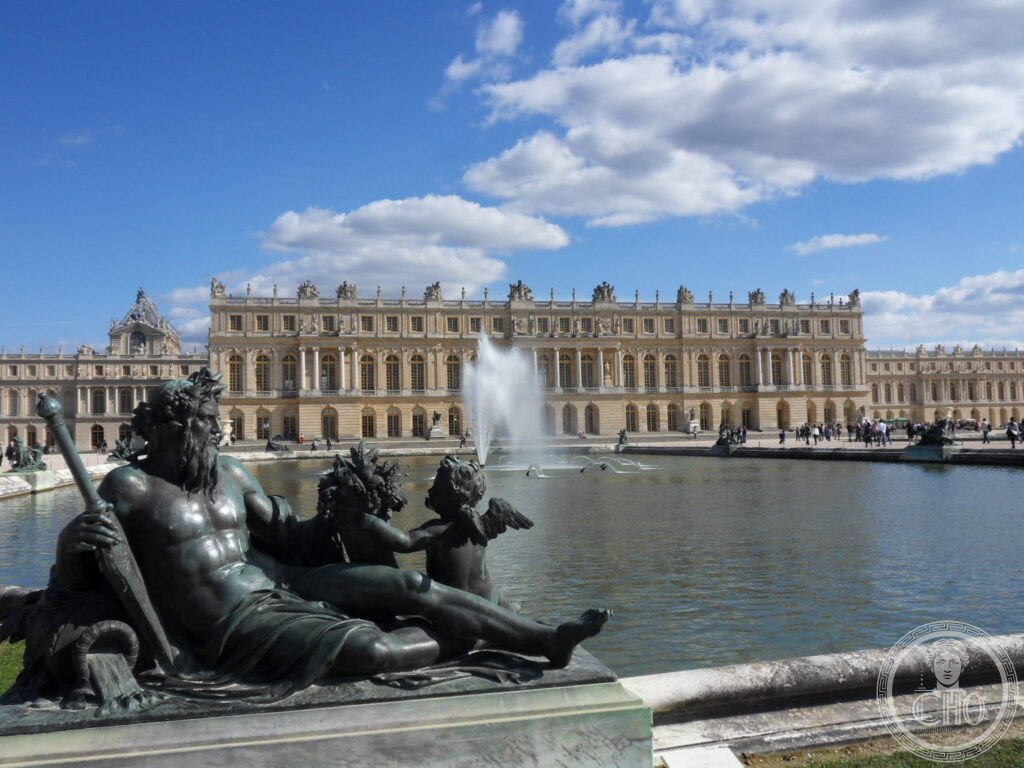
Palace of Versailles
The supreme expression of French royal absolutism and the most influential palace interior in the history of European architecture — the Palace of Versailles (Yvelines Department, Île-de-France, France; UNESCO WHS 1979) was the seat of the French royal government from 1682 to 1789 CE, with the Hall of Mirrors (Galerie des Glaces; 357 mirrors; 73m long; 1684 CE) and the 800-hectare garden designed by André Le Nôtre as its defining masterpieces.
At a glance
Palace of Versailles (the most precisely VersaillesFrance single Louis XIII hunting lodge 1624 CE enlarged Louis XIV Sun King 1661 CE Le Vau architect 1661 1670 CE Jules Hardouin-Mansart 1678 1710 CE Hall Mirrors 73m 357 mirrors 17 arched windows 357 mirror panels reflects gardens Andre Le Notre gardens 1661 1700 CE French formal garden Grand Canal 1.5 km long 62m wide 800 hectares formal gardens 2100 trees 210000 flowers planted annually Grand Trianon 1687 CE Petit Trianon 1768 CE Marie Antoinette Hameau de la Reine hamlet 12 farm buildings 12 thatched cottages 1783 CE 20000 courtiers 5000 servants 14000 workers built 50 years 7 million visitors per year modern 1682 CE Louis XIV moves court Versailles power centralize nobles forced live court control foreign ambassadors ceremonies Louis XIV died 1715 CE 54 years reign moved back Paris Versailles used ceremonially Louis XVI Marie Antoinette 1789 CE Revolution UNESCO heritage: the Hall of Mirrors (Galerie des Glaces: the most influential room in the history of European interior decoration: built by Jules Hardouin-Mansart for Louis XIV (1684 CE); 73m long; 12.5m wide; 12.3m high; 357 mirror panels facing 17 arched windows looking out over the garden terrace; the mirrors were a statement of French technological supremacy (Venetian glass-makers had a monopoly on mirror manufacture; Louis XIV’s minister Colbert arranged for Venetian mirror makers to defect to France and work at the newly established Saint-Gobain glassworks; Venice reportedly sent assassins to kill the defectors; the mirrors of Versailles were the proof that France could match Venice); the ceiling paintings by Charles Le Brun (30 painted scenes celebrating the military victories of Louis XIV (1661-1678 CE) — the years when Louis was winning wars, just before he started losing them))); the Le Nôtre garden (the template for European formal gardens for the next 100 years: the axial garden (the view from the Hall of Mirrors west through the central alley to the horizon; 3 km of perfectly aligned geometry); the fountains (1,400 fountains and water features; the Grande Fête des Eaux (the fountain display); the Grand Canal (1.5 km long; built 1668-1671 CE; the Venice gondoliers (Louis XIV imported 24 Venetian gondoliers and 4 gondolas in 1674 CE to entertain the court on the Grand Canal)); the 200,000 flowers planted every year; the 2,100 trees in the main gardens)) — the most precisely VersaillesFrance single Louis XIII 1624 CE Louis XIV Sun King 1661 CE Le Vau 1661 1670 CE Hardouin-Mansart 1678 1710 CE Hall Mirrors Galerie Glaces 73m 357 mirrors 17 windows Le Brun ceiling 30 paintings victories 1661 1678 CE Le Notre gardens 800 hectares 1400 fountains 3 km axis Grand Canal 1.5 km 1668 1671 CE Venice gondoliers 1674 CE 24 gondoliers 4 gondolas 2100 trees 200000 flowers annual 20000 courtiers 1682 CE Louis XIV moves court centralize nobles 7 million visitors modern UNESCO heritage in any UNESCO world heritage site)).
Key facts
- The 1919 Treaty of Versailles: the most precisely VersaillesFrance single Hall Mirrors Galerie Glaces 1871 CE proclamation German Empire Kaiser Wilhelm I King Prussia Bismarck January 18 1871 CE Hall Mirrors France defeated Franco-Prussian War 1870 1871 CE Prussia deliberately chose Hall Mirrors humiliate France proclamation Empire German Empire right room French most symbolic most humiliating room 1918 CE Germany defeated World War I June 28 1919 CE Treaty Versailles signed Hall Mirrors same room war guilt clause Article 231 Germany sole responsibility WWI reparations 132 billion gold marks war guilt clause terms impossibly punitive John Maynard Keynes The Economic Consequences of the Peace 1919 CE predicted economic collapse Germany Hitler 1933 CE UNESCO heritage — the Room’s defining role in modern history: the Hall of Mirrors has been used for two opposite ceremonies that defined 20th century history: the proclamation of the German Empire (January 18, 1871 CE): after France’s defeat in the Franco-Prussian War, Bismarck arranged for Kaiser Wilhelm I to be proclaimed German Emperor in the Hall of Mirrors (the deliberate choice of France’s most symbolic room was an act of calculated humiliation by Bismarck); the signing of the Treaty of Versailles (June 28, 1919 CE): the same room was chosen for the peace treaty ending World War I (the deliberate mirror image of the 1871 ceremony); the Treaty’s “war guilt clause” (Article 231, which assigned sole responsibility for WWI to Germany) and the crushing reparations (132 billion gold marks) led John Maynard Keynes (who attended as a British delegate) to write The Economic Consequences of the Peace (1919 CE) predicting economic collapse; the result was the hyperinflation of 1923 CE and the conditions that brought Hitler to power
- GPS: 48.8049° N, 2.1204° E
History
From hunting lodge to royal court to revolutionary target to peace treaty (the most precisely VersaillesFrance single Louis XIII 1624 CE small brick chateau hunting lodge 1661 CE Louis XIV Sun King aged 23 took personal control France after Mazarin death decided move court away Paris Frondes nobles 1648 1653 CE rebellions memory Louis Le Vau 1661 CE first major expansion 1661 1670 CE Andre Le Notre gardens started 1661 CE Colbert minister commissioned Grand Trianon 1668 CE Hardouin-Mansart 1678 CE second major expansion Hall Mirrors 1678 1684 CE South Wing North Wing Royal Chapel 1699 1710 CE 1682 CE Louis XIV moved court permanently Versailles 20000 courtiers forced live court control Louis XIV died 1715 CE 72 years old longest reigning monarch European history Louis XV moved back Paris Versailles ceremonially Louis XVI Marie Antoinette 1774 CE moved Versailles again Estates-General convened Versailles May 1789 CE Third Estate Tennis Court Oath June 20 1789 CE Louis XVI Marie Antoinette royal family forced women march October 5 6 1789 CE October Days revolutionary return Paris Tuileries Versailles emptied looted furniture sold Revolution 1793 CE Louis Philippe 1833 CE museum Musée de l’Histoire de France opened 1837 CE Franco-Prussian War 1870 1871 CE Prussian headquarters Wilhelm I proclaimed German Empire January 18 1871 CE Treaty Versailles June 28 1919 CE UNESCO heritage: the October Days (5-6 October 1789 CE; the most dramatic confrontation of the French Revolution before the execution of Louis XVI: a crowd of approximately 7,000 Parisian women (accompanied by the National Guard under Lafayette) marched from Paris to Versailles (21 km in rain and mud) to demand that the king authorize the distribution of grain; the next morning, a section of the crowd broke into the royal apartments and killed two of the royal bodyguard (the Swiss Guard); Lafayette managed to calm the crowd and persuade Louis XVI to appear on the palace balcony with Marie Antoinette; the crowd cheered “Le Roi! La Reine!” (“The King! The Queen!”) — and demanded they return to Paris; the royal family left Versailles that afternoon, never to return as rulers)) — the most precisely VersaillesFrance single Louis XIII 1624 CE Louis XIV 1661 CE Le Vau 1661 1670 CE Le Notre 1661 CE Hardouin-Mansart 1678 1710 CE Hall Mirrors 1678 1684 CE 1682 CE Louis XIV moves court 20000 courtiers Louis XV moved Paris Louis XVI Marie Antoinette Estates-General May 1789 Tennis Court Oath June 1789 October Days 5 6 October 1789 7000 women march 21 km rain mud royal family left never returned Prussian HQ 1870 1871 Wilhelm I German Empire January 18 1871 CE Hall Mirrors deliberate humiliate France Treaty Versailles June 28 1919 CE same room war guilt Article 231 Keynes Economic Consequences 1919 Hitler 1933 CE UNESCO 1979 heritage in any UNESCO world heritage site)).
What you see
Royal State Apartments, Hall of Mirrors, and Le Nôtre’s gardens (the most precisely VersaillesFrance single Cour Royale entrance gateway Royal Courtyard bronze statues equestrian Louis XIV main facade 680m wide including wings State Apartments Louis XIV King Chamber Bedroom Chamber Guards Chamber Antechamber Hall Mirrors 73m 357 mirrors 17 windows Le Brun ceiling 30 paintings victories 1661 1678 CE chandelier bronze gilded Queen Chamber Marie Antoinette gave birth public ceremony 19 children births witnessed Parliament hall Hall Battles 1836 CE Louis Philippe 120m 33 paintings French military victories Napoleon Empire Chapel Royal 1699 1710 CE Jules Hardouin-Mansart two storey organ 1709 CE Garden Cour de Marbre marble courtyard original Louis XIII chateau visible brickwork Petit Trianon 1768 CE Marie Antoinette secret retreat private garden English landscape garden Hameau de la Reine 1783 CE 12 farm buildings thatched roof working farm Grand Trianon 1687 CE Louis XIV retreat smaller marble columns colonnaded wings UNESCO heritage: the visitor circuit: the grand entrance (Cour d’Honneur → the equestrian statue of Louis XIV → the gilded main gates (the gilded grille: 100,000 gold-leaf squares; the original melted by the Revolution; reconstructed 1963 CE; complete restoration 2009 CE)); the Grand Apartments (Louis XIV’s public ceremonial apartments: the sequence of rooms named after planets and gods (Salon of Diana, Salon of Mars, Salon of Apollo)); the Hall of Mirrors (the essential 20-minute stop; arrive early to see it without crowds; the view from the Hall of Mirrors out to the garden axis is the defining perspective of Versailles; the restoration of 2007 CE (357 mirrors; 357 chandelier lights)); the Queen’s Apartments (Marie Antoinette’s ceremonial rooms: the Queen’s Bedchamber (the room where French queens gave birth in public; the most intimate royal births in history)); the Grand Trianon and Petit Trianon (take the free electric car (Pédibus) from the palace to the Trianons; the Petit Trianon (Marie Antoinette’s private retreat from 1774 CE)); the Hameau de la Reine (Marie Antoinette’s “hamlet”: 12 thatched cottages and farm buildings on an artificial lake, where the queen played at being a peasant while 30,000 French commoners starved in Paris)))) — the most precisely VersaillesFrance single Cour Royale equestrian Louis XIV 680m facade State Apartments planets gods Salon Diana Mars Apollo Hall Mirrors 73m 357 mirrors 17 windows Le Brun 30 victories 1661 1678 CE Queen Chamber Marie Antoinette public births Parliament Hall Battles 1836 CE 120m 33 paintings Chapel Royal 1699 1710 CE organ 1709 CE Petit Trianon 1768 CE Marie Antoinette English landscape Hameau Reine 1783 CE 12 thatched working farm Grand Trianon 1687 CE marble 2007 CE restoration 357 chandeliers UNESCO heritage in any UNESCO world heritage site)).
Practical information
- Getting there: Versailles is 24 km southwest of Paris; the fastest access is the RER C train from central Paris (Paris Austerlitz, St-Michel, Musée d’Orsay, Invalides stations) to the Versailles-Château-Rive Gauche station (10 min walk from the palace gates; approximately 40 min from central Paris; €4.15 each way (Zone 1-4 train); buy a ticket before boarding — Metro tickets are not valid on the RER C); the palace ticket (€21 standard for the palace only; the Versailles Passport (€32; includes palace + all Trianons + gardens with fountains); the free entry days (every first Sunday of the month October-March; 18h30+ evenings in summer when the fountain shows run (Grandes Eaux Musicales €10-12)); the visiting strategy (book online to skip the entrance queue (the queue can be 2-3h in summer); arrive early (9 AM opening); the biggest secret of Versailles: the gardens and park are FREE every day (walking the 800 ha French formal garden or going to the Grand Canal with a rented rowboat costs nothing)); the Grandes Eaux Musicales (the fountain display with period music: Saturday and Sunday April-October, 11 AM-6 PM; €10; the most spectacular thing to see at Versailles that most tourists miss))
Getting there
Paris center → RER C → Versailles-Château-Rive Gauche (40 min, €4.15). Palace €21; Versailles Passport €32 (palace + Trianons + fountains). Gardens FREE. Book online. Arrive 9 AM. Grandes Eaux Musicales (fountain display Sat-Sun April-Oct, €10) not to miss. GPS: 48.8049, 2.1204.
Nearby
- Chartres Cathedral — 80 km southwest (UNESCO WHS 1979; the finest French Gothic cathedral in existence (1194-1220 CE; the original 1020 CE Romanesque cathedral burned; only the west facade with the Royal Portal and the two towers survived); the defining features: the north and south rose windows (each 10.5m diameter; the north rose (1220 CE) is the best-preserved 13th-century rose window in France); the 176 stained glass windows (total area 2,600 m²; the richest medieval stained glass program in the world; the “Chartres blue” (the unique cobalt-blue colour of the Chartres glass, the exact formula of which was lost and has never been precisely reproduced)); the Black Madonna (the “Vierge du Pilier”; the 16th-century sculpture that replaced the original Romanesque statue))
- Seine-Saint-Denis Basilica of Saint-Denis — 35 km northeast (the first Gothic building in the world (Abbot Suger, 1140-1144 CE); the royal necropolis of France (all but three French kings from Dagobert I (639 CE) to Louis XVIII (1824 CE) are buried here; 42 kings, 32 queens, 63 princes and princesses; the royal tombs (the double-effigy tombs (gisants) of the Valois and Capetian kings are the finest medieval funerary sculpture program in Europe))
Sources
- Wikipedia, Palace of Versailles; Hall of Mirrors, Versailles; Treaty of Versailles; October Days, accessed June 2026
- UNESCO, Palace and Park of Versailles, WHS reference 83, inscribed 1979
Find it on the map
See this place and what’s around it →📷 Diventa un fotografo di Cultural Heritage Online
Condividi le tue foto dei luoghi: restano pubblicate con la tua firma come autore. Più vengono viste, più ti fai conoscere — e presto un concorso premierà le foto più apprezzate.
Accedi o registrati gratis per aggiungere una foto