
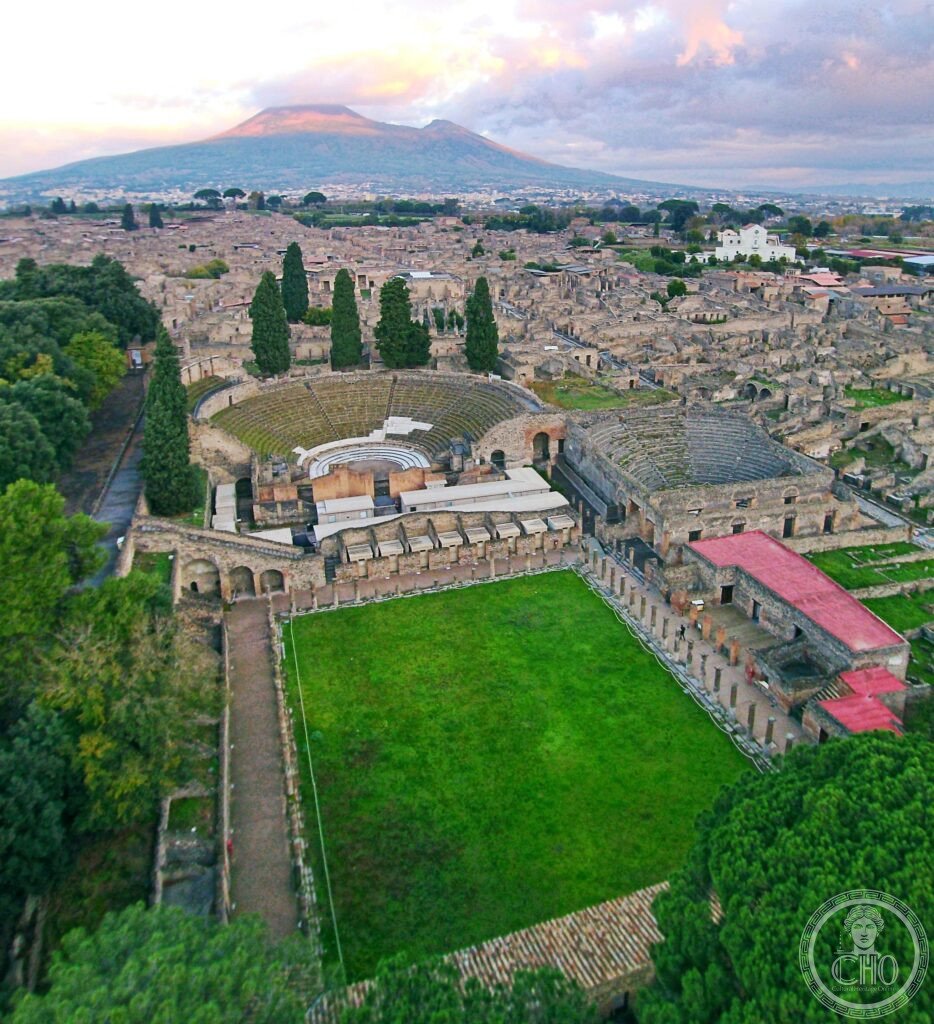
Pompeii
The most complete ancient Roman city ever uncovered and the most vivid snapshot of life in the 1st century CE — Pompeii (Metropolitan City of Naples, Campania, Italy; UNESCO WHS 1997) was a prosperous Roman city of 11,000-20,000 inhabitants buried under 4-6 metres of volcanic ash when Mount Vesuvius erupted on 24 August 79 CE, preserving its streets, houses, frescoes, and plaster body casts until systematic excavation began under the Bourbon king Charles III in 1748 CE.
At a glance
Pompeii (the most precisely PompeiiItaly single Oscan city 6th century BCE Roman colony 80 BCE Sulla 11000 20000 inhabitants 1st century CE 66 hectares excavated forum temples amphitheater (oldest stone amphitheater in the world, 80 BCE), baths brothels bakeries taverns Via dell’Abbondanza main street bars thermopolia hot food counters 80 discovered Pliny the Younger letters eyewitness account 79 CE eruption August 24 afternoon uncle Pliny the Elder died rescue mission Pompeii eruption 18 19 hours pyroclastic flows surges temperature 300 degrees 200 mph fourth surge killed everyone remaining 2000 victims found 1100 excavated plaster cast technique Giuseppe Fiorelli 1863 CE pour plaster into voids left by decomposed bodies bodies casts reveal pose death UNESCO heritage: the eruption (the most precisely documented natural disaster of the ancient world: Pliny the Younger (Gaius Caecilius Secundus; approximately 61-113 CE), who was staying 30 km west of Vesuvius at Misenum with his uncle Pliny the Elder (commander of the Roman fleet at Misenum), wrote two letters to the historian Tacitus approximately 25 years after the event; these letters are the only surviving eyewitness account of the Vesuvius eruption; the timing debate (Pliny gives the date as the “ninth day before the calends of September” = August 24 in the Julian calendar; the long-dominant interpretation; however, excavations in 2018 CE found a charcoal inscription that appears to record October 17 CE — suggesting the eruption occurred in late October, not August; the debate continues); the eruption phases (the Plinian column (the initial phase: Vesuvius sent a vast column of ash and pumice (the Plinian column) rising 33 km into the stratosphere; this phase lasted approximately 18-19 hours; the pyroclastic surges (the killing phase: 6 surges of superheated ash-and-gas flowing down the mountain at 200 mph and 300°C; the 4th surge killed everyone remaining in Pompeii at 7-8 AM the following morning)))) — the most precisely PompeiiItaly single 6th century BCE Oscan 80 BCE Roman colony Sulla 11000 20000 inhabitants 66 hectares excavated Forum Temple Jupiter Capitolium 2nd century BCE 62 CE earthquake Pliny Younger letters Tacitus 79 CE eyewitness Vesuvius 33 km Plinian column 18 19 hours 6 pyroclastic surges 4th surge killed 7 8 AM temperature 300 degrees 200 mph 2000 victims 1100 excavated Fiorelli 1863 CE plaster cast technique 2018 CE charcoal inscription October 17 CE debate UNESCO heritage in any UNESCO world heritage site)).
Key facts
- The plaster cast technique: the most precisely PompeiiItaly single Giuseppe Fiorelli superintendent excavations 1863 CE technique voids in pumice ash human body decomposed 1800 years skeleton only remaining poured plaster wet into hole waited hardened dug out revealed victim body pose at death 86 confirmed casts 48 cast Pompeii 1863 CE modern technique resin transparent CT scan visible bones 2015 CE UNESCO heritage — the discovery that transformed archaeology: Giuseppe Fiorelli (superintendent of excavations at Pompeii, 1863-1875 CE) noticed that the pumice-and-ash deposits surrounding skeletal remains sometimes contained hollow voids (air pockets where organic material had decomposed); he developed the technique of pumping liquid plaster into the voids through drilled holes; when the plaster hardened and the surrounding pumice was removed, it revealed the three-dimensional form of the victims at the moment of death; the 86 confirmed body casts (48 in the Pompeii archaeological park collection; others in the National Archaeological Museum in Naples); modern refinements (since 2015 CE, resin has replaced plaster in new casts (transparent resin allows the bones visible through the cast); CT scanning has revealed internal bone structures and even identified one victim who had dental cavities (indicating a diet high in sugar — indicating this was a high-status individual who could afford expensive imported sugar))
- GPS: 40.7503° N, 14.4891° E
History
From Oscan city to Roman colony to Bourbon rediscovery to UNESCO (the most precisely PompeiiItaly single Oscan Italic settlement 8th 6th century BCE Greek Doric Temple Apollo 6th century BCE earliest structure Samnite wars 4th 3rd century BCE Samnite control 2nd century BCE Roman ally Social War 89 BCE Lucius Cornelius Sulla besieged Roman colony 80 BCE veterans settled deductio 20000 Latin colonists settled Pompeii Forum enlarged Basilica built amphitheater 80 BCE first stone amphitheater world Theatre two forum baths 62 CE earthquake heavily damaged only partially rebuilt 79 CE eruption Pliny Younger letters August 24 pyroclastic Pompeii buried 4 6 meters pumice lapilli ash rediscovered 1599 CE architect Fontana building Sarno canal water channel uncovered traces 1748 CE Charles III Bourbon king Naples systematic excavation began Karl Weber Giuseppe Fiorelli 1863 1875 CE grid system pompeii street grid organized excavation data systematic recording Amedeo Maiuri 1924 1961 CE UNESCO 1997 heritage: the history of excavation (the most historically complex archaeological excavation: the initial accidental discovery (the Sarno Canal project in 1599 CE: the architect Domenico Fontana, building an underground canal to redirect the Sarno River, uncovered traces of ancient walls and frescoes; they were ignored and reburied)); the 1748 CE systematic beginning (the Bourbon king Charles III authorized excavation to find antique statues and treasure for his palace; the early excavations were treasure hunts, not archaeological; statues and bronzes were removed, mosaics were cut from floors; context was destroyed); the Fiorelli reform (Giuseppe Fiorelli (1863-1875 CE) was the first to treat Pompeii as a scholarly enterprise: he introduced the grid system (Pompeii is divided into 9 regiones (regions) and 34 insulae (city blocks); every building has a region-block-door address (e.g., IX.12.6)); he systematized documentation and introduced the plaster-cast technique)) — the most precisely PompeiiItaly single 8th 6th century BCE Oscan Doric Temple Apollo 6th century BCE Samnite wars 4th 3rd century BCE Sulla 80 BCE Roman colony amphitheater 80 BCE stone first world 62 CE earthquake 79 CE eruption 4 6 meters pumice Fontana 1599 CE canal accidental Charles III Bourbon 1748 CE treasure hunt statues Fiorelli 1863 1875 CE grid 9 regiones 34 insulae UNESCO 1997 heritage in any UNESCO world heritage site)).
What you see
Forum, Via dell’Abbondanza, House of the Faun, and the Lupanar (the most precisely PompeiiItaly single Forum 38m × 142m civic heart temples arcades flanking colonnade Temple Jupiter Capitolium north end Temple Apollo west Macellum food market northeast Basilica law court SW 2nd century BCE largest building Forum Baths Stabian oldest public baths Pompeii 4th century BCE House Faun largest private house Pompeii 3000 m2 Alexander Mosaic originally 5.82m × 3.13m 1.5 million tessere depicting Alexander Great Battle Issus 333 BCE now National Archaeological Museum Naples copy in situ Villa Mysteries outside city walls frescoes Dionysiac initiation rites 15 large panels 2nd style painting 60 BCE largest continuous narrative painting cycle surviving from antiquity amphitheater 80 BCE capacity 20000 eastern part city walls thermopolia hot food counters at least 80 Via Abbondanza gladiator barracks Lupanar brothel most visited 46 erotic paintings above doors ancient advertising only known purpose-built brothel surviving from antiquity UNESCO heritage: the visitor circuit: the Forum (the essential 30-minute circuit: the Temple of Jupiter / Capitolium (the largest and most important temple in Pompeii; the columns of the pronaos (porch) rising above the Forum level); the Basilica (the law court; the oldest known basilica in the world (2nd century BCE)); the entrance is through the Porta Marina (the western gate on the via de Marina); the must-see locations: the House of the Faun (the largest private house; the in-situ copy of the Alexander Mosaic; the original in the Naples Archaeological Museum); the Lupanar (the brothel; the most visited building after the Forum; the erotic paintings above each door (used as an advertising menu for illiterate clients)); the Villa of the Mysteries (600m outside the western Porta Ercolano; the most complete surviving frescoed room of the ancient world: the Dionysiac frieze (60 BCE; 15 panels; 3m high; the largest continuous narrative painting in the ancient world)); the plaster cast area (the Garden of the Fugitives: a garden in Regio I where 13 body casts of victims were found in a group, apparently trying to escape together))) — the most precisely PompeiiItaly single Forum 38m × 142m Temple Jupiter north Temple Apollo west Macellum northeast Basilica 2nd century BCE oldest world House Faun 3000 m2 Alexander Mosaic 5.82m × 3.13m 1.5 million tessere Alexander Issus 333 BCE Naples Museum copy in situ Villa Mysteries 60 BCE 15 panels 3m Dionysiac largest narrative painting antiquity amphitheater 80 BCE 20000 capacity 80 thermopolia Via Abbondanza Lupanar only purpose-built brothel antiquity Garden Fugitives 13 body casts UNESCO heritage in any UNESCO world heritage site)).
Practical information
- Getting there: fly to Naples International Airport (NAP; Capodichino; connections from all major European hubs); from Naples central station (Napoli Centrale), take the Circumvesuviana railway (the local narrow-gauge railway; Naples → Pompeii-Scavi-Villa dei Misteri station: 35 min; approximately €2.80); the station is directly at the western (Porta Marina) entrance to the archaeological park; entry (€18 standard / €9 (reduced); the combined ticket for Pompeii + Herculaneum + Oplontis + Stabia + Boscoreale (€22 standard) is good value); the visiting time (the archaeological park is large: a minimum of 3 hours for the essentials; a full 5-6 hours for a complete visit); the best time (April-June and September-October; avoid July-August (the site is entirely exposed; temperatures reach 35-40°C; heat exhaustion is a real risk for visitors); arrive early (8 AM opening) to avoid the worst of the crowds (the Via dell’Abbondanza becomes genuinely uncomfortable at midday in summer))
Getting there
Naples (NAP) → Circumvesuviana train → Pompeii-Scavi station (35 min, €2.80); station at Porta Marina entrance. Entry €18. Allow min. 3h; best to allow 5-6h. Avoid July-August heat. Early arrival strongly recommended. GPS: 40.7503, 14.4891.
Nearby
- Herculaneum (Ercolano) — 17 km northwest (UNESCO WHS 1997; the smaller sister city to Pompeii (population approximately 5,000 in 79 CE); buried under 20-25m of volcanic material (denser than Pompeii’s); far fewer excavated visitors = far less crowded; the outstanding preservation (the organic material (wood, papyrus, cloth, food) survived far better at Herculaneum than at Pompeii due to the different burial mechanism); the House of the Bicentenary; the Villa of the Papyri (the most extraordinary residential library of the ancient world: 1,800 carbonized papyrus scrolls found in 1752 CE; the villa has not been fully excavated (the section with the main residence and the library is still buried)); the boat sheds (approximately 300 skeletons of victims found huddled in the arched boat storage chambers on the ancient shoreline — the skulls of many show signs of instant death from extreme thermal shock))
- National Archaeological Museum Naples (MANN) — 24 km northwest in Naples (the finest collection of Greco-Roman antiquities in the world; the Secret Cabinet (Gabinetto Segreto): the erotic artwork from Pompeii and Herculaneum collected under the Bourbon kings and hidden from public view for 200 years (accessible to all visitors since 2000 CE); the Farnese Collection (the Farnese Hercules, the Farnese Bull, the Farnese Athena)); the Pompeii-origin collection (the Alexander Mosaic (the original; from the House of the Faun; the largest and finest surviving Hellenistic-era mosaic); the collection of 19,000 objects from Pompeii, Herculaneum, Stabiae, and Boscoreale))
Sources
- Wikipedia, Pompeii; 79 CE eruption of Vesuvius; Giuseppe Fiorelli; Pliny the Younger, accessed June 2026
- UNESCO, Archaeological Areas of Pompei, Herculaneum and Torre Annunziata, WHS reference 829, inscribed 1997
Find it on the map
See this place and what’s around it →📷 Diventa un fotografo di Cultural Heritage Online
Condividi le tue foto dei luoghi: restano pubblicate con la tua firma come autore. Più vengono viste, più ti fai conoscere — e presto un concorso premierà le foto più apprezzate.
Accedi o registrati gratis per aggiungere una foto