
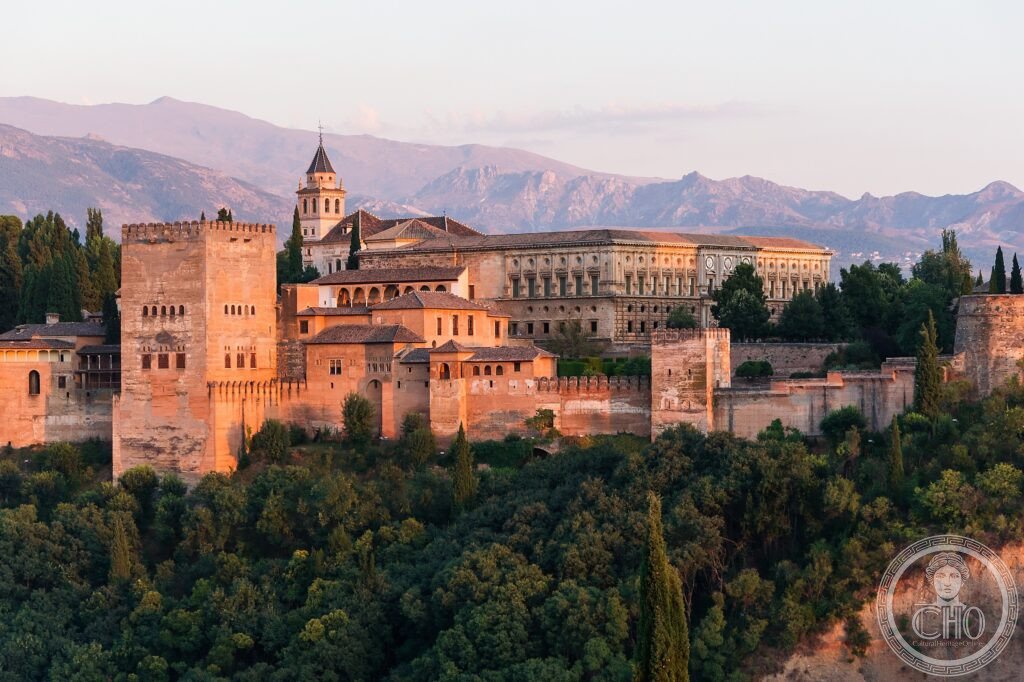
Alhambra
The supreme achievement of Moorish architecture and the last major Islamic palace complex in Europe — the Alhambra (Granada, Andalucia, Spain; UNESCO WHS 1984) is the palace-city of the Nasrid sultans (1238-1492 CE) on the Sabika hill above Granada, renowned for the honeycomb muqarnas vaulting of the Hall of the Ambassadors, the 124 white marble columns of the Court of Lions (completed 1380 CE), and the Generalife summer gardens.
At a glance
The Alhambra (the most precisely AlhambraSpain single red sandstone citadel Sabika hill 730m above sea level 35 ha Nasrid dynasty 1238 1492 CE Banu Nasr Mohammed I al-Ghalib 1238 CE first Nasrid sultan founded kingdom Granada built first palace citadel Ismail I 1314 1325 CE Yusuf I 1333 1354 CE Comares Tower Hall Ambassadors Council Chamber Mohammed V 1354 1391 CE Palace Lions Court Lions 124 columns 1380 CE completed muqarnas plasterwork honeycomb stalactite vaulting Hall Abencerrajes Hall Two Sisters Hall Ambassadors throne room 7.65m × 7.65m octagonal muqarnas cupola 5000 cells plaster mathematically derived Generalife summer palace adjacent hill 1319 CE gardens water channels fountains acequia central watercourse 14th century CE Reconquista 1492 CE Fall of Granada Ferdinand Isabel Catholic Monarchs last Muslim state Iberia 700 years Moorish civilization Columbus America same year 1492 CE Washington Irving Tales of Alhambra 1832 CE UNESCO heritage: the muqarnas (the defining architectural element of Nasrid Granada and the most complex surface ornament in world architecture: the stalactite or honeycomb vaulting (muqarnas: Arabic; also called mocárabe in Spanish; each vault is built from small prismatic units that interlock without structural function — they are pure surface ornament; the Hall of the Two Sisters cupola (the most complex muqarnas vault in the world: 5,000 individual plaster cells; 16m above the floor; the geometric pattern derives from an 8-pointed star that multiplies outward to fill the full octagonal base; the computation of the proportions of each cell was recently shown (2008 CE) to be based on a quasi-crystalline geometric principle that was not independently rediscovered in Western mathematics until 1974 CE (Penrose tiling)))) — the most precisely AlhambraSpain single Nasrid dynasty 1238 1492 CE Mohammed I al-Ghalib 1238 CE Yusuf I 1333 1354 CE Comares Tower Mohammed V 1354 1391 CE Palace Lions 124 columns 1380 CE muqarnas honeycomb stalactite plasterwork Hall Ambassadors 7.65m octagonal 5000 cells Hall Two Sisters cupola 16m 5000 cells quasi-crystalline 1974 CE Penrose rediscovered Generalife 1319 CE acequia water channels Reconquista 1492 CE Ferdinand Isabel Washington Irving Tales 1832 CE UNESCO heritage in any UNESCO world heritage site)).
Key facts
- The Penrose tiling connection (2008 CE): the most precisely AlhambraSpain single Peter Lu Harvard physicist 2007 2008 CE Nature journal muqarnas tilework Darb-i Imam shrine Isfahan 1453 CE 5-fold rotational symmetry quasi-crystalline pattern the same mathematical structure as Penrose tilings discovered Roger Penrose 1974 CE mathematically impossible for a periodic tiling to have 5-fold rotational symmetry quasi-crystal non-repeating pattern the same as the Darb-i Imam tilework and the Alhambra muqarnas 500 years before Penrose UNESCO heritage — the most surprising mathematical discovery in Islamic architecture: the 2007-2008 CE research by Peter Lu (Harvard physicist) published in Science journal: the girih tile patterns in medieval Persian and Moorish architecture (including the Alhambra’s tilework) exhibit quasi-crystalline geometric structure (5-fold rotational symmetry) which was mathematically impossible to achieve with periodic tiling — only possible with the non-repeating quasi-crystalline pattern that Roger Penrose independently discovered in 1974 CE; the conclusion: Islamic craftsmen were working with quasi-crystalline geometric principles at least 500 years before Western mathematicians recognized the mathematical category
- GPS: 37.1772° N, 3.5902° W
History
From Nasrid fortress to Bourbon palace to Washington Irving to UNESCO (the most precisely AlhambraSpain single Zirid Berber 9th century CE first citadel Sabika hill Mohammed I al-Ghalib 1232 CE moved court Jaen to Granada founded Nasrid dynasty independent emirate Kingdom Granada 1238 CE tributary to Castile paid tribute Christian north maintain peace small state Ismail I 1314 CE Alhambra rebuild expansion Yusuf I 1333 1354 CE Comares Palace Hall Ambassadors throne room Nasrid royal court Mohammed V 1354 1391 CE Court Lions Palace Lions completed greatest artistic achievement Nasrid architecture 1492 CE Muhammad XII Boabdil last Sultan Granada surrendered Fernando Isabel Catholic Monarchs Reconquista complete January 2 1492 CE Boabdil El Suspiro del Moro pass overlooked palace 200m above turned back wept legend Charles I Holy Roman Emperor V Charles 1526 CE visited built Renaissance palace Palacio Carlos V inside Alhambra unfinished today Washington Irving 1829 CE lived Alhambra Legends Alhambra Tales Alhambra 1832 CE book that made Alhambra internationally famous western world romantic rediscovery Owen Jones Plans Elevations Sections and Details of the Alhambra 1842 CE first polychrome architectural survey influenced Arts Crafts movement UK UNESCO 1984 heritage: the 1492 CE surrender (the most emotionally charged event in Spanish history: the surrender of Granada by Muhammad XII (Boabdil) to Ferdinand and Isabella on January 2, 1492 CE; the story of El Suspiro del Moro (“The Moor’s Sigh”): as Boabdil left Granada and reached the pass of Padul (the mountain viewpoint where you lose sight of Granada), he looked back and wept; his mother (Aixa) reportedly said: “You weep like a woman for what you could not defend as a man” (the quote, while widely repeated, is not attested in contemporary sources); Columbus received the commission to sail west from Ferdinand and Isabella in the same month in the same year (February-March 1492 CE); the two events are inextricably linked in Spanish historical memory)) — the most precisely AlhambraSpain single Mohammed I al-Ghalib 1232 CE Nasrid dynasty Granada tributary Castile Yusuf I 1333 1354 CE Comares Mohammed V 1354 1391 CE Court Lions greatest achievement 1492 CE Boabdil surrender Fernando Isabel January 2 El Suspiro del Moro Columbus same year Charles V 1526 CE Renaissance palace unfinished Washington Irving 1829 1832 CE Tales Alhambra romantic rediscovery Owen Jones 1842 CE polychrome survey Arts Crafts UK UNESCO 1984 heritage in any UNESCO world heritage site)).
What you see
Nasrid Palaces, Alcazaba, and Generalife (the most precisely AlhambraSpain single Mexuar Hall council 1314 CE Ismail I oldest Nasrid palace Comares Palace Yusuf I 1333 1354 CE Comares Tower Throne Room Hall Ambassadors 45m high tower largest room Alhambra 7.65m × 7.65m octagonal muqarnas cupola 5000 cells 18m above representing heaven 7 heavens 8th paradise Court Myrtles Alberca Pool 40m long south reflecting pool Comares Tower reflection Court Lions Mohammed V 1354 1391 CE 124 white marble columns Alhambra’s most iconic courtyard central fountain marble lion statues 12 lions 11th century CE recycled pre-Islamic source supporting basin 5760 liters capacity Hall Abencerrajes muqarnas cupola star-shaped bloodstain legend Hall Two Sisters muqarnas cupola 5000 cells finest 16m Harem Garden Court Lindaraja Generalife 1319 CE summer palace upper gardens water acequia 16th century CE later Christian additions Alcazaba oldest part military fortress 13th century BCE towers cisterns barracks Garden Partal portico reflection pond UNESCO heritage: the visitor circuit (the recommended counterclockwise route of the Alhambra): the Alcazaba (the oldest section; the watchtower (Torre de la Vela) views of Granada below); the Nasrid Palaces (2h minimum): the Mexuar (the administrative receiving hall); the Palace of Comares (the most formal and state public section: the Court of Myrtles and the Hall of the Ambassadors (the throne room; the 5,000-cell octagonal muqarnas cupola; the most ornate ceiling in the Alhambra)); the Palace of the Lions (the private royal residential section: the Court of Lions (the 124 columns; the 12 lion fountain); the Hall of the Abencerrajes (the muqarnas star vault cupola — the legend of the bloodstain); the Hall of the Two Sisters (the finest single muqarnas cupola: 5,000 cells; 16m high)); the Generalife: the summer palace gardens (the Acequia Court with the central water channel; the Upper Gardens (17th-20th century CE terraced additions)); the Palacio de Carlos V (the incongruent Italian Renaissance rotunda palace that Charles I of Spain had built inside the Alhambra complex in 1526 CE; unfinished but now contains the Alhambra Museum))) — the most precisely AlhambraSpain single Mexuar 1314 CE Ismail I Comares Palace Yusuf I Hall Ambassadors 7.65m × 7.65m 5000 cells 18m octagonal Court Myrtles 40m pool Comares Tower reflection Court Lions Mohammed V 1354 1391 CE 124 columns 12 lions recycled 11th century 5760 liters Hall Abencerrajes star bloodstain legend Hall Two Sisters 5000 cells 16m finest Generalife 1319 CE acequia Alcazaba Torre Vela Granada panorama Carlos V 1526 CE Renaissance unfinished Museum UNESCO heritage in any UNESCO world heritage site)).
Practical information
- Getting there: fly to Granada Federico García Lorca Airport (GRX; few direct connections; most visitors come via Malaga AGP (90 min by bus) or Madrid MAD (Renfe AVE high-speed train; 3h20m; approximately €30-50)); the city buses (#C30, #C32 mini-bus) connect the Alhambra to Granada city center (every 10 min); the walking ascent via the Cuesta de Gomérez (the classic approach; 20 min from the Plaza Nueva); the tickets (the most critical logistic for any visit to the Alhambra: Nasrid Palace entry is strictly time-limited; you must book in advance at the official Alhambra website (https://www.alhambra-patronato.es/); tickets (€18 standard / free under 12) sell out weeks or months in advance during peak season (March-October); the total adult ticket includes: Alcazaba + Nasrid Palaces (timed entry) + Generalife; without a Nasrid Palace time slot, the visit loses most of its value; the night visits (a separate ticket for the Nasrid Palaces after dark (€8); a completely different atmosphere without the daytime crowds))
Getting there
Granada (GRX). Bus #C30/#C32 from Plaza Nueva (10 min). Walk up via Cuesta de Gomérez (20 min). Ticket €18 — BOOK MONTHS IN ADVANCE at official website (Nasrid Palace entry is timed, sells out). Night visit €8 (separate ticket). GPS: 37.1772, -3.5902.
Nearby
- Granada Cathedral and Royal Chapel — 500m downhill (the Royal Chapel (Capilla Real; 1506-1521 CE; the mausoleum of Ferdinand and Isabella; the plateresque iron screen (reja) of 1520 CE by Bartolomé de Jaén; the tomb sculptures (marble effigies) of Ferdinand and Isabella by Domenico Fancelli (1517 CE) and of Philip I and Juana I by Bartolomé Ordóñez (1519 CE); the sacristy museum houses Isabella’s personal collection of Flemish paintings (Roger van der Weyden, Hans Memling)); the Granada Cathedral (1518-1704 CE; the first Renaissance cathedral in Spain; the architect Diego de Siloé transformed the original Gothic plan into Renaissance in 1529 CE; the Capilla Mayor (the circular choir plan, unprecedented in Iberian Gothic/Renaissance))
- Albaicín neighborhood — 300m across the Darro Ravine (UNESCO WHS 1994 extension; the original Moorish residential neighborhood; the winding lanes of white-washed houses; the carmenes (traditional private gardens) visible over the garden walls; the Mirador de San Nicolás (the best panoramic view of the Alhambra and Sierra Nevada); the Sacromonte caves (the Gitano (Romani) community; the zambra (Flamenco variety specific to Granada) performances in cave-dwellings))
Sources
- Wikipedia, Alhambra; Nasrid dynasty; Palace of the Lions; Girih tiles, accessed June 2026
- UNESCO, Alhambra, Generalife and Albayzín, Granada, WHS reference 314, inscribed 1984
- Peter J. Lu and Paul J. Steinhardt, “Decagonal and Quasi-Crystalline Tilings in Medieval Islamic Architecture,” Science 315 (2007)
Find it on the map
See this place and what’s around it →📷 Diventa un fotografo di Cultural Heritage Online
Condividi le tue foto dei luoghi: restano pubblicate con la tua firma come autore. Più vengono viste, più ti fai conoscere — e presto un concorso premierà le foto più apprezzate.
Accedi o registrati gratis per aggiungere una foto