

Chan Chan

Chan Chan Chimu Empire Peru adobe walls carved reliefs UNESCO World Heritage Trujillo
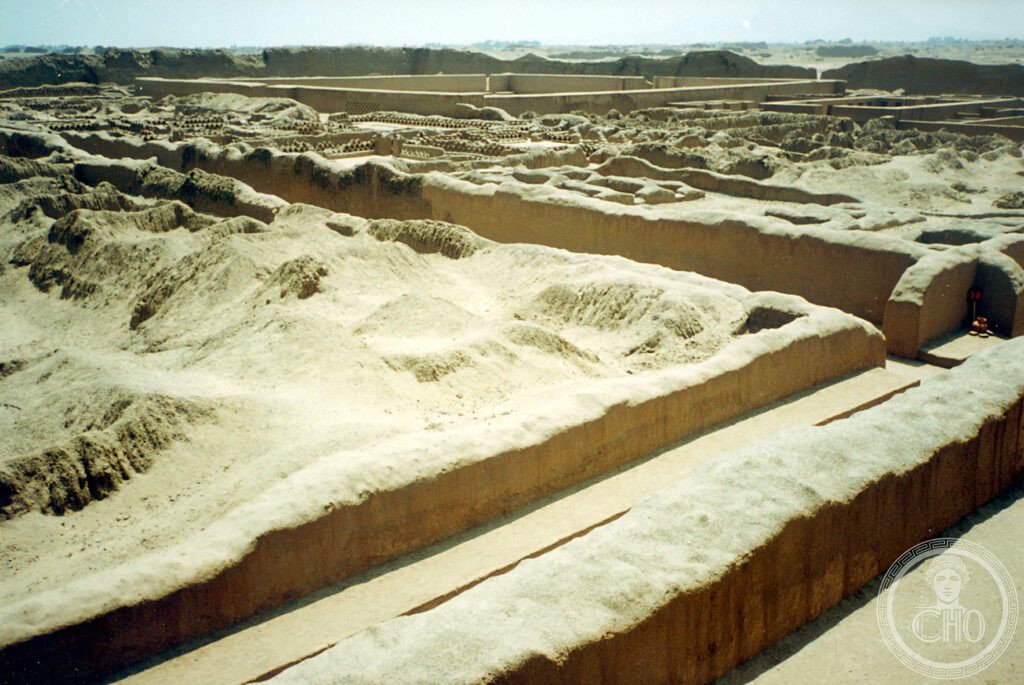
The carved adobe walls (the friezes of geometric fish and wave motifs) of the Ciudadela Tschudi (the Royal Compound of the Chan Chan archaelogical zone), Chan Chan, La Libertad Region, Peru (the largest pre-Columbian city in South America: the carved adobe reliefs on the interior walls of the royal palace compound (the Tschudi citadel) of the Chimu Empire; the repetitive frieze motifs (fish, birds, waves, geometric patterns) that cover the walls of the audiencias (formal reception rooms) of the royal court; the characteristic adobe brick construction (sun-dried mud brick; the standard Chimu construction material; the porous adobe absorbs water and is susceptible to El Niño rainfall (the greatest threat to Chan Chan today))), Chan Chan, La Libertad Region, Peru. UNESCO World Heritage Site 1986. Photo via Wikimedia Commons.
La Libertad Region, Peru · Chimu Empire 900-1470 CE; largest adobe city pre-Columbian Americas; 20 km² urban area; UNESCO WHS 1986 (in danger)

Chan Chan

The largest pre-Columbian city in South America and the most extensive adobe (mud-brick) city in the world — Chan Chan (La Libertad Region, Peru; UNESCO WHS 1986; on the UNESCO List of World Heritage in Danger) was the capital of the Chimu Empire from approximately 900 to 1470 CE, covered 20 km², contained 9 royal compounds (ciudadelas) each built by a successive king, and was home to approximately 30,000-60,000 inhabitants.

At a glance

Chan Chan (the most precisely ChanChanPeru single Chimu Empire 900 CE 1470 CE Tacaynamo legendary founder 10 kings each built own ciudadela royal compound palace 9 ciudadelas survive Tschudi Rivero Gran Chimu Velarde Bandelier Squier Labyrinth Uhle Chayhuac 20 km2 urban extent largest adobe city world largest pre-Columbian city South America 30000 60000 inhabitants 9 ciudadelas audiencias reception rooms U-shaped huachaques garden wells groundwater sunken burial platform Inca Tupac Inca Yupanqui 1470 CE conquest silver gold metal arts craftsmen relocated Cusco Viceroyalty Peru colonial looters 1533 CE UNESCO 1986 WHS danger erosion El Nino rainfall 1997 1998 ENSO crisis UNESCO heritage: the ciudadelas (the core of Chan Chan is 9 royal palace compounds (ciudadelas), each covering approximately 200,000 m² (20 ha); each ciudadela was built by a single Chimu king and served as his palace during his reign and his mausoleum after his death (the Chimu practiced a form of royal ancestor cult (split inheritance): when a king died, his compound was sealed and maintained by a court of attendants who continued to “serve” the king’s mummy; the new king had to build a new compound from scratch, driving the rapid architectural expansion of Chan Chan)); the hydraulic system (Chan Chan had no river within the city; the water supply came from infiltration wells (huachaques) sunk to the water table, and from a 74 km canal system bringing water from the Chicama River valley to the north; the 74 km Chicama-Moche canal (the longest pre-Columbian canal in South America) was the most ambitious hydraulic engineering project in the pre-Columbian Americas)) — the most precisely ChanChanPeru single Chimu Empire 900 1470 CE 9 ciudadelas 20 km2 largest adobe city world 30000 60000 inhabitants 9 kings each built ciudadela audiencias U-shaped huachaques sunken garden wells 74 km Chicama-Moche canal longest pre-Columbian canal South America split inheritance dead king mummy served Inca Tupac Inca Yupanqui 1470 CE conquest silver gold craftsmen relocated Cusco colonial looters UNESCO 1986 in danger El Nino erosion UNESCO heritage in any UNESCO world heritage site)).

Key facts

  • Split inheritance (royal ancestor cult): the most precisely ChanChanPeru single Chimu split inheritance royal ancestor cult king death compound sealed mummy court servants continued serve king dead mummy fed clothed consulted divination state decisions new king no inheritance build new ciudadela from scratch motivation expand Chan Chan 9 ciudadelas 900 1470 CE rapid architectural expansion UNESCO heritage — the defining political institution: the Chimu “split inheritance” system (the defining difference between the Chimu and the Inca): when a Chimu king died, his entire estate (including his ciudadela palace, all his gold and silver treasures, and all his retainers) was inherited by his descendants, who continued to serve the king’s mummy (maintaining the fiction that the dead king was still ruling); the new king inherited no property (only the title and authority), forcing him to build a completely new ciudadela from scratch and accumulate his own wealth; this system drove the explosive architectural growth of Chan Chan (9 ciudadelas in approximately 500 years)
  • GPS: 8.1097° S, 79.0753° W

History

From Chimu capital to Inca province to eroding ruin (the most precisely ChanChanPeru single Tacaynamo legendary founder first Chimu king Moche Valley 900 CE Chimu Empire 900 CE 1470 CE 10 kings ciudadelas expanded Lambayeque Sican incorporated 11th century CE Chimu Empire 1300 CE peak 1000 km Pacific coast Inca expansion Tupac Inca Yupanqui 1470 CE Chimu military resistance 3 years defeat fall Chimu king Minchancaman captured Cusco Chimu artisans silversmiths goldsmiths relocated Cusco transmitted metal arts Inca culture Francisco Pizarro Spanish conquest 1532 CE Moche valley Trujillo founded 1534 CE colonial looting Huacas Moche colonial period systematic looting 1533 1600 CE UNESCO 1986 in danger list El Nino 1997 1998 CE erosion conservation program UNESCO heritage: the Chimu Empire (900-1470 CE: the Chimu Empire (also called the Kingdom of Chimor) was the second-largest empire in pre-Columbian South America (after the Inca Empire at its height); the Chimu controlled approximately 1,000 km of Pacific coast (from modern Ecuador to Lima); their capital Chan Chan was the economic and political center of this coastal empire; the Chimu were known for their skill in metalwork (gold, silver, copper bronze), textile production, and hydraulic engineering)); the Inca conquest (1470 CE: Tupac Inca Yupanqui (the Inca crown prince; later the 10th Sapa Inca) besieged Chan Chan after the Chimu resisted for approximately 3 years; the Chimu king Minchancaman was captured and taken to Cusco as a hostage; the Chimu artisans (particularly goldsmiths and silversmiths) were relocated to Cusco where they transmitted their metal arts to the Inca tradition (explaining the high quality of Inca metalwork))); the colonial looting (after the Spanish conquest of 1532 CE, Chan Chan was systematically looted: the gold and silver burial offerings in the ciudadelas were melted down; the colonial period stripped Chan Chan of most of its metal content)) — the most precisely ChanChanPeru single Tacaynamo 900 CE 10 kings Chimu Empire 1000 km Pacific coast Ecuador Lima Inca Tupac Inca Yupanqui 1470 CE 3 years siege Minchancaman captured Cusco Chimu artisans goldsmiths relocated Cusco Inca metalwork tradition Spanish 1532 CE colonial looting gold silver burial melted Trujillo 1534 CE UNESCO 1986 in danger El Nino 1997 1998 CE erosion UNESCO heritage in any UNESCO world heritage site)).

What you see

The Tschudi ciudadela, adobe friezes, and sunken gardens (the most precisely ChanChanPeru single Tschudi ciudadela most accessible largest visible open visitors adobe brick sun-dried mud walls 10m high entry gateway audiencias U-shaped reception rooms geometric fish birds wave motifs carved friezes well-preserved best quality burial platform Mlam central royal burial mound multiple levels stripped looted huachaques sunken gardens wells groundwater 3m below surface Rivero ciudadela second most accessible Gran Chimu largest ciudadela 220000 m2 Squier Bandelier Tschudi audiencias friezes visible three-dimensional carved panels reliefs moonfish otters birds UNESCO heritage: the visitor experience: the Tschudi ciudadela (the best-preserved and most accessible of the 9 ciudadelas; 220,000 m²; the signposted circuit covers: the entrance gateway (3m wide, 10m high, the classic Chan Chan entry through a corbelled doorway); the audiencias (the U-shaped reception rooms; the carved adobe friezes on 3 walls of each audiencia; the fish-and-wave motifs); the burial platform (the multi-level royal burial mound; stripped of its silver and gold offerings by Spanish colonial looters; the empty burial chambers visible); the huachaques (3 sunken garden/well areas visible from the audiencia complex; the groundwater level approximately 3m below the surface; the Chimu planted the huachaques with edible plants and fish-farmed the water)); the site museum (the Museo Chan Chan at the site entrance; the exhibits covering the Chimu civilization, Chan Chan urban layout, and conservation challenges)); the El Niño threat (Chan Chan is on the UNESCO List of World Heritage in Danger since 1986 due to: the natural erosion from heavy El Niño rainfall events (the worst: 1997-1998 CE ENSO crisis; unprecedented rainfall in northern Peru; the adobe walls (built for the desert coastal climate) are extremely vulnerable to water); the urban expansion of Trujillo encroaching on the site boundaries)) — the most precisely ChanChanPeru single Tschudi ciudadela most accessible 220000 m2 entry gateway 3m wide 10m high audiencias U-shaped friezes fish birds waves three-dimensional carved burial platform looted empty huachaques 3 sunken gardens wells groundwater 3m below surface Rivero second Gran Chimu largest 220000 m2 Museo Chan Chan in danger 1986 El Nino 1997 1998 CE adobe erosion UNESCO heritage in any UNESCO world heritage site)).

Practical information

  • Getting there: the nearest city is Trujillo (5 km east; the largest city in northern Peru; the third-largest city in Peru (population approximately 1 million)); fly to Trujillo (TRU; Carlos Martínez de Pinillos International Airport; from Lima (LIM; LATAM/Avianca/Sky; 1h15m)); the taxi from Trujillo to Chan Chan (approximately PEN 20-30/€5-8; 15-20 min); the entry ticket (approximately PEN 20/€5 for the Chan Chan site + Huaca Arco Iris + Huaca Esmeralda (a combined ticket covering the Chan Chan Archaeological Zone); the ticket office at the Tschudi ciudadela entrance)); the combination day trip (the northern Peru day trip from Trujillo: Chan Chan (2h) + Huaca del Sol y de la Luna (2h; the two Moche pyramids 6 km south of Trujillo; the Moche civilization (200-800 CE) which preceded the Chimu in the Moche Valley; excellent polychrome fresco murals in the Huaca de la Luna)); the best time (year-round (Trujillo is in a desert climate; Chan Chan is extremely dry except during El Niño events))

Getting there

5 km from Trujillo (TRU airport, 1h15m from Lima). Taxi PEN 20-30/€5-8, ~15 min. Entry PEN 20/€5 combined ticket. Combine with Huaca del Sol y de la Luna (Moche murals, 6 km south). Year-round desert climate. GPS: -8.1097, -79.0753.

Nearby

  • Huaca del Sol y de la Luna — 6 km south (the two Moche ceremonial pyramids from the civilization that preceded the Chimu in the Moche Valley (approximately 200-800 CE); the Huaca de la Luna (the Temple of the Moon; the smaller but better-preserved pyramid; the polychrome fresco murals depicting Ai Apaec (the Decapitator God of the Moche) with tentacles and fangs; the murals in the excavated interior courts are among the finest pre-Columbian painted surfaces in South America; the site museum))
  • Caral — 350 km south (UNESCO WHS 2009; the oldest city in the Americas (approximately 2600-2000 BCE; contemporary with the Old Kingdom Egyptian pyramids); the Norte Chico civilization; 6 platform mounds; the earliest evidence of a complex urban society in the Americas; the discovery in 2001 CE of quipu (knotted record-keeping string) at Caral predated the previously known use of quipu by 2,000 years))

Sources

  • Wikipedia, Chan Chan; Chimu people; Moche culture, accessed June 2026
  • UNESCO, Chan Chan Archaeological Zone, WHS reference 366, inscribed 1986 (in danger)

Hero image: Chan Chan, Peru, Wikimedia Commons. Editorial text © Cultural Heritage Online, 2026.

📷 Diventa un fotografo di Cultural Heritage Online

Condividi le tue foto dei luoghi: restano pubblicate con la tua firma come autore. Più vengono viste, più ti fai conoscere — e presto un concorso premierà le foto più apprezzate.

Accedi o registrati gratis per aggiungere una foto
📋 Copy & share on social
Scroll to Top