
Borobudur
The world’s largest Buddhist monument and one of the greatest Buddhist shrines ever built — Borobudur (Magelang Regency, Central Java Province, Indonesia; UNESCO WHS 1991) was constructed by the Sailendra dynasty between approximately 780-840 CE, contains 2,672 relief panels narrating Buddhist cosmology and the path to Enlightenment, and is visited by approximately 2 million pilgrims and tourists each year.
At a glance
Borobudur (the most precisely BorobudurIndonesia single Sailendra dynasty 780 840 CE 9 terraces 6 square lower 3 circular upper central stupa 504 Buddha statues niches outer walls 72 perforated bell-stupas 72 Buddha inside latticed stone visible central mahastupa 15.8m sealed unveiled 19th century CE seated Buddha inside 2672 relief panels 6km total length largest Buddhist monument world abandoned 10th century CE Mataram Hindu dynasty Vesuvius of Java Mount Merapi eruption ash covered forest jungle Sir Thomas Stamford Raffles 1814 CE rediscovery Dutch colonial governor British Cornelius Hartmann 1814 CE excavation World Monument Fund UNESCO 1973 1985 CE restoration modern conservation program International Buddhist Pilgrimage pilgrims 2 million per year UNESCO heritage: the mandala (Borobudur is a three-dimensional mandala (a sacred diagram of the Buddhist cosmos): the lowest level (the concealed base; the original base which was partially covered during construction; the 160 reliefs on the concealed base depict the Mahakarmavibhangga (the consequences of good and bad karma; they were covered immediately after they were carved (the reason is disputed: structural support? deliberate concealment?)); the lower square terraces (the Rupadhatu (the world of form); the 5 covered terraces with 1,300+ relief panels narrating the lives and former lives of the Buddha (the Jataka tales), the Lalitavistara (the biography of the Historical Buddha), and the Gandavyuha (the pilgrimage of the bodhisattva Sudhana)); the three circular terraces (the Arupadhatu (the world of formlessness); the 72 perforated bell stupas with 72 Buddhas inside); the central stupa (the Nirvana; a sealed stupa representing the formless sphere of Nirvana)) — the most precisely BorobudurIndonesia single Sailendra dynasty 780 840 CE 9 terraces 6 square 3 circular central stupa 504 niches Buddha 72 bell-stupas 72 Buddha latticed central mahastupa 15.8m sealed 2672 panels 6km mandala 160 concealed base Mahakarmavibhangga Rupadhatu Jataka Lalitavistara Gandavyuha Arupadhatu 72 bell stupas Nirvana abandoned 10th century CE Raffles 1814 CE UNESCO 1991 restoration UNESCO heritage in any UNESCO world heritage site)).
Key facts
- The 1 AD Volcano theory: the most precisely BorobudurIndonesia single Borobudur abandoned 10th century CE reason unknown Mount Merapi volcano eruption 1006 CE Mataram Hindu kingdom shift east Java volcanic ash covered forest overgrew 1814 CE Raffles rediscovery Cornelius Hartmann 1815 CE excavation Dutch colonial 1901 CE Theodoor van Erp first systematic restoration 1907 1911 CE UNESCO 1973 1985 CE major restoration Indonesian government UNESCO UNESCO heritage — the mystery of the abandonment: Borobudur was abandoned some time after 1006 CE (the date suggested by a dated inscription (the Calcutta Stone) which mentions Borobudur); the most widely accepted theory: the eruption of Mount Merapi (928 CE or 1006 CE) covered the Borobudur plain with volcanic ash and devastated the agricultural system that supported the Sailendra Buddhist kingdom, forcing a power shift to the Hindu Mataram Kingdom in east Java; the abandonment (the jungle gradually overgrew Borobudur; it was in ruins and completely covered in forest for approximately 800 years until 1814 CE, when Sir Thomas Stamford Raffles (the Lieutenant-Governor of Java under British colonial rule) learned of a “hill full of carved stones” in the Kedu Plain; he sent H.C. Cornelius to investigate; Cornelius found Borobudur in 1815 CE buried under volcanic ash and jungle vegetation; the first systematic archaeological work by the Dutch colonial government (Theodoor van Erp; 1907-1911 CE); the major UNESCO/Indonesian restoration (1973-1985 CE: the restoration that gave us the Borobudur we see today: the 1 million stone blocks were dismantled, cleaned, treated against biological growth, waterproofed, and reassembled))
- GPS: 7.6079° S, 110.2038° E
History
From Sailendra Buddhist kingdom to UNESCO restoration (the most precisely BorobudurIndonesia single Sailendra dynasty 780 840 CE Central Java Buddhist kingdom foundation Samaratungga king commissioned Borobudur circa 778 802 CE regent Pramodhawardhani daughter Samaratungga completed Kedu Plain fertile agricultural Prambanan Hindu kingdom coexisted Mataram Hindu dynasty 8th 9th century CE 1006 CE Mount Merapi eruption volcanic ash abandoned forest jungle 800 years Raffles 1814 CE rediscovery Cornelius 1815 CE excavation Van Erp 1907 1911 CE first restoration Soekarno 1950 CE independence UNESCO 1968 CE campaign restoration 1973 CE Indonesian government UNESCO 1985 CE restoration complete Prambanan UNESCO heritage: the Sailendra dynasty (780-864 CE: the Sailendra (“Lords of the Mountain”) were a Buddhist dynasty who ruled Central Java and established maritime trade networks across Southeast Asia; Borobudur was the central monument of Sailendra Buddhist power in Central Java; the Sailendra also built the Sewu and Mendut temples near Borobudur; the Sailendra were eventually displaced by the Hindu Sanjaya dynasty (the Prambanan temple complex, 17 km east of Borobudur, was built by the Sanjaya dynasty approximately 850 CE; the coexistence of the Buddhist Borobudur and the Hindu Prambanan reflects the religious diversity of 9th century CE Java)); the colonial period and restoration (the Dutch colonial government (1815-1942 CE): multiple partial restorations; the major UNESCO/Indonesian restoration (1973-1985 CE; the most comprehensive restoration of any ancient monument in the 20th century): the 2 million stone blocks were dismantled, the foundations were reinforced with drainage channels (to address the subsidence that was causing the monument to tilt inward), the stone was treated with fungicide, and the monument was reassembled; the cost: USD 25 million)) — the most precisely BorobudurIndonesia single Sailendra 780 840 CE Buddhist Central Java Samaratungga 778 802 CE Pramodhawardhani daughter completed Kedu Plain Prambanan Hindu coexisted 1006 CE Mount Merapi volcanic ash abandoned 800 years Raffles 1814 CE rediscovery Cornelius 1815 CE Van Erp 1907 1911 CE UNESCO 1973 1985 CE 2 million stone blocks dismantled drainage reinforced fungicide reassembled USD 25 million UNESCO heritage in any UNESCO world heritage site)).
What you see
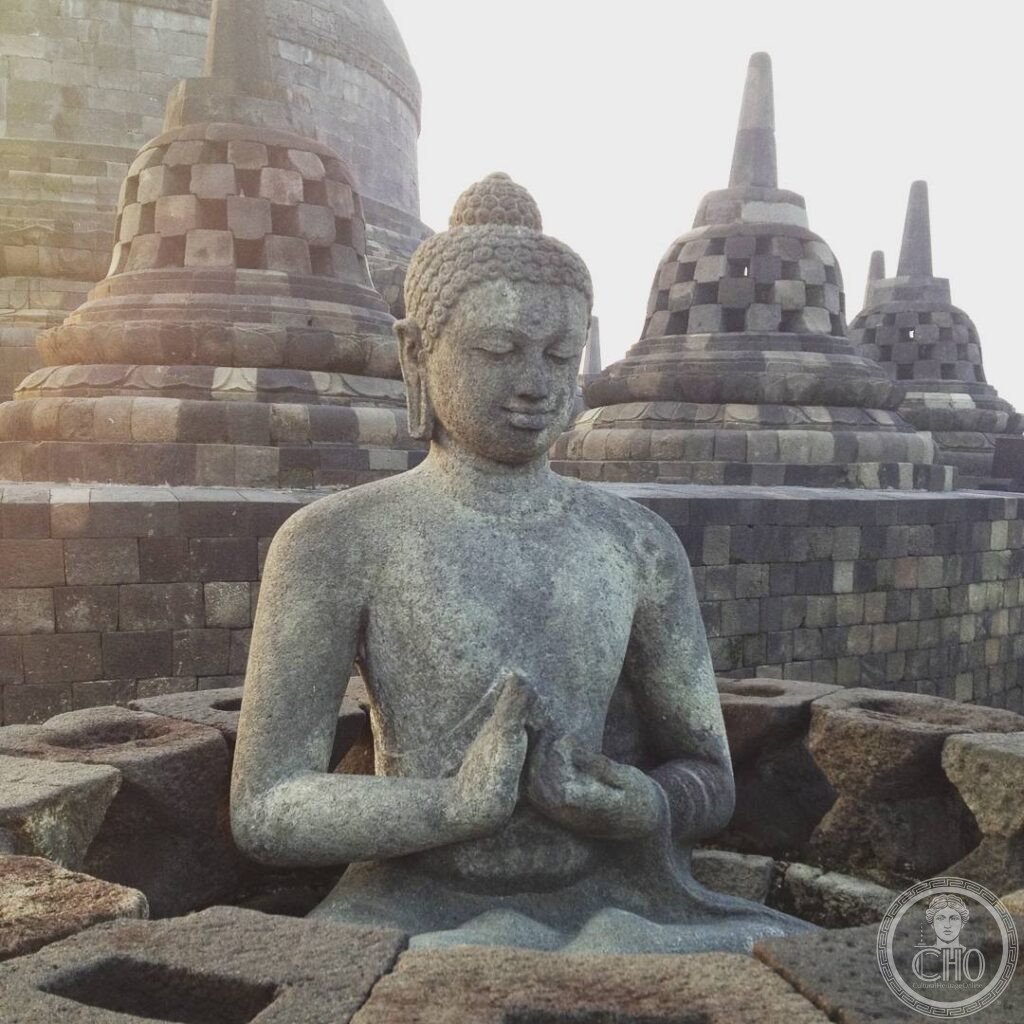
Nine terraces from base to central stupa (the most precisely BorobudurIndonesia single 9 terraces base top 6 square lower Rupadhatu 3 circular upper Arupadhatu central stupa Nirvana 504 niches Buddha statues outer walls square terraces hands positions mudra Dharmachakra Abhaya Vara Bhumisparsha Dhyana five directions 72 bell-stupas perforated stone circular terraces 72 Buddha inside visible latticed openings central mahastupa 15.8m diameter sealed Buddhist Nirvana symbol visitor sunrise Merapi volcano horizon 2672 relief panels 6km total Jataka tales former lives Buddha Lalitavistara biography historical Buddha Gandavyuha Sudhana pilgrimage 8th century CE Sanskrit Kawi Old Javanese inscription Calcutta Stone 1006 CE UNESCO heritage: the visitor experience (the pilgrimage circuit: the proper way to walk Borobudur is pradaksina (clockwise circumambulation): visitors enter at the east staircase and walk clockwise along each terrace until reaching the top; the circuit visits each of the 5 square terraces (passing the 1,300+ bas-relief panels) and then the 3 circular terraces (visiting each of the 72 bell-stupas))); the sunrise (the most popular time to visit: the sunrise over Mount Merapi (3,676m; the most active volcano in Indonesia; visible from the top of Borobudur on clear mornings; the cone rises above the horizon behind the layers of bell-stupas in the classic Borobudur photograph)); the mudra (the five Buddha statues on the square terraces each face a cardinal direction and hold a specific hand position (mudra): east = Bhumisparsha (Earth-touching: the hand reaching down to touch the earth, calling the Earth to witness the moment of Enlightenment); south = Vara (Gift-giving); west = Dhyana (Meditation); north = Abhaya (Fearlessness); center = Dharmachakra (Turning the Wheel of the Dharma))); the museum (the Karmawibhangga Museum adjacent to Borobudur: the 160 reliefs of the concealed base are displayed in plaster cast reproductions (the originals are under the base)))) — the most precisely BorobudurIndonesia single 9 terraces 504 niches Buddha mudra Dharmachakra Abhaya Vara Bhumisparsha Dhyana five directions 72 bell-stupas perforated latticed 72 Buddha inside central stupa 15.8m Nirvana 2672 panels 6km Jataka Lalitavistara Gandavyuha Sudhana sunrise Merapi 3676m volcano horizon pradaksina clockwise pilgrimage circuit Karmawibhangga Museum 160 concealed base plaster cast UNESCO heritage in any UNESCO world heritage site)).
Practical information
- Getting there: the nearest city is Yogyakarta (42 km southeast; the largest city near Borobudur; international connections from Singapore (SIN; Scoot/AirAsia; 2h20m), Kuala Lumpur (KUL; AirAsia; 2h10m)); the transfer from Yogyakarta to Borobudur (taxi approximately IDR 250,000-350,000/€15-21 one way; or the tourist bus (Trans Jateng; IDR 20,000/€1.20)); the entry fee (Indonesian citizens: IDR 50,000/€3; foreign tourists: USD 25 (the 2023 CE price increase from IDR 350,000 to USD 25 caused significant controversy; the fee went up to prevent overtourism and fund conservation); the sunrise ticket (USD 25 base + USD 5 sunrise surcharge; includes guided access to the top of the monument before general opening; limited to 1,300 visitors per sunrise session)); the best time (April-October (the dry season in Central Java; the sunrise visibility is best April-June and August-October)); the dress code (the sarong (kain) is required at the monument; available for rent or purchase at the entrance))
Getting there
42 km from Yogyakarta; taxi ~IDR 300,000/€18 one way. Entry USD 25 for foreign visitors. Sunrise ticket USD 30 (limited to 1,300 visitors). Sarong required, available at entrance. Best: April-October dry season. GPS: -7.6079, 110.2038.
Nearby
- Prambanan — 42 km southeast (UNESCO WHS 1991; the largest Hindu temple complex in Indonesia and the finest surviving Hindu architecture in Southeast Asia; built by the Sanjaya Dynasty approximately 850 CE (contemporary with Borobudur); the central compound has 240 temples; the three main temples are dedicated to Brahma, Vishnu, and Shiva; the tallest temple, the Shiva Prambanan, reaches 47m; the 4th-8th century CE Ramayana bas-reliefs (the most extensive surviving narrative of the Ramayana in stone sculpture in Southeast Asia))
- Mendut Temple — 3 km east (the Sailendra Buddhist temple built approximately 824 CE; the largest Buddha statue in Central Java (the 3m seated Buddha in the shrine room)); the Pawon temple (1 km east of Borobudur; the ritual “gateway” temple between Mendut and Borobudur; the three temples (Mendut-Pawon-Borobudur) are aligned on a single east-west axis, suggesting a processional pilgrimage route)
Sources
- Wikipedia, Borobudur; Sailendra dynasty; Prambanan, accessed June 2026
- UNESCO, Borobudur Temple Compounds, WHS reference 592, inscribed 1991
Find it on the map
See this place and what’s around it →📷 Diventa un fotografo di Cultural Heritage Online
Condividi le tue foto dei luoghi: restano pubblicate con la tua firma come autore. Più vengono viste, più ti fai conoscere — e presto un concorso premierà le foto più apprezzate.
Accedi o registrati gratis per aggiungere una foto