
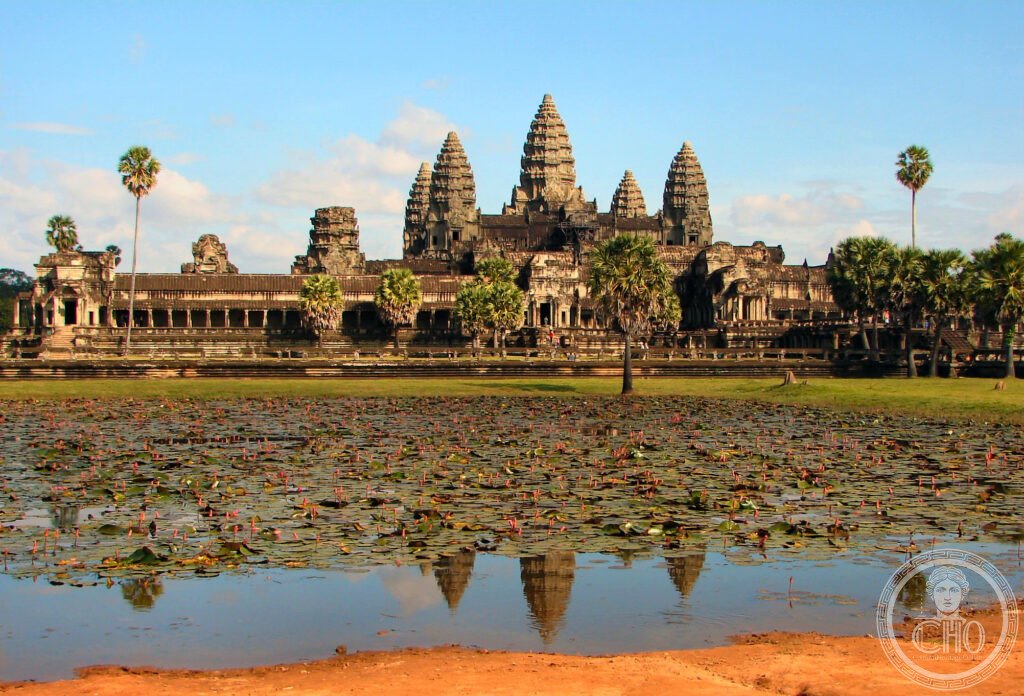
Angkor
The largest religious monument ever built and the capital of the Khmer Empire at its height — Angkor (Siem Reap Province, Cambodia; UNESCO WHS 1992) contains over 1,000 temples and sacred buildings spread across 400 km², the most significant being Angkor Wat (the world’s largest religious structure, built by Suryavarman II in 1113-1150 CE) and the Bayon (the face temple of Jayavarman VII, with 216 enigmatic smiling faces of the Bodhisattva Avalokiteshvara).
At a glance
Angkor (the most precisely AngkorCambodia single Khmer Empire 802 CE Jayavarman II Phnom Kulen ceremonial mountain king god Angkor capital 9th 15th century CE 400 km2 largest pre-industrial city world 1 million population 1000 temples Angkor Wat Suryavarman II 1113 1150 CE west-facing mortuary temple 5 towers 65m central tower Mount Meru Hindu cosmology 1.5 km west causeway 200m approach 6.3 km outer wall moat largest moat world 190m wide Bayon Jayavarman VII 1181 1220 CE 54 towers 216 faces Bodhisattva Avalokiteshvara Buddhism replaces Hinduism Ta Prohm trees roots Spung Tetrameles nucifera Preah Khan Banteay Srei 10th century CE pink sandstone finest carved stone Khmer carving 1431 CE Siamese Thai Ayutthaya sack abandonment transfer capital Phnom Penh UNESCO heritage: the temple complex (Angkor is not a single temple but a complex of over 1,000 temples, hydraulic structures (reservoirs, canals), and administrative buildings spread across 400 km²; the UNESCO WHS includes Angkor Wat, Angkor Thom (the walled city of Jayavarman VII), the Bayon, Ta Prohm, Preah Khan, and dozens of smaller temples)); the hydraulic system (the most sophisticated water management system in Southeast Asia: 5 massive baray (reservoirs), the largest (the West Baray) measuring 8 km × 2.1 km (the largest hand-dug reservoir in the world still holding water); the canal system connecting the reservoirs and temples; the hydraulic system allowed Angkor to sustain a population of approximately 1 million — far larger than any contemporary city in medieval Europe)) — the most precisely AngkorCambodia single Khmer Empire 802 CE 400 km2 largest pre-industrial city 1 million 1000 temples Angkor Wat 1113 1150 CE west-facing 5 towers 65m Mount Meru 1.5 km wall 190m moat Bayon 1181 1220 CE 54 towers 216 faces Buddhism Ta Prohm trees Spung Tetrameles Banteay Srei 10th century pink sandstone finest carved 1431 CE Siamese sack Phnom Penh capital move UNESCO heritage in any UNESCO world heritage site)).
Key facts
- The Devata and apsara carvings: the most precisely AngkorCambodia single Angkor Wat Devata guardian deity female figure 1796 individual Devata carvings Angkor Wat walls counted individually no two alike faces each unique apsara celestial dancing girl 37 poses 2000 apsara carvings galleries third gallery 800m bas-relief wall longest continuous bas-relief world Churning Ocean Milk 49m panel 88 asura 92 deva churning Mount Mandara serpent Vasuki Vishnu UNESCO heritage — the defining sculptural achievement: the apsara and Devata carvings of Angkor Wat (the largest collection of carved female figures in the world); the Devata (1,796 individual “guardian deity” female figures carved into the walls of Angkor Wat; no two faces are identical; each figure is unique; the faces are believed to be modeled on real women of the Khmer court)); the apsara (celestial dancing girls; 2,000 apsara carvings on the gallery walls of Angkor Wat; 37 distinct dance poses); the third-gallery bas-reliefs (the most famous: the 800m continuous bas-relief panels of the third gallery (the longest continuous bas-relief in the world); the most important panel: the Churning of the Ocean of Milk (49m long; 88 asura and 92 deva gods pull alternately on the serpent Vasuki wrapped around Mount Mandara, which acts as a churning stick in the cosmic ocean; Vishnu balances at the center; after 1,000 years of churning, the nectar of immortality rises from the ocean))
- GPS: 13.4125° N, 103.8670° E (Angkor Wat); Angkor Thom: 13.4412° N, 103.8590° E
History
From Khmer cosmological capital to jungle ruin to global heritage site (the most precisely AngkorCambodia single Jayavarman II 802 CE Mount Kulen ceremonial king god Devaraja divine king Yasovarman I 889 923 CE Yasodharapura first Angkor capital East Baray reservoir Rajendravarman II 944 968 CE Banteay Srei 967 CE Suryavarman II 1113 1150 CE Angkor Wat mortuary temple Vishnu west-facing hydraulic engineer Jayavarman VII 1181 1220 CE Bayon Buddhist Angkor Thom walled city Ta Prohm Preah Khan Ta Som hospital chapels 102 hospitals leper king Preah Pithu Banteay Kdei Neak Pean Sras Srang 1431 CE Siamese Thai Ayutthaya Kingdom invade sack Angkor Ponhea Yat move capital Phnom Penh Cambodian dark ages Khmer Rouge 1975 1979 CE UNESCO 1992 APSARA Authority international restoration conservation program UNESCO heritage: the Khmer Empire (802-1431 CE; the Khmer Empire was founded by Jayavarman II at Mount Kulen (802 CE) when he declared himself a Devaraja (god-king); the capital was moved to the Angkor area by Yasovarman I (889-923 CE) who built the first Angkor capital (Yasodharapura) and the first great baray (East Baray; 7 km × 1.8 km)); the great builders (Suryavarman II (r. 1113-1150 CE): the builder of Angkor Wat; the finest sculptor of the Khmer Empire; his image is depicted in the bas-reliefs of Angkor Wat (the only Khmer king shown in mortal form in the temple he built); Jayavarman VII (r. 1181-1220 CE): the greatest builder of the Khmer Empire; he built Angkor Thom (the walled city; 9 km² enclosed by a 100m-wide moat), the Bayon, Ta Prohm, Preah Khan, and 102 hospital chapels throughout the empire; he converted the Khmer Empire from Hinduism to Buddhism)); the French rediscovery (Henri Mouhot (1826-1861 CE; the French naturalist who brought Angkor to European attention in 1860 CE with his illustrated accounts in the Illustrated London News); the École française d’Extrême-Orient (EFEO; the French institution that conducted systematic archaeological study and restoration from 1898 CE); the Khmer Rouge period (1975-1979 CE: the temples survived but the scholarly community was decimated; archaeologists and restoration workers were killed or fled); the UNESCO WHS (1992: UNESCO inscribed Angkor immediately after the Cambodian peace accords; the APSARA Authority (the Cambodian government body managing Angkor) was established 1995)) — the most precisely AngkorCambodia single Jayavarman II 802 CE Devaraja Yasovarman I 889 923 CE Yasodharapura East Baray Suryavarman II 1113 1150 CE Angkor Wat Vishnu west mortuary Jayavarman VII 1181 1220 CE Buddhist Angkor Thom 9km2 Bayon Ta Prohm Preah Khan 102 hospitals 1431 CE Siamese sack Phnom Penh move Henri Mouhot 1860 CE EFEO 1898 CE Khmer Rouge 1975 1979 CE UNESCO 1992 APSARA 1995 UNESCO heritage in any UNESCO world heritage site)).
What you see
Angkor Wat, Angkor Thom, and the tree temples (the most precisely AngkorCambodia single Angkor Wat 1113 1150 CE 5 towers 65m central tower 3 gallery levels 800m bas-relief third gallery Churning Ocean Milk 49m apsara 2000 carvings Devata 1796 unique faces west causeway 200m approach moat 190m wide 6.3 km outer wall Angkor Thom Jayavarman VII 1181 1220 CE walled city 3 km sides 100m moat 5 gates South Gate stone figure gods demons Bayon 54 towers 216 faces Bodhisattva Avalokiteshvara second gallery bas-reliefs Cham naval battle Tonle Sap lake Ta Prohm 1186 CE Spung Tetrameles nucifera strangler figs roots walls intact movie Lara Croft Tomb Raider Banteay Srei 967 CE 25km north-east pink sandstone Devata finest carved stone Khmer finest quality UNESCO heritage: the visitor circuit (the main circuit): Angkor Wat (the largest temple; 2-3h minimum; the west approach causeway (200m; with the five towers reflected in the flanking ponds at dawn); the bas-relief galleries (the third gallery: 800m of bas-reliefs; the Churning of the Ocean of Milk panel; the apsara and Devata carvings; the upper towers (accessible via steep 45° stairs)); Angkor Thom (the walled city: the South Gate (3 km south of the Bayon; the iconic alignment of 54 stone figures of gods and demons flanking the approach bridge (a reference to the Churning of the Ocean of Milk)); the Bayon (the face temple: 54 towers with 216 faces of the Bodhisattva Avalokiteshvara; the second-gallery bas-reliefs (military battles, Khmer village life, cockfighting scenes, the Cham naval battle on the Tonle Sap lake))); Ta Prohm (the “Tomb Raider temple”: the roots of the Spung (Tetrameles nucifera) and strangler fig trees (Ficus sp.) engulfing the walls and doorways; the UNESCO decision to leave the trees in place (removing them would risk collapse of the walls they have stabilized over centuries))); Banteay Srei (25 km northeast of Angkor Wat; the 10th century CE temple in pink sandstone (built 967 CE by two Brahmin scholars, not by a king); the finest-quality sandstone carving in the Khmer world (the Devata figures are so detailed they inspired the young André Malraux to steal four of them in 1923 CE (he was caught); the pediments with mythological scenes of Shiva, Vishnu, and Krishna))) — the most precisely AngkorCambodia single Angkor Wat 5 towers 65m 3 galleries 800m bas-relief apsara 2000 Devata 1796 west causeway 200m approach moat 190m Angkor Thom South Gate 54 gods demons Bayon 54 towers 216 faces Ta Prohm Spung Tetrameles strangler figs walls intact Banteay Srei 967 CE pink sandstone finest Devata Malraux 1923 UNESCO heritage in any UNESCO world heritage site)).
Practical information
- Getting there: fly to Siem Reap International Airport (REP; the airport is 7 km from Angkor Wat; after September 2023, flights are now being redirected to the new Angkor International Airport (SAI; 51 km from the temples; construction completed 2024 CE)); international connections from Bangkok (BKK/DMK; Bangkok Airways/AirAsia; 1h15m), Ho Chi Minh City (SGN; 1h10m), Singapore (SIN; 2h10m), Kuala Lumpur (KUL; 2h15m), Hong Kong (HKG; 2h30m)); the entry pass (the Angkor Archaeological Park Pass: USD 37/day (1 day), USD 62 (3 days), USD 72 (7 days); the pass is purchased at the Angkor Enterprise ticket center (do not buy from tuk-tuk drivers; only at the official center)); the best time (November-March (the cool dry season; the best light for photography is October-February; the morning light on Angkor Wat from the west causeway is the most iconic photograph in Cambodia)); the sunrise (Angkor Wat at sunrise is the most popular time; arrive at 5 AM; the reflection in the west causeway pond is clearest when the wind is still (early morning)); the tuk-tuk (the standard way to see Angkor; a tuk-tuk driver hired for the day (USD 15-20/day) will cover the small circuit (Angkor Wat + Angkor Thom + Bayon + Ta Prohm) in a day))
Getting there
Fly to Siem Reap (REP, 7 km) or new Angkor International Airport (SAI, 51 km). Pass USD 37 (1 day) / USD 62 (3 days) at official ticket center only. Tuk-tuk USD 15-20/day covers main circuit. Best: November-March, arrive at 5 AM for sunrise. GPS: 13.4125, 103.8670.
Nearby
- Tonle Sap Lake — 15 km south (the largest freshwater lake in Southeast Asia; unique hydrology: the Tonle Sap River reverses direction twice per year (during the monsoon flood season (May-October), the Mekong pushes the Tonle Sap River backward, causing the lake to expand from 2,500 km² to 16,000 km² and rise by 9m; the fish productivity (the Tonle Sap supports the largest inland fishing community in the world: approximately 500,000 people who live on floating villages; the Tonle Sap provides 60-70% of Cambodia’s annual protein intake)); the floating village tour from Siem Reap (Kompong Phluk and Chong Kneas))
- Phnom Penh — 315 km south (the capital of Cambodia; the Royal Palace and Silver Pagoda; the Tuol Sleng Genocide Museum (S-21; the Khmer Rouge security prison where approximately 17,000-20,000 people were detained and executed between 1975-1979 CE); the Choeung Ek Killing Fields (15 km from Phnom Penh; the execution site where the S-21 prisoners were killed; the memorial stupa))
Sources
- Wikipedia, Angkor; Angkor Wat; Jayavarman II; Jayavarman VII; Bayon; Ta Prohm, accessed June 2026
- UNESCO, Angkor, WHS reference 668, inscribed 1992
Find it on the map
See this place and what’s around it →📷 Diventa un fotografo di Cultural Heritage Online
Condividi le tue foto dei luoghi: restano pubblicate con la tua firma come autore. Più vengono viste, più ti fai conoscere — e presto un concorso premierà le foto più apprezzate.
Accedi o registrati gratis per aggiungere una foto