
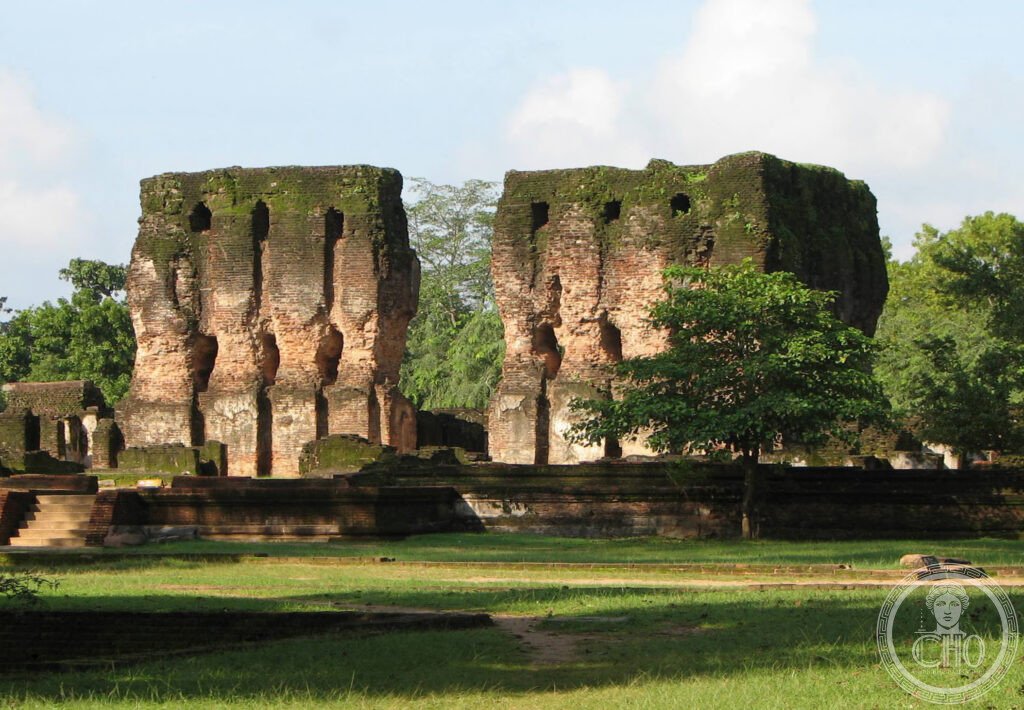
Sri Lanka’s second medieval capital holds what is often called the finest rock-cut Buddhist sculpture in the Theravada world, four colossal granite figures at Gal Vihara, alongside a vast reservoir and irrigation network built to sustain a dry-zone kingdom that briefly unified the island.
At a glance
Polonnaruwa became the Sinhalese capital after the Chola invasion forced the abandonment of Anuradhapura, and it remained the seat of government until the end of the 13th century. It is smaller and more compact than Anuradhapura, with its ruins concentrated in a single archaeological zone that includes a site museum explaining the chronology and the hydraulic systems.
The city’s defining achievement is the tank and canal system built to irrigate the dry zone, where rainfall is limited and highly seasonal. The kings, above all Parakramabahu I, consolidated existing reservoirs into one great artificial lake that still stores monsoon water for release through sluices into surrounding farmland.
Key facts
- Location: North Central Province, Sri Lanka
- Capital period: roughly 1000 CE to 1293 CE
- Peak ruler: Parakramabahu I, reigned 1153–1186 CE
- Reservoir: Parakrama Samudra, about 3 km by 6 km, capacity around 134 million cubic metres
- Gal Vihara reclining Buddha: 14.7 metres long, the largest rock-cut sculpture in Sri Lanka
- Coordinates: 7.9403° N, 81.0188° E
History
Anuradhapura’s fall to the South Indian Chola Empire, under Rajaraja I and his son Rajendra I, pushed the Sinhalese administrative centre south-east to Polonnaruwa, which the Chola themselves used as their base because it lay closer to South India by sea. Vijayabahu I then fought a long guerrilla campaign against the occupation and, having reconquered the island, kept Polonnaruwa as the capital of the reunified kingdom.
The city reached its height under Parakramabahu I, who completed the unification of Sri Lanka, the only time this happened in the medieval period, and used the wealth of a unified realm to commission the Gal Vihara sculptures and to consolidate several existing reservoirs into the Parakrama Samudra. His successor Nissankamalla continued building work and left an inscription recording his monuments, an important source for the period.
After Parakramabahu’s reign the hydraulic system and the agricultural base it supported gradually declined. A Pandyan invasion from Tamil Nadu in 1293 CE delivered the final blow, and the capital was abandoned, its monuments eventually reclaimed by jungle.
What you see
Gal Vihara is the centrepiece of any visit: four Buddha figures cut from a single granite outcrop. The standing figure, its arms crossed unusually at the waist, is traditionally read not as the Buddha himself but as his disciple Ananda, grieving beside the reclining parinirvana image next to him. That reclining figure, eyes closed in final nirvana, rests on an elaborately carved pillow and carries a decorated robe border. A separate rock-cut shrine room holds the most detailed of the three main statues, a seated Buddha in meditation with hands folded in his lap, and a fourth, smaller seated figure occupies the cave to one side.
The Vatadage is considered the finest surviving example of its type, a circular relic shrine built around a stupa with concentric terraces and four entrances aligned to the cardinal points. Its moonstones, the carved semicircular threshold stones, show rows of elephants, horses, lions, geese and flowers read as a symbolic journey from worldly existence to nirvana, and four Buddha images face outward in each direction.
Lankatilaka, the largest brick monument on the site, was built to house a standing Buddha some 17 metres tall. Much of its stucco skin has fallen away, exposing the brick beneath, and the figure itself has lost its head, but the tall corbelled vaults of the interior still convey the scale of the original structure. Nearby, the inscription left by King Nissankamalla records the buildings he commissioned and remains one of the more valuable written sources for the period.
Practical information
- Entry: a single archaeological site ticket covers the museum, the citadel and the main monuments including Gal Vihara; current pricing is best checked with the official site or park authority before travelling.
- Best time to visit: the dry season from June to September brings low humidity and settled weather, though the shoulder months of December to March are also favourable.
- On site: the museum near the entrance is worth visiting first, since it sets out the chronology and explains the hydraulic engineering before seeing the monuments themselves.
Getting there
Polonnaruwa lies north of Colombo and is reached by road or by a combination of train and onward transfer, with the train journey valued for its views across the North Central plain. Travelling from Kandy, the road runs past Dambulla, whose cave temple complex is a UNESCO World Heritage Site in its own right and makes a natural stop en route. Current timings and fares are best confirmed through official transport and tourism channels rather than relied on from older guides.
Nearby
- Sigiriya — about 35 km north; a UNESCO World Heritage Site centred on the 5th-century palace-fortress of King Kasyapa I, built atop a granite rock some 200 metres high, with the celebrated Mirror Wall and rock frescoes.
- Dambulla — on the road from Kandy; a cave temple complex, itself inscribed as a UNESCO World Heritage Site, known for its Golden Buddha statue.
Sources
- UNESCO World Heritage Centre
Find it on the map
See this place and what’s around it →📷 Become a Cultural Heritage Online photographer
Share your photos of places: they stay published under your name as the author. The more they're seen, the more you get noticed — and soon a contest will reward the most appreciated photos.
Log in or sign up free to add a photoDo you manage this place?
This page is read by travellers and heritage enthusiasts who find it on Google. Keep it accurate — and make it work for you. Free for non-profit heritage institutions.