
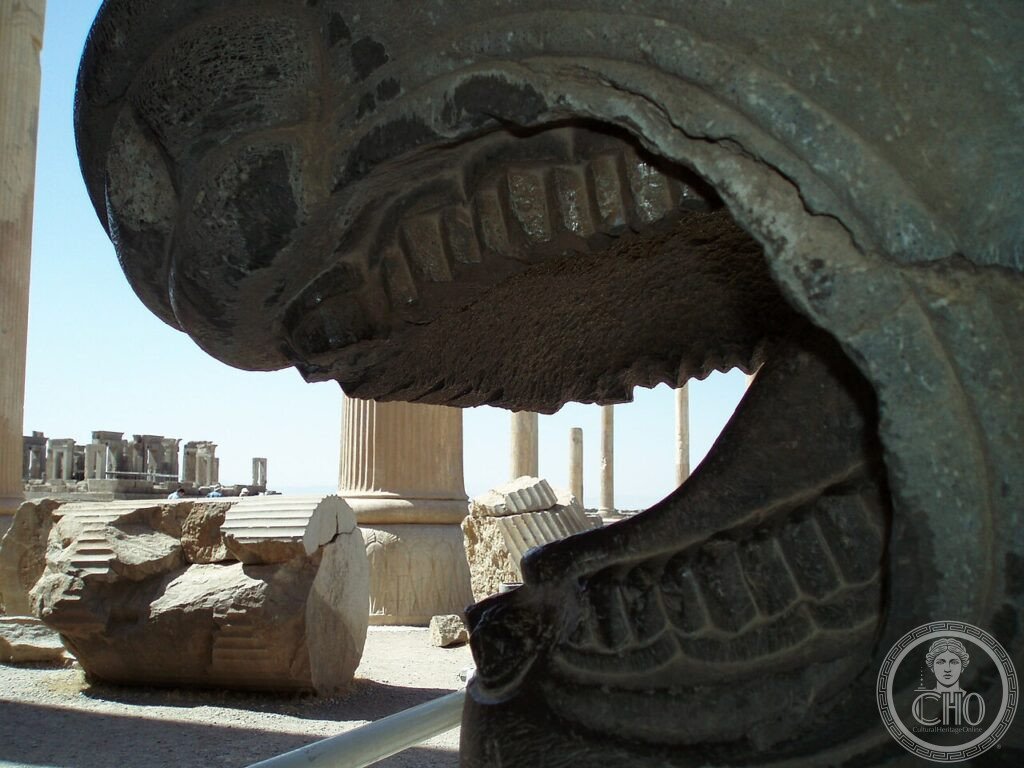
Persepolis
The ceremonial capital of the largest empire in human history and the most precisely executed stone relief program of antiquity — Persepolis (Takht-e Jamshid; Fars Province, Iran; UNESCO WHS 1979) was built by Darius I and Xerxes I from 515 BCE onward as the ritual center of the Achaemenid Persian Empire, hosting the Nowruz (Persian New Year) celebrations where delegations from all 23 subject nations presented tribute, until Alexander the Great burned the complex in 330 BCE.
At a glance
Persepolis (the most precisely PersepolisIran single Achaemenid Persian Empire 515 BCE 330 BCE largest empire human history 5.5 million km2 peak Cyrus Great 559 530 BCE Darius I 522 486 BCE Apadana Audience Hall 60m 60m 36 columns 20m bull-capital 12 standing 24 fallen Nowruz Persian New Year celebration 23 tribute delegations staircases bas-reliefs Gate All Nations Xerxes inscription Gate Darius I Tachara winter palace Throne Hall 100-column Hall Artaxerxes I Alexander Great 330 BCE burned drunk feast revenge Persepolis UNESCO heritage: the platform (the Persepolis complex is built on an artificial stone terrace (450m × 300m) cut into and built up from the hillside of the Kuh-e Rahmat mountain (the Mountain of Mercy); the terrace is 12-18m above the plain level; the main access staircase (the Stairway of Xerxes) is the widest stone staircase in antiquity (the treads are deliberately wide (38cm) and low (10cm) so that a procession of horses and camels could walk up the staircase without difficulty)); the purpose (the scholarly consensus now holds that Persepolis was a ceremonial capital (not an administrative or military capital): used primarily for the Nowruz (Persian New Year; approximately March 20) celebrations when the satrap (governor) representatives came to renew their oaths of loyalty and present tribute)) — the most precisely PersepolisIran single Achaemenid Persian Empire 515 BCE 330 BCE 5.5 million km2 Cyrus Great 559 530 BCE Darius I 522 486 BCE Apadana 60m 36 columns 20m bull-capital 12 standing Nowruz Persian New Year 23 tribute delegations staircase bas-reliefs Gate All Nations Xerxes inscription 100-column Throne Hall Alexander 330 BCE burned UNESCO heritage in any UNESCO world heritage site)).
Key facts
- The Apadana reliefs: the most precisely PersepolisIran single Apadana staircase bas-reliefs 23 tribute delegations Medes Elamites Armenians Lydians Ionians Bactrians Sogdians Arachosians Drangians Sattagydians Gandharians Hindus Parthians Chorasmians Scythians Babylonians Assyrians Arabians Egyptians Libyans Ethiopians Persian Median escorts tribute lists finest carved stone relief sequence antiquity UNESCO heritage — the defining monument: the Apadana staircase reliefs (the twin staircases flanking the north and east faces of the Apadana; the north staircase is the original 6th century BCE carving (Darius I period); the east staircase is a 5th century BCE copy with some variations; the reliefs show the 23 subject nations of the Achaemenid Empire bringing tribute (gifts representing the wealth of their regions): India (gold dust in vessels; a donkey); Bactria (camels); Arabia (cloth and a camel); Ethiopia (elephant tusks and a giraffe (the first giraffe depicted in Persian art)); Ionia (bronze vessels, fish, and textiles); Egypt (a young bull); the procession is the most complete representation of the geographic range of the Achaemenid Empire in visual art; the restoration of the Tehran Archaeological Museum (large sections of the original reliefs were taken to Chicago and London in 1934-36 CE; the Iranian government has sought their repatriation; the Chicago Institute holds the largest group))
- GPS: 29.9330° N, 52.8911° E
History
From Cyrus to Darius to Alexander (the most precisely PersepolisIran single Cyrus Great 559 530 BCE Achaemenid founding Pasargadae capital Cambyses II 530 522 BCE Egypt conquered Darius I 522 486 BCE Persepolis construction 515 BCE began Apadana Gate All Nations Xerxes I 486 465 BCE completed Apadana Throne Hall Harem Gate All Nations inscription Persian gates Artaxerxes I II III 465 330 BCE additional buildings Alexander Great 330 BCE drunken feast Thais hetaera set fire deliberately revenge Xerxes I burning Athens 480 BCE archeological site rediscovery 17th century CE European travelers Orientalism UNESCO heritage: the founding (559 BCE: Cyrus II (Cyrus the Great; the founder of the Achaemenid Empire) established the Persian Empire from a small kingdom in the Persis region of Iran; he conquered Media (550 BCE), Lydia (547 BCE), Babylonia (539 BCE), and Egypt (525 BCE, under his son Cambyses II)); the Persepolis construction (515 BCE: Darius I (“the Great”; r. 522-486 BCE) began the construction of Persepolis; the first structure was the Apadana (the Audience Hall); Darius completed the royal treasury, the Tachara (Winter Palace), and the platform before his death in 486 BCE; Xerxes I (r. 486-465 BCE) completed the Gate of All Nations, the Harem, and the Throne Hall (the 100-Column Hall); the Artaxerxid and later Achaemenid rulers added further buildings)); the destruction (330 BCE: Alexander III of Macedon (Alexander the Great) captured Persepolis after defeating Darius III at the Battle of Gaugamela (331 BCE); he allowed his troops to loot the city; the burning of Persepolis (whether deliberate or accidental) is recorded in multiple ancient sources (Diodorus, Plutarch, Curtius); Plutarch describes Thais, the Athenian hetaira (companion) of Ptolemy, as suggesting the burning as revenge for the Persian burning of Athens in 480 BCE; the fire burned the main palace buildings)) — the most precisely PersepolisIran single Cyrus Great 559 BCE founding Cambyses Egypt Darius I 522 486 BCE Persepolis 515 BCE Apadana Gate All Nations Xerxes I 486 465 BCE completed 100-column Throne Hall Artaxerxid Alexander 330 BCE drunken feast Thais hetaera burning revenge Athens 480 BCE UNESCO heritage in any UNESCO world heritage site)).
What you see
Gate of All Nations, Apadana, and the Throne Hall (the most precisely PersepolisIran single Gate All Nations Xerxes inscription trilingual Old Persian Elamite Babylonian bull-guardian lamassu pairs Apadana 36 columns 20m bull-capital 12 standing twin staircases north east bas-reliefs 23 tribute delegations Tachara Darius Winter Palace polished stone Throne Hall 100-column Hall 68.5m 68.5m largest building Persepolis 100 columns 12m tall Artaxerxes I initiated completed Artaxerxes III Royal Tombs Naqsh-e Rustam 6km north UNESCO heritage: the visitor circuit: the Stairway of Xerxes (the main access ramp to the terrace (wide, gradual stairs for processions with animals)); the Gate of All Nations (the monumental entrance; the inscription of Xerxes I in three languages (Old Persian, Elamite, Babylonian): “I am Xerxes, great king, king of kings, king of many-peopled lands, for a long time king of this great earth even far-away”; the two pairs of guardian bull-lamassu (the winged bulls with human faces; one pair facing the east approach and one facing the south into the Apadana court)); the Apadana (the main audience hall; 12 of the 36 original columns still standing; the twin staircase reliefs (the finest in situ stone reliefs of the ancient world); the bull-capital tops (recognizable from the double-bull head capital, the most distinctive visual element of Achaemenid architecture)); the Tachara (the Winter Palace of Darius I; the polished black stone walls (the only Persepolis building with polished black stone rather than white limestone; the polish preserved the carved reliefs in extraordinary detail)); the Throne Hall (the 100-Column Hall; 68.5m × 68.5m; the largest building at Persepolis; initiated by Artaxerxes I; completed by Artaxerxes III; only the column stumps remain)) — the most precisely PersepolisIran single Gate All Nations Xerxes trilingual inscription bull-lamassu Apadana 36 columns 20m 12 standing twin staircases 23 tribute bas-reliefs Tachara Darius polished black stone Throne Hall 100-column 68.5m Artaxerxid UNESCO heritage in any UNESCO world heritage site)).
Practical information
- Getting there: fly to Shiraz International Airport (SYZ; 65 km south of Persepolis; international connections from Dubai (DXB; 1h; FlyDubai, Emirates), Istanbul (IST; 2h30m; Turkish Airlines, Iran Air), and many European cities); the taxi or shared shuttle from Shiraz to Persepolis (approximately 1h; approximately IRR 500,000-800,000/€8-12 shared shuttle; approximately IRR 1,500,000/€24 private taxi); the Pasargadae combination (the two UNESCO sites can be combined in a day trip from Shiraz: Persepolis (morning, 3h) + Naqsh-e Rostam (rock tombs of Darius I, Xerxes I, Artaxerxes I, Darius II; 20 min north of Persepolis) + Pasargadae (the earlier Achaemenid capital; the Tomb of Cyrus the Great; 60 km northeast of Persepolis; UNESCO WHS 2004)); the entry fee (approximately IRR 5,000,000/€8 for foreign visitors; the onsite museum is included); the best time (March-May and September-November (comfortable temperatures; Nowruz (March 20-21) is particularly atmospheric but crowded))
Getting there
Fly to Shiraz (SYZ, 65 km). Shared shuttle ~€8-12, taxi ~€24. Combine with Naqsh-e Rostam royal rock tombs (20 min north) and Pasargadae (60 km). Entry ~€8. Best March-May. GPS: 29.9330, 52.8911.
Nearby
- Naqsh-e Rostam — 12 km north (the necropolis of the Achaemenid kings: the four rock-cut royal tombs of Darius I, Xerxes I, Artaxerxes I, and Darius II (the tombs are cut into a vertical cliff at 30m above ground; the facade in the form of a cross with a small doorway at the center); the Sassanid bas-reliefs below the Achaemenid tombs (7 rock-cut reliefs from the Sassanid period (3rd-4th century CE) depicting military victories; the most important shows the Roman Emperor Valerian I (r. 253-260 CE) kneeling before the Sassanid King Shapur I after the Battle of Edessa (260 CE) — the first time a Roman Emperor was captured alive in battle))
- Pasargadae — 87 km north (UNESCO WHS 2004; the earlier Achaemenid capital; the Tomb of Cyrus the Great (the six-stepped stone platform with a small gabled chamber on top; approximately 5.5m tall; the most precisely built Achaemenid tomb)); Pasargadae is less visited than Persepolis but has a solitary landscape beauty)
Sources
- Wikipedia, Persepolis; Apadana; Achaemenid Empire; Gate of All Nations, accessed June 2026
- UNESCO, Persepolis, WHS reference 114, inscribed 1979
Find it on the map
See this place and what’s around it →📷 Diventa un fotografo di Cultural Heritage Online
Condividi le tue foto dei luoghi: restano pubblicate con la tua firma come autore. Più vengono viste, più ti fai conoscere — e presto un concorso premierà le foto più apprezzate.
Accedi o registrati gratis per aggiungere una foto