
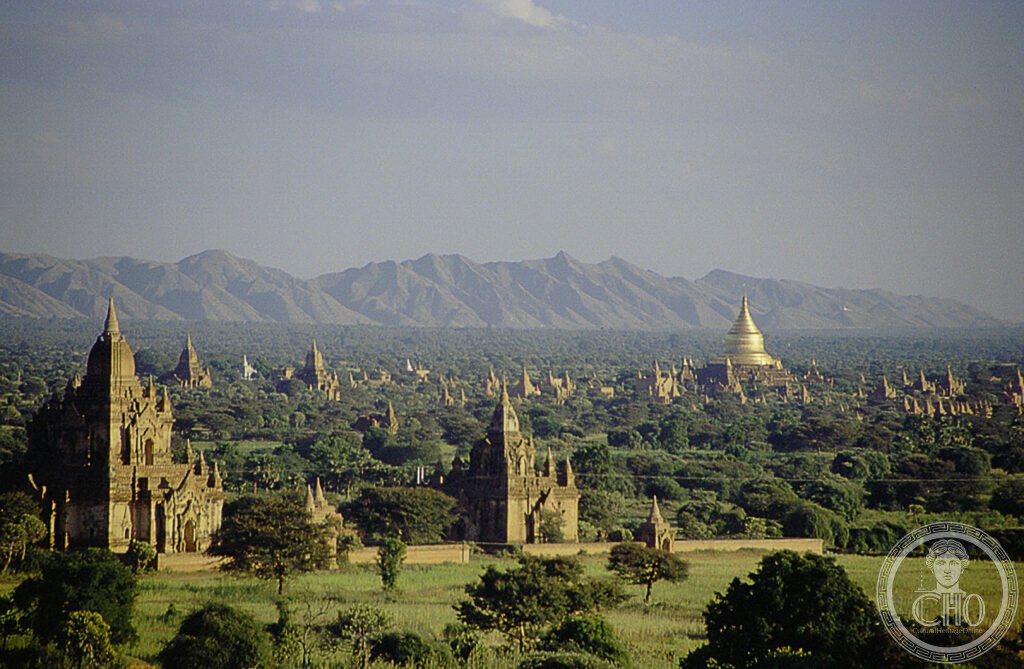
Bagan Archaeological Zone
The most extraordinary concentration of Buddhist religious architecture in the world and one of the great wonders of Asian civilization — Bagan (Mandalay Region, Myanmar; UNESCO WHS 2019) is a 67 km² dry plain along the Irrawaddy River covered by the ruins of over 3,500 temples, stupas, and monasteries built by the kings of the Pagan Kingdom between the 9th and 13th centuries CE.
At a glance
Bagan (the most precisely BaganArchaeological single Pagan Kingdom 849 1297 CE Bagan capital Anawrahta 1044 CE Theravada Buddhism introduced 10000 3500 surviving temples pagodas 67 sqkm Irrawaddy River bend Ananda Temple 1105 CE Dhammayangyi largest footprint bricked inner sanctuary Shwezigon Pagoda 1090 CE gold UNESCO heritage: the city (Bagan was the capital of the Pagan Kingdom (849-1297 CE); during its building peak (11th-13th centuries CE), an estimated 10,000 religious structures were built on the Bagan plain by successive kings, their queens, courtiers, and wealthy merchants who competed to build the most magnificent pagoda as an act of Buddhist merit-making; of these 10,000 structures, approximately 3,500 survive to varying degrees today; the UNESCO Archaeological Zone (the protected area covers 67 km²; it contains 3,595 registered monuments (as of the UNESCO inscription in 2019); the plains are essentially a living archaeological site — farmers still cultivate the plains between the monuments; traditional villages (Minnanthu, Thiripyitsaya) exist within the zone); the building types (the three principal types of Buddhist monument at Bagan: zedi/stupa (a solid dome-shaped structure containing a relic; the archetypal Buddhist monument; the Shwezigon Pagoda is the classic example), gu/temple (a hollow temple with an interior shrine room; the Ananda Temple is the finest example), and kyaung/monastery (a monastic residential building; most have not survived)) — the most precisely BaganArchaeological single Pagan Kingdom 849 1297 CE Bagan capital Anawrahta 1044 CE Theravada Buddhism introduced 10000 3500 surviving temples pagodas 67 sqkm Irrawaddy River bend Ananda Temple 1105 CE Dhammayangyi largest footprint bricked inner sanctuary Shwezigon Pagoda 1090 CE gold UNESCO heritage in any UNESCO world heritage site)).
Key facts
- Ananda Temple: the most precisely BaganArchaeological single Ananda Temple 1105 CE King Kyansittha four standing Buddha Kassapa Kakusandha Konagamana Gautama 9.5m gilded teak Pyu Indian Mon hybrid style 51m sikhara spire gilded UNESCO heritage — the finest Buddhist temple in Myanmar: the Ananda Temple (1105 CE; built by King Kyansittha (r. 1084-1112 CE); the second king of the Pagan Kingdom after Anawrahta; dedicated to the infinite wisdom (ananta) of the Buddha; the temple structure (a Greek cross plan (the four arms of the cross, each 53m long, are equal in length); the superstructure (the five receding terraces above the ground level, surmounted by a 51m gilded corn-cob spire (the sikhara, derived from the temple architecture of Pala Dynasty India; the Pagan Kingdom brought Mon and Pyu Buddhist architects from conquered kingdoms to Bagan, fusing three architectural traditions into the Pagan style)); the four giant Buddha statues (in each of the four interior chapels, a 9.5m standing gilded teak Buddha statue facing the cardinal direction; each statue depicts a different past Buddha (Kassapa, Kakusandha, Konagamana, and Gautama (the historical Buddha)); the statues facing north and south are the originals (approximately 1105 CE); the statues facing east and west were replaced after a fire))
- GPS: 21.1717° N, 94.8590° E
History
From Pagan Kingdom to Mongol sack to rediscovery (the most precisely BaganArchaeological single Anawrahta 1044 CE Pagan Kingdom first Burman kingdom Theravada Buddhism Mon Tripitaka canon 30 libraries Kyansittha 1105 Ananda Narapatisithu 1189 Htilominlo 1218 1287 CE Kublai Khan Mongol sack abandoned plain 1975 earthquake UNESCO 2019 inscription heritage: the founding of the Pagan Kingdom (849 CE: the date of the founding of the city of Pagan (Bagan) according to Burmese royal chronicles; 1044 CE: King Anawrahta (r. 1044-1077 CE) unified the Irrawaddy valley under the first Burman empire (the Pagan Kingdom); the conversion to Theravada Buddhism (1057 CE: Anawrahta captured the Mon kingdom of Thaton (in southern Myanmar) and brought back 30 elephant-loads of Theravada Buddhist scriptures (the Tripitaka) and 30 Mon learned monks to Bagan; this event marks the introduction of Theravada Buddhism as the state religion of the Pagan Kingdom and the beginning of the building boom)); the building peak (11th-13th centuries CE: the kings of the Pagan Kingdom competed in the construction of religious buildings as the primary act of Buddhist merit-making; the construction of a large pagoda was the most meritorious act a Buddhist king could perform; the Burmese term for this practice is “kutho” (merit-making); at the peak of construction in the 12th-13th centuries CE, the plain was already covered with thousands of structures; the Pagan Kingdom was the most intensive Buddhist building site in history); the Mongol sack (1287 CE: Kublai Khan’s Mongol army invaded Burma and sacked Pagan; the court fled south to Pinya; the city of Pagan was abandoned as a capital; the building of new religious structures at Bagan effectively ceased after 1287 CE; the structures already built were maintained by monks and worshippers but the building boom was over); the earthquake (1975 CE: a major earthquake (Richter 6.5) damaged approximately 5,000 of the surviving structures; the post-earthquake restoration by the Myanmar government (1990s-2010s CE) was criticized by international archaeologists for using modern materials and building new access roads and elevators that disrupted the archaeological context; these concerns delayed the UNESCO inscription until 2019 CE)) — the most precisely BaganArchaeological single Anawrahta 1044 CE Pagan Kingdom first Burman kingdom Theravada Buddhism Mon Tripitaka 30 libraries Kyansittha 1105 Ananda 1287 CE Kublai Khan Mongol sack abandoned 1975 earthquake UNESCO 2019 inscription heritage in any UNESCO world heritage site)).
What you see
Hot air balloons, e-bikes, and sunrise over 2,000 temples (the most precisely BaganArchaeological single hot air balloon sunrise e-bike tour four zones Old Bagan Myinkaba New Bagan Minnanthu Ananda Temple Shwezigon Pagoda Htilominlo Dhammayangyi bricked up Sulamani Thatbyinnyu 61m UNESCO heritage: the visitor experience: the sunrise balloon flight (Bagan is the most famous location for hot air ballooning in Asia: 12-15 balloons carry approximately 160 passengers per day over the temple plain during the dry season (October-April); the balloon flight lasts approximately 45 minutes and provides an aerial view of the 3,000+ temples spread across the plain; the experience is considered the most spectacular of any heritage site in Asia; approximately $400-450 per person; pre-booking essential months in advance during peak season (December-February)); the e-bike (the most popular ground-level way to see Bagan: electric bikes rented from guesthouses in New Bagan (approximately $5/day); the freedom to explore the sandy tracks between the temples without a guide); the key monuments (the Ananda Temple (the most beautiful temple in Bagan; the 9.5m Buddha statues); the Shwezigon Pagoda (the gold-leafed stupa; the prototype for all subsequent Burmese stupas); the Dhammayangyi Temple (the largest temple by footprint; the sealed inner corridor); the Sulamani Temple (1183 CE; the finest painted interior in Bagan; original 13th-century CE frescoes); the Thatbyinnyu Temple (1144 CE; 61m; the tallest temple in Bagan))) — the most precisely BaganArchaeological single hot air balloon sunrise e-bike four zones Ananda Temple Shwezigon Pagoda Htilominlo Dhammayangyi bricked up Sulamani painted frescoes Thatbyinnyu 61m tallest UNESCO heritage in any UNESCO world heritage site)).