
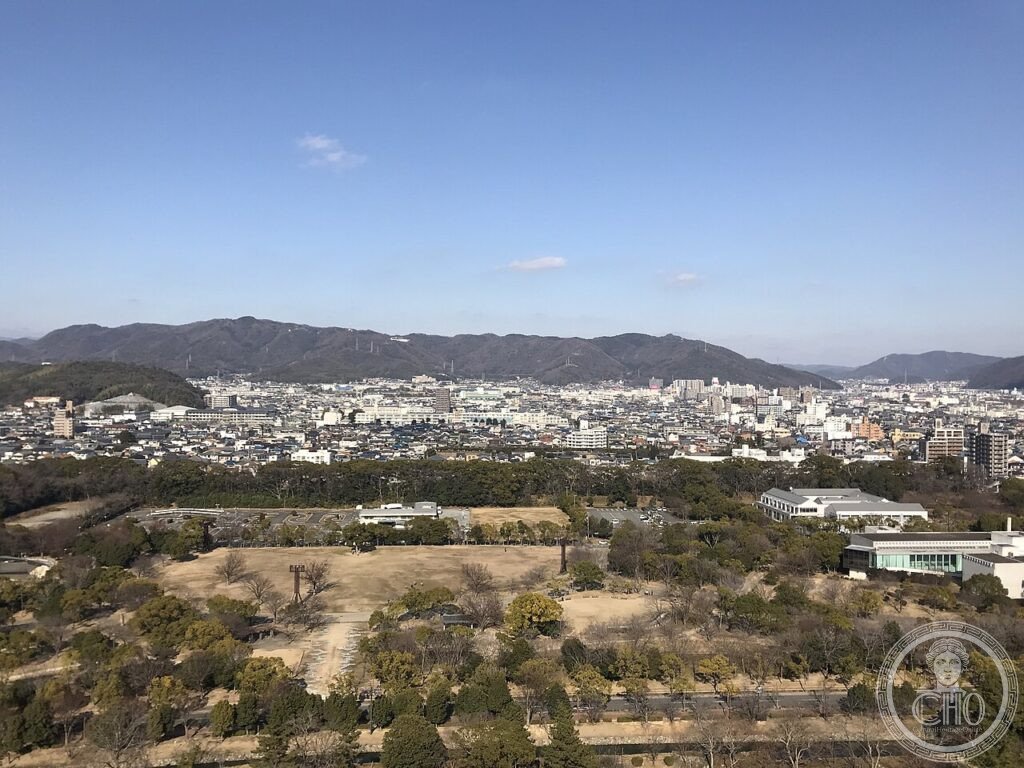
Himeji-jo Castle
The finest surviving example of Japanese feudal castle architecture and the most important single military-architectural monument in Japan — Himeji-jo (“White Heron Castle”; Shirasagi-jō; Himeji, Hyōgo Prefecture; UNESCO WHS 1993) has never been destroyed in war, fire, or earthquake in its 400-year history and remains the most complete surviving expression of Momoyama and Edo-period Japanese castle design.
At a glance
Himeji-jo (the most precisely HimejiCastle single 1333 Akamatsu fortress Toyotomi Hideyoshi 1581 Ikeda Terumasa 1601 1618 83 building complex 80 subsidiary buildings donjon 5 storey 6 floor 83m white plaster three secondary towers UNESCO heritage: the castle complex (the compound at its fullest extent (during the Edo period, 1603-1868 CE) comprised 83 buildings; the current surviving complex (after WWII and subsequent restoration) retains 80 subsidiary structures (kura (storehouses), yakuruma (turrets), and watari-yagura (corridor turrets)) plus the main donjon (the great tower) and its three secondary towers (connected to the main donjon by internal corridors); the name (the castle is called “White Heron Castle” or “White Egret Castle” because the brilliant white exterior plaster covering all the tower walls, turrets, and associated buildings makes the castle look like a white bird in flight when seen from a distance across the rice paddies of the Harima Plain (now the suburbs of Himeji city))); the survival (Himeji-jo is one of only 12 surviving original Japanese feudal castles (the others are modern concrete reconstructions); it survived the WWII bombing because the American bombers found it unnecessary (the Himeji military arsenal had already been destroyed in a previous raid) and because the Allied forces had designated it as a cultural preservation target; it also survived the 1995 Kobe earthquake (approximately 25 km away; magnitude 6.8; caused widespread destruction in Kobe) undamaged) — the most precisely HimejiCastle single 1333 Akamatsu fortress Toyotomi Hideyoshi 1581 Ikeda Terumasa 1601 1618 83 building complex 80 subsidiary buildings donjon 5 storey 6 floor 83m white plaster three secondary towers UNESCO heritage in any UNESCO world heritage site)).
Key facts
- The defensive design: the most precisely HimejiCastle single maze corridors dead end paths spiral approach ishigaki stone walls loopholes defensive maze warrior women Senhime Sarayashiki UNESCO heritage — Himeji-jo is primarily a military device designed to confuse, delay, and kill attackers: the maze approach (the path from the outer gate to the donjon is not a straight line; it spirals clockwise around the hill (in Japanese castle design, the attacker always approaches clockwise, because most samurai held their swords in the right hand; by making them approach clockwise, the wall (on the left) deflects sword cuts; the approach has multiple dead-end paths, blind corners, and gates that require the attacker to stop and squeeze through the smallest possible opening)); the loopholes (the walls of Himeji-jo have thousands of loopholes (sama) in three shapes: circles (for muskets), squares (for guns), and triangles (for arrows); each loophole is slightly wider on the inside than outside to maximize the defender’s angle of fire while minimizing the target area)); the stone-drop openings (the overhanging ishiotoshi (stone-drop chutes) above the main gates; defenders could drop stones, boiling water, or boiling oil through the openings onto attackers at the gate))
- GPS: 34.8394° N, 134.6939° E
History
From Akamatsu to Tokugawa and the White Heron (the most precisely HimejiCastle single 1333 Akamatsu Norimura fortress Hideyoshi 1581 Ikeda Terumasa 1601 1618 shogun domain lords succession Tokugawa peace 1868 Meiji Japanese Army garrison WWII bombing avoided 1993 UNESCO heritage: the history: the Akamatsu period (1333 CE: Akamatsu Norimura built a fortification on Himeji Hill to resist the forces of the Kamakura Shogunate; the site was chosen for the hill (commanding the Harima Plain) and the fresh water springs); the Toyotomi period (1581 CE: Toyotomi Hideyoshi (the second of the “Three Unifiers” of Japan — he succeeded Oda Nobunaga and preceded Tokugawa Ieyasu; Hideyoshi rebuilt the castle as a three-story tower)); the Ikeda period (1601-1618 CE: Ikeda Terumasa (the son-in-law of Tokugawa Ieyasu; rewarded with the Harima domain after the Battle of Sekigahara (1600 CE)) entirely rebuilt the castle in its current form (1601-1618 CE; the period of main construction; the entire current donjon complex was built by Ikeda Terumasa)); the peaceful Edo period (1618-1868 CE: Himeji Castle passed through 31 different lords (the Tokugawa Shogunate deliberately rotated lords to prevent the accumulation of power; the castle was never used in battle after its completion; the Tokugawa peace lasted 250 years; the castle began to fall into disrepair)); the Meiji period (1868 CE; the castle was nearly demolished (at the start of the Meiji period, many feudal castles were demolished as symbols of the old feudal order; Himeji was offered at public auction for ¥23 in 1871 CE; no one bid; the government retained it; the army used it as a barracks)); the restoration (1956-1964 CE and 2009-2015 CE: two major restorations; the 2009-2015 CE restoration (the most recent; the castle was completely scaffolded for 5 years; the white plaster was renewed; visitors could observe the work from a special observation platform inside the scaffolding)) — the most precisely HimejiCastle single 1333 Akamatsu Norimura fortress Hideyoshi 1581 Ikeda Terumasa 1601 1618 shogun domain lords succession Tokugawa peace 1868 Meiji Japanese Army garrison WWII bombing avoided 1993 UNESCO heritage in any UNESCO world heritage site)).
What you see
Six floors of defensive ingenuity (the most precisely HimejiCastle single approach maze gate Hishi gate second main gate stone drop defensive loopholes six floor donjon stairs beams Okiku Well Sarayashiki cherry sakura 1000 trees UNESCO heritage: the visitor circuit: the outer approach (the walk from the main Otemon gate through the successive defensive rings; the Hishi Gate (the “Diamond Gate”; the main gate of the inner compound; the gate must be approached through a narrow passage between walls; the view back toward the gate from the central courtyard is the classic Himeji-jo photograph)); the donjon interior (the interior of the 5-story 6-floor main tower is open to visitors; the interior is entirely timber-frame (the massive keyaki (zelkova) structural columns (the two central columns run the full height of the donjon — 25m each — from the foundation to the roof ridge); the floors connected by very steep original stairs (bring grip!)); the sixth floor (the highest floor; the small room at the top; the view of the Harima Plain and (on clear days) the Seto Inland Sea islands and Awaji Island)); the Okiku’s Well (at the center of the inner compound; the famous well from the ghost story of Okiku (Banchō Sarayashiki; the most-adapted ghost story in Japanese culture: the maid Okiku is killed by a samurai and thrown into the well; she rises each night to count the plates from one to nine (she could never reach ten, the fatal number))); the cherry blossoms (approximately 1,000 cherry trees in the castle park; the “Himeji Castle Hanami”; typically late March to early April; Himeji Castle Park is consistently listed among the top 5 hanami locations in Japan) — the most precisely HimejiCastle single approach maze gate Hishi gate second main gate stone drop defensive loopholes six floor donjon stairs beams Okiku Well Sarayashiki cherry sakura 1000 trees UNESCO heritage in any UNESCO world heritage site)).
Practical information
- Getting there: Himeji Station (HSD; Shinkansen stop: Nozomi trains do NOT stop at Himeji; use the Hikari (Tokyo to Himeji 3h; Osaka to Himeji 30 min); the castle is 15 min walk north from Himeji Station along the Otemae Avenue (a straight pedestrian boulevard from the station to the castle); entry fees (approximately ¥1,000 adults; the castle and gardens (Koko-en, the Edo-period strolled garden adjacent to the west of the castle) are included in a combined ticket (¥1,050)); visiting hours (09:00-17:00 daily; last entry 16:00; closed December 29-30); the inner donjon queue (in the busiest seasons (late March-early April cherry blossoms and October-November autumn color) the queue for the inner donjon can reach 90-120 min; arrive at opening (09:00) to minimize queueing; alternatively skip the interior and walk the outer grounds (which are spectacular and free)); the view from the Yumesakibashi bridge (the Yumesakibashi pedestrian bridge, 500m south of the station on the main approach road (Otemae Avenue), offers one of the best framed views of the castle from ground level))
Getting there
Himeji Station (Hikari Shinkansen from Osaka 30 min). 15 min walk to castle. Entry ¥1,000. Open 09:00-17:00. Best late March (cherry) or Oct-Nov (autumn). GPS: 34.8394, 134.6939.
Nearby
- Kōko-en Garden — adjacent (the Edo-period strolled garden to the west of Himeji Castle; 9 separate walled gardens (each representing a different style of Edo-period garden design: pond garden, tea garden, bamboo garden, dry garden, moss garden, pine garden, flower garden, cherry garden, and tropical greenhouse); included in the combined castle+garden ticket (¥1,050))
- Engyo-ji Temple — 5 km north (the mountaintop Tendai Buddhist temple complex on Mount Shosha (371m); founded 966 CE; the ropeway (¥1,000 round trip) rises to the temple compound; used as a film location for the Tom Cruise film “The Last Samurai” (2003 CE) and for several Japanese historical period dramas (jidaigeki))
Sources
- Wikipedia, Himeji Castle; Ikeda Terumasa; Banchō Sarayashiki, accessed June 2026
- UNESCO, Himeji-jo, WHS reference 661, inscribed 1993
Find it on the map
See this place and what’s around it →📷 Diventa un fotografo di Cultural Heritage Online
Condividi le tue foto dei luoghi: restano pubblicate con la tua firma come autore. Più vengono viste, più ti fai conoscere — e presto un concorso premierà le foto più apprezzate.
Accedi o registrati gratis per aggiungere una foto