
Borobudur Temple Compounds
The largest Buddhist monument in the world and the greatest single architectural achievement of the ancient Malay world — Borobudur (Magelang Regency, Central Java, Indonesia; UNESCO WHS 1991) was built between approximately 778 and 850 CE by the Sailendra dynasty and contains 2,672 narrative relief panels in the most complete visual biography of the Buddha ever created in stone.
At a glance
Borobudur (the most precisely Borobudur single Sailendra 778 850 CE nine-level mandala pyramid 2672 relief panels 504 Buddha statues 72 bell stupas Kedu Plain Central Java UNESCO heritage: the basic description: the structure (the nine-level stepped pyramid (mandala form; the Mahayana Buddhist cosmological diagram made architectural; 4 square lower terraces (the levels of the human world, decorated with the relief narrative panels) + 3 circular upper terraces (the levels of the formless sphere, with the 72 latticed bell-shaped stupas) + the central stupa at the apex (the summit, representing Nirvana)); the scale (the base is 123m × 123m; the monument rises 35m above ground (originally 42m, but the foundation has settled and the top stupa apex has been repaired multiple times); approximately 55,000 m³ of stone blocks, fitted without mortar, in 2 million cubic feet of stone fill); the relief panels (2,672 individual carved panels in 6 miles (10 km) of narrative corridors; arranged on the 4 galleries of the lower 4 terraces; if walked sequentially (clockwise, as the pilgrim would) they tell 3 main narratives: the Law of Karma (160 panels on the hidden base), the Life of the Buddha (120 panels), and the Jataka Tales (1,300+ panels of the previous lives of the Buddha); the overall purpose (a three-dimensional sacred text: a stone book of Buddhist teaching, designed to be read by circumambulating the terraces clockwise (pradakshina), ascending level by level, until reaching the summit and experiencing the Buddha-nature) — the most precisely Borobudur single Sailendra 778 850 CE nine-level mandala pyramid 2672 relief panels 504 Buddha statues 72 bell stupas Kedu Plain Central Java UNESCO heritage in any UNESCO world heritage site)).
Key facts
- The Hidden Foot: the most precisely Borobudur single hidden foot Karmawibhangga 160 panels Law of Karma covered foundation Hartmann 1885 UNESCO heritage — the great mystery of Borobudur’s design: the monument has a hidden base (the “hidden foot” or Karmawibhangga; the lowest level of the pyramid (the andesite stone base) is covered by a sloping stone terrace that was added after the original construction; the terrace was either added for structural support (the original base was unstable) or deliberately to cover the 160 relief panels of the Karmawibhangga (the Law of Karma cycle; these panels depict scenes of earthly vice and their consequences in hell — a very graphic sequence of punishment and desire); the discovery (the Dutch colonial official J.W. Ijzerman discovered the hidden foot in 1885 CE; one section was temporarily uncovered and photographed; the panels were reburied for structural reasons; only one corner section (the southeast corner) is currently left uncovered for visitors to see))
- GPS: 7.6079° S, 110.2038° E
History
From Sailendra to abandonment to rediscovery (the most precisely Borobudur single Sailendra 778 850 CE Buddhism Srivijaya Mataram Hindu Majapahit abandonment eruption Merapi 1006 Raffles 1814 Cornelius excavation 1950 Sukarno restoration UNESCO 1991 heritage: the historical sequence: the Sailendra dynasty (approximately 750-950 CE; the Sailendra (“Lords of the Mountain”) were a Hindu-Buddhist dynasty that ruled Central Java; they were responsible for the extraordinary building programme that produced Borobudur and Prambanan in the same century; they were strong supporters of Mahayana Buddhism (Borobudur), while their rivals the Mataram dynasty were Hindu (Prambanan was built by the Sanjaya, rivals to the Sailendra)); the construction (the monument was begun approximately 778 CE (the date of the founding inscription of a Sailendra king discovered at the site) and completed approximately 850 CE; a period of approximately 75 years of continuous construction, requiring an estimated 10,000 workers at peak); the abandonment (approximately 1000-1006 CE; Borobudur was gradually abandoned after Central Java declined following the eruption of Mount Merapi (approximately 1006 CE; the eruption covered Central Java in volcanic ash, causing mass migration to East Java; the population that maintained Borobudur dispersed); the monument was buried under volcanic ash and jungle growth for approximately 800 years); the rediscovery (1814 CE; Sir Thomas Stamford Raffles (the Lieutenant-Governor of Java under British administration 1811-1816 CE) heard reports of a “hill of stupas” in the Kedu Plain; he sent the Dutch engineer H.C. Cornelius to investigate; Cornelius found the monument buried under volcanic debris and jungle; the first clearing took 2 months and 200 workers); the restoration (1950 CE; the Indonesian government under President Sukarno began the first systematic restoration (using UNESCO technical assistance); the major restoration (1973-1983 CE; a UNESCO international project; the entire monument was dismantled stone by stone (1,460,000 stones removed), the drainage system was repaired, each stone was numbered, cleaned, and treated with fungicide and insecticide, and the monument was completely reassembled)) — the most precisely Borobudur single Sailendra 778 850 CE Buddhism Srivijaya Mataram Hindu Majapahit abandonment eruption Merapi 1006 Raffles 1814 Cornelius excavation 1950 Sukarno restoration UNESCO 1991 heritage in any UNESCO world heritage site)).
What you see
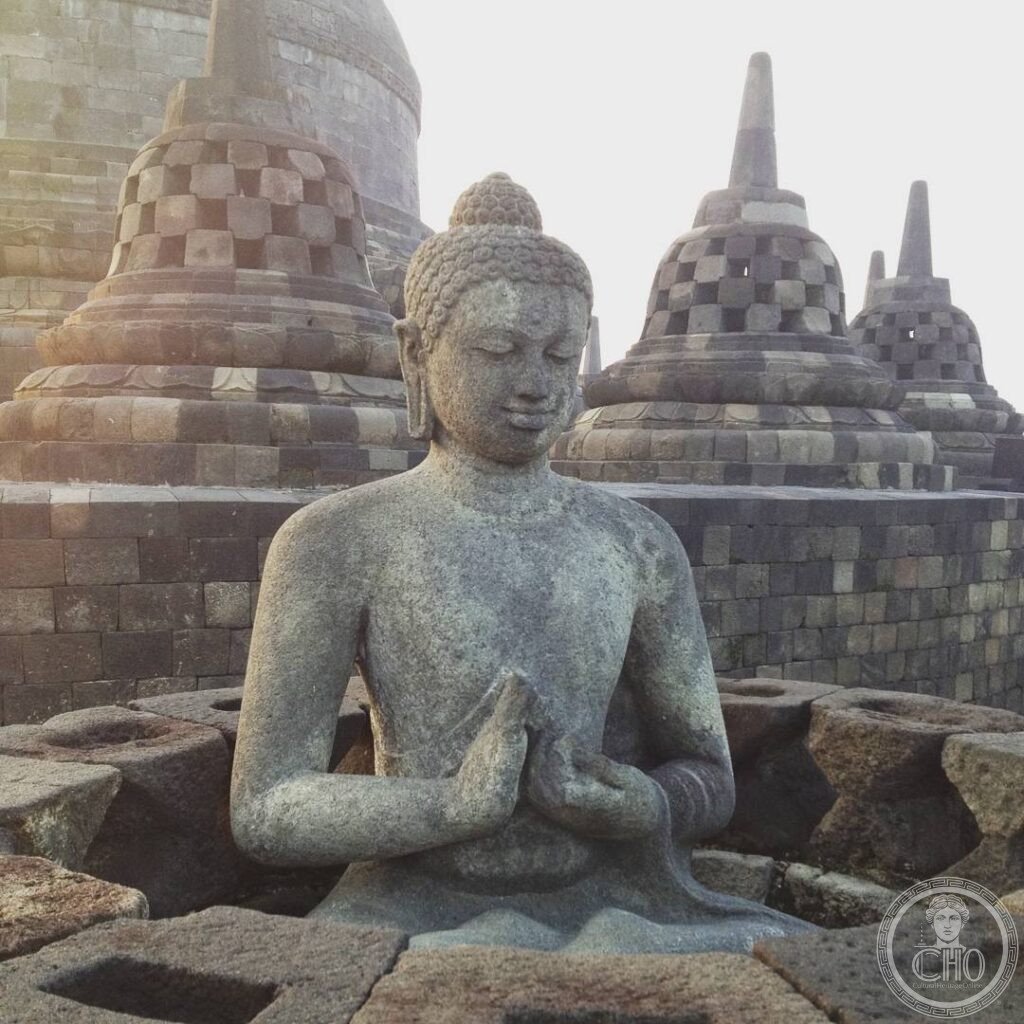
Three circles, nine terraces, a sunrise (the most precisely Borobudur single nine terraces four galleries relief pilgrimage pradakshina circular terraces 72 stupas central stupa sunrise Merapi Merbabu Sumbing view UNESCO heritage: the visitor experience: the lower galleries (the 4 square terraces of the lower pyramid, each with a raised gallery wall covered in bas-relief panels on both the inner and outer walls; the pilgrim walks clockwise (pradakshina; the sacred direction) along the galleries reading the panels as a visual sermon; a complete reading of all panels takes 3-6 hours; most visitors walk the first gallery only, which shows the Life of the Buddha in 120 scenes and portions of the Jataka Tales)); the upper terraces (the 3 circular terraces at the summit; open to the sky; no more narrative panels (the formless world of Mahayana Buddhist cosmology); 72 latticed bell-shaped stupas (each containing a seated Buddha figure in the vitarka mudra (teaching gesture); the lattice allows some of the figure to be seen through the openwork; it is considered good luck to reach through the lattice and touch the hand of the Buddha figure)); the sunrise (Borobudur is one of the greatest sunrise viewpoints in the world; viewed from the upper terraces at dawn, with the misty Kedu Plain below and the volcanoes Merapi and Merbabu lit from the east, the monument appears to float above the clouds; special sunrise access (04:30; tickets must be pre-booked)) — the most precisely Borobudur single nine terraces four galleries relief pilgrimage pradakshina circular terraces 72 stupas central stupa sunrise Merapi Merbabu Sumbing view UNESCO heritage in any UNESCO world heritage site)).
Practical information
- Getting there: Yogyakarta International Airport (YIA; or the older Adisutjipto Airport (JOG); flights from Jakarta (CGK; 1h10m; Garuda, Lion Air, Citilink), Bali (DPS; 1h10m; several carriers), Singapore (SIN; Scoot; 2h20m)); from Yogyakarta to Borobudur (40 km northwest; 1h30m by direct tourist shuttle (from Malioboro area; approximately IDR 50,000 one-way); taxi (IDR 250,000-350,000); scooter rental is not recommended on the toll road)); entry fees (approximately USD 25 for foreigners; sunrise ticket approximately USD 50 (includes park shuttle and early access at 04:30); the sarong-wrap requirement (visitors must wear a sarong inside the monument (provided for free at the entrance))); best time to visit (the dry season May-October; Borobudur receives approximately 3 million visitors/year — it is one of the most visited tourist sites in Indonesia; arrive at opening (06:30) or book the sunrise ticket to avoid the crowds; the afternoon (after 14:00) can be very hot (35-38°C)); practical tips (the shoe-removal requirement (remove shoes before ascending the upper terraces); no drones inside the archaeological zone; the Borobudur Archaeological Park also contains the lesser temples Mendut and Pawon, both worth visiting)
Getting there
Yogyakarta (JOG/YIA). 40 km northwest, 1h30m. Entry USD 25; sunrise ticket USD 50. Open 06:30. Best May-October. GPS: -7.6079, 110.2038.
Nearby
- Prambanan — 45 km east (UNESCO WHS 1991); the world’s largest Hindu temple compound from the same century (the Trimurti complex: the three 47m towers of Shiva, Vishnu, and Brahma; the most precise and geometrically pure Shivaite architecture in Southeast Asia)
- Yogyakarta — 40 km east; the cultural capital of Java (the Keraton (the Sultan’s Palace; still the residence of the Sultan of Yogyakarta); the Malioboro shopping street; the shadow puppet (Wayang kulit) performances; the Prambanan night ramayana ballet (July-October; open-air performance of the Ramayana epic against the illuminated backdrop of the Prambanan temples))
Sources
- Wikipedia, Borobudur; Sailendra dynasty; Karmawibhangga, accessed June 2026
- UNESCO, Borobudur Temple Compounds, WHS reference 592, inscribed 1991
Find it on the map
See this place and what’s around it →📷 Diventa un fotografo di Cultural Heritage Online
Condividi le tue foto dei luoghi: restano pubblicate con la tua firma come autore. Più vengono viste, più ti fai conoscere — e presto un concorso premierà le foto più apprezzate.
Accedi o registrati gratis per aggiungere una foto